

Unpacking the standards: A Practical Guide for Private School Leaders
When school leaders talk about “unpacking the standards,” what do they actually mean? At its core, it’s the process of taking broad academic or accreditation requirements and breaking them down into small, specific, teachable pieces.
For private schools, this isn't just a compliance headache. It's a strategic necessity. Done right, it ensures every lesson, every project, and every single assessment is laser-focused on your school’s mission and the outcomes you promise families. It turns abstract goals into a concrete roadmap for your teachers, a critical step for the 76% of private schools that operate independently and must define their own rigorous academic pathways.
Why Unpacking Standards Is a Non-Negotiable For School Success
As a private school leader, you have to move beyond treating standards like a simple checklist. The real work is in building a resilient and reputable institution, and that means the difference between just covering content and ensuring genuine student mastery. A deep dive into your standards directly impacts your ability to earn and maintain accreditation—a non-negotiable cornerstone of your school's credibility.
But it goes deeper than that. A well-defined academic program, built on clearly understood standards, becomes one of your most powerful marketing tools. It’s tangible proof of your commitment to quality that attracts discerning families and the best educators.
When your teachers know exactly what students need to know and be able to do, they can pour their creativity into designing truly engaging and effective learning experiences. This clarity creates real, measurable wins:
- Improved Student Outcomes: Instruction is focused, targeted, and perfectly aligned with assessments. The result is academic growth you can actually see and measure.
- Higher Teacher Engagement: Educators are empowered with a clear framework. They can stop guessing about what to teach and focus their energy on how to teach it.
- A Stronger School Brand: A reputation for academic excellence, backed by a coherent and rigorous curriculum, is what sets your school apart in a very competitive market.
This isn’t abstract theory. It’s a practical framework for success, especially in the agile environment of a private school.
The Financial and Strategic Impact
Let's be blunt: Compliance with recognized academic standards is a key driver of your school's financial health. For school founders and investors, solid assessment protocols and clear learning outcomes have a material effect on everything from enrollment projections to expansion plans.
The global K–12 private education market is booming, jumping from around USD 396.9 billion to an expected USD 431.5 billion in just one year. In a field this crowded, excellence based on clear standards gives you a critical competitive edge. You can explore more insights on the private education market here to see how strategic academic planning can secure your school's future.
A methodical unpacking process is your first step toward building a sustainable academic engine—one that delivers consistent results for students and solidifies your school’s market position.
Ready to build a stronger, more marketable academic program? Book a complimentary consultation with JAG Consulting or visit our website to learn how we translate standards into success.
From Verbs To Nouns How To Deconstruct Any Standard
The first real step in unpacking standards is to treat each one like a puzzle. Your goal is to break down that dense, formal language into its two most fundamental parts: what you need students to do and what you need them to know. It’s a simple but incredibly powerful technique that makes even the most intimidating standard feel completely manageable.
You start by pulling out all the action verbs. These are the skills students have to demonstrate. Then, you pinpoint the key nouns, which are the core concepts and content knowledge they need to lock in. When you separate these two elements, you create a crystal-clear blueprint for your instruction. In our work with private schools, we've found that teachers who consistently use this deconstruction process report a significant increase in their confidence to design perfectly aligned lessons.
Breaking Down the Language
Let’s take a look at a real-world example from a history class. Say the standard is: "Students will analyze primary source documents from the Civil War era to evaluate the differing perspectives of Union and Confederate leaders."
On the surface, it feels like a big, single task. But let's pull it apart using this verb/noun method. Here's how we'd break this down with a practical table.
Deconstructing A 7th Grade Science Standard
| Original Standard | Action Verbs (Skills) | Key Nouns (Concepts) |
|---|---|---|
| Students will analyze primary source documents from the Civil War era to evaluate the differing perspectives of Union and Confederate leaders. | Analyze, Evaluate | Primary source documents, Civil War era, Differing perspectives, Union leaders, Confederate leaders |
This simple T-chart approach instantly brings your instructional priorities into focus. The verbs—analyze and evaluate—demand a high level of cognitive work. That’s a huge clue that a simple multiple-choice quiz isn't going to cut it for assessment. And the nouns give you a precise checklist of the content you have to cover.
This visual process transforms a complex sentence into a clear action plan. The diagram below shows how this initial step of unpacking is truly the foundation for school-wide success.
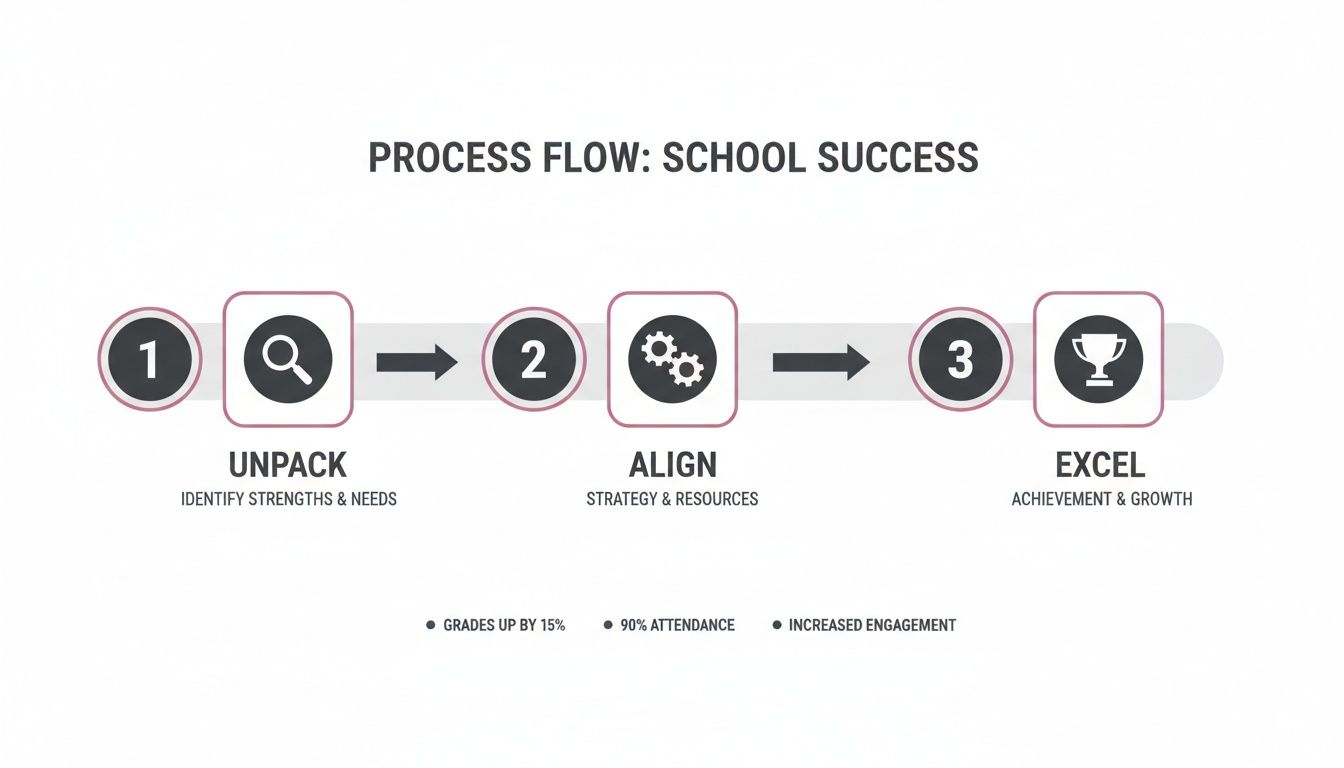
This flow really drives home the point: deconstructing standards is the essential first move that makes aligning curriculum and assessment possible, which is what ultimately leads to academic excellence.
Understanding Cognitive Demand
Here’s a critical piece of the puzzle: not all verbs are created equal. The cognitive demand of a standard is baked right into its action verbs, and if you misinterpret it, your lessons and assessments will miss the mark.
A standard asking students to 'identify' parts of a cell requires a completely different teaching strategy than one asking them to 'compare' the functions of those parts. The first is about recall. The second requires genuine analytical thinking.
Recognizing this distinction is a game-changer. It’s what ensures the rigor of your classroom activities actually matches the rigor of the standard. If a standard uses a high-level verb like ‘synthesize’ or ‘justify,’ your instruction has to give students authentic opportunities to practice that specific, high-level skill. Without this analysis, it’s far too easy to design lessons that are misaligned with the standard’s true intent.
Are you ready to build a system that ensures every standard is broken down with this level of clarity? Book a call with JAG Consulting or visit our website to see how we help private schools implement these powerful academic frameworks.
Crafting Clear And Measurable Learning Targets

Once you've broken down a standard into its essential verbs and nouns, the real work begins. Now you have to translate that raw material into language that actually drives daily instruction. This is where you craft clear, specific, and measurable learning targets.
These targets, often framed as student-friendly "I can" statements, are the critical bridge connecting a massive, year-long standard to the focused, bite-sized tasks happening in your classroom every single day.
A common pitfall I see is schools simply rewording the standard and calling it a day. But effective learning targets are much more granular. They dissect a single, complex standard into a series of distinct skills that might guide an entire week of instruction, giving teachers daily clarity and students a real sense of ownership over their own progress.
A Practical Formula For Success
To get beyond vague objectives, I always recommend a simple but powerful formula for writing your targets: I can [VERB] + [CONCEPT] + [CONTEXT/CRITERIA]. This structure is brilliant because it forces precision and ensures every single target is both actionable and measurable.
Let’s go back to our history standard: "Students will analyze primary source documents from the Civil War era to evaluate the differing perspectives of Union and Confederate leaders." Just rephrasing that isn't enough.
Instead, using the formula, you could generate a sequence of focused targets like these:
- I can identify the author and purpose of a primary source document.
- I can summarize the main argument in a letter from a Union leader.
- I can compare the perspectives of two different primary source documents on the same event.
See the difference? Each target uses a specific verb and isolates a distinct skill. This sequence builds student capacity one step at a time, making sure they can eventually handle the full cognitive lift of the original standard.
Research consistently shows that when students know the learning target for a lesson, their achievement can jump by as much as 27 percentile points. This kind of clarity isn't just good pedagogy; it's a direct driver of academic results.
It's also crucial to nail down the terminology. A key step in this process is understanding the difference between learning outcomes and learning objectives, as this ensures your big-picture goals and daily instructional aims are perfectly aligned.
Making Targets Genuinely Measurable
The true power of this process is its direct link to assessment. A well-written learning target practically writes the assessment question for you.
If the target is "I can identify the author and purpose," a quick exit ticket asking students to do just that gives you immediate, actionable data on their progress. It’s that simple.
This approach transforms assessment from a final judgment into a natural part of the learning cycle. It lets teachers see exactly where students are getting stuck and adjust their instruction in real-time, not weeks later when it's too late.
Is your team ready to translate broad standards into daily instructional wins? Book a call with JAG Consulting or visit our website to see how we can help you build this essential academic system from the ground up.
Designing Assessments That Genuinely Measure Mastery
Once you have those crisp, clear learning targets, the next move is almost intuitive: how are we going to know if students have hit them? This is where we design assessments that actually give us evidence of mastery.
Forget the old model of just a single, high-stakes final exam. A truly effective assessment strategy is a mix of ongoing formative checks and summative evaluations. Together, they tell the full story of what a student has learned and what they can do.
The key is to go back to the verbs you worked so hard to identify in your learning targets. Those action words are your compass now. They dictate the cognitive demand of the task, which in turn dictates the type of assessment you need. You wouldn't use a multiple-choice quiz to see if a student can 'analyze' a poem, just like you wouldn't assign a five-page essay to check if they can 'identify' the parts of a cell. Alignment is everything.
Matching Assessment to Cognitive Demand
Misaligned assessments are one of the biggest reasons schools struggle to get clean, accurate data on student achievement. It’s a classic trap. We write a great learning target with a high-level verb like “evaluate” or “synthesize,” but then create an assessment that doesn't actually let students demonstrate that skill.
On the other hand, targets with simpler verbs like "list" or "define" can be checked off quickly and efficiently. When you intentionally match the assessment to the verb, you ensure you’re measuring what you actually set out to measure.
Let's make this concrete:
- Learning Target: I can analyze an author’s use of symbolism in a short story.
- Aligned Assessment: A short essay or even a well-structured paragraph is perfect here. Students have to pull textual evidence to back up their analysis. A simple quiz just can't capture this skill.
- Learning Target: I can identify the key parts of a plant cell.
- Aligned Assessment: Think fast and effective. A labeled diagram, a matching activity, or a quick online quiz gets the job done perfectly.
Building Simple and Effective Rubrics
You've designed the perfect assessment. Now what? You need a rubric to define what mastery actually looks like. A good rubric is the key to consistency and transparency, moving grading from a subjective gut feeling to an objective measurement of a specific skill.
And it doesn't need to be some overly complicated, ten-page document. A simple, effective rubric just needs to clearly outline the criteria for success at different levels. The research here is compelling: when students know the criteria for an assessment ahead of time, their performance can jump by as much as 34 percentile points.
A well-crafted rubric is a powerful communication tool. It tells teachers, students, and parents exactly what is expected, removing ambiguity and focusing everyone on the specific skills required for mastery.
Take our "analysis" target, for instance. A straightforward rubric might break down proficiency levels like this:
- Advanced: Student insightfully analyzes symbolism, using multiple pieces of strong textual evidence to support a clear and compelling argument.
- Proficient: Student correctly identifies symbolism and uses relevant textual evidence to support their analysis.
- Emerging: Student identifies a symbol but provides limited or no textual evidence, or the analysis is unclear.
This level of clarity is the bedrock of a strong academic program. It’s what ensures that an 'A' in one classroom means the same thing as an 'A' down the hall.
Take the next step in strengthening your school's academic framework. Book a call with JAG Consulting or visit our website to learn how we can support your assessment and curriculum design goals.
Building Aligned And Engaging Classroom Activities

This is where all the groundwork—the deconstruction, the target-setting, the assessment design—finally comes to life in the classroom. We're about to connect the dots between your carefully unpacked standard and the day-to-day instructional moves that make learning happen for students.
The goal here is intentional design. We're moving beyond just filling the period with busy work. Every single activity, from a quick warm-up to a major group project, should be a purposeful step toward mastering the learning target. This direct alignment is what makes a good lesson great. It’s the final, crucial piece of the unpacking the standards puzzle.
From Targets To Tasks
Let's make this tangible. Say one of your learning targets is, "I can analyze an author's use of symbolism in a short story." That target, which came directly from a larger literature standard, now becomes your roadmap for planning.
Instead of a generic lecture on what symbolism is, you can design activities that directly practice this specific skill. The focus shifts from just covering a topic to actively building a competency.
Here are a few activities that align perfectly with that target:
- Collaborative Annotation: Students huddle in small groups, using different colored markers to highlight and comment on instances of symbolism right in the text.
- Symbolism Graphic Organizer: You provide a structured worksheet that prompts students to identify a symbol, pull the textual evidence, and explain its deeper meaning.
- Small-Group Debates: Each group gets assigned a different symbol from the story and has to prepare an argument defending their interpretation of its significance.
Notice how each activity forces students to do the verb from the target—analyze. That's the heart of aligned instruction.
Differentiating To Ensure Success For All
A common challenge for private schools is figuring out how to maintain high standards while meeting every student where they are. This framework is actually the perfect vehicle for effective differentiation. Because your learning target is so clear, you can adjust the path to that target without ever lowering the expectation.
A study revealed that differentiated instruction can increase student achievement by an average of 20 percentile points. It confirms that providing varied pathways to the same goal is a powerful driver of academic success.
This means you can provide different levels of support or challenge, all aimed at the exact same learning goal.
- For students needing more support: You might provide a partially completed graphic organizer or a list of potential symbols to look for in the text.
- For students needing a challenge: You could ask them to compare the use of symbolism in two different short stories or to write their own short narrative that uses symbolism to convey a theme.
The core learning target doesn't change for anyone; only the process and scaffolds do. This approach ensures every student has a real shot at success, making your academic program both rigorous and inclusive.
Ready to translate your unpacked standards into powerful, engaging classroom activities? Let's connect. Book a call with JAG Consulting or visit our website to learn how we help private schools build world-class instructional programs.
Creating A Sustainable School-Wide System
Let’s be honest. Unpacking standards isn’t a one-off project you can check off a list. To make this work—to really see the results in student learning—it has to become a genuine cultural shift. It’s about embedding this process into the very DNA of how your private school operates.
We need to move beyond isolated training days and build a continuous loop of improvement.
This starts by taking a hard look at your collaborative planning time. Is it being used for generic updates and logistical chatter, or is it a powerhouse for instructional design? The goal is to create dedicated, structured sessions where teachers are consistently deconstructing standards, designing aligned lessons, and analyzing student work together.
Research shows that schools with strong, focused teacher collaboration see remarkable gains in student achievement—sometimes as high as 15 percentile points. That’s not a small number.
Leading The Change
As a private school leader, this is where you make your biggest impact. Your job is to provide the time, the resources, and the unwavering support needed to get this academic engine running and keep it humming.
This means introducing simple, shared curriculum mapping templates that bake these steps right into your planning cycle. And as you work toward a sustainable system, don’t be afraid to bring in modern tools. It's worth exploring effective AI tools specifically designed for teachers to help streamline the planning and instruction process, freeing up teachers to focus on the high-impact work.
The goal is to build a system where unpacking the standards is not an extra task, but simply how teaching and learning is done at your school. It becomes the bedrock of a strong, consistent academic program.
Instructional coaching then becomes the critical follow-through, providing the ongoing, in-classroom support that turns professional development into consistent practice. Your leadership is the glue that holds this all together and ensures the system thrives.
Ready to build a stronger academic program that delivers on its promise? Book a call with JAG Consulting or visit our website to discuss implementing these strategies in your school.
Questions (and Straight Answers) About Unpacking Standards
Let's be honest—whenever you introduce a new framework in a school, good questions and healthy skepticism are part of the deal. They're not signs of resistance; they're signs of thoughtful educators trying to connect the dots.
Here are some of the most common questions we hear from private school leaders when they first start digging into the work of unpacking standards, along with some straight-up, practical answers.
"What Do We Do With Vague Standards?"
This is probably the number one question, and for good reason. Some standards feel so broad they're almost useless. This is exactly why the deconstruction process is so essential.
When a standard feels fuzzy, the first move is to zero in on the highest-leverage verbs and nouns you can find. What is the core skill (the verb) and what is the core content (the noun)?
From there, you might need to pull in your subject-matter experts or look at external curriculum resources to really define the specific knowledge implied by that standard. This process allows you to break down that one vague statement into a series of crystal-clear, actionable learning targets. You're not changing the standard; you're just bringing it into focus.
"Isn't This Just Going to Limit Teacher Creativity?"
It's a fair question, but the answer is a resounding no. In fact, it does the exact opposite.
Unpacking standards provides a clear destination—it tells teachers exactly what students need to master by the end of a unit. But it says absolutely nothing about the journey. Research actually shows that when teachers have this level of clarity, their job satisfaction and sense of efficacy go way up.
This framework frees teachers from the exhausting work of guessing what to teach. It lets them pour all that creative energy into the how—designing the engaging projects, the memorable lessons, and the dynamic activities that get students to that clear, shared goal.
Unpacking standards doesn’t put teachers in a box. It gives them a solid foundation to build upon, ensuring their creative energy is channeled effectively toward student mastery.
"How Much Time Is This Really Going to Take?"
Initially, this requires a real investment of time. There's no sugarcoating that. Your professional development days and collaborative planning meetings are going to be the engine for building momentum and shared understanding.
A recent survey of school leaders revealed that 78% found protected, collaborative time to be the single most important factor for successful curriculum reform.
But here’s the payoff: once this process becomes embedded in your school’s culture, it becomes a natural and incredibly efficient part of unit planning. The time you invest upfront saves you countless hours in remediation and re-teaching down the line. It's a classic "go slow to go fast" scenario.
Ready to build a sustainable system for academic excellence? JAG Consulting provides the expert guidance to make it happen. Schedule your complimentary consultation today or visit our website to learn more.

I'm Dr. Jeannie Gudith, Founder and CEO of JAG Consulting. We help you develop, improve, buy or sell your private school.
I'm so glad you're here
Hello!


