


A Guide to Board of Trustees Duties in Private Schools
The work of a private school’s board of trustees really boils down to three core responsibilities—what are known as fiduciary duties. These are the Duty of Care, the Duty of Loyalty, and the Duty of Obedience.
Think of these not as legal jargon, but as the ethical and legal guardrails that ensure effective governance. They form the very foundation of a trustee's commitment, demanding diligence, selfless focus on the school's best interests, and absolute faithfulness to its mission. According to the National Association of Independent Schools (NAIS), boards that master these duties are fundamental to a private school's long-term health and academic excellence.
The Three Fiduciary Duties Every Trustee Must Uphold
At the heart of a trustee's role are these three legally binding duties. They aren't just abstract concepts or best practices; they are the pillars supporting the school's integrity and long-term health. Getting this right is everything.
A failure to uphold them can have serious consequences. In the world of nonprofit governance, this isn't a theoretical risk. Data shows that over 60% of board-related lawsuits between 2015 and 2022 were tied to breaches of the duty of care, usually involving a lack of proper oversight.
On the flip side, high-performing boards are incredibly proactive about this. Research reveals that 90% of members on top-tier boards formally disclose potential conflicts of interest every year to honor their duty of loyalty. You can explore more about these legal duties for every board member and how to put them into practice.
The Duty of Care
The Duty of Care requires a trustee to act with the same prudence and diligence that a reasonable person would in a similar situation. In simple terms, it means you have to do your homework and show up prepared.
This is about being an engaged, informed steward of the school. It means you're not just attending meetings; you're actively participating, asking tough questions, and thoroughly reviewing financial statements and reports before making decisions. A trustee fulfilling this duty is a true guardian, keeping a watchful eye on the school’s operations, finances, and strategic direction.
The Duty of Loyalty
Next is the Duty of Loyalty. This one is straightforward but critical: a trustee must always put the school's interests ahead of their own personal or professional interests. It's about ensuring your allegiance is solely to the institution.
This duty demands that trustees avoid any conflicts of interest, whether real or simply perceived. For example, if the board is voting on a new construction contract and one trustee’s company is bidding on the project, the duty of loyalty is crystal clear. That trustee must disclose the conflict immediately and remove themselves from both the discussion and the vote. Every decision must be for the benefit of the school, full stop.
This diagram helps visualize how these three duties all flow from the central responsibility of a trustee.
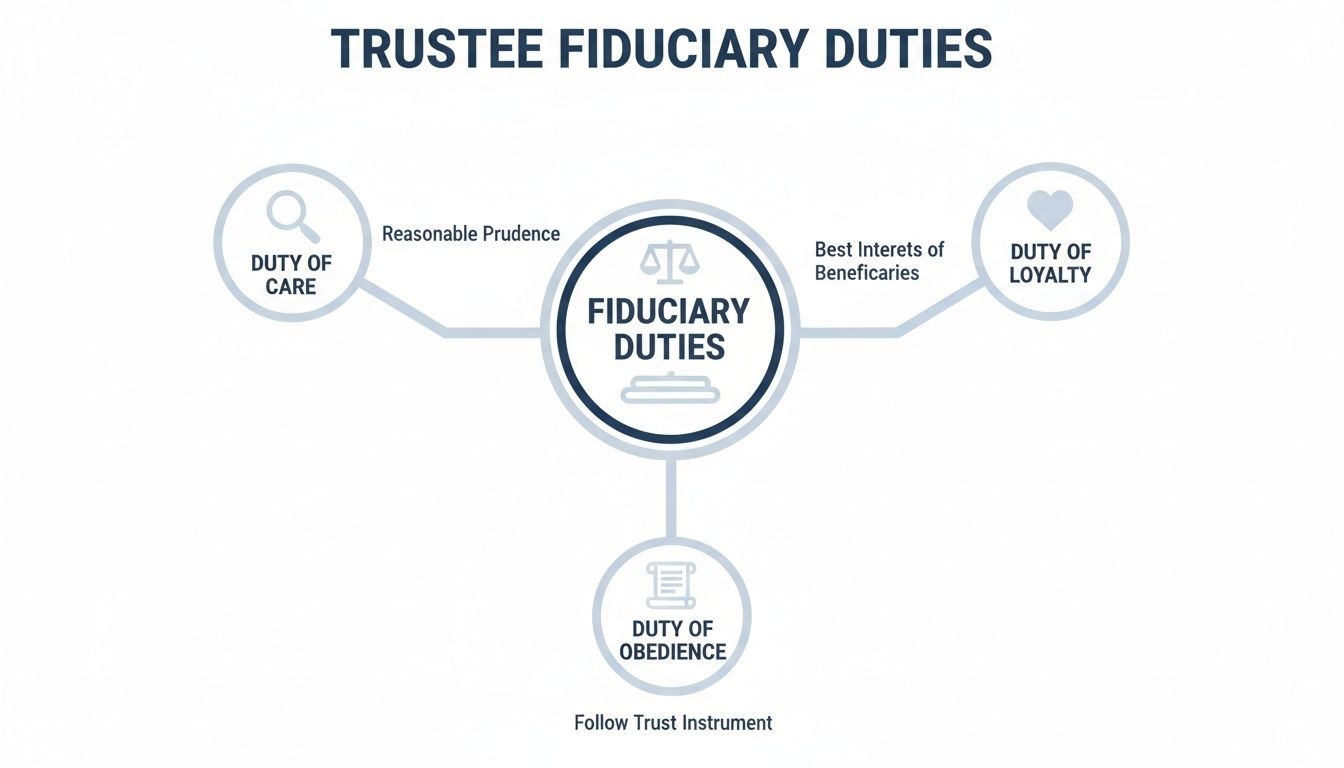
While each duty is distinct, they are deeply interconnected, all part of a single, unified commitment to the school's well-being.
The Duty of Obedience
Finally, the Duty of Obedience charges the trustee with making sure the school stays true to its mission. This is the promise-keeper's role, guaranteeing the institution operates in line with its own governing documents—like its bylaws and articles of incorporation—and all applicable laws.
This duty acts as the school's North Star. It compels the board to make decisions that are consistently aligned with the core values and stated goals of the institution, preventing mission drift and ensuring the school's enduring legacy.
To help you put this all into practice, here is a quick summary table.
The Three Fiduciary Duties at a Glance
This table provides a snapshot of the core principles behind each fiduciary duty and what they look like in a private school setting.
| Fiduciary Duty | Core Principle | Private School Application |
|---|---|---|
| Duty of Care | Act with reasonable prudence and diligence. | Regularly attending board meetings, reading financial reports before voting, asking clarifying questions, and staying informed about educational trends. |
| Duty of Loyalty | Prioritize the school's interests above personal interests. | Disclosing any potential conflicts of interest (e.g., a business relationship with a school vendor) and recusing oneself from related decisions. |
| Duty of Obedience | Ensure the school adheres to its mission and all laws. | Making decisions that align with the school's mission statement, bylaws, and all state and federal regulations for nonprofits and educational institutions. |
Understanding and applying these duties is non-negotiable for a healthy board and a thriving school.
Strengthening your board’s grasp of these duties is one of the most important investments you can make in your school's future. To build a more effective governance framework, book a complimentary consultation with JAG Consulting today or visit our website at jagconsultingservices.com to learn how we can support your mission.
Ensuring Long-Term Financial Sustainability

Of all the duties a trustee holds, none is more critical than safeguarding the school's long-term financial future. This goes far beyond just stamping "approved" on the annual budget. It’s a profound act of strategic stewardship, making certain the institution has the resources to deliver on its mission for generations of students.
Think of the board as the captain of a ship, not the engineers in the engine room. While the business office manages the day-to-day accounting, the board’s job is to chart the course. They must understand the financial currents, anticipate storms, and make the high-level decisions that keep the ship safe, solvent, and headed in the right direction.
This means every trustee must be financially literate enough to scrutinize statements and ask the insightful questions that get beneath the surface.
Beyond the Budget Approval
Truly effective financial oversight starts with a deep, intuitive grasp of the school’s financial health. Trustees need to move past a simple "income vs. expenses" mindset and learn to read and interpret the key financial documents that tell the real story.
These three reports give you a complete picture:
- The Statement of Financial Position: This is a snapshot in time—like a photograph—showing what the school owns (assets), what it owes (liabilities), and its net worth.
- The Statement of Activities: This is more like a video, telling the story of a period (usually a year) by detailing revenues and expenses to show whether the school ran at a surplus or a deficit.
- The Statement of Cash Flows: This tracks the actual movement of cash. It shows where money came from and where it went, which is vital for understanding day-to-day liquidity.
When a board masters these statements, they can monitor crucial indicators like the debt-to-asset ratio, which signals the school's reliance on borrowing, and the days of cash on hand, which reveals its ability to cover immediate expenses without a panic.
The Board's Role in Major Financial Decisions
A trustee's financial duty is never more visible than during major decisions. Setting annual tuition is a perfect example. This isn't just a math problem; it's a strategic balancing act. The board has to weigh the operational needs of the school against its commitment to accessibility and the financial realities facing its families.
Endowment management is another core responsibility. The endowment is the school’s financial bedrock, a permanent fund designed to support the institution forever. The board is directly responsible for establishing a sound investment policy and providing the oversight to ensure that fund is managed for responsible, long-term growth.
The impact of this oversight is huge. Robust, board-led financial reviews are not just a best practice; they produce tangible results. Organizations with this level of scrutiny experience 40% fewer audit findings.
What’s more, proactive fiscal oversight directly correlates with healthier long-term growth. Data reveals that institutions with engaged trustee oversight saw their endowments grow by an average of 8.5% annually over a decade, far outpacing the 5.2% growth seen by others. You can explore more insights about board roles and responsibilities to see the full picture.
Overseeing the Annual Audit
One of the most formal duties of a board of trustees is overseeing the annual independent audit. The board, usually through its finance or audit committee, is responsible for hiring the independent auditor. This step is critical because it ensures objectivity—the auditor reports directly to the board, not to the school’s management.
The board’s role is to:
- Select the Auditor: Choose a qualified, independent firm.
- Review the Audit Plan: Understand the scope and focus of the audit before it begins.
- Receive the Report: Meet with the auditor to review the findings, ask tough questions, and understand any identified weaknesses in internal controls.
- Ensure Action: Work with the Head of School to guarantee that any recommendations from the auditor are properly addressed.
This process provides a crucial third-party validation of the school’s financial statements and internal controls. It gives the board—and the entire school community—confidence in the institution's financial integrity.
At the end of the day, a trustee’s financial duty isn't about being an accountant. It’s about being a strategic guardian, ensuring every dollar is managed wisely and aligned directly with the school's enduring mission.
Is your board equipped to provide the high-level financial stewardship your school deserves? Book a call with JAG Consulting to strengthen your financial governance or visit our website at jagconsultingservices.com for more resources.
Guarding the Mission with Strategic Oversight

While fiduciary duties and financial stewardship are the foundation of good governance, the best boards don't just keep the lights on—they build the future. This brings us to one of the most critical board of trustees duties: strategic oversight. At its core, the board is the primary guardian of the school's mission, making sure it’s the North Star for every major decision.
This isn’t a passive role. It demands a close partnership between the trustees and the school’s leadership to hammer out a compelling, long-term vision. That vision then gets translated into a strategic plan, which is essentially the school's roadmap for the next three to five years.
From Document to Living Roadmap
Here’s a common pitfall: the strategic plan becomes a beautifully bound document that gathers dust on a shelf. An effective board simply won't let that happen. The plan must be a living, breathing guide that actively informs decisions on everything from launching new academic programs and investing in technology to renovating campus facilities and growing the endowment.
The board’s job is to drive this process from a 30,000-foot view. They don’t write the plan in a vacuum. They work with the Head of School, who in turn pulls in the entire community—faculty, staff, parents, and even students—to get their input. The board then helps distill all that feedback into a handful of clear, ambitious strategic priorities.
These priorities might look something like this:
- Become a recognized leader in project-based learning.
- Achieve 100% faculty participation in the annual fund.
- Increase student diversity by 15% over five years.
- Construct a new arts and innovation center.
The non-negotiable? Every single priority must tie directly back to the school’s mission. If your mission is to cultivate global citizens, a strategic priority might be to expand international exchange programs. This alignment is what gives the plan its teeth.
Setting Goals Without Micromanaging
One of the trickiest balancing acts for any board is monitoring progress without getting tangled in the weeds of day-to-day operations. The line between oversight and micromanagement is thin, but it's crucial. The board’s job is to set the "what," while the Head of School and their team figure out the "how."
The key to getting this right is establishing clear Key Performance Indicators (KPIs) for each strategic goal. KPIs are the specific, measurable metrics that tell you if you're on track.
For example, for a goal to "enhance academic excellence," the board and Head might agree on these KPIs:
- Metric 1: Student performance on standardized tests will meet or exceed a specific benchmark.
- Metric 2: The number of faculty members presenting at national conferences will increase by 20%.
- Metric 3: Post-graduation surveys will show a 95% satisfaction rate with college preparedness.
By focusing on high-level metrics like these, the board can track progress effectively without dictating curriculum or telling teachers how to teach. This approach respects the professional expertise of the school's educators while ensuring the board fulfills its duty of strategic oversight.
Research consistently shows the immense value of this focused approach. Boards that are deeply committed to strategic planning and mission oversight are linked to 25% better stakeholder satisfaction scores.
This strategic guidance is also a powerful tool for resilience. A survey found that 92% of nonprofits with active strategic trustee oversight successfully navigated the disruptions of the COVID-19 pandemic, compared to just 65% of those without it. You can learn more about the impact of board responsibilities on institutional success.
Ultimately, the board's strategic duty is to hold the school accountable to its own aspirations. By acting as mission-keepers and forward-thinkers, trustees ensure the institution not only stays true to its core purpose but also adapts and thrives for years to come.
Is your board ready to build a strategic plan that truly drives your school's future? Book a call with JAG Consulting https://link.jagconsultingservices.com/widget/bookings/prospective/school/consultation/zoom or visit our website at jagconsultingservices.com to learn how we can help you create a living roadmap for success.
Hiring and Partnering with the Head of School
Of all the relationships in a private school, none is more critical than the one between the board and the Head of School. It’s the very bedrock of stability and the primary engine for growth. And among all board of trustees duties, nothing carries more weight than hiring, supporting, and evaluating its one and only employee: the Head.
This partnership is a delicate, powerful balance. The board must provide high-level strategic direction and unwavering support, all while empowering the Head to run the school's daily operations without getting tangled in the weeds.
When this relationship is healthy, the entire school community flourishes. But when it breaks down, the resulting instability can set a school back for years. A recent study by the Southern Association of Independent Schools (SAIS) found that schools with a strong board-head partnership reported 22% higher parent satisfaction rates.
The Search and Hiring Process
Finding and hiring the right Head of School is an intense, high-stakes process that the board must own from start to finish. The first step is forming a search committee, usually made up of trustees, to figure out who you’re looking for. This ideal candidate profile isn't just a wish list; it should be a direct reflection of the school's immediate strategic needs and its vision for the future.
The board has to be crystal clear about its expectations right from the get-go. This means creating a detailed job description that lays out the responsibilities, the scope of authority, and the key metrics that will define success. A great search isn't just about finding a talented educator—it’s about finding the right leader for your specific mission and culture, at this specific moment in your school's history.
Forging a Powerful Partnership
Once the new Head is on board, the work shifts from recruitment to relationship-building. A strong partnership doesn't just happen; it has to be intentionally built on a foundation of mutual trust, transparent communication, and clearly defined roles. The board’s job is governance, not management. Period.
Here are the pillars of a board-Head partnership that actually works:
- No Surprises: Communication must flow freely, honestly, and regularly in both directions. The Head needs to feel safe bringing both good and bad news to the board, and the board must provide feedback that is candid but always constructive.
- Speak with One Voice: Individual trustees should never, ever give direction to the Head of School. The board’s authority is collective. Any formal direction must come from a decision of the full board, typically delivered by the Board Chair.
- Strategic Alignment: The board and the Head have to be completely united in their commitment to the school’s strategic plan. The Head's annual goals should be developed together and tied directly to the objectives in that plan.
A common point of failure is when the board blurs the line between governance and operations. Trustees must resist the urge to get involved in day-to-day issues like student discipline or specific faculty matters. Their focus must remain on the strategic horizon.
Supporting and Evaluating the Head
Effective support is just as crucial as effective oversight. It's the board's job to make sure the Head has the resources—financial, human, and professional—to do their job well. This includes a competitive compensation package and meaningful opportunities for professional development, which are essential for retaining top-tier leadership.
The annual performance review is the formal process for both accountability and support. This shouldn't be an informal chat; it needs to be a structured, evidence-based process. The review must center on the pre-agreed annual goals, celebrating wins and identifying areas for growth. This process reinforces the strategic partnership and ensures both the Head and the board stay aligned and focused on moving the school forward.
Building this critical relationship is a cornerstone of effective governance. If your board is preparing for a leadership transition or wants to strengthen its partnership with your current Head, expert guidance can make all the difference. Book a call with JAG Consulting to ensure this vital partnership thrives, or visit our website at jagconsultingservices.com to learn more about our leadership development services.
Running an Effective and Productive Board
Great governance doesn't just happen. It’s the result of smart structure, clear roles, and disciplined meetings. While the full board is responsible for steering the ship, the real, heavy lifting often gets done in focused committees. Mastering this operational rhythm is what separates a high-impact board from one that just goes through the motions.
Think of it this way: the full board is the ship's bridge, setting the course. The committees are the specialized crews in the engine room, navigation, and on deck, making sure every part of the ship is running perfectly. They dive deep into specific issues, do the legwork, and bring polished recommendations back to the bridge for a final decision. This structure allows the board to cover far more ground and tap into the specific expertise of its members. In fact, well-structured boards can make decisions 30% faster and report significantly higher engagement from trustees.
Key Committees and Their Functions
Most private school boards rely on a handful of core committees to keep things moving. While your exact setup might vary, these three are pretty much universal, each with a critical role to play in the school's long-term health.
- Governance Committee: This is the board’s self-improvement engine. They’re tasked with identifying and recruiting top-notch new trustees, running a solid orientation for new members, and regularly assessing the performance of the board and its individual members. They keep the board itself healthy and effective.
- Finance Committee: As the financial stewards, this team is laser-focused on the numbers. They oversee the entire budget process, monitor the school's financial performance, review the annual audit, and make recommendations on big-ticket items like tuition and endowment management.
- Advancement (or Development) Committee: This is the fundraising powerhouse. They work hand-in-hand with the school's advancement office to map out fundraising strategy, build relationships with potential donors, and most importantly, ensure every single trustee is actively participating in philanthropy.
Of course, with great responsibility comes the need for clear ethical lines. Every board needs to have firm guidelines in place to navigate potential conflicts. A strong conflict of interest policy sample is a great starting point to ensure every decision is made with the school's absolute best interests at heart.
To help visualize how these roles fit together, here's a quick look at the most common committees and what they do.
| Committee | Primary Responsibility | Key Activities |
|---|---|---|
| Governance | Ensures the board operates effectively and ethically. | Trustee recruitment, onboarding, performance assessment, bylaw review. |
| Finance | Oversees the school's financial health and sustainability. | Budget development, audit review, investment oversight, tuition recommendations. |
| Advancement | Leads the board's philanthropic and fundraising efforts. | Fundraising strategy, donor cultivation, capital campaign planning. |
| Audit | Provides independent oversight of financial reporting. | Selects independent auditor, reviews audit results, ensures compliance. |
| Buildings & Grounds | Manages the school's physical assets and long-term campus plan. | Master planning, major maintenance oversight, capital project review. |
These committees form the backbone of a productive board, allowing for deeper focus and more informed decision-making at the full board level.
Transforming Board Meetings
The board meeting is where everything comes together. But let's be honest—too many are dreadful. They become a series of monotonous reports that could have been an email, leaving no time for the real strategic work. An effective meeting needs a tight, forward-looking agenda focused on decisions, not just updates.
One of the most powerful tools for this is the consent agenda. It's a simple but brilliant trick: bundle all the routine, non-controversial items—like approving last month's minutes or accepting standard committee reports—into a single item that can be approved with one vote, no discussion needed. This move alone can free up 20-30% of your meeting time, creating space for the rich, generative conversations that actually move the school forward.
The goal is to shift from reporting to thinking. A productive board meeting is one where trustees spend their time grappling with future-focused questions: "What trends will impact our school in the next decade?" or "How can we better deliver on our mission?" This generative discussion is where true strategic value is created.
By building a strong committee structure and running disciplined, decision-focused meetings, a board can dramatically amplify its impact. This operational excellence isn't just bureaucratic box-checking; it's the engine that powers successful governance and drives the school's mission forward.
Time to Elevate Your School’s Governance

Serving on a private school's board of trustees is more than just a role—it’s a profound commitment to the school's future. Throughout this guide, we've walked through the core board of trustees duties: upholding fiduciary responsibilities, steering the school’s financial health, shaping long-term strategy, and building a powerful partnership with school leadership.
An effective board isn't just a compliance requirement; it's the single greatest strategic advantage a school can have. When a board truly embraces these principles, it builds a culture of excellence that ensures the institution doesn't just survive, but thrives for generations.
From Principles to Performance
Knowing what to do is one thing. Doing it consistently is another. Moving from understanding these duties to executing them flawlessly takes continuous learning and a real commitment to growth.
Boards that invest in their own development are simply better prepared to handle the complex challenges that come their way, from unexpected economic shifts to the ever-changing landscape of education. In fact, research shows that nonprofits with ongoing board development see a 15% higher effectiveness in their strategic planning.
To keep sharpening your board’s skills, an essential guide on Board Member Training for Nonprofits is a great place to start. This is the kind of commitment that transforms a good board into a great one.
A trustee’s role is one of stewardship. It is the active, engaged oversight that protects the school’s mission and secures its legacy, making certain that it serves students not just today, but decades from now.
This dedication to governance excellence is the ultimate fulfillment of a trustee’s purpose.
Take the Next Step in Governance
If you’re ready to strengthen your board's performance and confidently tackle your school's unique challenges, it’s time to take the next step. High-performing governance is absolutely within reach, but it requires intentional action and often, a bit of expert guidance.
Are you prepared to elevate your school’s governance from a procedural necessity to a true strategic force?
Book a complimentary consultation with JAG Consulting to explore strategies tailored specifically for your school. You can schedule your call right here: https://link.jagconsultingservices.com/widget/bookings/prospective/school/consultation/zoom or visit our website at jagconsultingservices.com to see how we help private school boards achieve their goals.
Your Top Board of Trustees Questions, Answered
Stepping onto a private school board can feel like learning a new language. The roles, responsibilities, and unwritten rules can be a lot to take in, especially for new members. Here are some clear, straightforward answers to the questions we hear most often from trustees.
What Is the Single Biggest Mistake Boards Make?
Without a doubt, the most common pitfall is confusing governance with management. It’s a classic trap. Trustees are there to set the vision, craft policy, and steer the ship from 30,000 feet. The Head of School and their team are the ones on the ground, managing the day-to-day operations.
When board members dive into operational weeds—weighing in on curriculum details, second-guessing student discipline, or influencing hiring decisions below the Head of School—it creates chaos. It not only undermines the Head's authority but also muddies the waters for everyone. The best boards maintain a laser focus on the big picture, trusting the administration to handle the "how."
How Can a New Trustee Get Up to Speed Quickly?
A thoughtful, structured onboarding process is non-negotiable. You can't just hand someone a binder and hope for the best. A well-designed orientation is the fastest way to turn a new member into a confident, contributing trustee. In fact, a survey of nonprofit leaders found that organizations with formal onboarding see 35% higher board engagement.
A great orientation should always cover:
- The school's mission, vision, and the stories that define its history.
- The current strategic plan and where things stand.
- The bylaws and essential governance policies.
- Recent financial statements and this year's approved budget.
- Minutes from the last several board meetings to get a feel for the conversation.
An incredibly effective tactic is pairing a new trustee with a seasoned board member as a mentor for their first year. This gives them a safe harbor to ask questions, learn the board's culture, and quickly find their footing.
What Is the Board's Real Role in Fundraising?
The board's role in fundraising—or "advancement"—is all about leadership. It's far more than just signing off on a plan. Every single trustee is expected to make the school one of their top personal philanthropic priorities. This powerful act of leading by example is often the most compelling fundraising tool a school has. It sends a clear signal to every other potential donor: "We believe in this mission so much, we're putting our own money behind it first."
Beyond their own giving, trustees are the school's most important ambassadors. They are expected to actively help identify, cultivate, and solicit major gift prospects. This means using their personal and professional networks to open doors and champion the school’s vision in the community.
This collective effort is what fuels the school's strategic vision and secures its financial future for generations to come.
When your board truly understands its duties, your school's potential is limitless. JAG Consulting offers expert guidance to help private school boards move from good to great.
Ready to see what your board is capable of? Book a complimentary call with us or visit our website at jagconsultingservices.com to learn more about how we empower school leadership.

I'm Dr. Jeannie Gudith, Founder and CEO of JAG Consulting. We help you develop, improve, buy or sell your private school.
I'm so glad you're here
Hello!


© 2025 JAG CONSULTING.
all rights reserved. privacy policy + REFUND POLICY. TEMPLATE by sugar studios + Showit
