

A Guide to Nonprofit Board Governance Training for Private Schools
Effective board governance isn't just a compliance exercise; it’s the engine that drives a private school's mission forward. It’s a structured program designed to give board members the tools, knowledge, and strategic mindset they need to truly oversee the school's long-term health. For private schools, this has to go way beyond generic nonprofit advice. We're talking about grappling with the real-world pressures of financial sustainability, shifting enrollment trends, and the delicate, critical partnership with the Head of School.
Investing in this kind of specialized training isn't a luxury—it's one of the smartest investments a school can make in its own future.
Why Generic Board Advice Fails Private Schools
Your school's success lives or dies by the effectiveness of its board. Yet, so much of the governance advice out there is painfully generic, and for private schools, that’s a recipe for disaster.
Unlike many other nonprofits, private school boards operate in a completely different arena. They aren’t just stewards of a mission; they are the custodians of a complex educational institution that has to compete in a crowded marketplace. This demands a sophisticated understanding of unique financial models, enrollment dynamics, and the constant push for academic excellence. According to the National Association of Independent Schools (NAIS), the median number of board members for a private school is 20, a significant group whose effectiveness is paramount.
You see it all the time. A well-intentioned board member with a sharp corporate background tries to apply for-profit logic to a mission-driven school, and the result is friction and misunderstanding. Or a passionate parent trustee, meaning well, dives too deep into day-to-day operational details, stepping on the toes of the administrative team.
Without training that’s specifically tailored to the private school world, these well-meaning perspectives can accidentally create serious dysfunction.
The Real Cost of an Untrained Board
The consequences of an unprepared board are steep, and they often stay hidden until a crisis hits. A lack of specific training almost always leads to predictable problems:
- Weak Financial Oversight: Board members don't fully grasp the nuances of a tuition-dependent budget, the complexities of endowment management, or the levers of financial aid.
- Micromanagement: The board oversteps the critical line between governance (the "what" and "why") and daily operations (the "how"), which erodes the Head of School's authority and demoralizes staff.
- Stagnant Fundraising: Trustees fail to fully embrace their role as chief fundraisers, unable to make a compelling case for support or effectively leverage their personal and professional networks.
- Fuzzy Strategic Vision: The board struggles to set a clear, long-term direction, leaving the school adrift and vulnerable to market changes.
This isn’t just anecdotal. The data paints a stark picture of the performance gaps on many nonprofit boards. A Stanford study revealed some shocking numbers: 27% of nonprofit board members admitted they didn't have a strong grasp of their organization's core mission and strategy, while a staggering 48% observed low engagement from their fellow board members. You can dig into the full findings on nonprofit board effectiveness.
This data confirms a critical truth: simply recruiting smart, successful people and hoping they’ll automatically excel at nonprofit governance is a path to mediocrity. Effective nonprofit board governance training is the bridge that closes this gap. It’s how you transform a group of well-meaning individuals into a dynamic, strategic asset that actively drives the school forward.
Ready to build a board that truly fuels your school's success? Book a call with JAG Consulting to explore customized training solutions, or visit our website to learn more.
Building a Training Curriculum That Actually Works
Let's be blunt: a generic, off-the-shelf training program is a wasted opportunity. For a private school board, a curriculum has to speak your language. It must tackle the unique financial, strategic, and leadership challenges inherent in your world—otherwise, it’s just another binder gathering dust on a shelf.
The most effective nonprofit board governance training I've ever seen starts not with content, but with questions.
Before you even think about designing a module, you have to do a needs assessment. This doesn’t need to be some complicated, month-long process. It can be as simple as a confidential survey or a series of one-on-one conversations with the Head of School and each trustee. The whole point is to find out where the real knowledge gaps and pressure points are right now.
This process tells you exactly where to focus your energy. You might discover that while your board is fantastic at mission alignment, they get a little shaky when it comes to their fiduciary duties of care, loyalty, and obedience in a private school context. Or maybe they need to get comfortable interpreting complex enrollment analytics to make the right strategic calls.
Pinpointing Your School's Unique Needs
Once you have this feedback, you can start building a curriculum that actually hits home. Look for the common themes that bubble up. Do several board members feel unsure about their role in fundraising? Are they crystal clear on the line between governance and management, especially when it comes to the Head of School partnership?
These themes become the pillars of your training. Instead of a generic "Fundraising 101" session, you can design a module like "Championing Our Annual Fund and Capital Campaigns." This simple shift turns abstract concepts into real, actionable strategies tied directly to your school's success.
To make sure your curriculum is solid from the ground up, it helps to follow best practices for creating a robust course outline that guides the learning journey from core principles to advanced application.
Here's a critical mistake I see all the time: assuming every board member starts from the same place. A trustee who's a CFO by trade will have a completely different grasp of financial oversight than one who's a physician. A thoughtful curriculum meets each member where they are and elevates the entire group's collective wisdom.
This is the journey we want to create—moving from vague, ineffective advice to targeted training that gets real results.
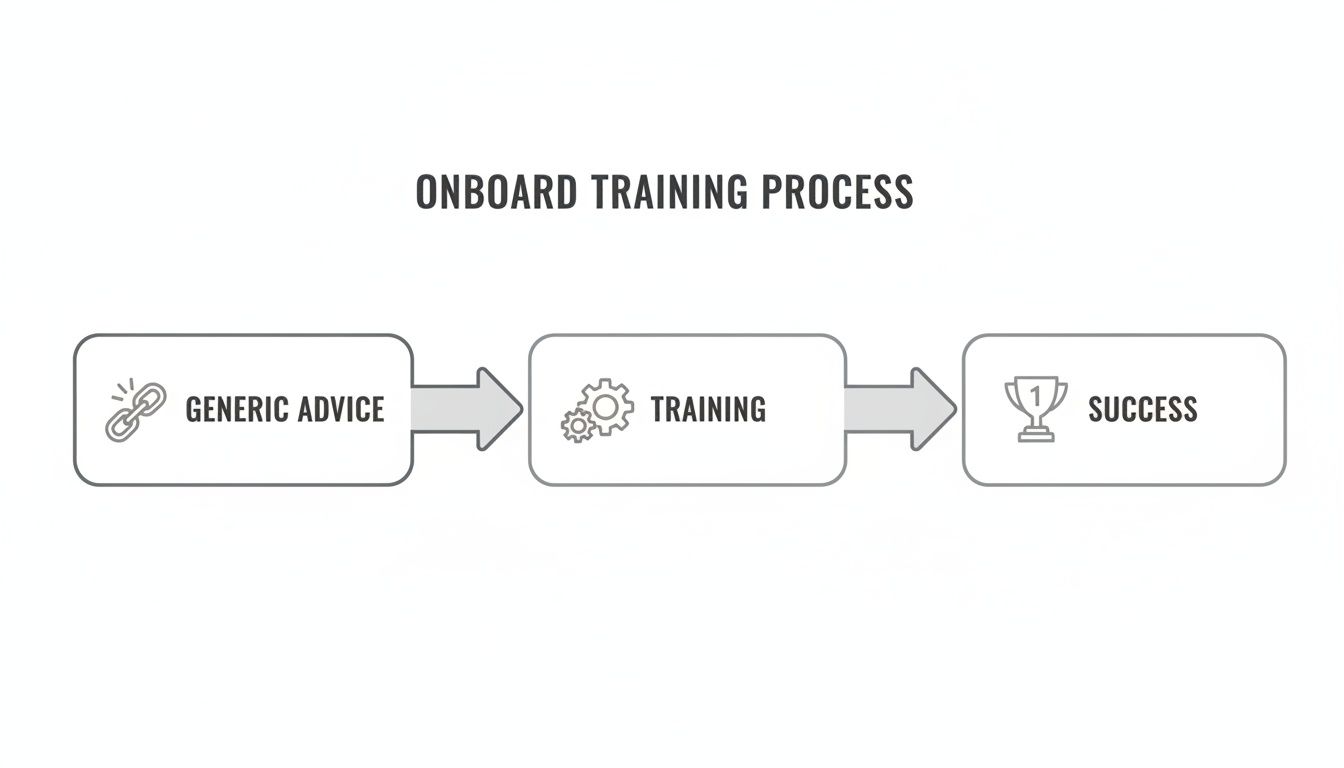
As you can see, breaking that cycle of generic advice and implementing a real training process is the most direct path to successful governance.
Crafting Core Curriculum Modules
Based on what you've learned, you can develop specific, relevant modules. The key is to move past theory and ground every single topic in the reality of running a private school.
Here are some real-world examples of curriculum modules that address common private school pain points:
- Financial Stewardship in a Tuition-Driven Model: This is way more than just reading a balance sheet. It’s about understanding the levers of net tuition revenue, managing financial aid budgets strategically, and overseeing endowment health for the long haul.
- Navigating Enrollment Analytics and Market Trends: Board members don’t need to be admissions experts, but they absolutely need to understand the data. This module teaches them how to interpret key performance indicators (KPIs) like inquiry-to-application rates, yield, and attrition to inform high-level strategy.
- Fostering a Thriving Head of School Partnership: This is non-negotiable. This module clarifies roles and responsibilities once and for all. It establishes clear processes for setting annual goals for the Head, conducting fair and productive evaluations, and building a relationship based on trust and respect, not micromanagement.
- The Board’s Role in Philanthropy and Advancement: Let’s face it, many trustees are hesitant fundraisers. This training demystifies their role. It focuses on being an ambassador, identifying potential supporters in their networks, and making personal commitments that inspire others. The data doesn't lie: a stunning 73% of nonprofit organizations report that board members are far more likely to participate in fundraising after they’ve received specific training.
When you design a curriculum around these tangible, school-specific issues, you create something board members see as a valuable use of their time—a tool that directly empowers them to be better stewards of the school's mission.
Choosing a Training Format That Board Members Value
The most brilliant curriculum in the world will fall flat if the delivery doesn't respect the time and learning styles of your board members. These are busy, high-level professionals volunteering their most precious asset: their time. The format you choose sends a clear message about how much you value their commitment.
How you deliver your nonprofit board governance training matters just as much as what you deliver. It's about matching the format to the goal, whether that's deep strategic thinking, ongoing skill-building, or getting new trustees up to speed efficiently.

This is about more than logistics; it's about engagement. The 2025 Board Effectiveness Survey paints a sobering picture: 87% of respondents believe at least 10% of their board members are ineffective. That’s a staggering number, and it underscores the urgent need for training formats that combat disengagement and turn passive members into strategic assets. You can dig into the full survey findings about board effectiveness for more detail.
The Intensive Weekend Retreat
For deep, strategic work, nothing beats getting the board off-site for a focused retreat. Taking everyone out of their usual environment for a weekend strips away the daily distractions and fosters the kind of creative, long-range thinking you need to launch a new strategic plan or kick off a capital campaign.
The catch? The time commitment is huge. A poorly planned retreat can feel like a colossal waste of a valuable weekend.
To make it work:
- Set a Clear, High-Stakes Goal: The theme can't be "general governance." It has to be something concrete and urgent, like "Finalizing Our Five-Year Campus Master Plan" or "Designing Our Centennial Capital Campaign."
- Balance Work and Connection: Build in social time. Stronger personal relationships among trustees lead to more trust and candor in the boardroom. A group dinner or a shared activity can be just as productive as a formal session.
- Bring in an Expert Facilitator: An external guide is worth their weight in gold. They keep the conversation on track, manage different personalities, and bring an objective perspective that’s nearly impossible to achieve when the Head of School or Board Chair is leading.
Quarterly Half-Day Workshops
For continuous, ongoing development, quarterly workshops are a powerful tool. This approach breaks down complex governance topics into manageable, focused sessions that fit into the board’s regular rhythm. It’s perfect for tackling timely issues that align with the school's operational calendar.
Think of it as a steady drip of knowledge rather than a firehose. A workshop on financial oversight right before the annual budget vote is far more impactful than a generic finance talk in the middle of summer.
A common mistake is trying to cram too much into one workshop. Zero in on one core topic—like "Understanding Enrollment Funnel Metrics" or "The Board's Role in Accreditation"—and go deep. This ensures the learning actually sticks and can be applied to the board's current work immediately.
Self-Paced Online Modules
For onboarding new members, self-paced online modules are incredibly efficient. New trustees can absorb the foundational knowledge—the school’s history, bylaws, key financial documents, and the legal duties of a board member—on their own schedule, before they even attend their first meeting.
This gets every new member to the same baseline of understanding. It frees up precious in-person meeting time for strategic discussion instead of remedial explanations.
To keep online modules from feeling like a chore, build in interactive elements. Short quizzes, video messages from the Head of School, and brief case studies based on real school challenges can make the content much more engaging and memorable.
Ultimately, the best approach is often a hybrid one. You might use an annual retreat for big-picture strategy, quarterly workshops for skill development, and online modules for foundational onboarding. This layered approach to nonprofit board governance training respects your board’s time while building a culture of continuous learning and high performance.
Ready to design a training format that truly resonates with your board? Schedule a complimentary consultation with JAG Consulting today or visit our website to see how we can help.
Making Governance Training a Continuous Practice
Great governance isn’t born in a single, powerful workshop. That’s just the spark. Real, sustainable excellence comes from building a culture of continuous learning that’s woven into the very rhythm of your private school's board.
The goal is to shift training from an isolated "event" to a fundamental part of how your board operates, thinks, and grows. When you do this, you stop just checking a box. You start transforming your boardroom from a place of simple oversight into an engine of perpetual strategic leadership.
Building a Robust Onboarding Process
The journey starts the second a new trustee says "yes." A well-structured onboarding process is your single best opportunity to set the tone for their entire term. It’s the difference between a new member spending a year just trying to find their footing versus feeling prepared, confident, and ready to contribute from day one.
A haphazard welcome is a recipe for disengagement. You need a comprehensive plan that gives them the tools and context to succeed.
- The Essential Welcome Packet: Go beyond just the bylaws. Curate a packet with the last two years of audited financials, the current strategic plan, recent board meeting minutes, and a clear organizational chart. This isn't just paperwork; it's the story of where the school has been and where it's going.
- A Mentorship Pairing: Match every new trustee with a seasoned board member. This creates a safe, informal channel for them to ask the "silly questions" and get a feel for the unwritten norms and culture of your board. It’s an absolute game-changer for integration.
- Key Leadership Meetings: Don't wait for them to meet people by chance. Proactively schedule brief, one-on-one meetings with the Head of School, Director of Finance, and Director of Advancement. These conversations build crucial relationships and provide priceless, firsthand insight into the school’s operational realities.
This isn’t just about informing new members; it’s about integrating them. The faster they’re integrated, the faster they become effective.
The Annual Development Plan
Once a trustee is onboarded, their development is really just beginning. The most effective boards I’ve seen build an annual development plan that connects specific training topics directly to the school’s calendar and strategic priorities. This approach makes governance training intensely practical—it's "just-in-time" learning.
Imagine a rhythm like this:
- Q1 (Pre-Budget Cycle): A workshop focused on advanced financial oversight. You’d dig into key performance indicators and really understand the nuances of the school's tuition-dependent model right before the budget talks heat up.
- Q2 (Strategic Planning Kickoff): A facilitated session on environmental scanning and competitive analysis. This primes the board for the high-level, forward-thinking discussions that strategic planning requires.
- Q3 (Pre-Annual Fund Launch): A focused training module on the board's role in philanthropy. This isn't about asking them to write checks; it's about sharpening their skills as ambassadors and storytellers for the school.
- Q4 (Head of School Evaluation): A refresher on best practices for conducting a fair and productive Head of School evaluation, ensuring the process is supportive, constructive, and aligned with strategic goals.
When you structure learning this way, it’s never abstract. It gives the board the specific knowledge they need, precisely when they need to apply it.
Board service is not just an act of volunteerism; it's a powerful tool for professional growth. This continuous development model creates more effective leaders for the school while simultaneously enriching the skills of the trustees themselves.
And this isn't just a nice idea—the data backs it up. One study found that 65% of employees who serve on nonprofit boards developed skills in board governance. For those serving longer than two years, the numbers are even more striking: skill development in governance soared from 53% to 70%, and in decision-making, it grew from 42% to 56%. You can explore more of these findings on how board service develops leaders.
By making nonprofit board governance training a continuous practice, you create a virtuous cycle. Better-trained trustees make smarter strategic decisions, which leads to a stronger school. That, in turn, makes board service a more rewarding and impactful experience, helping you attract the high-caliber leaders you need for years to come.
Ready to build a culture of continuous improvement for your board? Book a call with JAG Consulting or visit our website to learn how we can design a development plan that secures your school’s future.
Measuring the True Impact of Your Training
You’ve invested a ton of time and resources into nonprofit board governance training. It’s a serious commitment. So, how do you know if it’s actually working? If you want to justify the investment and make next year’s training even better, you have to move beyond the simple “happy sheets” or satisfaction surveys.
The real measure of success isn’t whether board members enjoyed the session. It’s whether their behavior—and the board’s performance—has tangibly improved. You need to connect the dots between the training content and the school's actual health, both operationally and strategically.

From Feelings to Facts
To get a clear picture, you have to shift from subjective feedback to objective, measurable indicators. This starts with establishing a baseline before the training even begins. A simple pre-training assessment can capture the board’s current understanding of key governance principles, from fiduciary duties to the strategic planning process.
That initial data point is your starting line. A post-training assessment, maybe a few months down the road, can then reveal concrete shifts in knowledge and confidence, giving you hard evidence of learning.
The most powerful metrics are often behavioral. A survey might show that 90% of board members now feel more confident in their fundraising roles, but the real test is seeing a 20% increase in their actual participation in advancement activities six months later. That's the kind of data that makes a compelling case for continued board development.
Key Performance Indicators for Board Effectiveness
Tracking the right metrics will draw a direct line between your investment in training and the school's improved performance. These are the indicators that move beyond theory and into the practical reality of how the board functions day-to-day.
Consider implementing a few tools to track progress in these core areas:
- Board Meeting Efficiency: Are meetings shorter and more focused? Are you spending less time on operational minutiae and more on big-picture strategy? Track the percentage of meeting time spent on strategic discussions. A healthy shift here proves the board is governing at the right altitude.
- Committee Engagement: Watch the output and initiative of your committees. Are they proactively tackling issues and presenting well-researched recommendations, or are they just passively reacting to whatever comes up? An increase in committee-driven initiatives is a strong sign of deeper engagement.
- Fundraising Participation: This is one of the most straightforward metrics you can track. Look at the percentage of board members who make a personal financial contribution. Just as important, monitor their active participation in identifying, cultivating, and soliciting other potential donors.
- Strategic Plan Adherence: How often are board decisions explicitly linked back to the school's strategic plan? A noticeable increase shows that the board is finally using the plan as a guiding document, not just a decoration for the shelf.
Practical Assessment Tools
Gathering this data doesn’t have to be complicated, but it does need to be consistent. A well-designed board self-evaluation tool, administered annually, can provide invaluable insights into the board’s perception of its own effectiveness.
Compare the results year-over-year to spot the trends. Did the board’s collective score on "Financial Oversight" jump after that targeted workshop? This kind of comparison helps you pinpoint which training initiatives are delivering the strongest results and where you need to focus your efforts next.
By tracking these meaningful indicators, you can prove the ROI of your training program, plain and simple. This data-driven approach not only helps you refine future training but also makes a powerful case to the entire school community that investing in your board is one of the most effective ways to invest in the school's future.
Is your private school ready to build a high-performing board that drives real results? Let's discuss how to design and measure a training program that makes a tangible impact. Book a call with JAG Consulting or visit our website to get started.
Ready to Build a Stronger Board and Secure Your School's Future?
Putting a real, intentional board governance training program in place is one of the most powerful moves any private school can make. It’s what transforms a board from a group of well-meaning volunteers into a genuine strategic asset—one that actively secures the school’s long-term health and mission.
When governance is strong, the results are tangible: greater financial stability, a clear and confident strategic direction, and a more vibrant school community for everyone.
This commitment to continuous improvement sends a powerful signal to every stakeholder, from current families and donors to the wider community. It shows you take your responsibilities seriously. Don't leave something this critical to chance. The only way to build that foundation of excellence is to implement proven nonprofit board governance best practices.
The challenges of building an effective board are real, but the rewards are truly transformative for your school.
Ready to build a stronger, more strategic board? Let’s talk.
Book a call with JAG Consulting to discuss a customized governance training plan for your private school, or visit our website to learn more. We can build a brighter future for your school, together.
Common Questions About Board Training
When we work with school leaders, a few key questions about board governance training always come up. Let's tackle them head-on, based on what we've seen work (and what hasn't) in countless schools.
How Do We Get Busy Board Members to Actually Commit to Training?
You can't just add another meeting to their calendars and expect them to be thrilled. The key is to frame training not as an obligation, but as a high-leverage tool that makes their valuable time more impactful.
Show them the direct line between targeted training and better, faster decisions. Nobody wants to sit in a meandering, inefficient board meeting. Highlight how these sessions are designed to prevent exactly that. When they see the "why" — a clearer strategic path, a stronger financial position, a healthier relationship with the Head of School — they get on board.
A telling statistic: A recent governance study found that 48% of board members feel their peers are disengaged. Effective training is the most direct solution to that problem.
Make it easy for them to say yes. Offer flexible formats like a 90-minute virtual workshop or, even better, build training modules directly into your existing board retreats.
What’s the Single Most Important Topic We Should Cover?
If you only have time to focus on one thing, make it this: the bright, uncrossable line between governance and management.
It's the foundational issue. Board members, especially successful executives, have a natural and well-intentioned instinct to roll up their sleeves and "fix" things. But when they slip into an operational mindset, they can inadvertently undermine the Head of School and create chaos.
Your training absolutely must cement the board's role in strategic oversight—asking "what" and "why." This empowers the school's leadership team to handle the "how." Getting this right prevents micromanagement and is the cornerstone of a healthy leadership dynamic.
How Much Should We Budget for This?
Budgets will obviously depend on your school's size and the training's scope, but a great starting point is to earmark 1-2% of your total operating budget for governance and professional development.
Think of it as an investment, not an expense. A small investment in financial oversight training could easily help the board spot a budget inefficiency that saves the school tens of thousands of dollars. The ROI can be massive. This can come from the operating budget, or you can often find capacity-building grants from foundations that want to support strong institutions.
Should We Run the Training Ourselves or Hire an Expert?
Doing it yourself can work for routine onboarding or simple policy updates. The board chair or Head of School can handle those just fine.
But for your annual retreat, comprehensive governance training, or when you need to navigate sensitive topics (like a capital campaign or a leadership transition), bringing in an outside facilitator is a game-changer.
An external expert brings a few things you just can't replicate internally:
- Objectivity: They have no internal agenda and can address the "elephants in the room" with neutrality.
- Best Practices: They've seen what works and what doesn't at dozens of other schools.
- Skilled Facilitation: They know how to manage different personalities, keep the conversation on track, and ensure everyone is heard.
A seasoned consultant elevates the entire experience from just another meeting to a truly productive working session.
Ready to build a stronger, more effective board for your private school? JAG Consulting specializes in creating customized training programs that address the unique challenges private schools face.
Book a call with JAG Consulting to discuss a tailored governance plan, or visit our website to learn more.

I'm Dr. Jeannie Gudith, Founder and CEO of JAG Consulting. We help you develop, improve, buy or sell your private school.
I'm so glad you're here
Hello!


