

Private Schools for Sale: Smart Path to Acquisition Success
Thinking about buying a private school? It's a move that opens you up to a remarkably stable and growing sector, one fueled by parents' increasing demand for more specialized education. This isn't just another financial deal; it's a chance to shape future generations and create a real community asset. But before you get too far down the road, you absolutely have to understand the market you're walking into.
Decoding the Private School Investment Landscape

Before you even start looking at listings for private schools for sale, you need a solid grasp of the big picture. The private education market isn't just holding steady—it's growing, and that growth is powered by some significant social and economic shifts. Getting this context right is the foundation for making a smart investment.
The demand for private education is clearly on the rise. More and more parents are looking for alternatives to public schools, seeking out smaller classes, specialized programs (like STEM or the arts), and environments that better match their own values. In the United States, approximately 10% of all K-12 students attend private schools, a testament to the sector's significant role in the educational landscape. This isn't some passing fad; it's a fundamental change in how families are planning for their children's futures.
The decision to invest in a private school is often a decision to invest in a community's future. These institutions are more than businesses; they are cornerstones of local identity, attracting families who prioritize high-quality education and shared values.
This growing demand creates financial stability and real growth potential for school owners. Unlike a lot of other industries that get rocked by economic changes, education is a constant need. That means a reliable revenue stream from tuition and fees you can count on.
Key Market Drivers and Financial Health
So, what’s actually pushing this growth in the private education market? A few key factors are making this an attractive space for buyers. These drivers don't just keep a steady flow of students coming in the door; they also support the long-term financial health of the schools themselves.
- Rising Disposable Incomes: As families earn more, private tuition becomes a realistic option for a much broader group, expanding the customer base well beyond the traditionally wealthy.
- Focus on Specialized Learning: Parents are actively hunting for schools that meet specific needs, whether that means advanced placement courses, robust support for special needs, or unique philosophies like Montessori or Waldorf.
- Desire for Safe and Nurturing Environments: Smaller school communities often feel safer and provide more personalized attention, which is a huge priority for many families today. Statistics show that the average private school has a student-teacher ratio of 12.2 to 1, significantly lower than the public school average, which is a major selling point for parents.
The financial data tells a compelling story. The global private schools market hit a massive $61.5 billion in 2025. North America grabs the biggest piece of that pie, showing just how strong the demand for premium education is here.
To give you a better feel for the numbers, we've put together a quick overview of the key market indicators.
Key Private Education Market Indicators
This table summarizes the critical financial and operational statistics for the private school sector, providing a quick reference for potential investors.
| Market Segment | Recent Market Size | Projected CAGR | Key Growth Drivers |
|---|---|---|---|
| Global Private Schools | $61.5 Billion (2025) | 6.90% (2025-2033) | Increased focus on personalized education, rising disposable incomes. |
| North America | Largest market share | 10% Y-o-Y Growth | Strong demand for premium K-12 and specialized programs. |
As you can see, the data points to a robust and expanding market. The sector is not only large but also growing at a healthy clip, promising a solid runway for future success.
Understanding the Investment Profile
Buying a private school is a different ballgame than acquiring a typical business. The real value isn't just what's on the balance sheet. It’s tied up in the school's reputation, its accreditation status, and its standing in the community. A school with a long track record of academic excellence and strong parent engagement has huge intangible value that directly leads to stable enrollment and financial strength.
To get a better handle on the financial side of things, it’s worth looking into accounting insights for Early Childhood Education (ECE) centers. Their business models have a lot in common with private schools when it comes to revenue streams and cost structures. This kind of knowledge is vital when you start digging into the financials of a potential acquisition.
Navigating this unique investment landscape requires a specific kind of expertise. Whether you're a seasoned investor or new to the education world, understanding these market fundamentals is the critical first step toward a successful purchase.
Ready to explore the opportunities in the private school market? Book a call with a JAG Consulting expert today at https://link.jagconsultingservices.com/widget/bookings/prospective/school/consultation/zoom or visit our website to learn how we can guide you through every stage of the acquisition process.
Finding and Vetting Your Ideal School Acquisition
Hunting for the right private school to buy is a lot more nuanced than a quick Google search. The best deals, the ones that are truly turnkey, are almost never on public listings. They’re found through quiet networks and specialized channels. Finding a great school comes down to a methodical sourcing process and a tough, clear-eyed vetting system to make sure you're not buying someone else's problems.
The private school market is surprisingly scattered. In the United States, the industry is projected to hit $79.5 billion in revenue for 2025. And even with a slight dip in recent years, the market is made up of 25,433 individual businesses—a perfect landscape for consolidation. For a smart buyer, this means there are fantastic, established schools out there if you just know where to look. You can explore more about these market dynamics to get a sense of the scale.
Uncovering Off-Market Opportunities
Let’s be clear: the most attractive private schools for sale aren’t advertised. Owners are intensely private, and for good reason. The last thing they want is to spook parents, staff, and students with a "For Sale" sign out front. This is where a professional approach becomes non-negotiable.
- Lean on Advisory Firms: Specialized consultants, like us at JAG Consulting, live in this world. We maintain private lists of qualified buyers and sellers, making confidential introductions to schools that fit your exact criteria long before they ever see the open market.
- Work Your Education Network: Get out there. Go to the industry conferences, and build real relationships with Heads of School, board members, and education-focused lawyers. These folks are the gatekeepers of information and often know who is quietly thinking about their exit strategy.
- Try Careful, Direct Outreach: A well-written, respectful letter to a school you admire can sometimes start a conversation. But this has to be handled with incredible discretion. A clumsy approach can damage both your reputation and the school's.
The single biggest mistake I see buyers make is getting stuck on public business-for-sale websites. The A-list acquisition targets are almost always off-market deals, brokered through trusted advisors who get the unique sensitivities of selling a school.
Building Your Vetting Checklist
Okay, you’ve got a potential school on your radar. Now the real work begins. This isn’t the time for a deep dive into the financials—not yet. This is about a high-level screening to quickly weed out the non-starters. The goal is to gauge the school's fundamental health and see if it has a real future. A solid checklist keeps you objective and ensures you’re comparing every opportunity apples-to-apples.
This first look should zero in on the key operational and reputational signs that tell you whether the school is stable or sitting on a shaky foundation.
Key Indicators for Initial Screening
Your first pass is all about confirming the school meets your core investment thesis. Don't burn hours on a deep analysis until you've checked these boxes.
1. Accreditation Status
First question, no exceptions: Is the school fully accredited by a recognized agency? Accreditation is a stamp of approval on everything from academic quality to operational health. A non-accredited school, or one with provisional status, is a massive red flag. It brings a world of risk and can create major headaches with financing and student recruitment down the line.
2. Enrollment and Retention Trends
Ask for the last five years of enrollment data. What you're looking for is stability or, even better, steady growth. But the more important number is the student retention rate. A high "churn rate"—where the school is constantly recruiting new kids just to replace the ones who are leaving—points to deep problems. It could be academics, a toxic culture, or unhappy parents.
3. Local Reputation and Market Position
What do people in the community really think of this school? Dig into online reviews (the good and the bad), chat with local real estate agents who work with families, and get a feel for its brand. A school with a stellar reputation is a priceless asset that directly translates into higher tuition tolerance and strong enrollment demand.
4. Leadership and Staff Stability
Find out how long the Head of School and other key administrators have been there. If you see a revolving door in the main office, it’s a sign of serious trouble, likely pointing to governance issues or a brutal work environment. Remember, a stable, experienced team is one of the most valuable assets you can possibly acquire.
By methodically running every potential deal through this framework, you can cut through the noise and focus your time and energy on the private schools for sale that represent a genuine opportunity for growth.
Ready to find and vet your ideal school acquisition? Book a call with a JAG Consulting expert today or visit our website to learn how our specialized network can connect you with exclusive, off-market opportunities.
Mastering School Valuation And Financial Due Diligence
Getting the valuation right is the absolute cornerstone of a smart school acquisition. It's what separates a fair price for a thriving institution from a costly mistake loaded with hidden liabilities. This process isn't about plugging numbers into a formula; it's about digging into the financials to understand the story they tell—about the school's past performance, its current health, and its real future potential.
To truly grasp what a private school is worth, you have to look far beyond a single year's profit. The final number reflects everything from the school's reputation in the community and enrollment stability to its day-to-day operational efficiency. A school with consistent cash flow and a respected brand will always fetch a higher price.
This decision tree is a great starting point for quickly vetting potential schools based on the big-ticket items, like accreditation and enrollment trends.
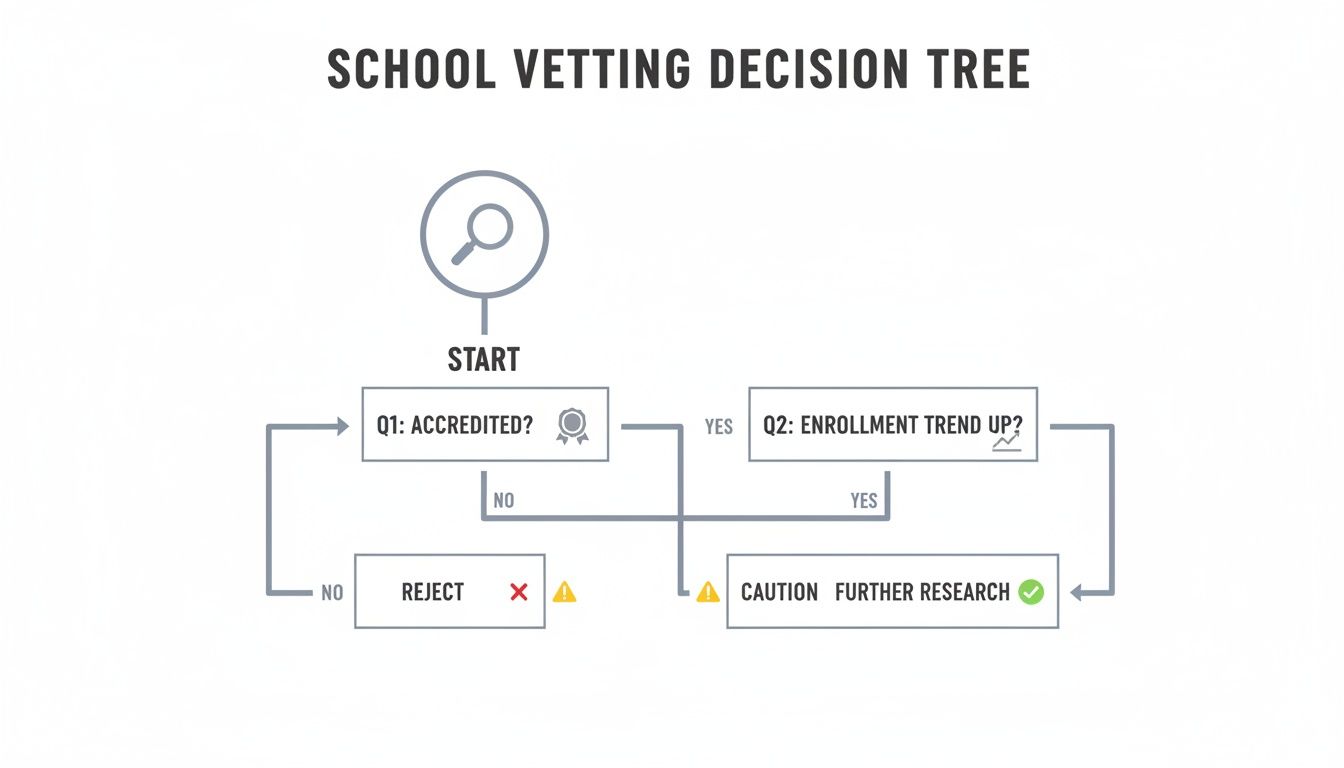
As you can see, a single "no" to a critical question like accreditation can be an immediate dealbreaker. Using this framework early on will save you an incredible amount of time and resources.
Choosing The Right Valuation Method
There’s no single "correct" way to value a school. In reality, professional appraisers almost always use a combination of methods to triangulate a supportable price range. Each approach provides a different, valuable lens through which to view the school's worth.
The K-12 private education market is a major factor here. It ballooned to $431.46 billion globally in 2025 and is on track to hit $609.22 billion by 2029, growing at a formidable 9% CAGR. This incredible market tailwind directly boosts school valuations and justifies premium multiples for well-run institutions poised to capture this demand.
Here are the three primary methods you'll encounter.
Comparing School Valuation Methods
To determine a fair and defensible purchase price, you need to understand the strengths and weaknesses of each valuation model. This table breaks down the three most common methods used in private school acquisitions.
| Valuation Method | Best For… | Key Metric | Primary Consideration |
|---|---|---|---|
| SDE Multiples | Most small-to-midsize private schools with active owner involvement. | Seller's Discretionary Earnings | How accurately can you "add back" owner-specific expenses to find the true cash flow? |
| Asset-Based | Schools with significant real estate or tangible assets. | Fair Market Value of Assets | Does this capture the intangible value of the brand, curriculum, and student body? (Often, it doesn't.) |
| Discounted Cash Flow | High-growth schools or those with clear, predictable future expansion plans. | Projected Future Cash Flows | How reliable are the growth projections? This method is highly sensitive to assumptions about the future. |
Each method tells a piece of the story. SDE gives you a snapshot of current earning power, the Asset-Based approach sets a baseline value, and DCF offers a glimpse into future potential. The most accurate valuations blend insights from all three.
The real art of valuation lies in blending these methods. An SDE multiple might tell you what the school is worth today, while a DCF analysis shows what it could be worth with a strategic investment. Using them together gives you a complete and defensible financial picture.
Conducting Rigorous Financial Due Diligence
Once you have a valuation range in mind, it's time to verify every single number. This is where you move from assumptions to hard facts. Financial due diligence is a deep, exhaustive audit of the school's financial health, specifically designed to uncover any red flags before an offer is on the table.
Your checklist needs to be airtight, covering every corner of the school's finances.
- Dive into the Financial Statements: Get your hands on at least three to five years of audited or reviewed income statements, balance sheets, and cash flow statements. You're looking for consistent profitability, healthy margins, and a solid balance sheet. Any weird inconsistencies or sudden nosedives in revenue are immediate red flags that need explaining.
- Scrutinize Tuition Dependency: What percentage of revenue is tied directly to tuition? While it will always be the majority, you want to see diversified income streams. Things like summer camps, after-school programs, facility rentals, or robust fundraising efforts show resilience. A school that's 100% reliant on tuition is vulnerable if enrollment ever dips.
- Examine All Debt and Liabilities: Get a clear picture of all outstanding loans, lines of credit, and debts to vendors. More importantly, are there any unusual or off-balance-sheet liabilities? This could be anything from a pending lawsuit to major deferred maintenance costs that will immediately become your problem.
- Project Future Capital Needs: A school's facilities are not a "set it and forget it" asset. Review the age of the buildings, HVAC systems, and the state of their technology infrastructure. You have to budget for future capital expenditures. A new roof or a campus-wide tech upgrade can be a massive, unbudgeted expense for an unprepared new owner.
When you're digging into the school's operational efficiency, pay close attention to its revenue collection process. Researching modern and comprehensive tuition management systems can give you a benchmark for what's possible. If the school is still chasing paper checks and managing payments on a spreadsheet, that’s a sign of operational drag that's likely costing them money and time.
Diving into the Legal Weeds and Accreditation
Once you’ve put the school’s finances under a microscope and everything looks solid, the deal moves into what is arguably the most treacherous phase: legal and regulatory due diligence. This is where a fantastic opportunity can turn into a nightmare if you’re not obsessively detailed.
Buying a private school isn't like buying a typical business or a piece of commercial real estate. You're acquiring a living, breathing entity that’s tangled in a web of educational laws, faculty contracts, student agreements, and—most critically—accreditation standards. Getting this part right is about protecting yourself from hidden landmines that could blow up long after you’ve taken the keys.
Why Accreditation is Your Most Valuable Intangible Asset
Let’s be crystal clear: a school’s accreditation is the single most important non-financial asset you will acquire. It’s the official seal of approval, a third-party guarantee to the world that the school meets rigorous standards of academic quality and operational integrity.
For parents, it’s a non-negotiable mark of trust. For students, it ensures their hard-earned credits will actually be recognized by other high schools and colleges.
Losing accreditation, even for a short time, can be a death sentence for a school's reputation and enrollment. That’s why you have to make its status your top priority. As you look at private schools for sale, you must verify that the school is in good standing with its accrediting body and—this is crucial—understand that agency's specific rules for a change of ownership.
A school's accreditation is its seal of quality in the marketplace. Acquiring a school with provisional or lapsed accreditation is like buying a restaurant with a failing health score—you're starting from a deep deficit of trust that can be incredibly difficult to overcome.
Some accrediting bodies will put new owners through the wringer with a full re-evaluation process. Others have a more streamlined transfer protocol. Never, ever assume it will be simple. You need to get on the phone with the accrediting agency early in the process to make sure the transition will be seamless and won't cause any disruption for the school community.
Your Essential Legal Due Diligence Checklist
To safeguard your investment, your legal team needs to perform a forensic-level review of the school's entire legal structure. Think of it as a comprehensive inspection of every document that underpins the school's right to operate. Getting these files in hand will expose any red flags before they become your problem.
This isn’t just paperwork; it’s your shield against future liabilities.
- Corporate Governance and Structure: Start at the very beginning. You need to see the school’s articles of incorporation, bylaws, and recent board meeting minutes. This confirms who actually has the authority to sell the school and can uncover any simmering internal disputes or unresolved governance issues.
- Employee and Staff Contracts: Get your hands on every single employment agreement. Pay extremely close attention to termination clauses, severance packages, and any language that grants tenure-like protections. A school with a veteran faculty might be sitting on legacy contracts that could seriously limit your flexibility and balloon your budget.
- Student Enrollment Agreements: These are the contracts you have with your customers. You need to read them for clarity around tuition payment, withdrawal policies, and parental rights. Ambiguous or poorly drafted agreements are a recipe for future conflicts with families.
- Real Estate Titles and Leases: This is a massive piece of the puzzle, whether the school owns its campus or leases it. If the property is owned, a thorough title search is non-negotiable to find any liens or claims against it. If it’s leased, you have to dissect the lease agreement, looking for any clauses about assignment or what happens in a change of control.
- Vendor and Service Contracts: Schools run on a network of outside partners, from the company that provides cafeteria food to the one that manages the IT infrastructure. Review every active contract to understand the terms, costs, and cancellation policies. You need to know exactly which financial obligations you're about to inherit.
- Regulatory Compliance Records: Finally, demand proof of compliance with all local, state, and federal rules. This includes everything from fire and safety codes to zoning permits and any special licenses needed for programs like preschool or special education.
This isn’t a process you can navigate on your own. The legal landscape for educational institutions is incredibly complex, and a single misstep can be extraordinarily expensive.
Don't risk going it alone. Book a call with a JAG Consulting expert at https://link.jagconsultingservices.com/widget/bookings/prospective/school/consultation/zoom or visit our website to ensure your acquisition is built on a rock-solid legal and regulatory foundation.
Structuring the Deal and Planning a Seamless Transition

Once the heavy lifting of due diligence is behind you, the game shifts. Now, you’re on two parallel tracks: hammering out the final deal structure and designing a transition plan that guarantees stability for everyone involved. This is the moment where the school's abstract value turns into a concrete transaction.
Get this part right, and you can save a fortune in taxes and shield yourself from nasty surprises down the road. But a thoughtful transition plan is just as critical—it ensures the school’s community, its most valuable asset, stays confident and intact.
How you buy the school is every bit as important as the price you pay. This single decision affects everything from your future tax burden to the legal risks you inherit. A misstep here can create headaches for years to come.
Choosing Between an Asset and a Stock Purchase
Your first major fork in the road is deciding between an asset purchase and a stock purchase. Each path has huge implications, and the right choice boils down to your financial goals and how much risk you're willing to stomach. This is absolutely not a time for guesswork; get your legal and financial experts in the room.
An asset purchase is almost always the preferred route for buyers. In this setup, you're buying specific, chosen assets—things like the real estate, curriculum, student lists, and brand name—but not the legal entity itself. This is huge because it allows you to leave behind any unwanted liabilities, like old debts or pending lawsuits. Tax-wise, it lets you "step-up" the basis of the assets to their current market value, which can create some fantastic depreciation benefits.
A stock purchase, on the other hand, means you buy the actual corporation or LLC that owns the school. The catch? You acquire everything—all the assets and all the liabilities, whether they're known or lurking in the shadows. Sellers often prefer this for tax reasons, but it's a riskier proposition for the buyer. If you go this route, your only defense is an absolutely bulletproof legal due diligence process.
The decision between an asset and a stock sale is one of the most consequential in any acquisition. While sellers often push for a stock sale due to favorable capital gains treatment, buyers almost always benefit more from an asset sale's liability protection and tax advantages. This is a key negotiation point where expert guidance is crucial.
Securing the Right Financing Mix
Unless you’re walking in with an all-cash offer, financing is going to be a central part of the deal structure for private schools for sale. Lenders generally see schools as stable, recession-resistant businesses, but they still need to see a rock-solid business plan and a clear path to profitability. Most school acquisitions end up using a blend of funding sources.
- SBA Loans: The Small Business Administration's loan programs, particularly the 7(a), are incredibly popular for acquisitions. They often have longer repayment terms and lower down payment requirements than conventional loans, making them a great starting point.
- Conventional Bank Loans: If you have a strong financial history and a decent down payment, a traditional bank loan is a solid choice. You’ll likely get competitive interest rates, but be prepared for more stringent approval criteria.
- Seller Financing: This can be a game-changer. Here, the seller agrees to "carry back" a portion of the purchase price, essentially acting as a lender. It not only shows their confidence in the school’s future but can also bridge a funding gap if traditional loans don't cover the full price.
- Investor Partnerships: For larger deals, bringing on equity partners might be the way to go. This could mean partnering with private equity firms that focus on education or finding individual investors who believe in your vision.
Crafting a Bulletproof Transition Plan
A successful school acquisition isn't just about the numbers; it's a transfer of trust. From the moment the ink is dry, your number one priority has to be managing the human side of the change. A clumsy transition can sink staff morale, scare parents, and trigger a student exodus faster than you can say "new ownership."
Your transition plan needs to be a detailed playbook for the first 90-120 days after closing. Your goal is simple: project stability, confidence, and a deep respect for the school’s legacy.
Key Components of a Transition Plan:
- Communication Strategy: Map out your messaging for each group: staff, parents, and students. The key is clear, consistent communication. Be present, be visible, and over-communicate your commitment to the school's mission.
- Leadership Retention: Figure out which administrators and faculty are the lifeblood of the school's daily operations and culture. Offering retention incentives, like bonuses or new professional development opportunities, is a smart investment to ensure a smooth handover.
- Operational Integration: Plan exactly how you'll integrate systems for things like payroll, tuition management, and academic reporting. My advice? Avoid making any drastic, sweeping changes in the first few months. Take the time to understand how things work before you start trying to "improve" them.
The transition period sets the tone for your entire tenure as the owner. Get it right, and you'll build goodwill and preserve the very momentum you worked so hard to acquire.
Navigating deal structures and planning a transition requires specialized experience. Book a call with a JAG Consulting expert today at https://link.jagconsultingservices.com/widget/bookings/prospective/school/consultation/zoom or visit our website to ensure your school acquisition is successful from the closing table to the first day of school under new leadership.
Common Questions About Buying a Private School
Stepping into the world of private school acquisitions is a unique venture, far different from buying a typical business. It’s a specialized field that naturally brings up a lot of questions. Getting clear, straightforward answers is the only way to build the confidence you need to move forward on a potential deal for private schools for sale.
Let’s tackle the most common questions we hear from prospective buyers. Our goal here is to cut through the complexity and give you the practical insights you need to make smart decisions on your path to ownership.
What Are The Most Common Mistakes To Avoid?
One of the biggest pitfalls we see is buyers underestimating the power of a school’s culture. They get laser-focused on the financials and completely overlook the deep-seated traditions, community values, and unwritten rules that make the school what it is. Trying to change that culture too fast is a recipe for instant backlash from staff, parents, and even alumni.
Another frequent misstep is failing to have a rock-solid transition plan for key leadership. The Head of School and senior administrators are often the heart and soul of the institution. If you don't have a clear strategy to retain them, at least for an interim period, you risk a massive loss of institutional knowledge and a serious blow to stability right out of the gate.
Finally, a critical mistake is looking only at historical financials without accurately projecting future capital needs. Old buildings need constant upkeep. Technology requires regular updates. If you don't budget for these significant, inevitable expenses, a profitable school can quickly become a financial drain.
How Long Does It Typically Take To Buy A Private School?
While every deal is different, a realistic timeline is anywhere from 6 to 12 months from your initial search to the day you get the keys. This process isn't a single sprint; it’s a series of distinct phases, each with its own rhythm.
- Sourcing & Screening (1–3 Months): This is the discovery phase—identifying potential schools, making discreet inquiries, and conducting the first round of high-level evaluation.
- Deep-Dive Due Diligence (2–4 Months): This is where the real work happens. You’ll be digging into everything: financials, legal documents, accreditation status, enrollment trends, and the school’s overall operational health.
- Negotiation & Financing (2–3 Months): Once your diligence checks out, you’ll move into negotiating the final purchase agreement and lining up your funding from lenders or investors.
- Closing & Transition (1–2 Months): The final leg of the race involves signing all the legal paperwork, transferring funds, and finalizing the handover plan.
Keep in mind, delays are common. Uncovering unexpected legal issues or navigating a complex real estate component can easily stretch this timeline.
How Important Is Accreditation?
Accreditation isn’t just important—it’s the absolute bedrock of a private school's credibility. It’s the independent, third-party validation that confirms the school's academic quality, operational integrity, and financial stability. For a buyer, an accredited school is a much, much lower-risk investment.
Think of accreditation as a school's official seal of approval. It tells families they can trust the educational quality, makes it easier for students to transfer credits to other schools and universities, and often makes securing financing for the acquisition significantly easier.
During the acquisition, you need to do more than just check a box confirming the school is accredited. You have to verify its status is in good standing and get a crystal-clear understanding of the accrediting body’s specific process for a change of ownership. Letting accreditation lapse during the transition can do severe, sometimes irreparable, damage to the school’s reputation and enrollment.
What Financing Options Are Available?
Very few school acquisitions are all-cash deals; most involve a mix of financing sources. The good news is that because private schools are viewed as stable businesses with reliable, recurring revenue streams, there are several excellent financing options on the table.
- Small Business Administration (SBA) Loans: Often the first stop for buyers, SBA loans can offer favorable terms, longer repayment periods, and lower down-payment requirements, making them highly attractive.
- Conventional Bank Loans: If you have a strong personal financial background and a significant down payment, traditional commercial loans are a very viable option.
- Seller Financing: This is a common and incredibly powerful tool. The current owner agrees to finance a portion of the purchase price, which not only helps bridge a potential funding gap but also shows their deep confidence in the school's future success.
- Private Equity or Investor Partnerships: For larger acquisitions, bringing in partners or private equity firms that specialize in the education sector can provide the necessary capital and strategic expertise.
Navigating these questions is a crucial part of the journey. For expert guidance tailored to your specific situation, book a call with a JAG Consulting expert at https://link.jagconsultingservices.com/widget/bookings/prospective/school/consultation/zoom or visit our website to learn more.
Ready to Find the Right School? Here’s Your Next Step.
You’ve got the roadmap. We’ve walked through locating opportunities, digging into the financials, and planning for a smooth transition. But knowing the steps is one thing; successfully navigating the journey is another.
With over 25,000 private schools in the U.S. alone, the right opportunity is out there. The challenge isn't a lack of options—it's the complexity of finding the right one and avoiding the costly mistakes that can sink a deal before it even starts. Going it alone is a huge risk.
Whether you’re just starting to browse private schools for sale or you have a specific target in your sights, getting an expert second opinion is invaluable. An experienced advisor has seen what can go wrong and knows how to make things go right.
The best school acquisitions are built on a foundation of expert advice, rigorous analysis, and a deep respect for the school's legacy. A seamless transition preserves the community's trust, which is the most valuable asset you will acquire.
Don't leave your investment to chance. A partner who lives and breathes the education sector can help you sidestep the common pitfalls, cut through the noise, and position you for success long after the papers are signed.
Let our team at JAG Consulting put our experience to work for you. We provide the specialized support needed to turn your acquisition goals into a reality.
Ready to move forward? Let's talk. Book a complimentary consultation with JAG Consulting to discuss your goals. We connect qualified buyers with premier school opportunities every day.
Book your call at https://link.jagconsultingservices.com/widget/bookings/prospective/school/consultation/zoom or visit our website for more information.

I'm Dr. Jeannie Gudith, Founder and CEO of JAG Consulting. We help you develop, improve, buy or sell your private school.
I'm so glad you're here
Hello!


