


A Private School Guide to Education Market Research
So, what exactly is education market research?
Think of it as the foundational work you do before making any big decisions. It’s the process of methodically gathering real-world information about the families you want to serve, the other schools in your area, and the broader educational climate. This isn't just about crunching numbers; it's about making sure your vision for a new private school actually lines up with a genuine need in the community. For private schools, where enrollment is the lifeblood of the institution, this step is non-negotiable.
This research informs absolutely everything that comes next—from your school's core mission and curriculum design to your tuition rates and marketing messages.
Why Market Research is Your Private School’s Bedrock
Launching a private school on passion alone is a gamble. A big one. I’ve seen too many founders and boards skip this step, only to face the harsh reality of disappointing enrollment and a mission that just doesn't connect with local families.
Before you hire a single teacher or even think about a school mascot, you have to deeply understand the community you plan to serve.
Proper market research is what de-risks your entire project. It's not some academic exercise; it's a strategic necessity that turns a hopeful idea into a viable, data-backed plan. The demand for private and specialized education is booming—the global private school market is projected to reach $2.96 trillion by 2028, a significant increase driven by parental demand for quality and specialized learning environments.
That reflects a strong and consistent growth rate, a number that screams opportunity for well-positioned private schools. You can explore more on this growth in a report from Cognitive Market Research.

This growth isn't just an abstract statistic. It signals a competitive landscape where the private schools that succeed are the ones that make smart, data-driven decisions from day one.
Shifting from "If" to "How"
The real goal here is to get your team to stop asking, "Is this really necessary?" and start asking, "Okay, how do we do this right?"
Let me give you a few real-world examples where solid research was the absolute cornerstone of a successful private school launch:
- Finding a Hidden Niche: A founding group I worked with uncovered a large pocket of dual-income families in the tech sector who were desperate for a STEM-focused preschool. That single insight shaped their entire curriculum, their brand identity, and even their after-school program offerings, leading to a fully enrolled inaugural class.
- Validating a Bold Idea: Another team wanted to launch a specialized arts high school. Through a series of focus groups with local middle school parents, they confirmed a huge market gap. That data gave their investors the confidence they needed to fund a brand-new, state-of-the-art facility.
- Getting Tuition Just Right: By analyzing local income data and what competitor private schools were charging, a new school was able to set its tuition at a point that felt premium but was still seen as attainable. They paired it with a targeted financial aid strategy that attracted the exact mission-aligned families they were looking for.
Solid market research provides the hard evidence you need to build a compelling case for donors, investors, and accrediting bodies. It transforms your vision from a hopeful idea into a viable, data-backed plan.
To help you organize your thinking, we've broken down the essential research components into a clear framework. This table outlines the core questions you need to answer and explains why each piece is so critical to your private school's ultimate success.
Key Market Research Areas for Private School Viability
| Research Area | Core Question It Answers | Impact on Your School's Strategy |
|---|---|---|
| Demographic Analysis | Who lives here? (income, education, family size, age) | Informs tuition affordability, program demand, and marketing channels. |
| Parent Demand Survey | What are families actually looking for in a school? | Shapes your curriculum focus, school culture, and value proposition. |
| Competitive Landscape | Who are the other private and charter schools and what do they offer? | Helps you define your unique niche and avoid becoming a "me-too" school. |
| Market Sizing | How many potential students are in our target area? | Validates the fundamental viability and potential scale of your school. |
| Financial Modeling | Can we build a sustainable financial model here? | Drives tuition setting, financial aid strategy, and long-term planning. |
Each of these areas builds on the last, creating a comprehensive picture that guides everything from your curriculum and facility planning to your marketing messages and financial projections. It’s the blueprint for a sustainable and impactful private school.
Ready to build your school's future on a solid foundation of data? Book a complimentary call with JAG Consulting at https://link.jagconsultingservices.com/widget/bookings/prospective/school/consultation/zoom or visit our website to see how we help school founders turn big ideas into thriving realities.
Defining Your Core Research Questions
Vague goals get you vague data. That’s the hard truth.
The best education market research never starts with a fuzzy objective like "let's figure out what parents want." It starts with sharp, specific questions that force you to dig for real intelligence. Every single survey, interview, and data pull you do should be laser-focused on answering these core questions.
For a private school founder, this means getting brutally specific. You’re not just wondering if there's a market for your school; you’re asking questions that can only be answered with hard data. This is the difference between hoping for a good outcome and actually engineering one.
Questions for New Private School Founders
If you're launching a new private school, your research questions are your first line of defense against making catastrophic assumptions. Think of it as building a legal case for your school's existence—each question adds another undeniable piece of evidence.
Your first round of questions needs to hit three critical areas: actual demand, price tolerance, and the gaps your competitors are leaving wide open.
- Verifying Demand: "What is the total addressable market for a STEM-focused elementary program within a 15-mile radius of our proposed campus?" This question forces you to look at demographic data, not just your gut feeling.
- Testing Price Sensitivity: "What is the maximum annual tuition that dual-income households with a combined income over $200,000 in this community perceive as 'premium yet accessible'?" This gets you a number that plugs directly into your financial model.
- Identifying Market Gaps: "Among families who recently left the public school system, what were the top three programmatic or cultural features they were seeking but could not find in local private schools?" This is how you find your unique selling proposition.
A well-formulated research question is a roadmap. It tells you exactly what data you need, who you need to talk to, and what success looks like. It turns a massive, intimidating process into a series of manageable steps.
Questions for Established Private Schools
For a private school that's already up and running, market research isn't about proving viability. It's about staying relevant and finding smart ways to grow. Your questions need to be about optimization, sniffing out competitive threats, and spotting future opportunities before someone else does.
This kind of research is usually triggered by something specific—maybe application numbers are slipping, you're considering a major expansion, or the board wants to justify a big capital campaign.
Here are a few examples of what that looks like in the real world:
- Analyzing Attrition: "Which three competitor private schools are attracting the highest number of our top-performing middle school graduates, and what specific programs or attributes are driving their decisions?"
- Validating Expansion: "Is there sufficient, verifiable demand among our current and prospective families to justify a capital campaign for a new performing arts center?"
- Program Development: "What is the perceived value of adding a full-day pre-kindergarten program versus expanding our after-school enrichment offerings for elementary students?"
A huge part of this is figuring out how to write survey questions that get honest answers, so the data you collect is clean and actionable. When you crystallize your goals into sharp, focused questions like these, you ensure your research produces data that drives decisions, not just thick reports that gather dust on a shelf.
Are you ready to define the core questions that will shape your school's future? Book a call with a JAG Consulting expert today at https://link.jagconsultingservices.com/widget/bookings/prospective/school/consultation/zoom to get started, or visit our website to learn more about our strategic planning services for private schools.
Gathering Quantitative Data That Tells a Story
Passion and vision will get your private school started, but hard numbers build a business plan that investors and accrediting bodies can actually trust. Quantitative data is the objective evidence that validates your school's entire concept.
This is the part of your education market research where you answer the make-or-break questions of how many and how much. It’s where your brilliant ideas transform into a concrete, defensible plan, forming the backbone of your financial projections and enrollment strategy. But it's not just about collecting stats; it's about weaving them into a compelling narrative that proves a clear market need for your school.
Designing Surveys That Deliver Actionable Insights
One of the most direct ways to get quantitative data is simply to ask your target market. A well-designed online survey lets you gauge demand for specific programs, test how sensitive parents are to tuition, and understand their priorities at scale.
But to get clean, valuable data, your survey needs to be sharp and focused. Forget broad, fuzzy questions. Concentrate on getting specific answers that can drive real-world decisions.
- Program Demand: Don’t ask, "Would you be interested in a language program?" Instead, ask, "On a scale of 1-5, how likely would you be to enroll your child in a Mandarin immersion program?"
- Price Point Analysis: Frame tuition questions within a range. For example, "Which of the following annual tuition ranges do you consider appropriate for a private school offering [Your Key Differentiator]?"
- Feature Prioritization: Use a ranking question like, "Please rank the following school attributes in order of importance when choosing a school for your child (1 being most important): class size, STEM curriculum, arts programs, athletic facilities."
Effective surveys transform assumptions into data points. They provide the statistical proof needed to show that your proposed school model isn't just a good idea—it's a viable business venture that meets a documented community need.
It helps to remember the sheer scale of this world. The global education market is a massive ecosystem valued at $7.6 trillion, with K-12 and post-secondary education making up a combined 80% of that total. This context, drawn from HolonIQ's market analysis, highlights the immense opportunity for specialized private schools that can cater to specific parental demands.
Sourcing Credible Demographic and Market Data
Beyond surveys, your research has to include publicly available data to build a complete market profile. This is how you map your target enrollment areas and estimate the size of your potential student pool without just guessing.
The infographic below outlines the core questions your quantitative research should be laser-focused on answering: defining your market, setting the right price, and pinpointing the gaps your competitors leave open.
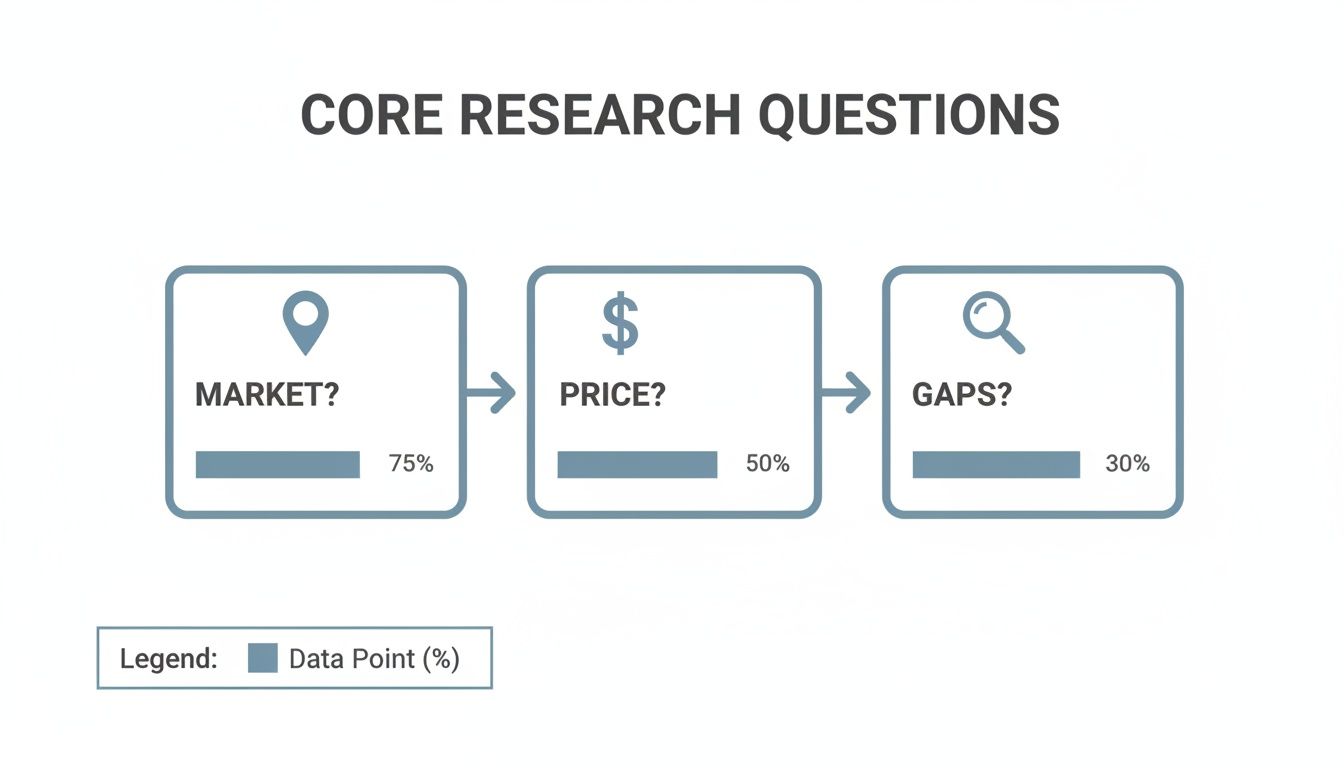
Each question builds on the last, creating that solid statistical foundation your strategic plan needs. You don't have to pay a fortune for this data, either. Some of the most reliable sources are free.
Quantitative Data Sources for Private School Planning
This table breaks down the most reliable sources for gathering the numerical data you'll need to build a strong market case for your private school. Think of it as your cheat sheet for finding the numbers that matter.
| Data Source Type | Specific Examples | Key Insights You Can Extract |
|---|---|---|
| Government Census Data | U.S. Census Bureau's American Community Survey, National Center for Education Statistics (NCES) | Granular detail on household income, family size, parental education levels, and number of school-aged children by zip code. |
| Real Estate & Market Trends | Zillow, Redfin, local Realtor association reports | Where families are moving, property value trends, and types of communities that are growing. Rising home values often correlate with a population that can afford private tuition. |
| Local Government & Economic Development | City/County planning departments, local Chamber of Commerce publications | Economic development reports, population projections, and data on local industries, which help you understand the long-term viability of your target area. |
| Private School Directories & Associations | Niche.com, Private School Review, National Association of Independent Schools (NAIS) | Competitor tuition rates, enrollment numbers, program offerings, and parent reviews. Essential for competitive mapping. |
Tapping into these sources gives you a multi-layered view of your market, moving you from broad assumptions to specific, actionable intelligence.
Conducting a Market-Sizing Analysis
Once you have this data, you can run a market-sizing analysis. This is a straightforward but incredibly powerful calculation to estimate the number of potential students who actually fit your ideal family profile.
Here’s how it works. Start with the total number of school-aged children in your primary catchment area (say, a 10-mile radius). Then, start applying filters based on your research. You might narrow it down by households with an income above $150,000, then filter it again by parents who hold a bachelor's degree or higher.
What’s left is your total addressable market—the real-world pool of families you can realistically target.
This number is arguably the most critical input for your enrollment projections. It grounds your financial model in reality, showing potential investors that your goals are based on solid demographic data, not just wishful thinking.
The numbers you gather at this stage are the bedrock of your private school's future. Are you ready to dig in and find the data that will bring your vision to life?
Let our experts guide you through the process of quantitative analysis. Schedule a no-obligation consultation with JAG Consulting today at https://link.jagconsultingservices.com/widget/bookings/prospective/school/consultation/zoom or visit our website to learn how we build data-backed strategies for private schools.
Uncovering Deeper Insights with Qualitative Research
Quantitative data tells you what is happening. Qualitative research is how you find out why.
While numbers can give you the scale of your market, it's the conversations that reveal the real motivations, frustrations, and unmet needs of the families you hope to serve. This is where your private school’s unique value proposition is truly born.
Effective education market research for a new private school has to go beyond surveys. It demands real, human-to-human interaction to understand the subtle dynamics that drive one of the most important decisions a family will ever make. This is how you move from a generic school concept to one that feels indispensable to your community.
Running Structured Parent Focus Groups
Imagine getting eight to ten local parents in a room, speaking candidly about their frustrations with current school options. That's the power of a focus group. This isn't just a casual chat; it's a carefully guided discussion designed to uncover shared pain points and aspirations.
The key is to guide the conversation without leading it. Your goal is to hear their words, not to validate your own assumptions.
- Recruitment is Crucial: Target parents who fit your ideal family profile. Think about partnering with local community groups, preschools, or parenting blogs to find participants who can offer truly relevant insights.
- Create a Discussion Guide: Your questions should be open-ended. Try things like, "Tell me about your experience searching for a private school in this area," or "What is the one thing you wish you could change about your child's current educational environment?"
- Listen for Themes: Pay close attention to recurring words, emotions, and priorities. When multiple parents independently bring up a desire for "more hands-on learning" or frustration with "overcrowded classrooms," you’ve struck gold.
A single, well-run focus group can provide more actionable insight into your brand messaging and curriculum design than a hundred survey responses. It’s where you hear the exact language parents use—invaluable for your future marketing.
The Art of One-on-One Interviews
While focus groups reveal group dynamics, one-on-one interviews let you dig much deeper into individual perspectives. These conversations are absolutely essential for understanding the local landscape from the viewpoint of key community influencers.
These are the people who have a bird's-eye view of the community's evolution. They can provide context that demographic data alone simply cannot.
- Community Leaders: Local officials or the heads of non-profits can speak to the area’s long-term vision and potential community partnerships.
- Real Estate Agents: No one knows the priorities of incoming families better. They hear daily what families are looking for in a neighborhood, and school quality is almost always a top concern. Ask them, "What are the first questions families with children ask about local private schools?"
- Feeder School Principals: The heads of local preschools and elementary schools have direct insight into where their graduates go and why. They know the decision-making process firsthand.
These interviews help you build a network of support while you gather priceless anecdotal data that will add color and depth to your numerical analysis.
Performing a Deep Competitive Analysis
Your qualitative research must also include a deep dive into your competitors. This goes way beyond just listing their tuition fees and enrollment numbers from their websites. You need to understand their perceived brand positioning, programmatic strengths, and—most importantly—their weaknesses.
This is all about gathering intelligence from the community to see how these rival private schools are truly perceived.
- Analyze Their Brand Voice: Scrutinize their website, social media, and admissions materials. How do they position themselves? Are they the academically rigorous choice, the creatively nurturing one, or the athletically dominant powerhouse?
- Monitor Parent Reviews: Go read online reviews on platforms like Niche.com and Private School Review. Look for consistent themes in both the praise and the complaints.
- Conduct "Secret Shopper" Inquiries: Have a neutral third party call their admissions office to gauge responsiveness and communication style. This simple step can reveal a great deal about their customer service and internal culture.
This kind of deep analysis is how you find the gaps in the market. If every competitor is hammering on traditional academics, you might discover a powerful niche by emphasizing project-based learning or social-emotional development.
Ultimately, qualitative research is what gives your private school a soul. It ensures the institution you build is not just financially viable but also deeply resonant with the families it is meant to serve.
Turning Your Research Into a Strategic Plan
All that data you've collected is just the beginning. The real magic happens when you start connecting the dots. Think of your survey results, demographic stats, and interview notes from your education market research as raw ingredients. Now it's time to cook them into a coherent strategy that will steer every major decision for your new private school.
This is where you build the bridge between understanding your community and creating a school that actually serves it. It's about blending your quantitative findings with the rich, qualitative insights you've gathered to forge a plan that’s not just data-backed, but one that truly resonates with the families you want to attract.
Mapping Your Unique Market Position
First things first: you need to visualize exactly where your private school fits in the local landscape. A competitive positioning map is the perfect tool for this. It’s simple but incredibly powerful.
On one axis, you might plot "Academic Rigor," and on the other, something like "Programmatic Focus"—ranging from Traditional to Progressive. From there, you start placing your competitor schools on the map based on your research into how they're perceived and what they actually offer.
This is where your qualitative interviews and focus group data become gold. If parents kept bringing up a desire for "more project-based learning" and you see most local competitors are bunched up in the "Traditional" quadrant, you've just pinpointed a massive market gap. This simple visual exercise makes your unique value proposition crystal clear, showing you exactly where you can stand out.
Your goal isn't just to be another option; it's to become the only logical choice for a specific segment of families. This mapping process reveals the strategic territory you can own.
This positioning work directly feeds your brand messaging. The exact words parents used to describe their frustrations become the bedrock of your marketing language. You’ll be speaking directly to their unmet needs from day one.
From Data to a Phased Enrollment Plan
With a clear market position, you can now build a realistic, phased enrollment plan. Your market-sizing analysis gave you the total number of potential students. But you're not going to capture them all in year one—and you shouldn't try. A practical, multi-year projection that grows logically is what investors and accreditors want to see.
A smart phased plan often looks something like this:
- Year 1 Launch: You might focus on opening with a few key grade levels where you know demand is highest (like K-2), aiming to capture 5-7% of your immediate addressable market. This keeps your initial staffing and facility costs manageable.
- Years 2-3 Expansion: Plan to add a grade level each year, growing organically with your founding students. Your goal here is to nudge your market share up to 10-12% as brand awareness and word-of-mouth kick in.
- Years 4-5 Maturity: This is when you reach your full grade-level offering. The focus shifts to hitting target class sizes and building a waitlist, solidifying your position with a 15%+ market share.
This phased approach signals financial prudence. It shows your growth is tied to demonstrated demand, not just wishful thinking.
And the timing couldn't be better. The global education sector is on a steep growth trajectory. The higher education market alone, for instance, is projected to more than double from $1,042.31 billion in 2025 to a staggering $2,557.93 billion by 2034. This explosive growth, detailed in a recent higher education market analysis from Precedence Research, is fueled by innovation and a relentless demand for quality—a trend that creates a massive opportunity for new private schools.
This powerful upward trend underscores the immense opportunity for well-researched, strategically positioned private schools to meet rising global demand.
Informing Your Financial and Marketing Models
Finally, every bit of your research needs to directly shape your financial and marketing models. This is where the rubber meets the road.
-
Setting Tuition: Your survey data on perceived value and price sensitivity tells you exactly where to set tuition. If families see incredible value in your unique STEM program, you have the justification to price it at a premium compared to competitors who don’t offer anything similar.
-
Allocating the Marketing Budget: Your qualitative research uncovered how and where local parents get their information. If they live in community Facebook groups and follow local parenting blogs, you know to put your marketing dollars there instead of wasting them on less effective traditional ads.
Every single piece of data you've gathered should translate into an actionable line item in your school's business plan. This is how you build a compelling case for investors, sail through accreditation, and lay the foundation for a sustainable, mission-driven school that will thrive for years to come.
Ready to translate your research into a winning strategy? Book a free consultation with a JAG Consulting expert today at https://link.jagconsultingservices.com/widget/bookings/prospective/school/consultation/zoom or visit our website to learn how we help founders build successful private schools from the ground up.
Build Your School's Future on a Foundation of Data
You now have the playbook that separates thriving, mission-driven private schools from those that perpetually struggle to fill seats. From big-picture market trends down to the specific needs of your own neighborhood, this is the kind of education market research that informs every critical decision you'll make about curriculum, finance, and marketing.
Making this process the bedrock of your planning is what data-driven decision making is all about. It’s how you ensure your vision isn’t just a dream, but a viable, sustainable reality. It moves you from hopeful assumptions to hard evidence, proving to your board, your investors, and your future families that your private school meets a genuine, measurable need in the community.
A school built on passion is an aspiration. A school built on data is a legacy. Your research is the critical bridge between the two.
If you’re ready to turn this strategic plan into action and make sure your vision is built to last, having an experienced guide can make all the difference. Our team has been in the trenches, launching and growing private schools around the world and helping leaders just like you navigate every step of this journey.
To put our expertise to work for your school, we invite you to book a complimentary consultation with JAG Consulting at https://link.jagconsultingservices.com/widget/bookings/prospective/school/consultation/zoom or visit our website to learn more about how we help build schools that endure.
Common Questions About School Market Research
Even with a clear plan in hand, I know that diving into market research can feel overwhelming. Over the years, I've seen private school founders, investors, and board members run into the same practical questions. Let's get them answered right now.
How Much Should a Private School Budget for Market Research?
This is always one of the first questions, and for good reason. The truth is, the budget for education market research can swing pretty widely depending on how deep you need to go. A quick, preliminary analysis using publicly available data might only set you back a few thousand dollars.
But a truly comprehensive study—the kind that gives you unshakable confidence—is a much bigger undertaking. For projects that involve professionally run focus groups, large-scale parent surveys, and a deep dive into your competitors, you should expect to budget anywhere from $15,000 to over $50,000.
I know that number can cause some sticker shock. But it's essential to frame it as an investment. This research de-risks the much larger capital outlay required to launch and sustain a new private school. Getting it right upfront saves a fortune down the road.
How Long Does a Thorough Market Research Study Take?
Patience is your best friend in research. A properly executed, comprehensive market study for a new private school will generally take three to six months from kickoff to final report. Rushing this process is one of the most common mistakes I see, and it almost always leads to flimsy insights and bad assumptions.
That timeline isn't arbitrary. It allows for each phase to be done right:
- Careful Planning and Instrument Design: You have to craft the right questions and survey tools. This takes time and thoughtful debate.
- Thoughtful Data Collection: Parent availability and mindset can be seasonal. A rushed timeline might miss key windows to get honest feedback.
- Rigorous Data Analysis: This is where you turn raw numbers and interview transcripts into a coherent story that guides your strategy.
- Strategic Integration: The findings don't just sit in a report; they need to be woven into your business plan and financial models.
Should We Do This Ourselves or Hire a Consultant?
It’s always tempting to try and manage research in-house to save some cash, but that approach is loaded with risk. A professional firm brings three things to the table that are nearly impossible to replicate on your own: objectivity, specialized tools, and invaluable benchmark data from other private school projects.
The single biggest mistake schools make in their research is confirmation bias—unconsciously looking for data that supports the idea they already love. An external consultant’s job is to eliminate those internal blind spots and ensure the methodology is rigorous enough to stand up to the scrutiny of investors, donors, and accrediting bodies.
What Is the Biggest Mistake Schools Make in Research?
Beyond the DIY approach, the most damaging mistake is an unwillingness to pivot. Good market research isn't an exercise in validating a perfect, pre-baked idea. It's an honest investigation into what the market truly needs and is willing to pay for.
The research might tell you that your initial concept needs a major overhaul. In some tough cases, it might reveal that the fundamental demand just isn't there. The private school founders who succeed are the ones who listen to the data, even when it’s telling them something they don't want to hear. That willingness to let the research guide the strategy is what separates a sustainable school from a failed dream.
Ready to get clear, data-backed answers to your private school's most critical questions? The team at JAG Consulting has the expertise to guide you through every step of the education market research process. Book a complimentary call with an expert today or visit our website at to learn how we help build thriving schools on a foundation of data.

I'm Dr. Jeannie Gudith, Founder and CEO of JAG Consulting. We help you develop, improve, buy or sell your private school.
I'm so glad you're here
Hello!


© 2025 JAG CONSULTING.
all rights reserved. privacy policy + REFUND POLICY. TEMPLATE by sugar studios + Showit
