


Private School Strategic Planning Process Steps
A strategic plan is your school's roadmap. It provides a clear, actionable path that moves you from a high-level vision to on-the-ground implementation and monitoring. Done right, it aligns your board, leadership team, and faculty around a shared destination, ensuring that every decision—from hiring to fundraising—supports your ultimate mission.
It’s the framework for growth, not just survival.
Your School's Roadmap to a Thriving Future
In the crowded private school market, where, according to the National Association of Independent Schools (NAIS), over 80% of schools have fewer than 500 students, just reacting to the latest challenge isn't a strategy—it's a recipe for falling behind. What separates the schools that simply survive from those that truly thrive is a forward-looking, methodical strategic plan.
This kind of plan provides the clarity you need to make confident decisions on everything, from launching a new academic program and setting enrollment targets to green-lighting facility upgrades and kicking off a capital campaign. This guide is built to cut through the jargon and give you a concrete framework for the entire strategic planning process.
The journey can feel massive, but it breaks down into a manageable cycle. We'll walk through four key phases: Discovery, Development, Implementation, and Monitoring. This structure is what turns an abstract vision into tangible results, creating the alignment and accountability that drives real progress. From your founders and board members to your faculty leaders and parent association, everyone has a part to play.
Building a Foundation for Success
The way you start your strategic planning process sets the tone for everything that follows. Getting the initial steps right is critical for ensuring buy-in from every corner of your community.
According to the experts at The Strategy Institute, a proven process starts by building awareness across the entire school, educating everyone on why strategic planning matters. Their six-step process—which moves from education and goal-setting to rigorous analysis, strategy creation, implementation, and measurement—is a solid foundation.
Following a proven framework like this just plain works. Studies from sources like McKinsey have shown that organizations with a formal strategic planning process have a significantly higher chance of outperforming their peers.
A great strategic plan does more than just set goals; it builds a shared sense of purpose. It answers not only what we want to achieve but why it matters to our students, our staff, and our community.
This isn't just about administrative box-checking; it's about gaining a crucial advantage. By dedicating real time to building a thoughtful, data-driven plan, you’re not just planning for the next school year. You're building a legacy of excellence for generations of students to come.
Ready to move from theory to an actionable roadmap for your school? Let's build a plan that gets results. Book a call with JAG Consulting or visit our website to see how we help private schools like yours achieve their vision.
Before you can build a roadmap for your school's future, you have to get brutally honest about where you are right now. This is the Discovery Phase, and it’s where the best strategic plans are born—not from wishful thinking, but from a tough, clear-eyed look at your school's place in the world.
Think of it as the intelligence-gathering stage. This is where you map out your entire ecosystem. You look inward at your academic programs and faculty morale, and you look outward at local demographics, what competing schools are doing, and what parents really expect today.
Without this deep dive, any strategy you create is pure guesswork. In a market this competitive, that’s a risk you can’t afford to take.
The simple workflow below shows how this critical discovery work lays the foundation for everything that follows.
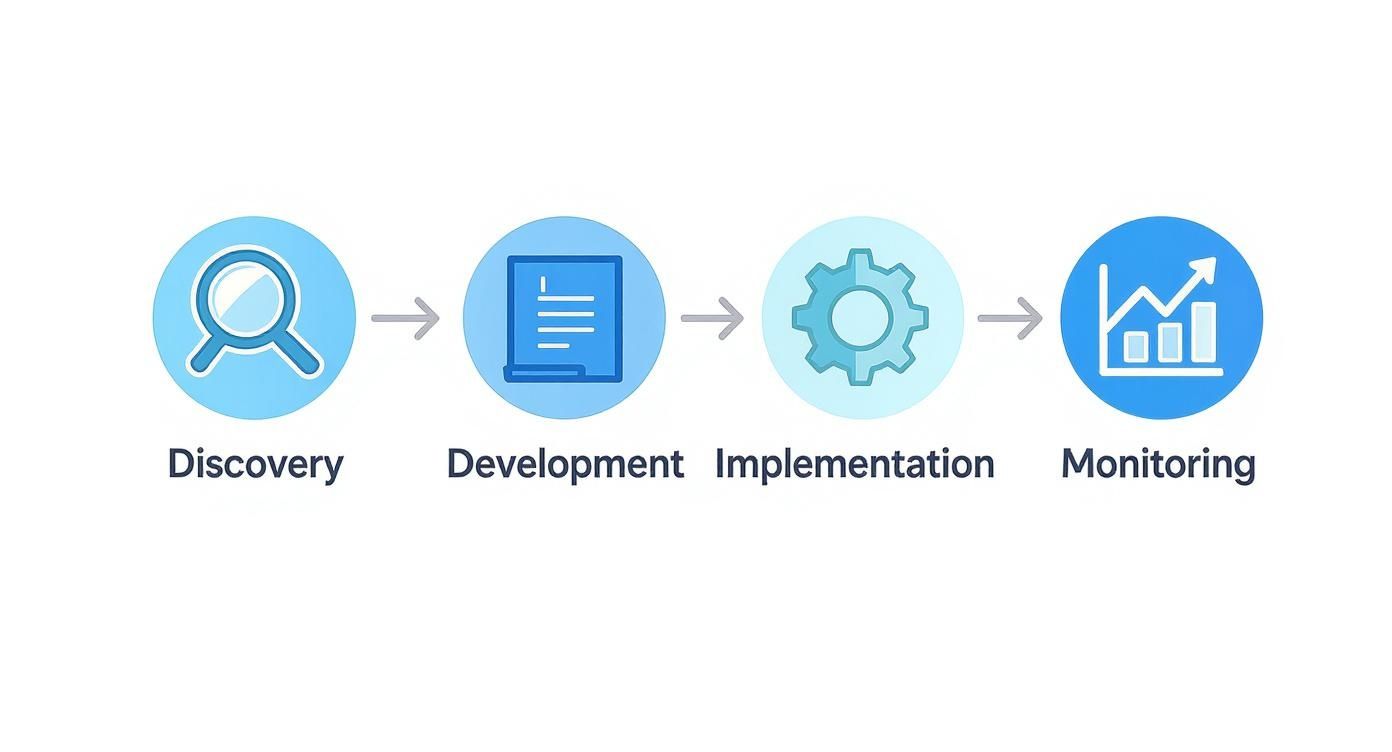
As you can see, the quality of your entire plan—from the goals you set to how you execute them—hinges on the intel you gather right at the start.
Conducting a School-Specific SWOT Analysis
A classic SWOT analysis (Strengths, Weaknesses, Opportunities, Threats) is a powerful tool here, but a generic corporate version won't cut it for a private school. You need to dig for the nuanced insights that directly impact your mission.
To get real value, your planning team should be asking sharp, specific questions like these:
- Strengths: What are we actually known for? Is it our standout arts program, our state-championship athletics, or our unique project-based learning model? Where do our enrollment numbers consistently beat the competition?
- Weaknesses: Let's be honest. Are there curriculum gaps parents are asking about? Is our campus tech from 2015? Do we have a faculty retention problem in the science department?
- Opportunities: Are new housing developments bringing young families into our zip code? Could a summer program create a new revenue stream and an admissions pipeline? Are there local tech companies we could partner with for student internships?
- Threats: Is that new charter school opening a mile away a direct competitor? Are rising property taxes squeezing our families' ability to afford tuition? Are our traditional feeder schools seeing enrollment declines?
This kind of structured honesty grounds your strategy in reality. It’s no surprise that a Bain & Company survey found that 89% of executives agree that SWOT analysis is a critical tool for strategy. This isn't just a business trend; it's a proven method for building a plan that can actually win. You can learn more about the history and impact of strategic planning frameworks to see how they've evolved.
Gathering Authentic Stakeholder Feedback
Market data and internal analysis are essential, but they don't tell the full story. The real gold is in the lived experiences of your community—your parents, students, staff, and alumni. The trick is to gather this feedback in a way that encourages genuine, unfiltered honesty.
Your community will tell you everything you need to know, but only if you ask the right questions and, more importantly, truly listen to the answers. This feedback is the difference between a plan that looks good on paper and one that actually works.
To get the full picture, you need to use a few different channels:
- Anonymous Surveys: Use simple digital tools to ask direct questions about academics, communication, school culture, and facilities. Anonymity is key—it’s the only way you’ll get raw honesty on sensitive topics.
- Targeted Focus Groups: Get small, specific groups in a room for a real conversation (e.g., middle school parents, alumni from the last 5 years, new faculty). A skilled facilitator can dig into the "why" behind survey data.
- One-on-One Interviews: For your most invested stakeholders—like major donors, board members, or founding faculty—a personal conversation can uncover profound insights that would never surface in a group setting.
When you analyze this qualitative feedback alongside your SWOT findings, the core challenges and biggest opportunities will jump right out at you. This comprehensive, 360-degree view is the bedrock of a strategy that can actually move your school forward.
Who Does What? Clarifying Stakeholder Roles
A common pitfall in the discovery phase is role confusion. Everyone knows they should be involved, but who is responsible for what? Defining roles early on prevents headaches and ensures you get the right input from the right people.
Below is a quick breakdown of how key groups typically contribute to the process.
| Stakeholder Group | Primary Role | Key Contributions |
|---|---|---|
| Board of Trustees | Governance & Oversight | Approves the final plan, ensures alignment with the school's mission, provides high-level strategic direction, and holds leadership accountable for results. |
| Head of School & Leadership Team | Driving the Process | Manages the day-to-day planning process, synthesizes data, facilitates discussions, drafts the strategic plan, and leads its implementation. |
| Faculty & Staff | On-the-Ground Expertise | Provides invaluable feedback on academic programs, school culture, student needs, and operational realities. Their buy-in is critical for successful implementation. |
| Parents & Alumni | Community Perspective | Offers external viewpoints on the school's reputation, perceived value, and competitive positioning. They provide crucial insights into family satisfaction and long-term outcomes. |
| Students | The User Experience | Shares direct feedback on the learning experience, campus life, and what truly matters to them. Their input ensures the plan is student-centered. |
Clarifying these responsibilities from the outset ensures a smoother, more collaborative process. When everyone understands their contribution, the intelligence you gather is richer, and the resulting plan is far more likely to gain widespread support.
Ready to dig deep and uncover the insights that will power your school's future? Book a call with JAG Consulting today and let’s talk about building a strategic plan that truly works.
You've done the hard work of research and analysis. You’re now sitting on a mountain of incredibly valuable raw material—feedback from parents and teachers, insights into market trends, and a brutally honest SWOT assessment.
This is the pivot point. The process now shifts from analysis to creation, from data to direction. It’s time to transform all that intelligence into the heart and soul of your strategic plan: a vision that inspires and goals that actually get done.

This whole effort starts by taking a hard look at your school's foundational statements. Your mission (why you exist) and vision (where you're headed) can't just be pretty phrases collecting dust on your website. They have to be living, breathing documents that truly reflect who you are today and who you aspire to become.
Refining Your School's North Star
Think of your mission and vision as the ultimate filter for every single decision you'll make in the next five years. If they're vague, generic, or sound like they were written a decade ago, your entire strategy will be built on sand. The goal here is to sharpen them until they are both aspirational and deeply practical.
Get your strategic planning committee in a room for a workshop and really stress-test these statements. It's time to ask the tough questions:
- Does our mission still capture the unique promise we make to every student who walks through our doors?
- Does our vision paint a clear, compelling picture of what our school will look and feel like in five years?
- Can a prospective parent, a brand-new teacher, and a major donor all grasp what we stand for just by reading them?
Nailing this refinement process ensures that every goal you set is directly tethered to your school's core identity. It’s what prevents strategic drift and keeps your entire team pulling in the same direction.
From Broad Objectives to Laser-Focused Goals
With a crystal-clear vision locked in, you can now define your high-level Strategic Objectives. These are the big pillars of your plan—the 3-5 critical areas where you absolutely must excel to bring your vision to life.
But here’s where so many schools go wrong: they create a laundry list of priorities. This dilutes focus, drains resources, and almost guarantees that nothing gets done well.
To maintain focus and ensure your plan is manageable, it's critical to limit your long-term strategic objectives. Best practices suggest capping these at no more than six per plan. This discipline prevents resource strain and keeps your team's energy concentrated on what truly matters.
Once you have these broad objectives, the real work of goal-setting begins. You have to translate them into SMART goals, a framework that forces clarity and builds in accountability from the start.
- Specific: What, exactly, do you want to achieve? Who needs to be involved?
- Measurable: How will you track progress and know, without a doubt, when you’ve succeeded?
- Achievable: Is this goal realistic given the time, money, and people you have?
- Relevant: Does this goal directly push one of your strategic objectives forward and align with your mission?
- Time-bound: What is the non-negotiable deadline for making this happen?
This framework transforms a fuzzy wish like "improve enrollment" into a powerful, actionable target. For example: "Increase new student enrollment for grades 6-8 by 15% over the next 24 months by hiring a dedicated admissions director and launching a targeted digital marketing campaign."
The difference is night and day. One is a hope; the other is a plan. This level of clarity is vital. A study by the Project Management Institute found that 76% of high-performing organizations use SMART goals to drive success. You can discover more about the impact of structured goal-setting and see how it drives results.
This disciplined approach is what turns your strategic plan from a document of aspirations into a practical roadmap for tangible success.
Feeling overwhelmed by the process of turning data into a clear, actionable strategy? You don't have to do it alone. Book a call with JAG Consulting or visit our website to see how we help private schools build plans that deliver real results.
Turning Your Strategic Plan into Action
A well-researched, beautifully written strategic plan is inspiring. But inspiration alone doesn't increase enrollment or launch new programs.
Frankly, this is where most strategic plans die—in the gap between the document and the daily work required to bring it to life. This is where your vision meets the real world, and a strategy sitting on a shelf is completely useless. To avoid this fate, you have to intentionally translate your high-level goals into clear, concrete, and accountable actions.
This is what separates schools that dream from schools that achieve.

The transition from planning to doing requires a disciplined approach, breaking down big objectives into manageable tasks and creating a culture of ownership throughout your school.
Building Detailed Action Plans
For every SMART goal you've created, the next step is to build a detailed action plan. Think of this as the "how" for your strategic "what." An action plan deconstructs a large, multi-year goal into a sequence of smaller, tactical steps.
For a private school, this means getting granular. If your goal is to "Enhance STEM programming," the action plan needs to answer critical questions like:
- What specific initiatives are required? (e.g., Develop a new robotics curriculum, upgrade the science labs, establish a partnership with a local tech firm).
- Who is the "owner" of each initiative? (e.g., The Head of the Science Department owns the curriculum update, while the Director of Operations owns the lab upgrade).
- What resources are needed? (e.g., Budget for new equipment, professional development funds for teachers, time allocated for curriculum writing).
- What are the deadlines? (e.g., Curriculum draft due by Q3, lab renovations completed by next summer).
This level of detail moves your strategy from the abstract to the actionable. It creates a clear roadmap that your teams can actually follow.
The Power of Clear Ownership
Accountability is the engine of implementation. Assigning a specific "owner" to each strategic initiative isn't just a good idea—it's non-negotiable. This person isn't necessarily the one doing all the work, but they are the one responsible for driving progress, coordinating resources, and reporting on outcomes.
When ownership is crystal clear, there's no confusion about who is responsible for moving the ball forward. That person becomes the champion for that piece of the plan, making sure it doesn't get lost in the shuffle of daily operations.
A plan without owners is a plan that will fail. Clear accountability ensures that every part of your strategy has a dedicated champion who is empowered to drive it forward and is responsible for its success.
This clarity prevents finger-pointing and ensures that someone is always thinking about the long-term goal, even amid short-term pressures.
Cascading Goals for Total Alignment
True implementation only happens when the strategic plan is understood and acted upon at every level of the school. This requires "cascading" your high-level goals down through the organization, so every department and individual understands their specific contribution.
This process ensures alignment from the boardroom to the classroom. For example, a board-level objective to "Strengthen Community Engagement" cascades into specific, tangible actions for different teams:
- Admissions Team: Develops a plan to host three new community open house events per year.
- Faculty: Is tasked with incorporating one service-learning project per grade level into the curriculum.
- Communications Director: Creates a social media campaign highlighting student volunteer work and community partnerships.
Each of these smaller goals is specific, measurable, and directly supports the overarching strategic objective.
Fostering Stakeholder Engagement
Ultimately, your people execute your plan. Ensuring they are engaged, informed, and motivated is crucial for success. Research consistently shows that a lack of stakeholder engagement is a primary cause of strategic failure.
One critical step is to 'Build Awareness' from the very beginning, investing time in educating everyone—from faculty to board members—on the principles of the plan. Given that studies show as many as 70% of strategic plans fail due to a lack of buy-in and execution, this foundational work is essential. You can discover more about the key phases of strategic planning and how they build momentum.
Turning your strategic document into a living, breathing plan of action is a continuous process of communication, accountability, and alignment.
Ready to build a plan that gets implemented, not ignored? Let's turn your school's vision into reality. Book a call with JAG Consulting or visit our website to learn more.
Measuring Progress and Adapting for Success
So you've created your strategic plan. That's a huge milestone, but it's the starting line, not the finish. The real test of your plan’s worth is in how it guides your school through the inevitable twists and turns of the coming years. This is where a solid monitoring system becomes your most critical tool.
Think of it this way: the plan is your roadmap, but monitoring turns it into a dynamic GPS. It gives you real-time feedback on your progress, shows you what’s working, and—just as importantly—flags what isn’t, long before a small hiccup becomes a major roadblock.
Strategic planning isn't a "set it and forget it" exercise. It's a continuous cycle of execution, measurement, and adaptation. Without that commitment, even the most brilliant strategy can become irrelevant sitting in a binder on a shelf.
Selecting the Right Key Performance Indicators
To measure progress effectively, you need the right tools. Key Performance Indicators (KPIs) are the specific, quantifiable metrics you'll use to track progress toward your SMART goals. Vague measures lead to vague results, but strong KPIs give you the hard data needed to make informed decisions.
Choosing the right KPIs is more art than science. It demands a deep understanding of what truly drives success for each specific goal. The trick is to focus on metrics that are leading indicators of future success, not just lagging indicators of what already happened.
Here’s what this looks like for a private school:
- Goal: Increase new student enrollment for grades 6-8 by 15% in 24 months.
- Primary KPI: New student enrollment numbers for grades 6-8.
- Secondary KPIs: Number of campus tours completed, application conversion rate (from application to offer), and new student retention rate after year one.
Those secondary KPIs are your early warning system. If campus tour numbers are down in the first quarter, you can adjust your marketing tactics immediately, rather than waiting until you’ve already missed your final enrollment target.
Sample KPIs for Private School Strategic Goals
To bring this to life, here's a table showing how different strategic goals can be tracked with specific, meaningful KPIs. Notice how each goal has a primary metric that directly measures the outcome, supported by secondary metrics that track the activities leading to that outcome.
| Strategic Goal | Primary KPI | Secondary KPIs |
|---|---|---|
| Enhance Academic Excellence | Average student growth percentile on standardized tests | Faculty retention rate; Percentage of faculty with advanced degrees; Student-to-faculty ratio |
| Boost Enrollment and Retention | Net enrollment growth year-over-year | Inquiry-to-tour conversion rate; Application-to-enrollment rate; Annual student retention rate (by grade level) |
| Strengthen Financial Sustainability | Annual operating margin | Annual fund participation rate (parent & alumni); Endowment growth; Percentage of budget covered by non-tuition revenue |
| Improve Parent Engagement | Parent satisfaction score (annual survey) | Volunteer hours per family; Attendance at parent-teacher conferences & school events; Parent association membership |
| Innovate STEM/Arts Programs | Percentage of students enrolled in advanced STEM/Arts electives | Number of interdisciplinary projects completed; Student performance in academic/arts competitions; Post-graduation major declarations in STEM/Arts fields |
This kind of structured measurement takes the guesswork out of strategy. It provides a clear, objective view of where you are succeeding and where you need to focus your energy.
Establishing a Cadence for Review and Accountability
Data is only useful if someone is actually looking at it. By establishing a regular review cadence, you weave your strategic plan into the operational rhythm of your school. Monitoring shifts from an annual afterthought to a disciplined, ongoing practice.
A strong review rhythm often looks like this:
- Monthly KPI Dashboards: Key leaders get a concise, one-page report tracking progress on their specific initiatives. This keeps the plan top-of-mind.
- Quarterly Strategy Meetings: The leadership team and board representatives hold a dedicated deep-dive session. This is the forum for assessing performance, celebrating wins, and collaboratively solving problems that have emerged.
- Annual Strategic Review: A more comprehensive session to look at the big picture. Here, you'll assess the overall plan, confirm priorities for the next school year, and make any major adjustments to goals or timelines.
This structured process creates a culture of accountability where data, not just gut feelings, drives decisions. It ensures your strategic plan remains a living, breathing guide for the school's leadership.
A data-driven approach is a powerful engine for success. Research shows that organizations using a formal strategic management system are twice as likely to outperform their peers. You can find more insights on the power of structured goal-setting from our friends at OnStrategy.
This commitment to continuous improvement is what keeps a school agile and responsive in an ever-changing world. It ensures your plan evolves right alongside your school, delivering real, sustainable results year after year.
Ready to build a monitoring system that ensures your strategic plan delivers on its promise? Book a call with JAG Consulting today to learn how we can help you turn your vision into measurable success.
Let's Build Your School's Future, Together
Navigating a full-blown strategic plan is a massive undertaking. It’s exciting, but it’s also complex. A great plan can completely reshape your school’s future—driving enrollment, shoring up finances, and cementing your academic reputation for years to come.
But the reality is, as highlighted in the Harvard Business Review, up to 67% of strategic plans fail. That’s a tough number to look at. They don't fail because of bad intentions; they fail from a lack of expert guidance, an objective perspective, and the bandwidth to truly see it through. That’s where an experienced partner comes in.
At JAG Consulting, this is what we do. We live and breathe private school strategy, guiding schools just like yours through every single stage of the journey. We bring proven frameworks and a critical outside perspective to help you build a plan that’s both ambitious and, most importantly, achievable.
Our approach is hands-on. We work to ensure your strategy doesn't just become another document sitting on a shelf. It becomes a dynamic, living roadmap that informs your daily decisions and delivers real, measurable results for your entire community.
Your school's legacy is too important to leave to chance. Working with a specialist turns your vision from a possibility into a sustainable reality.
Ready to build a clear, actionable path forward? Let's talk.
Book a call with JAG Consulting or visit our website to see how we help private schools not just survive, but truly thrive.
Have Questions About Your Strategic Plan? You’re Not Alone.
Even with the best roadmap, hitting the trail on a strategic plan can bring up some big questions for school leaders. Getting the timing right, sidestepping common mistakes, and actually making the plan happen—these are the details that separate a plan that truly inspires from one that just collects dust on a shelf.
Here are the most common questions we hear from founders, boards, and heads of school as they get started on this critical work.
How Often Should a Private School Update Its Strategic Plan?
Think of your big strategic plan as a 3-5 year vision. That’s the horizon it’s built for. But it absolutely cannot be a static document you create and then ignore. The best schools we work with treat it as a living, breathing guide for every major decision they make.
We’re big advocates for a formal annual review. This is where the leadership team and board get together to look at the hard data. You need to assess your progress against the KPIs you set and be ready to make adjustments based on what you're seeing in your own numbers and in the broader market.
While the big-picture goals should stay consistent to provide stability and direction, the tactics you use to get there can—and should—be more fluid. Many schools find a quarterly check-in is perfect for making those smaller, more nimble shifts.
What Is the Biggest Mistake Schools Make in Strategic Planning?
Hands down, the single biggest mistake is failing to bring your stakeholders into the process from day one. When a plan is cooked up in a conference room by a handful of senior leaders, it’s almost guaranteed to land with a thud. It will lack the buy-in from the very faculty, staff, and parents you need to bring it to life.
A successful strategic plan feels co-created, not handed down from on high. It has to be inclusive and transparent, built on a solid foundation of community feedback. Without that, even the most brilliant strategy will be met with resistance, because the people responsible for executing it feel zero ownership.
When people don't see their own voices or concerns reflected in the final document, the result is often passive resistance. You end up with a beautifully designed plan that has no real impact on the school’s daily life or future.
How Do We Ensure Our Strategic Plan Is Actually Implemented?
This is where the rubber meets the road—and where most plans fall apart. Some studies suggest that as many as 67% of strategic plans fail during the implementation phase. If you want your plan to drive real change, you have to build accountability into its DNA from the very beginning.
Here’s how you make it stick:
- Assign Clear Ownership: Every single strategic objective needs to be broken down into specific initiatives. And every initiative needs a designated "owner"—a real person who is responsible for seeing it through.
- Define Your Resources: You can't just have goals; you need a realistic plan to achieve them. That means setting clear deadlines and allocating the necessary resources, both in terms of budget and people's time. This part is non-negotiable.
- Create a Rhythm of Review: Progress on the strategic plan can’t be an afterthought. It needs to be a standing agenda item in your leadership team and board meetings. This regular check-in is what maintains focus and momentum when the day-to-day gets busy.
When you communicate progress regularly and transparently, you keep the plan top-of-mind for everyone. It stops being a document and starts being the way you do business, turning your big vision into real, measurable results.
Navigating the strategic planning process is a heavy lift, but you don’t have to figure it all out on your own. At JAG Consulting, we specialize in guiding private schools through every step, ensuring your final plan is both ambitious enough to inspire and practical enough to work.
Ready to build a clear, actionable roadmap for your school's future? Book a call with JAG Consulting and let's talk about what's possible.

I'm Dr. Jeannie Gudith, Founder and CEO of JAG Consulting. We help you develop, improve, buy or sell your private school.
I'm so glad you're here
Hello!


© 2025 JAG CONSULTING.
all rights reserved. privacy policy + REFUND POLICY. TEMPLATE by sugar studios + Showit
