


A Guide to Strategic Planning for Schools
Strategic planning isn't just a corporate buzzword that found its way into education. For private schools, it's the fundamental process of charting a course—defining exactly where you want to go and making the tough decisions about how to get there. It’s a living roadmap that connects your school's unique mission to its long-term financial health and academic reputation.
This is about moving beyond putting out fires and proactively building the future you want.
Why Strategic Planning Is Non-Negotiable
In the hyper-competitive private school world, simply hoping for the best isn't a strategy. Reactive leadership—where you're only dealing with problems as they flare up—is a guaranteed path to stagnation. The National Association of Independent Schools (NAIS) reports that nearly 1 in 10 private schools closed or merged in the last decade, highlighting the immense pressure to remain viable.
The hard truth is that most well-intentioned plans fail. They become static documents gathering dust on a shelf. A recent analysis hit the nail on the head, finding that most plans stall due to limited visibility, inconsistent execution, and outdated information.
This is precisely why proactive strategic planning for schools is no longer a "nice-to-have." It’s your most essential tool for navigating shifting enrollment trends, evolving parent expectations, and constant technological change. It flips the script, moving your school from a defensive crouch to an offensive stride, giving you control over your own destiny.
A Roadmap for Resilience
A modern strategic plan has nothing to do with corporate checklists or vague, fluffy goals. Think of it as a dynamic guide that aligns every single part of your school's operation. It draws a straight line from your mission statement directly to measurable outcomes, ensuring you’re both financially sound and delivering an exceptional education.
The process itself forces school leaders to confront the tough, essential questions:
- Where are we truly excellent, and where are we falling behind our competitors?
- Do our programs actually align with what prospective families value and are willing to pay for?
- Is our financial model built to last for the next five to ten years?
A well-crafted plan does more than just provide answers; it builds consensus. It transforms your vision from a solo mission into a shared journey, creating a culture where faculty, staff, and the board are all rowing in the same direction.
Answering these questions with brutal honesty lays the foundation for a resilient future. It allows you to make smart, informed decisions about where to put your money and energy—whether that’s launching a new STEM facility or investing in the kind of professional development that keeps your best teachers from leaving.
Without this clarity, schools often spread their resources too thin, trying to be everything to everyone and ultimately mastering nothing.
Before you can build a plan that gets real results, you have to understand its core components. The table below outlines the essential pillars we will unpack throughout this guide. Think of it as the framework for building a resilient future for your institution.
Core Components of a Modern Strategic School Plan
| Component | Key Focus Areas | Example Goal |
|---|---|---|
| Academic Excellence | Curriculum innovation, faculty development, student outcomes, technology integration. | Launch a project-based learning curriculum in the middle school by 2026, increasing student engagement scores by 15%. |
| Financial Sustainability | Tuition modeling, fundraising strategy, auxiliary revenue streams, endowment growth. | Increase the annual fund's participation rate to 70% and grow the endowment by 5% annually over the next three years. |
| Enrollment Management | Market positioning, admissions funnel optimization, retention strategies, financial aid. | Achieve a 92% student retention rate and increase new student enrollment from target zip codes by 10% year-over-year. |
| Marketing & Brand | Value proposition, digital presence, community engagement, brand messaging. | Redesign the school website and social media strategy to drive a 25% increase in qualified inquiries. |
| Facilities & Operations | Campus master plan, technology infrastructure, safety and security, operational efficiency. | Complete Phase 1 of the campus master plan, including the new arts wing, by 2027, funded through a capital campaign. |
This table gives you a high-level view of where we're headed. Each component is a critical piece of the puzzle, and getting them right is the key to a plan that works.
For expert guidance tailored to your school's unique needs, you can always book a complimentary consultation with JAG Consulting or visit our website to learn more.
Building Your Data-Driven Foundation

An impactful strategic plan isn't built on assumptions; it’s constructed with hard evidence. Before you can even think about drafting a single goal, your school needs to enter a discovery phase to understand its true position on the ground.
This is the bedrock of all effective strategic planning for schools—it’s where you turn gut feelings into measurable facts.
The first move is to pull together a dedicated strategic planning committee. This group will act as the central nervous system for the entire process, tasked with gathering, interpreting, and making sense of all the information you collect.
A common misstep here is keeping this committee limited to senior administrators and board members. For a plan to have genuine buy-in across the community, its architects must actually reflect that community.
Assembling Your Strategic Planning Committee
Your committee needs to be a diverse coalition of voices, with each member bringing a unique and valuable perspective to the table. You’re aiming for a true cross-section of your school community to ensure you get a genuine 360-degree view.
- Board Members: They provide critical governance oversight and ensure the plan aligns with the school's long-term fiduciary health.
- Administrators: These folks offer deep operational knowledge, from the admissions office and business office to academics and facilities.
- Faculty Representatives: They bring the crucial on-the-ground perspective of classroom realities, curriculum gaps, and student needs.
- Parent Leaders: Who better to represent the voice of your current families? They offer priceless insights into satisfaction, communication breakdowns, and evolving expectations.
- Key Alumni: Don’t forget them. They contribute a long-term perspective on the school's legacy and brand reputation in the wider world.
This mix of people is your best defense against the kind of groupthink that can doom a plan from the start. It ensures the data you collect gets analyzed from multiple angles, leading to much richer, more nuanced conclusions.
Gathering Meaningful Intelligence
With your committee in place, the real work begins: data collection. This isn’t just about crunching numbers; it’s about blending quantitative metrics with the qualitative human experience. Your goal is to create a complete mosaic of your school's current reality.
A SWOT analysis (Strengths, Weaknesses, Opportunities, Threats) is a classic starting point, but it has to be done with rigor. Don't just treat it as a quick brainstorming session—this is a formal intelligence-gathering exercise.
The most insightful strategic plans emerge from a willingness to confront uncomfortable truths. You have to create safe, confidential channels for stakeholders to provide candid feedback without fear of reprisal.
To go deeper, a PESTLE analysis (Political, Economic, Social, Technological, Legal, Environmental) forces you to look beyond your campus walls. This framework examines the external macro-environmental factors that could shape your school's future, from local demographic shifts to emerging educational technologies.
This initial analysis is then validated through more direct methods. Stakeholder surveys, sent to parents, faculty, and even older students, can provide invaluable data on satisfaction levels, perceived value, and areas for improvement. Research shows that 73% of organizations with a formal stakeholder engagement process outperform their peers.
Follow up those surveys with candid, professionally facilitated focus groups. These small-group discussions allow you to probe deeper into the "why" behind the survey results, uncovering the stories and emotions that numbers alone can’t convey.
Finally, a thorough competitive review and financial audit are non-negotiable. You have to understand how your school is positioned against competitors and what your true financial capacity for change really is. This grounds your aspirations in reality, ensuring your final plan addresses real challenges and capitalizes on genuine opportunities. The concept of formal strategic planning for schools has been around since the 1960s, evolving as a way to align resources with institutional goals. Frameworks like SMART are widely recommended to ensure plans are effective. You can explore more about the history and frameworks of educational planning to inform your process.
Ready to build a data-driven foundation for your school's future? Book a call with JAG Consulting today or visit our website to see how we can guide you.
Translating Your Mission into Measurable Goals
You’ve done the hard work of gathering data and listening to your community. Now comes the moment where analysis shifts to ambition. This is where your school's vision stops being a nice idea and starts becoming an actual blueprint for the future.
Let’s be honest: a mission statement hanging on a wall is just decoration. For it to mean anything, it has to be the authentic "North Star" for your school—the filter you run every tough decision through, whether it’s about allocating resources, launching a new program, or making a key hire.
This stage of strategic planning for schools is all about getting crystal clear. We're going to distill those big, inspiring ambitions into specific, measurable milestones that your entire community can get behind.
From Broad Vision to Strategic Pillars
A powerful vision gets people excited, but a detailed plan is what actually gets things done. The first move is to break down your overarching mission into 3-5 strategic pillars. These are the big-ticket focus areas that will anchor all your efforts for the next few years.
Think of them as the main chapters in your school's story for the next three to five years. They need to be broad enough to house multiple projects but specific enough to point everyone in the right direction.
For a private school, these pillars often look something like this:
- Pioneering Academic Innovation: This is all about curriculum, new teaching methods, and how you integrate technology.
- Ensuring Long-Term Financial Health: Focuses on growing the endowment, finding new revenue streams, and running a tight ship operationally.
- Fostering an Inclusive and Vibrant Community: Centers on student life, getting parents engaged, and your diversity and belonging initiatives.
- Cultivating Future-Ready Graduates: Emphasizes skills that matter, like critical thinking, leadership, and a global perspective.
These pillars give you a framework. They make your priorities clear to everyone, from a trustee on the finance committee to a brand-new teacher.
Crafting Goals That Drive Real Outcomes
Once you have your pillars, it's time to attach SMART goals to each one. A goal without a number and a deadline is just a wish. The SMART framework (Specific, Measurable, Achievable, Relevant, Time-bound) is non-negotiable for turning abstract ideas into things you can actually track.
A well-designed goal leaves no room for ambiguity. It clearly defines what success looks like, who is responsible for achieving it, and by when it needs to be accomplished. This level of precision is what separates plans that succeed from those that fail.
This isn't just about operational neatness; it directly impacts students. Research consistently shows a strong link between high-quality strategic plans and better academic outcomes. One study even found that schools with comprehensive plans saw significantly better performance on standardized tests in math and reading. You can explore the connection between planning and student success to see just how much these efforts pay off in the classroom.
Let's see what this looks like in the real world.
Pillar: Ensuring Long-Term Financial Health
- Weak Goal: Improve our fundraising.
- SMART Goal: Increase the annual fund participation rate among current parents from 65% to 80% by the end of the 2026 fiscal year.
Pillar: Pioneering Academic Innovation
- Weak Goal: Add more technology to classrooms.
- SMART Goal: Implement a 1:1 device program for all middle school students and provide 20 hours of targeted professional development on project-based learning to all middle school faculty by the start of the 2025 school year.
See the difference? This is the kind of specificity that makes progress trackable. It gives your teams clear targets and lets leadership know if you're actually winning.
A Real-World Scenario
Imagine a private day school noticing a dip in middle school enrollment from its usual neighborhoods. After digging into the data, they realize that new, affluent families are moving into adjacent communities but simply don't know the school exists.
From that insight, they built a strategic pillar: Expanding Our Market Reach and Enrollment.
Under that pillar, they set a perfectly clear SMART goal:
- Goal: Increase middle school enrollment from new feeder markets (defined by specific zip codes) by 15% over the next three years.
- Actions: That goal immediately kicks off specific initiatives. You’d see them launching targeted digital marketing campaigns in those zip codes, hosting admissions coffees in those neighborhoods, and building relationships with local real estate agents who work with relocating families.
This is how it’s supposed to work. A strategic goal, born from real data, creates a direct line to execution. You’re no longer just trying to "increase enrollment"—you’re executing a precise plan to capture a specific market opportunity.
Turning your mission into measurable goals is where the rubber meets the road. If you need an expert partner to facilitate this process and ensure your goals are both ambitious and achievable, we're here to help. Book a complimentary call with JAG Consulting or visit our website to learn more about our approach.
Funding the Vision and Securing Buy-In
A brilliant strategic plan is just an idea on paper without the resources and collective will to bring it to life. This is where vision meets viability. It’s about building the financial runway and the community-wide enthusiasm you need to turn goals into reality.
Effective strategic planning for schools comes down to one thing: demonstrating a clear return on every dollar invested. Whether you're in front of the board of trustees, the parent association, or a potential donor, the question is always the same: "Why is this the best use of our resources?"
Your job is to connect every dollar requested directly to your school's mission and its long-term financial health. Do this well, and a budget request stops feeling like an expense and starts feeling like a strategic investment in the future.
Presenting a Compelling Case to the Board
Getting your board of trustees on board is the first and most critical hurdle. This isn’t just another financial report. You’re telling the story of your school’s future, and you need to back it up with a rock-solid, multi-year financial model.
Boards are guardians of the school's fiduciary health. They need to see more than just exciting ideas. They need a pragmatic, sustainable financial roadmap that lines up perfectly with the strategic priorities you’ve all agreed on. In fact, a recent survey of independent school business officers revealed that over 60% named enrollment and financial sustainability as their top concerns. Frame your plan through that lens.
Make sure your presentation clearly articulates:
- The Financial Ask: Break down the specific costs for each strategic initiative over the entire life of the plan. No fuzzy numbers.
- The Funding Strategy: Show them you’ve explored every viable avenue by proposing a diversified mix of funding sources.
- The Projected Impact: Use your financial models to forecast the outcomes. Show them the numbers on increased enrollment revenue, higher retention rates, or endowment growth.
A common mistake is to present the strategic plan and the budget as two separate things. They must be woven together. You have to show the board exactly how funding a new coding curriculum directly supports the goal of becoming the top STEM-focused school in the region.
Diversifying Your Funding Streams
Relying on tuition hikes to fund every major initiative is a recipe for disaster. A forward-thinking financial plan explores a whole menu of funding options, each suited to different types of goals. This approach de-risks the entire plan and shows your board you’re being fiscally creative.
Think about a blended strategy that could include:
- Targeted Fundraising: Forget the generic annual fund appeal. Create campaigns tied to specific, exciting projects. "Help us build the Innovation Lab" is infinitely more compelling than "Contribute to the school."
- Capital Campaigns: For the big stuff—new buildings, major renovations—a formal, multi-year capital campaign is the gold standard. It’s designed to raise significant funds without gutting your operating budget.
- Grant Applications: A surprising number of foundations support educational initiatives, especially around technology, professional development, or accessibility. This is an often-untapped resource that can easily fund pilot programs and innovative curricula.
- Innovative Tuition Models: Some schools are getting creative with flexible or indexed tuition structures. The goal is to attract a wider range of families, which can boost net tuition revenue without relying on steep, across-the-board increases.
Transforming Stakeholders into Advocates
Securing the budget is only half the battle. You also need to win the hearts and minds of your faculty, staff, and parents. Without their genuine buy-in, even the best-funded plan will stall out. This is where your communication strategy becomes absolutely critical.
Start by translating the high-level plan into what it means for each group. For teachers, it’s about new professional development opportunities. For parents, it might be that new after-school arts program they’ve been asking for. For students, it's the promise of a more engaging education.
Regular, transparent communication is everything. Use your newsletters, hold town halls, and create a dedicated section on your website to share progress. Celebrate the early wins and be honest about the challenges.
When people feel informed and included, they stop being passive stakeholders and become passionate advocates who actively champion the school's vision. This groundswell of support is invaluable. It creates a positive culture that drives the plan forward and reminds the entire community why this work matters.
If you’re ready to build a financial model that powers your vision and rallies your community, we can help. Book a call with JAG Consulting to discuss how to fund your school’s future, or visit our website for more information.
Bringing Your Strategic Plan to Life
Execution is where the rubber meets the road. It’s the bridge between a beautifully crafted document and real, tangible results for your school. I’ve seen it time and again: the most common reason strategic planning for schools fails isn’t a bad vision; it's a breakdown in execution.
This is the point where your plan has to move from the boardroom into the day-to-day life of the school. A plan without clear action steps, ownership, and timelines is just a wish list destined to become a forgotten file on a server. To prevent this, every single strategic goal has to be broken down into a detailed action plan. This isn't about micromanagement; it's about building the architecture for success.
Creating a Rhythm of Accountability
To truly embed your plan into the school's culture, you need a steady rhythm of accountability. This is what moves the plan from a once-a-year discussion to a constant, guiding presence in your team's daily work. It ensures momentum is maintained and small issues get addressed before they become major roadblocks.
This operational rhythm is built on three core activities:
- Assigning Clear Ownership: Every initiative needs a champion. This is the person responsible for driving progress, coordinating resources, and reporting back on milestones. Without a designated owner, important tasks will inevitably fall through the cracks.
- Setting Realistic Timelines: Break down your multi-year goals into quarterly and annual milestones. This makes daunting objectives feel manageable and provides regular checkpoints to ensure the work is on track.
- Allocating Necessary Resources: Attach a realistic budget and the right people to each action item. This step forces a practical, honest conversation about what is truly achievable and prevents your teams from being set up for failure.
The real goal here is to make the strategic plan the central organizing principle for your leadership team. When it's fully integrated, it stops being an "extra task" and becomes the compass that guides every operational decision, from budget meetings to hiring priorities.
Using Dashboards for Transparent Reporting
You can't manage what you don't measure. A transparent reporting dashboard is the single most effective tool for tracking progress and keeping your strategic goals front-and-center for the entire community. This isn’t about creating complicated spreadsheets; it’s about providing a clear, at-a-glance view of performance against your most important targets.
A well-designed dashboard translates your strategic pillars into clear Key Performance Indicators (KPIs). These metrics give you real-time visibility, support informed decision-making, and hold everyone accountable for results.
Here's a simple look at the core process that supports a plan's financial viability, which is a prerequisite for any execution and tracking.
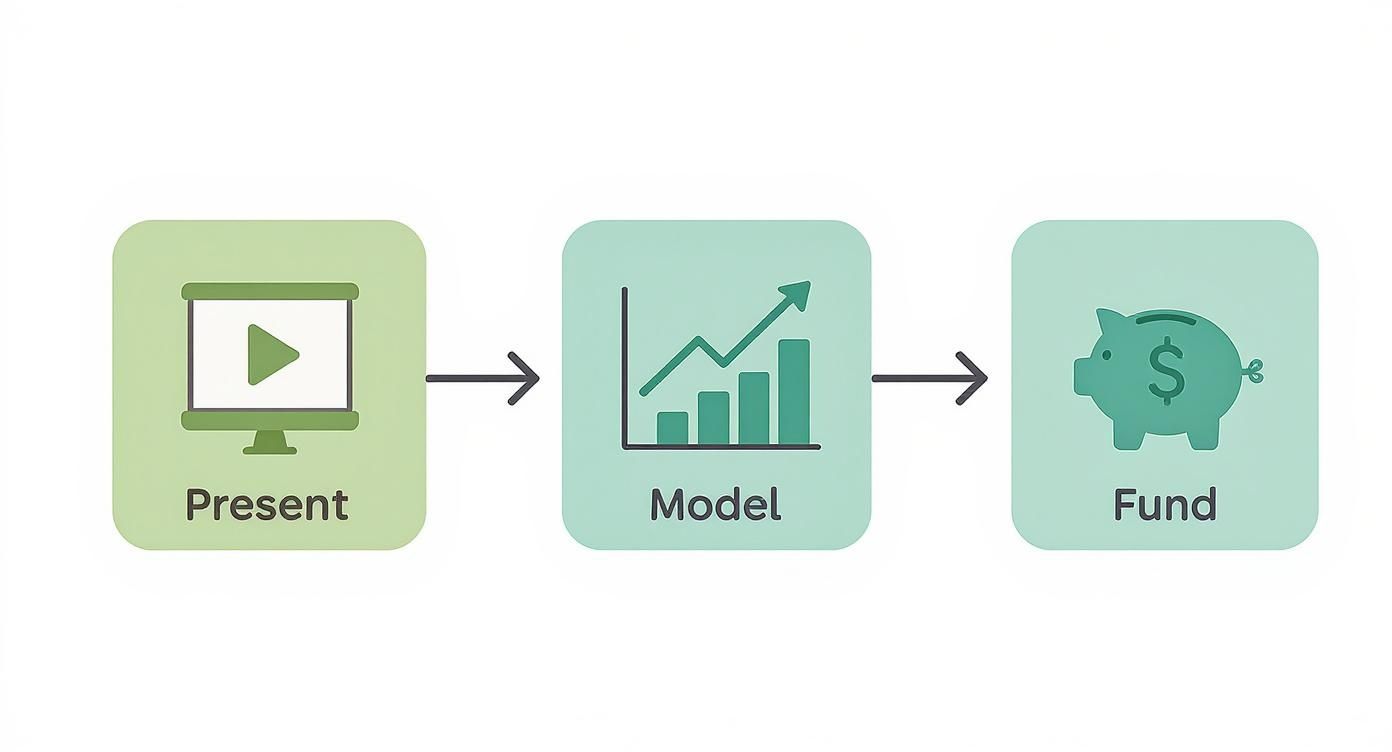
This workflow shows the essential steps of presenting the plan, modeling the financials, and securing the funding—all of which must happen before you can successfully execute and track your progress.
Quarterly progress reviews should become standard practice. These meetings aren't for assigning blame; they are collaborative problem-solving sessions. The dashboard provides the data, and the leadership team uses that data to discuss what's working, what isn't, and what adjustments need to be made.
Maintaining Agility and Adapting to Change
A strategic plan is a guide, not a straitjacket. The world changes, and your school must be able to adapt without abandoning its long-term vision. This requires building agility directly into your execution framework. It means empowering your team leaders to make necessary adjustments to their action plans as new challenges and opportunities pop up.
The private international school sector offers a powerful example. As that market experiences explosive growth, schools are constantly adapting their plans to stay competitive. These schools are now building strategic plans focused on affordability, sustainability, and hybrid learning models that can expand access and reduce costs by up to 40%. You can read the full research on international school trends to see how they're navigating these dynamics.
This ability to pivot is crucial. An unforeseen maintenance issue might require reallocating funds, or a new educational technology could emerge that accelerates a key initiative. Your process must allow for these shifts, ensuring the plan remains a living, relevant guide, not a static relic.
Bringing your plan to life requires diligence, transparency, and a commitment to continuous improvement. If you need a partner to help build the systems that turn your strategic vision into measurable outcomes, we’re here to help. Book a call with JAG Consulting or visit our website to get started.
Time to Turn Your Vision into a Living Plan
So, where do you go from here? The most important takeaway is this: strategic planning isn't a project you finish. It’s a muscle you build.
This guide has walked you through the nuts and bolts—from the initial discovery phase and crafting a compelling vision to aligning your resources and, finally, executing the plan. By embracing this cycle, you’re not just creating a document; you’re building the foresight and agility your school needs to do more than just survive. You’re setting it up to thrive.
Recent research confirms what many of us have seen firsthand. Most strategic plans don’t fail because the vision was wrong. They fail because of limited visibility, inconsistent execution, and outdated information. That’s why your plan can’t just sit on a shelf. It has to be an active, living management tool you consult every week.
A well-executed plan is the single most powerful instrument you have to secure your school's legacy. It ensures every dollar spent, every teacher hired, and every program launched is a deliberate step toward deepening your impact for generations of students to come.
The real goal is to weave your strategic plan into the daily rhythm of your school. When it’s fully integrated, it stops feeling like an extra task and becomes the compass that guides every operational decision, from budget meetings to hiring priorities.
If you're ready to put these ideas into practice but feel you could use an expert partner to guide the process, that's what we're here for. This is a complex journey, and you don’t have to navigate it alone.
Book a complimentary consultation with JAG Consulting today and let's talk about how our experience can help turn your vision into a measurable reality. Or, feel free to explore our website to learn more about how we help schools like yours build a thriving future.
Answering the Tough Questions
When you're deep in the weeds of strategic planning, a few critical questions always bubble up. These aren't just details; they're the practical realities that can make or break your plan's success. Let's tackle the most common ones we hear from school leaders.
How Long Should a School Strategic Plan Be?
Aim for a three- to five-year window. That’s the sweet spot.
It’s long enough to tackle meaningful, ambitious goals—like a major capital campaign or a full curriculum overhaul—but short enough that your plan won't become a fossil. The educational landscape shifts too quickly for anything longer. A plan that stretches beyond five years is just guesswork.
On the flip side, a one or two-year plan isn't really strategic. It's tactical. You'll end up with a concise final document—a high-level summary for the whole community and a more granular version for your leadership team to actually work from.
Who Should Be Involved in the Planning Process?
Getting this right is non-negotiable. While your core steering committee will likely be the Head of School and key board members, the real magic happens when you bring more voices to the table.
Inclusivity isn't just a buzzword here; it's the secret ingredient for a plan that actually gets executed. You need to create real opportunities to hear from:
- Your faculty and administrative staff—the people on the ground.
- Current parents and, where it makes sense, students.
- Influential alumni who hold the long-term perspective of your school.
Pulling in these different groups does more than just give you better ideas. It builds a deep sense of shared ownership. When people feel heard, they become champions for the plan's success down the road.
A strategic plan cooked up in a boardroom will die on the vine. The process of creating it together is what turns a piece of paper into a genuine community commitment.
How Do We Actually Measure Success?
If you can't measure it, you can't manage it. Vague hopes won't cut it. Success has to be defined with crystal-clear Key Performance Indicators (KPIs) that are tied directly to your strategic goals.
You need a mix of hard numbers and softer, but equally important, measures.
- Quantitative Metrics: These are the black-and-white numbers. Think: "Increase the annual fund by 10% year-over-year" or "Grow the endowment to $5M by 2028." There’s no ambiguity.
- Qualitative Metrics: These gauge perception and satisfaction. For example: "Improve parent satisfaction scores on the annual survey" or "Achieve a 90% positive rating on our faculty climate survey."
The best schools we work with build a simple, regularly updated dashboard to keep these KPIs front and center. It allows the leadership team to see what's working, what isn't, and make smart, data-backed decisions to keep the entire plan on track.
Navigating these questions is what separates a plan that works from one that gathers dust. At JAG Consulting, we specialize in guiding private schools through every stage of this critical process, ensuring your vision is backed by a practical, measurable, and achievable roadmap.
Ready to build a plan that secures your school's future? Book a complimentary consultation call with JAG Consulting today or visit our website to learn more.

I'm Dr. Jeannie Gudith, Founder and CEO of JAG Consulting. We help you develop, improve, buy or sell your private school.
I'm so glad you're here
Hello!



© 2025 JAG CONSULTING.
all rights reserved. privacy policy + REFUND POLICY. TEMPLATE by sugar studios + Showit
