

Crafting Your Private School Business Plan
A solid private school business plan isn't just a document for bankers; it's the detailed roadmap that turns your passionate idea into a thriving school. It’s the tool you'll use to secure funding, convince those crucial first families to enroll, and guide every decision you make along the way.
Defining Your School's Core Mission

Every great private school is built on a clear, compelling purpose. This is where you translate your vision into a concrete identity that connects with the families you want to serve. Think of it as your school's story—the one that will capture the imagination of investors, donors, and your founding students.
And make no mistake, you're entering a growing market. In 2023, North America was home to over 34,000 private schools serving around 5.6 million students. The global K-12 private education market is expected to swell from USD 52.09 billion in 2025 to USD 96.81 billion by 2034.
This growth means massive opportunity, but it also means serious competition. A well-defined mission isn't just nice to have; it's critical for standing out. You can dig deeper into these private education market trends here.
Articulating Your Educational Philosophy
Before you type a single word of your business plan, you have to nail down what makes your school different. Generic mission statements are forgettable and fail to inspire anyone. Get specific about your core educational philosophy.
Is your school going to be:
- Montessori-based? Centered on self-directed activity and hands-on, collaborative learning.
- STEM-focused? Designed to prepare students for a future in science, technology, engineering, and math.
- Arts-integrated? Using creative expression as the central vehicle for teaching all academic subjects.
- Classical? Following a traditional curriculum rooted in trivium and quadrivium principles.
Your chosen philosophy is the North Star for everything that follows—from curriculum design and teacher recruitment to the marketing messages you'll use to attract families. It’s the promise you make about the experience their child will have every single day.
Conducting a Thorough Market Analysis
A brilliant idea needs an audience ready to receive it. A market analysis is your reality check, confirming that a genuine need for your school exists in the community you want to serve. This is a non-negotiable step.
Start with local demographics. Dig into population growth, average family income, and parental education levels. Are there enough families in your target area who can afford private tuition and, more importantly, who value the specific educational approach you plan to offer?
Next, get a clear picture of the existing educational landscape. Map out every nearby public, charter, and private school.
A common mistake is seeing other schools only as competitors. Instead, view them as data points. Analyze their tuition rates, enrollment numbers, academic programs, and perceived strengths and weaknesses. This helps you pinpoint an unmet need or a service gap your school can fill.
Maybe there are no schools in a 20-mile radius with a true language immersion program. Perhaps parents are desperate for the smaller class sizes you plan to offer. That's your opening. That's your niche.
Pinpointing Your Unique Value Proposition
Once you understand the market, you can sharpen your unique value proposition (UVP). This is a simple, clear statement that explains the benefit you offer, how you solve a problem for families, and what makes you different from every other option.
Your UVP needs to be compelling and easy to grasp in a heartbeat. For example:
- "We are the only K-8 school in the county with a project-based STEM curriculum that prepares students for the high-tech economy."
- "Our school provides a nurturing, arts-integrated environment where creative children thrive with personalized attention in classes of 12 students or fewer."
This foundational work—defining your philosophy, analyzing the market, and crafting your UVP—is the bedrock of your entire private school business plan. It ensures your school is not only mission-driven but also market-ready.
To give you a clearer picture, a comprehensive business plan needs to cover several key areas. Here’s a quick rundown of the essential components.
| Component | Core Focus | Key Questions to Answer |
|---|---|---|
| Executive Summary | A concise overview of the entire plan. | What is your school's mission? Who will you serve? What are your financial projections and funding needs? |
| School Mission & Vision | The "why" behind your school. | What is your educational philosophy? What are your core values? What long-term impact will you have? |
| Market Analysis | Understanding the local education landscape. | Who are your competitors? What are their strengths/weaknesses? What is the demographic profile of your target families? |
| Educational Program | The details of your curriculum and instruction. | What curriculum will you use? What are your academic goals? How will you assess student progress? |
| Marketing & Enrollment | Your strategy for attracting and retaining students. | How will you reach prospective families? What is your enrollment funnel? What are your enrollment projections? |
| Organization & Management | The team and structure behind the school. | Who is on your leadership team? What is your governance structure (e.g., Board of Directors)? What are your staffing needs? |
| Financial Plan | The numbers that prove viability. | What are your startup costs? What is your 5-year operating budget? What are your revenue projections (tuition, fundraising)? |
Each of these sections builds on the last, creating a complete and convincing narrative for your school's future success.
Feeling overwhelmed? Turning a powerful vision into a bankable plan is a significant undertaking. The experts at JAG Consulting specialize in guiding founders through this exact process. Book a call with JAG Consulting or visit our website to see how we help build schools from the ground up.
Building Your School's Financial Foundation

A powerful mission statement is what gets people excited, but a sustainable financial engine is what makes it real. This is the section of your private school business plan where you prove your school is more than just a noble idea—it's a viable, long-term institution.
Lenders and philanthropic backers are looking for a clear, realistic financial story that inspires confidence. It's time to move beyond passion and get pragmatic. A well-crafted financial model shows you've thought through every dollar, from the first check you write for startup capital to the day-to-day costs of running a thriving school.
Mapping Your Revenue Streams
Tuition is the lifeblood of nearly every private school, but banking on it exclusively is a huge risk. A diversified revenue model builds financial resilience and opens up new ways to engage with your community. Your business plan needs to map out every potential source of income.
While tuition will likely make up 80-90% of your total revenue, here are the other crucial pieces of the puzzle:
- Auxiliary Programs: Think after-school care, summer camps, and enrichment clubs like robotics or debate. These aren't just revenue generators; they deepen your relationship with families.
- Facility Rentals: Can you rent out your gym, theater, or athletic fields on evenings and weekends? This can turn into a steady, passive income stream.
- Annual Fund & Fundraising: Detail your game plan for philanthropic giving. An annual fund is standard practice for covering the gap between what tuition brings in and what it actually costs to educate a student.
- Application & Enrollment Fees: These one-time fees help cover the administrative overhead of your admissions process.
Each of these streams needs its own projection, grounded in market rates and how many people you realistically expect to participate. This shows a sophisticated approach to financial planning, not just wishful thinking.
Deconstructing Your Expenses
On the other side of the ledger are your expenses. Transparency and detail are everything here. Vague estimates will sink your credibility in a heartbeat. Group your expenses into logical categories so your financial projections are easy to understand and defend.
The biggest line item, by a long shot, will be personnel. Faculty and staff salaries and benefits typically eat up 60-70% of a private school's operating budget. This is your primary investment in quality, and your plan must reflect competitive compensation if you want to attract top-tier talent.
Your financial plan must tell a compelling story. It should clearly show that every dollar spent directly supports the school's mission and enhances the student experience, proving fiscal responsibility and strategic thinking.
Other major expense categories you'll need to detail in your private school business plan include:
- Instructional Costs: This bucket holds everything from textbooks and curriculum licenses to classroom supplies, technology, and essential professional development for your teachers.
- Facility Costs: If you're leasing, this is your rent. If you own, it's your mortgage, plus utilities, insurance, maintenance, and janitorial services.
- Administrative Expenses: Think salaries for non-teaching staff, office supplies, legal and accounting fees, and your marketing budget.
- Accreditation Fees: Don't forget to budget for the accreditation process itself, which can include application fees, site visit expenses, and annual dues.
Projecting Your Financial Future
Once you've mapped out your revenue and expenses, it's time to build your multi-year financial projections. A standard five-year forecast is a non-negotiable for any serious business plan. This means creating the three core financial statements:
- Pro Forma Income Statement: This shows your projected revenue, expenses, and resulting profit or loss for each of the first five years.
- Cash Flow Statement: This tracks the actual movement of cash in and out of the school. It’s critical for anticipating and managing those inevitable cash-tight periods.
- Balance Sheet: This provides a snapshot of your school's assets, liabilities, and equity at a specific point in time.
Finally, you need to calculate your startup costs. This is a one-time budget covering everything required to open your doors—from acquiring or renovating a facility and buying furniture to funding initial marketing campaigns and paying legal fees for incorporation. A detailed startup budget is what tells you exactly how much funding you need to secure from the get-go.
Building this financial foundation is complex and demanding, but it's the most critical test of your school's viability. If you need help translating your educational vision into a financial model that investors and lenders will trust, our team at JAG Consulting is here to guide you. Book a call with JAG Consulting or visit our website to learn how we help founders build successful schools from the ground up.
Developing a Winning Enrollment Strategy

A beautiful campus and a powerful mission are table stakes. An empty school, however, is just a building. Your enrollment strategy is the engine that fills those classrooms with the right students—the ones who will thrive in the unique environment you’ve built.
This section of your private school business plan has to go way beyond generic marketing ideas. It needs to lay out a precise, data-informed plan for attracting, converting, and retaining families. This isn't about casting a wide net; it’s about understanding exactly who you serve and connecting with them on a level that feels personal and genuine.
The good news? Many families are actively searching for what you offer. Recent data shows that between the 2023-24 and 2024-25 school years, 40% of private schools in the U.S. reported an enrollment increase.
When asked why families were choosing them, 69% of schools pointed to an alignment of values between parents and the school. This was followed by a better academic experience (44%) and parental religious beliefs (43%). This tells us there's a clear demand for schools with a distinct identity. You can dig deeper into these private school enrollment trends.
Crafting Your Ideal Family Profile
Before you spend a single dollar on marketing, you need to know who you’re talking to. Creating a detailed ideal family profile—sometimes called a buyer persona—is the foundational step that informs every other decision you make. This is a semi-fictional portrait of the family you are best equipped to serve.
Go beyond basic demographics like income and zip code. You need to understand their psychographics—what makes them tick.
- What are their core educational values? Are they looking for academic rigor above all else, a deep focus on character development, or a nurturing, creative space for their child to blossom?
- What are their biggest frustrations with their current school? This could be massive class sizes, a lack of one-on-one attention, or a curriculum that just isn't challenging their kid.
- Where do they get their information? Are they active in local parent groups on Facebook? Do they read niche parenting blogs or rely on word-of-mouth from their tight-knit community?
- What are their real decision-making factors? Is it the school’s academic reputation, the feeling of community they get on a tour, a specific program you offer, or is tuition the bottom line?
Answering these questions gives you a crystal-clear picture of your target family, allowing you to tailor your message and marketing channels for maximum impact.
A well-defined ideal family profile stops you from wasting resources trying to be all things to all people. It ensures your message about small class sizes reaches the parent who feels their child is lost in a sea of 35 students, not the parent looking for a massive D1-level sports program you don’t offer.
Designing a Multi-Channel Marketing Plan
With your ideal family in mind, you can build a marketing strategy that meets them right where they are. A successful plan is always a blend of smart digital tactics and proven, old-school community outreach. Relying on just one will limit your reach and your results.
Digital Marketing Channels
- Local SEO: This is non-negotiable. You have to show up when a parent searches for "private schools near me" or "best STEM school in [Your City]." This means optimizing your website with local keywords, actively managing your Google Business Profile, and making it easy for happy parents to leave positive online reviews.
- Targeted Social Media: Use platforms like Facebook and Instagram to share authentic stories—not just announcements. Showcase student projects, spotlight your amazing teachers, and post videos from campus events. Use their advertising tools to get your message directly in front of your ideal family profile based on their demographics, interests, and location.
- Content Marketing: Create genuinely helpful content that addresses the pain points of your target families. Think blog posts, downloadable guides, or checklists. Topics like "How to Know if Your Child is Ready for Kindergarten" or "5 Benefits of a Project-Based Learning Environment" establish you as an educational leader, not just another school trying to fill seats.
Community Outreach and Traditional Methods
- Engaging Open Houses: This is your school's audition. Let your culture shine. Make them interactive with student-led tours, informal teacher meet-and-greets, and hands-on activities that get prospective students excited.
- Partnerships with Feeder Schools: Build real relationships with local preschools, daycare centers, and middle schools (depending on your grade levels). Offer to host an event for their families or provide an expert speaker for a parent education night.
- Local Events and Sponsorships: Get your name out there by having a presence at community fairs, family-focused festivals, and local sporting events. Be visible where your ideal families spend their weekends.
Building a Seamless Admissions Funnel
Marketing gets people in the door, but a smooth and welcoming admissions funnel is what turns a curious parent into an enrolled family. Every single interaction—from the first phone call to the final contract signing—must reflect your school's mission and values.
Map out each stage of the parent's journey and define what success looks like:
- Awareness & Inquiry: How easy is it for a family to find you and request information? Is your response time measured in minutes or days?
- Consideration & Tour: How do you showcase your school's unique value proposition during a campus visit? Is it a canned speech or a personalized experience?
- Application: Is your application process clear, straightforward, and easy to complete online? Or is it a 20-page PDF from 2008?
- Acceptance & Decision: How do you communicate an acceptance? Does it make the family feel wanted and celebrated?
- Enrollment: What does your onboarding process look like to ensure a smooth, welcoming transition for new students and their parents?
Tracking key metrics like your inquiry-to-application rate and application-to-enrollment rate is critical. These numbers will tell you exactly where your funnel is strong and where you might be losing promising families along the way.
Building Trust: Governance and Accreditation
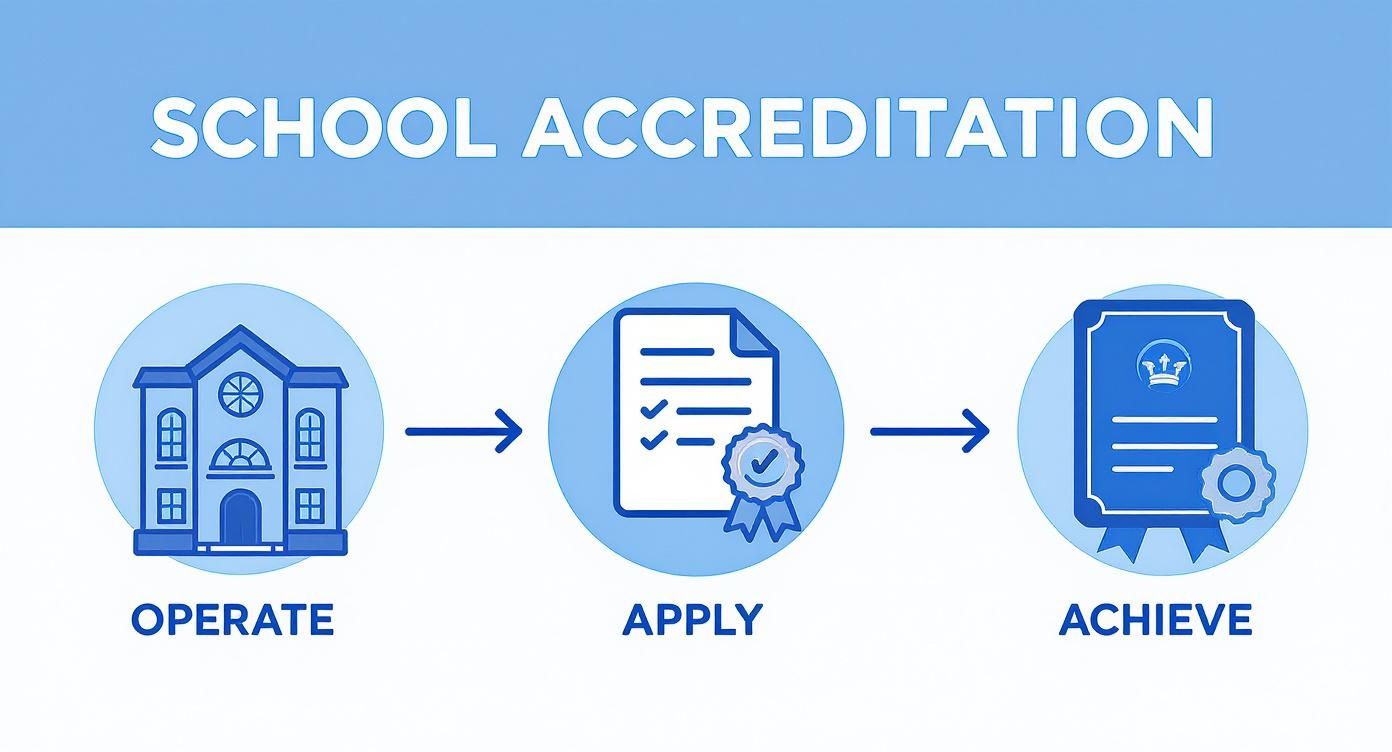
Beyond the curriculum and the budget, a truly successful private school is built on a foundation of trust. This is where your governance structure and accreditation status come in. They aren't just bureaucratic hurdles; they are the bedrock of your school's credibility.
A strong board provides stability and strategic oversight, while accreditation is the ultimate third-party seal of approval. Getting both right is fundamental to your private school business plan, signaling to families, donors, and colleges that you're not just a startup, but a serious, sustainable institution.
Think of your governance structure as the school's internal support system. It ensures that critical decisions are made with foresight, not on a whim, and that the school stays true to its mission for the long haul.
Assembling a Strategic Governing Board
The first real step here is forming a board of trustees or directors. This isn't a social club. This group is legally and financially responsible for the school's well-being, holding the ultimate authority over finances, major policies, and the hiring (and firing) of the Head of School.
Recruiting the right people is an art. You're not just looking for enthusiastic supporters; you need a strategic mix of professional skills. The goal is to build a diverse team that can steer the ship through the inevitable complex challenges.
Aim to recruit individuals with deep experience in:
- Finance and Accounting: Absolutely essential for budget oversight, financial audits, and ensuring the school is built to last.
- Law: Invaluable for navigating contracts, compliance issues, and managing risk. You'll be glad you have an attorney on the board when you need one.
- Education: An experienced educator or administrator brings a crucial perspective on academic programming and what makes a school culture thrive.
- Fundraising and Development: A board member with a powerful network and a proven track record in fundraising can be a game-changer.
- Real Estate or Construction: If you're planning to buy, build, or renovate a facility, this expertise is non-negotiable.
A common pitfall for new schools is filling the board exclusively with founding parents. While their passion is the spark that starts the fire, it's critical to balance it with independent members who provide objective, high-level guidance without getting tangled in day-to-day operational drama.
The Path to Formal Accreditation
Accreditation is the gold standard of educational quality. It’s a rigorous, multi-year process where an external agency puts every single aspect of your school under a microscope—from your mission statement and curriculum to your financial health and governance—and measures it against a set of demanding standards.
While it's often voluntary, for any school with long-term aspirations, it’s a non-negotiable.
Accreditation tells the world you’re committed to excellence. It gives families confidence that they're investing in a quality program and ensures your students' diplomas and transcripts will be respected by colleges and universities everywhere.
The journey typically involves a few key phases:
- Operating Period: Most accrediting bodies won't even look at you until you’ve been fully operational for at least two to three years. They want to see that you have a track record.
- Candidacy and Self-Study: Once you’re accepted as a candidate, the real work begins. The school undertakes an intensive self-study process, which can take 12-18 months. This involves a deep, honest internal review of everything you do, documenting how the school meets each of the agency's standards.
- Peer Review Visit: A team of educators from other accredited schools conducts an on-site visit to validate your self-study. They'll observe classes, pore over documents, and interview everyone from staff and parents to board members.
- Accreditation Decision: Based on your self-study and the visiting team's report, the accrediting agency's commission votes on whether to grant accreditation.
The number of students choosing private education highlights just how important these quality markers are. In the U.S., about 4.7 million K-12 students are enrolled in private schools, making up roughly 9% of the total student population. As you can see from data provided by the National Center for Education Statistics, families are actively seeking out these schools for specialized programs and a better learning environment, making proof of quality through accreditation a powerful differentiator.
Navigating governance and accreditation is a complex but absolutely essential part of building an institution that will last for generations. If you need expert guidance on forming your board or preparing for the accreditation journey, the team at JAG Consulting has been there. Book a call with JAG Consulting to make sure your school is built on a foundation of excellence from day one.
Mapping Your Timeline and Managing Risks
A vision for a school is just a dream until you anchor it to a concrete timeline. This is where your private school business plan gets real—shifting from lofty goals to a phased, step-by-step operational plan that guides you from a concept on paper to the first day of school.
This detailed schedule does more than just keep you on track. It proves to investors and your board that you've thought through the immense logistical puzzle of opening a school.
Of course, even the best-laid plans hit snags. A great plan anticipates those bumps in the road. Showing foresight into potential risks and having contingency plans ready demonstrates you're a serious leader prepared for reality, not just the best-case scenario. This proactive approach builds tremendous confidence.
Crafting a Realistic Pre-Launch Timeline
Launching a school is a marathon, not a sprint. The pre-launch phase is an intense period, typically spanning 18 to 24 months, and it's packed with critical milestones that have to happen in the right order. Rushing this process is a recipe for overlooked details and expensive mistakes down the line.
Breaking it all down into manageable phases makes the entire endeavor feel less overwhelming. You can’t hire a Head of School before you’ve secured funding, and you can’t market for students until you have a building. Sequence is everything.
We've found that mapping out the pre-launch journey into distinct phases helps founders stay focused and prioritize what matters most at each stage. The table below provides a high-level overview of what those key activities look like in the 18-24 months leading up to opening day.
| Sample Pre-Launch Milestone Timeline |
| :— | :— | :— |
| Phase (Months Before Opening) | Key Milestones & Activities | Primary Focus |
| 24-18 Months Out | Finalize mission & vision, conduct deep market analysis, incorporate legal entity, recruit founding board members. | Foundation & Vision |
| 18-12 Months Out | Site selection & facility negotiation, develop detailed financial model, begin Head of School search. | Securing Resources |
| 12-6 Months Out | Hire Head of School, curriculum development, begin accreditation candidacy, launch website & branding, hire admissions director. | Building the Program |
| 6 Months to Opening | Intensive marketing & open houses, accept applications & enroll students, hire faculty, purchase furniture & supplies. | Execution & Enrollment |
This timeline isn't just a checklist; it's a strategic roadmap. Each milestone builds upon the last, creating the momentum needed to successfully open your doors on time and on budget.
A word of caution from experience: everything takes longer than you think it will. Build buffer time into every phase of your timeline. A one-month delay in securing a building permit can have a cascading effect on your entire launch if you haven't planned for it.
Identifying and Mitigating Potential Risks
No business venture is without risk, and private schools are certainly no exception. A strong private school business plan doesn't hide from these possibilities; it confronts them head-on with clear mitigation strategies.
Identifying risks shows you're a realist. Planning for them shows you're a capable leader who can navigate challenges. Start by brainstorming potential issues across different areas of the school. What could go wrong with finances? Operations? Your reputation?
Here are a few common risks and how you might plan for them:
-
Financial Risk: What if initial enrollment is lower than projected?
- Mitigation: Create conservative, moderate, and optimistic financial scenarios in your model. Most importantly, secure a line of credit for potential cash flow gaps in the first couple of years.
-
Operational Risk: What if facility renovations go over budget or face delays?
- Mitigation: This is almost a guarantee. Build a 15-20% contingency fund directly into your startup budget for this. It’s also wise to have a pre-vetted list of backup contractors just in case.
-
Reputational Risk: What if you struggle to attract high-quality faculty?
- Mitigation: Don't skimp on salaries and benefits from day one. Great teachers are your best asset. You also need to actively foster a strong, mission-driven school culture that top talent wants to be a part of.
-
Compliance Risk: What if you fail to meet state licensing or safety codes?
- Mitigation: Engage legal and architectural experts who specialize in schools early in the process. Conduct regular compliance audits yourself before and after opening to stay ahead of any issues.
Thinking through these "what if" scenarios allows you to build a much more resilient and adaptable plan. This foresight not only prepares you for the inevitable challenges but also dramatically strengthens your case when you're sitting across the table from potential funders.
Your Blueprint for a Thriving School
So, we’ve covered a lot of ground. From crystallizing your school’s core mission to getting granular on the financial and operational nuts and bolts, you now have the essential framework for a powerful private school business plan.
But let’s be clear: this document is so much more than a hoop you jump through for funding. It’s your strategic blueprint—the architectural plans for an institution that will shape lives for decades.
The best business plans aren't carved in stone. They’re living, breathing documents that you’ll revisit and refine as your school grows and the educational world inevitably shifts. Fusing your passion with this kind of pragmatic, detailed planning is what builds a truly compelling case for your school’s success.
A well-crafted private school business plan doesn’t just say what you’re going to do. It proves you have a deep understanding of how you’ll navigate the inevitable challenges and seize the right opportunities. That’s what builds unshakable confidence with everyone from your founding board to your very first enrolled families.
This blueprint is what transforms your vision from a powerful idea into an actionable, day-to-day roadmap. It’s the tool that ensures every decision you make—from hiring your first teacher to launching a marketing campaign—is pulling in the same direction, straight toward your long-term goals.
If you’re ready to move your vision from dream to reality but could use an expert guide to help sharpen your plan, we’re here to help. Book a call with JAG Consulting or visit our website to see how we help build successful schools from the ground up.
Common Questions from School Founders
When you're deep in the weeds of planning a new school, a lot of questions come up. We see the same ones time and again from founders and boards. Here are some straightforward answers to the most common hurdles you'll face.
How Much Capital Do We Really Need to Start?
This is the million-dollar question—sometimes literally. The truth is, startup costs are all over the map. They hinge entirely on your location, whether you're leasing or building, and the grade levels you plan to serve.
A lean, scrappy startup might get the doors open in a leased space for $250,000 to $500,000. But if your vision involves breaking ground on a new facility, you’re easily looking at several million dollars. Your business plan has to break this down with absolute precision, leaving no room for guesswork.
How Long Does Accreditation Take?
Accreditation is a marathon, not a sprint. This is a critical timeline reality that many founders underestimate. Most accrediting agencies require you to be fully operational for at least two to three years before you can even apply for candidacy.
From there, the full self-study, site visits, and evaluation process can easily take another one to two years. You should realistically bake a three- to five-year journey into your plan, starting from the day you open your doors to the day you achieve full accreditation.
What’s the Biggest Mistake You See in School Business Plans?
Hands down, the most common and damaging pitfall is wildly optimistic enrollment projections for the first few years. Founders are passionate, and that's essential. But passion can blind them to the sheer effort it takes to build a brand and earn a community's trust from a dead stop.
A strong plan anticipates this slow ramp-up. It should include conservative, moderate, and optimistic financial scenarios. This doesn't show a lack of confidence; it demonstrates fiscal prudence and proves to any potential investor that you're prepared for reality, not just the best-case fantasy.
Do We Still Need a Business Plan if We Aren’t Getting a Loan?
Absolutely. One hundred percent. Think of your business plan as your school's constitution and strategic roadmap, not just a document for a banker.
Writing it forces your entire founding team to get on the same page, validate every assumption, set clear operational goals, and build a marketing strategy that makes sense. It's the blueprint you'll use to attract your first key hires and guide every major decision long before you welcome your first student.
Turning a vision for a school into a viable, fundable plan is a monumental undertaking. The experts at JAG Consulting live and breathe this process, guiding founders through everything from financial modeling to accreditation readiness. Book a complimentary call today and let's talk about how we help build successful schools from the ground up.

I'm Dr. Jeannie Gudith, Founder and CEO of JAG Consulting. We help you develop, improve, buy or sell your private school.
I'm so glad you're here
Hello!


