


How to Buy a School: The Ultimate Insider’s Guide
So, you're thinking about buying a school. It's a huge step, one that goes far beyond a typical business deal. The journey starts long before you ever look at a listing, with a solid strategic foundation built on your educational mission, your financial goals, and a deep understanding of the private education market.
This is where passion for education meets sharp business planning, ensuring your vision can become a sustainable reality.
Laying the Groundwork for Your School Acquisition

Buying a private school isn't just a transaction; it’s an opportunity to shape a legacy and impact countless lives. The most critical work happens right now, before you even start your search. This initial phase is all about introspection and strategy, making sure your search is targeted and purposeful from day one.
Getting this foundational work right prevents costly mistakes down the road and aligns your investment with a vision that can thrive for decades. It starts with a clear-eyed look at your personal and professional motivations.
Defining Your Educational Mission
First things first: what is the "why" behind your desire to own a school? Your answer becomes the north star for this entire journey. A clearly defined mission statement isn't just a nice-to-have; it dictates the type of school you'll seek, the community you'll serve, and the culture you'll build.
Get specific by asking yourself these core questions:
- What's your educational philosophy? Are you passionate about a specific approach like Montessori, Reggio Emilia, a STEM-focused curriculum, or a classical liberal arts education?
- Who is your target student? Do you want to serve the local neighborhood, attract international students, create a haven for gifted learners, or support students with specific learning needs?
- What are the school's non-negotiable values? Will you prioritize academic rigor above all else? Character development? Artistic expression? Or perhaps faith-based principles?
A strong, authentic mission resonates with families and faculty. It’s the story that sets your school apart in a competitive market and builds a loyal community around shared values.
Aligning Financial Goals with Market Realities
Once your mission is clear, it's time to ground it in reality. You need to align your vision with your financial capacity and the hard truths of the private school market. This means being brutally honest about your risk tolerance and investment horizon. Are you looking for a profitable, turnkey institution, or are you energized by a turnaround opportunity with high growth potential?
The private education sector is growing, which brings both opportunities and challenges. For example, the global K–12 international schools market is projected to hit $90.4 billion by 2033, a huge jump from $51.9 billion in 2025. This explosive growth, driven by demand for globally recognized curricula, signals a robust investment landscape for savvy buyers. You can find more data on this market expansion and other key insights online.
This stage is all about creating a realistic investment thesis. It’s a process that often requires expert guidance to navigate the nuances of the market and find opportunities that are a true fit for your strategic and financial profile.
To give you a clearer picture of the road ahead, here’s a high-level look at the acquisition process.
Key Stages of a School Acquisition
| Phase | Key Activities | Typical Duration |
|---|---|---|
| 1. Preparation & Strategy | Define mission, set financial goals, analyze market, assemble advisory team. | 1-3 Months |
| 2. Search & Initial Vetting | Identify potential schools, sign NDAs, conduct preliminary analysis. | 2-6 Months |
| 3. Valuation & Offer | Perform detailed valuation, structure Letter of Intent (LOI), negotiate terms. | 1-2 Months |
| 4. Due Diligence | In-depth review of financials, legal, academics, operations, and HR. | 2-4 Months |
| 5. Financing & Closing | Secure funding, finalize purchase agreement, close the transaction. | 2-3 Months |
| 6. Transition & Integration | Announce new ownership, manage leadership handover, integrate systems. | 3-6+ Months |
Each phase has its own complexities, but a well-defined strategy from the start makes the entire process smoother and more successful.
Ready to translate your vision into a concrete plan? The complexities of the private school market demand specialized expertise. Book a complimentary consultation with a JAG Consulting expert or visit our website at JAGConsultingServices.com to start building your acquisition strategy today.
Getting the Numbers Right: School Valuations and Funding
Figuring out what a private school is actually worth is more art than science. A school isn't just a business with a P&L statement; its value is tied up in its reputation, its role in the community, and the buildings it calls home. If you want to buy a school, you first have to get fluent in the language of valuation and funding.
This isn't about a quick glance at the balance sheet. It's a deep dive into the school's financial health, its physical assets, and where it stands in the competitive education market. Nailing this part is the foundation of a smart investment.
How Schools Are Valued: The Three Core Methods
There are really only three ways to put a price tag on a private school. Any serious valuation will blend all three to land on a number that’s both fair and defensible.
-
The Asset-Based Approach: Think of this as the "sum of the parts" method. You’re calculating the net value of everything the school owns, tangible and intangible. This includes the market value of the real estate, buses, computers, and even curriculum, minus any debts or liabilities. This approach is huge for schools that own prime real estate, as the land and buildings alone can make up a massive chunk of the total value.
-
The Income-Based Approach: This is all about the school's ability to generate cash. The key metric here is EBITDA (Earnings Before Interest, Taxes, Depreciation, and Amortization). A multiplier, usually somewhere between 4x and 8x, gets applied to that EBITDA number. So, a school with stable enrollment and a $1 million EBITDA might be valued anywhere from $4 million to $8 million. The exact multiple depends on things like growth potential and market stability. A prep academy that relies entirely on tuition and sees enrollment fluctuate year to year will get a much lower multiple than a school with diverse revenue from summer camps, facility rentals, and a healthy endowment.
-
The Market Comparison Approach: This method is a reality check. You look at what other, similar private schools have sold for recently. By analyzing these "comps," you can establish a solid benchmark for the school you're eyeing. This grounds your valuation in what the market is actually willing to pay.
A classic mistake is leaning too heavily on just one of these methods. A school might sit on incredibly valuable real estate (great for the asset-based value) but have shaky profitability (which tanks its income-based value). A truly accurate valuation synthesizes all three perspectives to paint the full picture.
Finding the Capital to Make It Happen
Once you have a realistic valuation, the next mountain to climb is financing the deal. In the United States, the average purchase price for a private school can run from $2 million to over $20 million. A mid-sized school with 500 students and modern buildings in a major metro area could easily sell for around $10 million—that breaks down to roughly $20,000 per student seat. For more context, check out the private school statistics on the NCES website.
With numbers like that, lining up solid financing is non-negotiable. Luckily, you have options.
-
SBA Loans: The Small Business Administration has programs like the 7(a) loan that can be used for school acquisitions. The terms are often great and the down payment requirements can be lower, but be prepared for a mountain of paperwork and some very strict eligibility criteria.
-
Conventional Bank Loans: Traditional banks will absolutely finance a school purchase, but they’ll want to see a bulletproof business plan and rock-solid financial projections. They’re looking for stable enrollment numbers, healthy profit margins (typically 10-20%), and a believable plan for who will be in charge after the sale.
-
Seller Financing: Sometimes, the current owner is willing to finance part of the deal themselves. This can be a game-changer. It not only helps bridge a potential gap in your funding but also shows the seller has real confidence in the school's future success under your leadership.
-
Private Investors: For larger acquisitions, partnering with private investors or an equity group can be the way to go. These partners will bring the capital, but they'll expect a clear strategy for how they're going to get a return on their investment.
Your financial proposal is your sales pitch. It needs to do more than just justify the price; it needs to tell a compelling story about the school's potential with you at the helm. This is your chance to prove you have the vision and the business savvy to take the institution to the next level.
Feeling buried in the numbers? You don't have to go it alone. Book a call with a JAG Consulting financial expert or visit our website to get professional guidance on valuations and financing that fits your specific situation.
Navigating the Critical Due Diligence Phase
Once you’ve settled on a valuation and the seller has an offer in hand, the real work begins. This is the due diligence phase—your single best defense against discovering expensive, deal-breaking problems after the contracts are signed.
Think of it as a full-access pass to every corner of the school’s operations. You’re moving far beyond a simple financial audit to uncover the institution's true health, warts and all. A rushed or incomplete process is one of the biggest mistakes a buyer can make, as hidden liabilities can pop up months or even years down the road, turning a great investment into a financial nightmare.
Properly executed, due diligence protects your investment and gives you the hard data you need to either confirm the school's value or head back to the negotiating table with leverage.
This is where you stress-test the assumptions that led to your initial offer.
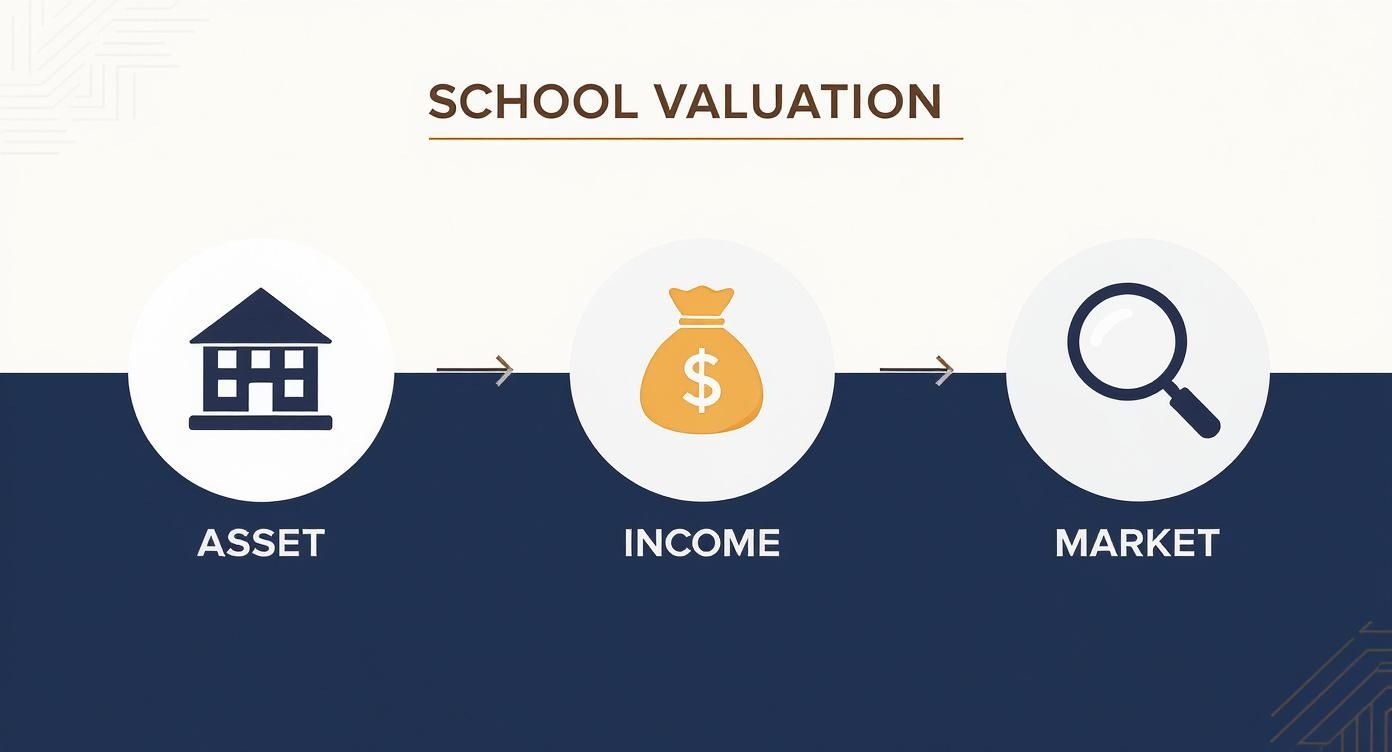
The valuation gives you a starting point based on assets, income, and market position. Now, your job is to verify every single one of those data points through rigorous investigation.
Beyond the Balance Sheet
Financial documents only tell you part of the story. A healthy school is much more than profit margins; it's a living, breathing ecosystem of academics, staff, students, and its reputation in the community. Your investigation has to reflect that reality.
Start by digging into the academic programs and, more importantly, their outcomes. You need to see historical data on student performance, standardized test scores, and college acceptance rates. This information reveals the real strength of the educational "product" that families are paying a premium for. A sudden dip in test scores or a decline in matriculation to top-tier universities is a major red flag.
Accreditation is another non-negotiable checkpoint. Verify the school's current standing and get your hands on any recent reports or recommendations from the accrediting body. Losing accreditation can be catastrophic for a private school's reputation and enrollment, making this a critical area of focus.
Uncovering Operational Strengths and Weaknesses
A school’s mission is either brought to life or completely undermined by its day-to-day operations. This part of your due diligence is all about the people and processes that make the school tick.
You absolutely must investigate:
- Staffing and Human Resources: Get your eyes on teacher contracts, salary schedules, and benefit packages. High staff turnover is a huge warning sign. One study found that teacher turnover costs U.S. schools over $2.2 billion every year. If teachers are heading for the exits, you need to find out if it's because of poor leadership, a toxic culture, or uncompetitive compensation.
- Enrollment and Admissions Trends: Analyze enrollment numbers over the past five to seven years. Is the growth steady and organic, or is it being propped up by unsustainable marketing spending? You also need to look at student attrition rates—how many families leave each year, and more importantly, why are they leaving?
- Facilities and Infrastructure: This requires more than a casual walkthrough. Conduct a thorough, professional inspection of the campus. Deferred maintenance on buildings, athletic fields, or technology can lead to massive, unexpected capital expenditures right after you take over.
A common mistake is to get so buried in the numbers that you overlook the "soft" data. With the owner's permission, talk to key faculty members. Review parent survey results. Gauge the school's reputation in the local community. A strong, loyal community is an invaluable asset that will never show up on a financial statement.
The Due Diligence Checklist for School Buyers
To keep this complex process organized, we use a comprehensive checklist. It ensures every critical area is examined, helping you spot potential issues before they become your problems. Here’s a look at what that covers.
| Category | Key Items to Verify | Potential Red Flags |
|---|---|---|
| Financial | Audited financial statements (3-5 years), tax returns, detailed budget vs. actuals, accounts receivable aging, debt schedules. | Declining revenue, inconsistent profit margins, heavy reliance on a few donors, high accounts receivable. |
| Legal & Compliance | All corporate documents, permits, licenses, vendor contracts, leases, insurance policies, history of litigation. | Unfavorable contract terms, pending lawsuits, zoning or compliance issues, expired permits. |
| Accreditation | Current accreditation status, reports from accrediting bodies, any pending reviews or warnings. | Conditional accreditation status, unresolved recommendations from past reviews, loss of accreditation risk. |
| Academic Quality | Curriculum documentation, student performance data (test scores, college acceptances), teacher qualifications and certifications. | Falling standardized test scores, declining college placement rates, outdated curriculum, high number of uncertified teachers. |
| Operations | Enrollment and attrition data (5-7 years), admissions funnel metrics, facility inspection reports, technology infrastructure audit. | High student attrition, deferred maintenance on facilities, outdated IT systems, inefficient operational processes. |
| Human Resources | Employee contracts, salary and benefit schedules, staff turnover rates, employee handbooks, background check procedures. | High teacher turnover rate, uncompetitive salary/benefits, lack of formal HR policies, unresolved staff grievances. |
This checklist is your roadmap. Following it diligently helps you build a complete, 360-degree picture of the school's health, allowing you to move forward with confidence or walk away from a bad deal.
Identifying Hidden Liabilities and Red Flags
The final piece of due diligence is all about mitigating risk. This is where your legal and financial advisors really earn their keep, hunting for potential liabilities that could jeopardize the school’s future.
Pay extremely close attention to any pending or past litigation. Scrutinize every single contract—vendor agreements, facility leases, curriculum licensing deals—for unfavorable terms or clauses that could bite you later.
Another critical area is donor dependency. If a huge chunk of the school's operating budget comes from a small handful of major donors, you need a plan for what happens if one of them decides to pull their support. Diversified, predictable revenue streams are always the sign of a more resilient financial model.
Due diligence is an exhaustive, time-consuming process, but it's an investment that pays for itself many times over. It’s what empowers you to proceed with confidence, armed with a complete understanding of the school you’re about to buy.
Navigating this intricate phase requires specialized expertise. Book a call with a JAG Consulting due diligence specialist to ensure no stone is left unturned, or visit our website to learn more.
Crafting the Deal and Finalizing the Purchase
Alright, you've made it through due diligence. You’ve seen the financials, walked the grounds, and understand the school’s inner workings. Now you’re armed with the facts you need to move from being a potential buyer to becoming the next owner. This is where your careful preparation meets the art of negotiation.
The goal here isn't to "win." It's to build a fair, legally solid deal that sets the school—and you—up for a successful future. The best private school acquisitions feel collaborative, with both sides feeling confident that the institution's legacy is in good hands.
The Letter of Intent: Your Roadmap to the Deal
The first real step toward a formal offer is drafting a Letter of Intent (LOI). While it’s usually non-binding, don't underestimate its power. The LOI lays out the foundational terms of the deal and acts as a roadmap for the final, legally binding agreement.
A well-crafted LOI does more than just name a price. It signals that you’re a serious, professional buyer and sets a positive tone for the negotiations to come.
Your LOI should clearly cover these key points:
- Proposed Purchase Price: State the price and briefly explain the logic behind it, tying it back to your due diligence findings.
- Structure of the Deal: Are you proposing an asset purchase or a stock purchase? This is a critical distinction with major tax and liability implications for both sides.
- Financing Contingencies: Be upfront about any conditions tied to securing your funding.
- Due Diligence Confirmation: Acknowledge that you’ve completed your review and that it has informed your offer.
- Exclusivity Period: This is crucial. Request a "no-shop" clause that prevents the seller from entertaining other offers for a set period, usually 60-90 days, giving you time to finalize the deal.
Negotiating the Definitive Purchase Agreement
The LOI paves the way for the main event: the Definitive Purchase Agreement (DPA). This is the official, legally binding contract that seals the deal. All those details you uncovered during due diligence now become your most important negotiation tools.
For instance, if your facility inspection revealed the HVAC system is on its last legs and will cost $200,000 to replace, that’s not just an observation—it’s a concrete data point. You can use it to negotiate a fair price adjustment or a seller credit. This isn’t about lowballing; it’s about aligning the price with the school’s actual condition.
A critical mistake is treating negotiation as a zero-sum game. When you buy a school, you're not just buying a business; you're inheriting a community. A hostile negotiation can poison the well with key staff and parents loyal to the outgoing owner, creating a mountain of challenges for you after closing.
In the DPA, you’ll want to pay close attention to several key clauses:
- Representations and Warranties: These are the seller's sworn statements of fact about the school. If you discover an inaccuracy after the sale, this clause gives you legal recourse.
- Indemnification: Think of this as your insurance policy. It protects you from financial losses that might arise from the seller breaching their warranties or from liabilities that existed before you took over.
- Seller Transition Support: Be specific. How long will the current owner stay on to help? What will their role be? This support is vital for a smooth handover of relationships with staff, parents, and donors.
- Non-Compete Agreement: This clause prevents the seller from opening a competing private school within a certain geographic area for a specific period of time. It’s standard practice and protects your investment.
- Transfer of Accreditations and Licenses: The DPA must spell out exactly how all necessary permits, licenses, and—most importantly—the school's accreditation will be transferred. Any hiccup here can cause major operational headaches.
Negotiating these terms requires a deep understanding of the unique legal and operational details of the education world. The end game is a purchase agreement that not only secures a fair price but also minimizes your risk and ensures a seamless transition of leadership.
The final steps of buying a school are complex and the stakes are high. Don't leave it to chance. Book a call with a JAG Consulting acquisition expert to make sure your deal is structured for long-term success, or visit our website to learn more.
Ensuring a Smooth Transition for Lasting Success

The ink on the purchase agreement might be dry, but let’s be honest—the most delicate part of buying a school is just getting started. A successful acquisition isn't defined by the deal itself. It’s defined by what happens in the first few months under new leadership.
This transition period is your single greatest opportunity to build trust, calm anxieties, and set a positive tone for the future.
Failing to plan this phase is a common and costly error. I’ve seen it happen. A poorly managed transition can quickly burn through the goodwill you’ve just acquired, leading to staff departures, nervous parents, and a dip in student morale. The key is to move forward with a clear, intentional plan that honors the school's past while paving the way for your vision.
Your First 100 Days
Forget about sweeping, dramatic changes. The first 100 days are about listening, learning, and establishing stability. Your primary goal is to show everyone that the school is in capable, caring hands. This is your time to build relationships and gather the firsthand insights that will shape your long-term strategy.
A practical 100-day plan should really zero in on three things:
- Observation and Assessment: Get out of the office. Spend time in classrooms, sit in on staff meetings, and be visible during morning drop-offs. Your goal is to understand the school's culture, its rhythms, and all the unwritten rules from the inside out.
- Communication and Engagement: Don't wait for people to come to you. Proactively open channels for feedback. Schedule town halls for parents, hold one-on-one meetings with every faculty member, and find ways to hear from the students themselves.
- Identifying Quick Wins: Look for small, tangible improvements that boost morale and show you're invested. This could be anything from upgrading the coffee maker in the faculty lounge to streamlining the carpool line. These small victories build momentum.
The most effective leaders in a post-acquisition scenario prioritize reassurance over revolution. They understand that before you can lead people forward, you must first earn their trust by showing you respect what they have already built.
Mastering Post-Acquisition Communication
Your communication strategy is the absolute bedrock of a smooth transition. Rumors thrive in a vacuum, so you have to control the narrative with clear, consistent, and empathetic messaging. Never, ever underestimate the anxiety that a change in ownership can create.
The best approach is to develop a tailored communication plan for each group.
| Stakeholder | Key Message | Best Channel |
|---|---|---|
| Faculty & Staff | "Your role is valued, and I am here to support you. Let's work together to understand what makes this school special." | In-person meetings (group and individual), followed by clear email summaries. |
| Parents | "The school's core mission and commitment to your children's success remain our top priority. We are excited about the future." | A welcome letter, town hall meetings (virtual and in-person), and a genuine open-door policy. |
| Students | "This is still your school. We are here to make your experience even better." | Age-appropriate assemblies, classroom visits, and just being present at school events. |
Honoring Legacy While Introducing Vision
One of the biggest tightropes you'll walk is balancing respect for the school's history with your own vision for improvement. The private school market is dynamic and growing, with the global secondary school market projected to climb from $432.65 billion in 2024 to $462.02 billion in 2025.
This growth shows that schools must adapt to thrive. You can use this reality to frame your vision not as a rejection of the past, but as a necessary step toward a stronger future. You can find more insights on this trend in The Business Research Company's full report.
My advice? Avoid drastic changes in the first year. Instead, introduce new ideas as pilot programs or collaborative initiatives. When you propose something new, connect it back to the school's founding mission and values. Show everyone that your vision is an evolution, not an erasure, of what came before.
The post-acquisition phase is complex, and having an experienced guide can make all the difference. To ensure your new leadership gets off to a strong, successful start, book a call with a JAG Consulting transition specialist or visit our website.
Ready to Take the Next Step?
You've just walked through the entire process of buying a private school, from shaping your initial vision to planning the final transition. It’s a complex journey, no doubt, but one filled with incredible opportunity. With over 30,000 private schools operating in the U.S. alone, the landscape is active and full of potential for the right kind of owner.
This guide gives you the map, but every acquisition has its own unique terrain. The real success comes down to navigating the specific details of your deal, at every single stage.
Your Path to Success Starts Here
If you’re serious about turning your vision of school ownership into a reality, getting expert guidance isn't a luxury—it's a critical advantage. This isn't a process you want to navigate alone. Let our team’s direct experience in these exact transactions work for you, ensuring you secure the right school on the best possible terms.
The most successful school acquisitions are built on a foundation of expert advice, rigorous due diligence, and a clear vision for the future. Partnering with a specialist from day one is the surest way to protect your investment and ensure a lasting legacy.
When you're ready to get started, the first conversation is on us. We invite you to book a complimentary consultation with our experts today.
You can also head over to our website to see more about how we help aspiring owners just like you find and acquire the right school.
Your Questions Answered: Buying a Private School
Buying a private school isn't just a transaction; it's a massive undertaking that blends high-stakes finance with a deep commitment to education. It’s natural to have questions. We get calls all the time from aspiring school owners, and a few key concerns always come up.
Let's walk through some of the most common questions we hear, with straight answers to help you navigate the path ahead.
How Long Does This Whole Process Actually Take?
From the day you start your search to the day you get the keys, you should realistically plan for nine to eighteen months. Of course, this isn't set in stone.
I've seen straightforward deals, where the seller was motivated and financing was already lined up, close in less time. But I’ve also seen complex acquisitions—especially those with tricky real estate issues or back-and-forth negotiations—stretch well beyond that eighteen-month mark.
What Are the Biggest Risks I Should Worry About as a New Owner?
Your two biggest vulnerabilities, without a doubt, are enrollment stability and staff retention. A private school’s financial health is tied directly to tuition. Even a small dip in the student body can throw your entire budget into a tailspin.
Another classic mistake is underestimating the power of the school's existing culture. New owners who march in and try to change everything overnight almost always meet a wall of resistance from teachers and parents. That can poison the well, disrupt the learning environment, and do serious damage to the school's reputation.
A critical risk right after you take over is losing your best teachers. The data is clear: teacher turnover can cost a school up to 20% of that teacher’s annual salary in recruitment and training alone. That doesn’t even account for the loss of institutional knowledge and the disruption to student relationships.
Can I Really Buy a School If I'm Not an Educator?
Absolutely. In fact, some of the most successful school owners we've worked with came from backgrounds in business, finance, or operations. Your business savvy is a huge asset for managing the budget, driving strategic growth, and running the school efficiently.
The key is that you must hire or partner with an experienced Head of School or an academic director to run the educational side. You handle the business, and you empower a strong academic leader to ensure the curriculum and teaching quality are second to none. It's all about building that balanced, effective leadership team.
The journey to buying a private school is complex, but you don't have to go it alone. JAG Consulting specializes in guiding entrepreneurs and investors like you through every single stage of the acquisition.
Ready to turn your vision of owning a school into a reality? Book a complimentary consultation with our experts or visit our website to see how we can help you achieve your goals.

I'm Dr. Jeannie Gudith, Founder and CEO of JAG Consulting. We help you develop, improve, buy or sell your private school.
I'm so glad you're here
Hello!



© 2025 JAG CONSULTING.
all rights reserved. privacy policy + REFUND POLICY. TEMPLATE by sugar studios + Showit
