

A Strategic Planning Framework Template for Private Schools
At its core, a strategic planning framework is simply a structured way to define where you want to go and map out the steps to get there. Think of it less as a rigid, formal document and more as a dynamic guide that keeps your private school's vision, mission, and day-to-day work in sync. When it's done right, this framework ensures every single decision—from curriculum choices to fundraising campaigns—is pushing your school's ultimate objectives forward.
Why Your Private School Needs a Strategic Framework Now
The challenges facing private schools today are significant. We're talking intense enrollment competition, rising operational costs, and the constant pressure to ensure long-term financial health. In this environment, trying to operate without a clear, documented strategy is like sailing into a storm without a compass. A solid strategic planning framework is the tool that turns your school’s lofty vision statement into a practical, day-to-day guide for growth and sustainability.
This isn't just another administrative box to check; it’s the foundational work that secures your school’s future. The data backs this up. Research consistently shows that organizations that actually write down their strategic plans grow 30% faster than those that don’t. For a private school, that translates directly into more effective enrollment marketing, stronger academic programs, and a much more engaged community of parents and donors.

From Vision to Actionable Steps
A well-structured plan brings incredible clarity to the tough decisions you have to make every day. It empowers your leadership team to answer critical questions with confidence:
- Resource Allocation: Should we invest in that new STEM lab or expand the arts program?
- Enrollment Strategy: Which specific zip codes should our admissions team focus on next year?
- Program Development: Does adding a new language immersion program actually align with our core mission, or is it just chasing a trend?
Without a framework, these decisions often become reactive, driven by the loudest voice in the room or the most immediate pressure. A strategic plan ensures every initiative, big or small, is a deliberate step toward a defined destination. This alignment is what separates the schools that thrive from those that just barely survive.
A strategic plan is the bridge between your school's aspirational vision and its operational reality. It converts broad goals into specific actions, assigning ownership and creating a culture of accountability that drives measurable progress.
The Power of a Proven Model
You don't have to reinvent the wheel. Many frameworks exist, but some have a proven track record of success. One of the most widely adopted is the Balanced Scorecard, first introduced by Robert Kaplan and David Norton. This model pushes organizations to look beyond just the financial numbers.
In fact, a 2019 survey found that 68% of organizations using it reported better alignment between their big-picture goals and their daily work. Even better, they saw a 25% increase in their ability to actually track performance against those goals. You can explore more about these findings and how strategic templates improve performance.
Adopting a proven strategic planning framework template gives your private school a structured approach to not just set goals, but to achieve them consistently. It fosters a proactive culture where everyone—from board members to faculty—understands their role in the school's success.
Are you ready to build a roadmap that secures your school’s legacy? Let's turn your vision into a reality. Book a complimentary call with JAG Consulting today or visit our website to learn how we can help.
Crafting Your School's Vision, Mission, and Values
Before you even think about strategic goals or complex frameworks, you have to get this part right. Your Vision, Mission, and Values are the soul of your private school. They’re not just fluffy words for a plaque in the lobby; they are the ultimate filter for every decision you make—from who you hire to what curriculum you adopt.
Too many schools treat this as a quick, top-down exercise. That's a huge mistake. For these statements to have any real teeth, they must come from a collaborative process. Get your board members, administrators, faculty, and even parent reps in a room together. This is the only way to ensure the final product is a genuine reflection of your community’s shared identity.
The Vision Statement: Where Are You Going?
Your vision statement is your North Star. It’s a vivid, aspirational picture of what your school will become and the impact it will have on students and the world. It should be ambitious enough to inspire people but clear enough to actually guide them.
Think about the difference here: a small, faith-based K-8 school’s vision might be, "To be the region's most beloved community, fostering academic excellence and compassionate, faith-filled leaders for the next generation."
Now, contrast that with a competitive STEM-focused high school. Their vision might be, "A national leader in pre-collegiate engineering and robotics, producing innovative problem-solvers who will shape the future of technology."
These two visions point to completely different strategic paths. One prioritizes community and character; the other prioritizes innovation and technical skill. Neither is better, but they are critically different. That clarity is everything.
The Mission Statement: What Is Your Purpose?
If the vision is the "where," the mission is the "what" and "how." It defines your school's fundamental purpose, who you serve, and your approach to education, right now. It needs to be present-tense, actionable, and specific.
Don't underestimate its power. One study found that 86% of nonprofits believed a strategic plan anchored by a clear mission positively impacted their revenue—a crucial data point for any private school relying on tuition and donations.
A strong mission statement cuts through the jargon and gets straight to the promise you make to your families.
- For a liberal arts prep school: "Our mission is to cultivate intellectual curiosity and critical thinking in a diverse student body through a rigorous, Socratic-based curriculum that prepares students for thoughtful and engaged citizenship."
- For a progressive, project-based elementary school: "We empower young learners to become confident, creative, and collaborative individuals by providing a hands-on, inquiry-driven education that nurtures their natural love of learning."
These statements clearly outline the educational philosophy. They become the benchmark you measure every new initiative against.
The most effective vision and mission statements are born from honest conversations about your school's unique identity. They provide the 'why' behind every goal and the rationale for every tough decision your leadership team will face.
Core Values: The Guiding Principles
Finally, your core values are the non-negotiable beliefs that shape behavior and define your culture. Think of them as the ethical and operational compass for your entire community.
Keep it simple. Limiting your values to 3-5 memorable words or short phrases makes them much easier to weave into the fabric of daily life at your school.
Consider these examples:
- Integrity: We act with honesty and uphold the highest ethical standards.
- Community: We foster a supportive and inclusive environment where every member feels they belong.
- Excellence: We pursue the highest standards in our academic, artistic, and athletic endeavors.
- Innovation: We embrace creative thinking and adapt to prepare students for a changing world.
These values only become real when you use them. Does that proposed disciplinary policy align with your value of "Community"? Does a new technology investment truly support your value of "Innovation"? Getting these foundational elements right is the most important first step in building a strategy that actually works.
If you need help facilitating these crucial conversations and articulating a vision that truly resonates, the team at JAG Consulting can help. Book a complimentary consultation call or visit our website to see how we help private schools build unshakable foundations for the future.
Conducting an Honest School SWOT Analysis
Once your vision and mission are on paper, it's time to get brutally honest with where you stand right now. A great strategic plan isn’t built on wishful thinking; it’s grounded in a clear-eyed assessment of your school's current reality. This is where a SWOT analysis—looking at your Strengths, Weaknesses, Opportunities, and Threats—becomes your most critical tool.
There’s a reason this framework is still a staple in private school boardrooms. It just works. A 2022 global study found that 78% of organizations felt a SWOT analysis led to more informed strategic decisions. In fact, over 60% of nonprofits and schools in North America now build it right into their planning process. You can find more details on popular strategic planning frameworks if you want to dig deeper.

Looking Inward: Strengths and Weaknesses
The first half of the exercise is an internal audit. It's about what your school does well and where you're falling short. Radical honesty is the only rule.
-
Strengths are the assets and attributes that give you an edge. Think of your renowned faculty, a stellar reputation in the community, or that healthy endowment providing a financial cushion. These are your crown jewels.
-
Weaknesses are the internal factors holding you back. This could be aging campus buildings, an outdated tech infrastructure, or high teacher turnover that disrupts program consistency.
To get the full picture, you need voices from every corner of your school. Board members see the 30,000-foot view, but the admissions team knows what families are saying, and teachers on the ground have insights administrators might miss. This 360-degree perspective is essential.
A SWOT analysis forces uncomfortable but necessary conversations. Identifying a 'weakness' isn't about placing blame; it's about acknowledging a reality that must be addressed to move forward. The goal is clarity, not criticism.
Looking Outward: Opportunities and Threats
Next, you shift your focus to the world outside your school's walls. These are the external forces you can't control but absolutely must respond to.
-
Opportunities are the tailwinds you could catch. Maybe there's a growing population of young families in your zip code, a new corporate campus looking for STEM partnerships, or rising demand for the kind of specialized learning support you already offer.
-
Threats are the headwinds that could knock you off course. This could be a new, well-funded charter school opening down the street, an economic downturn impacting tuition affordability, or shifting demographics shrinking your applicant pool.
A simple four-quadrant table is the best way to organize your findings. This visual layout is where the magic happens, helping your team see the connections between each area and sparking real strategic insights.
To make this more concrete, let's look at what a SWOT analysis might reveal for a private prep school.
Sample SWOT Analysis for a Private Preparatory School
| Category | Example |
|---|---|
| Strengths (Internal) | Strong college placement record and a highly engaged alumni network. |
| Weaknesses (Internal) | A financial aid budget that's smaller than key competitors. |
| Opportunities (External) | A local tech industry boom creating demand for advanced coding and robotics programs. |
| Threats (External) | Rising operational costs due to inflation, putting pressure on the budget. |
Laying it all out like this is what turns a simple list into a strategic roadmap. You start asking the right questions. How can we leverage our strong alumni network (Strength) to build partnerships with the booming tech industry (Opportunity)? How do we address our limited financial aid (Weakness) to stay competitive and counter rising costs (Threat)?
This analysis isn't just an academic exercise; it’s the raw material for building the ambitious, achievable goals that will drive your school's success.
If the thought of facilitating this kind of honest and productive session with your team seems daunting, we can help guide the process. Schedule a free consultation with JAG Consulting or visit our website to see how we help private schools turn these crucial insights into decisive action.
Turning Your SWOT into Action: Priorities and Goals with Teeth
A deep SWOT analysis is a fantastic starting point. It gives you an honest, clear-eyed look at where your private school stands. But its real power isn't in the diagnosis; it's in the cure. An analysis without action is just an interesting academic exercise that ends up in a binder on a shelf.
This is the moment your strategic plan shifts from reflection to real, forward motion. It’s where you translate all those insights into a focused set of strategic priorities that will be your North Star for the next three to five years.
Now, the temptation is to try and fix every weakness or chase every opportunity you've identified. Resist that urge. The data is clear: organizations that zero in on fewer than five key priorities are dramatically more likely to actually achieve them. For a private school, this is about choosing your battles. Your SWOT has already pointed you to the most critical issues and the most promising paths forward. These are the natural foundation for your core strategic priorities.
From Big Ideas to Battlefield Tactics
After a good SWOT session, common priorities for private schools start to emerge. You’ll hear big, ambitious statements like:
- ‘Enhancing the Student Experience’
- ‘Achieving Long-Term Financial Sustainability’
- ‘Becoming a Leader in STEM Education’
These sound great, but on their own, they’re too vague to act on. The next crucial step is to break each priority down into specific, measurable goals. This is where the SMART goal framework becomes your best friend. It’s the tool that forces you to move from fuzzy intentions like "improve enrollment" into the kind of concrete objectives your team can actually execute.
A SMART goal is:
- Specific: What exactly will you do? Who owns it?
- Measurable: How will you track progress? What does success look like in numbers?
- Achievable: Is this realistic given your budget, staff, and timeline?
- Relevant: Does this goal directly push a core strategic priority forward?
- Time-bound: What's the deadline? What are the key milestones along the way?
The precision of the SMART framework is what separates a plan that works from a document that gathers dust. It strips away the ambiguity and gives your team a clear set of instructions, making real accountability and progress tracking possible.
Let’s Get Real: A SMART Goal in Action
Let's walk through a real-world scenario. Imagine one of your big strategic priorities is ‘Strengthening Enrollment and Market Position.’ A well-meaning but useless objective would be "get more students." This gives your admissions director absolutely no direction.
Now, let's run that through the SMART framework and give it some teeth.
Vague Goal: Improve enrollment.
SMART Goal: Increase new student enrollment in grades 6-9 by 15% for the 2025-2026 academic year. This will be achieved by expanding our digital marketing campaigns into two new geographic feeder markets and hosting four targeted open house events, with progress reviewed quarterly by the admissions director.
See the difference? It’s night and day.
This goal is specific (grades 6-9, 15% increase, new markets, four events), measurable (15%), achievable (presumably based on market analysis), relevant (it directly supports the priority), and time-bound (by the next academic year, with quarterly check-ins).
This level of detail empowers your team. The marketing department knows exactly where to aim its digital ad budget. The admissions team can get to work planning the logistics for four distinct events. And the Head of School knows precisely what metric to discuss with the admissions director at their quarterly meetings. This is how a strategic plan drives real, measurable action across the entire school.
Crafting these sharp, precise goals for each of your strategic priorities is what turns your plan into a powerful engine for growth. If you need an expert partner to facilitate this process and ensure your goals are both ambitious and grounded in reality, the team at JAG Consulting is here to help. Book a complimentary consultation call today or visit our website to learn more.
Building Your Implementation Roadmap with KPIs
A brilliant strategy collecting dust on a shelf is a common tragedy in private school leadership. The real magic happens when your strategic planning framework transforms from a document of ideas into a living, operational roadmap. This is where the vision meets the pavement.
Too often, plans fail because accountability is fuzzy and progress is just a feeling. A clear implementation path, loaded with the right Key Performance Indicators (KPIs), is absolutely non-negotiable for success. Think of this roadmap as your school's GPS, giving turn-by-turn directions to every department and making sure the big priorities you've set are broken down into real tasks with clear owners.
It’s not just about being organized. Organizations that actually document their plans and measure progress grow 30% faster than those that don't. For a private school, that translates directly into better admissions, stronger academic outcomes, and a healthier bottom line.
A huge piece of this is setting goals the right way. That's where the SMART framework comes in—it’s the engine that drives an effective plan.
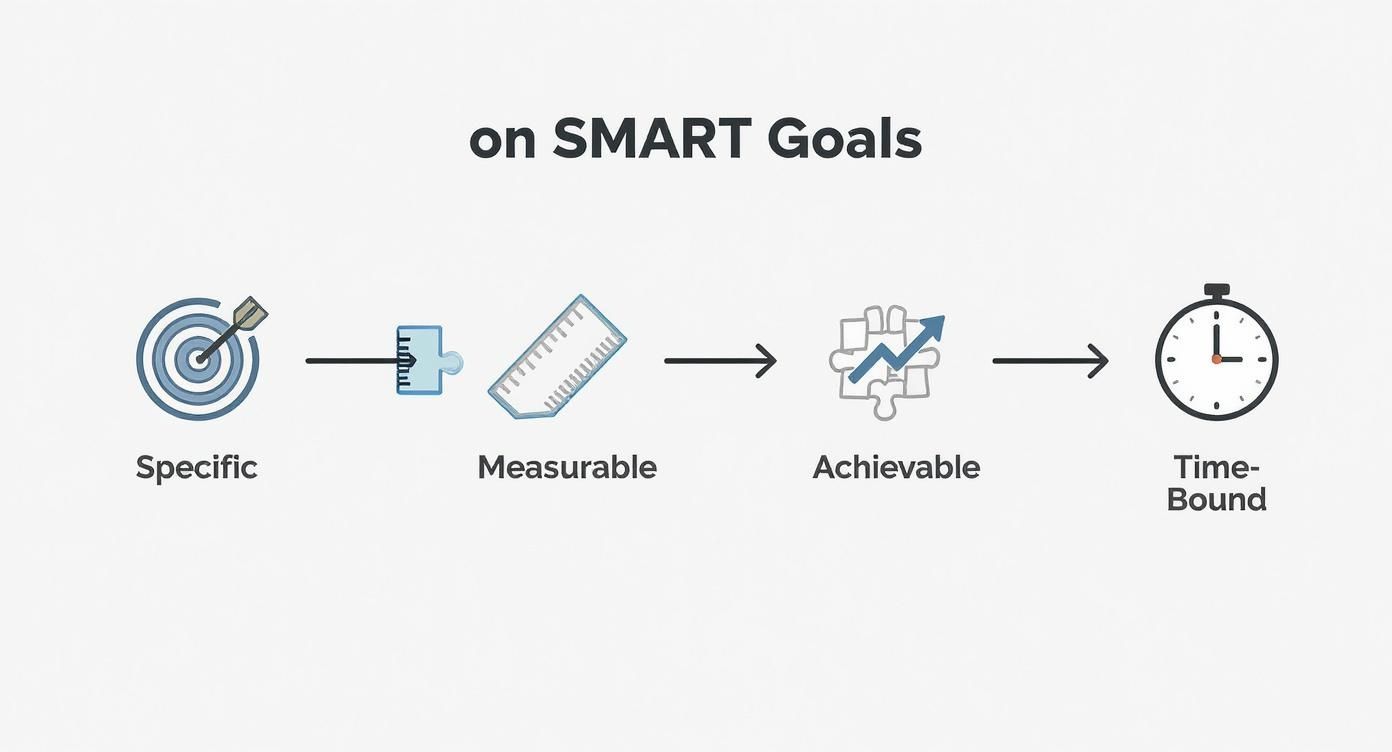
This process forces the kind of precision that turns vague ambitions into concrete targets.
From Goals to Meaningful Metrics
For every single SMART goal you've created, you need a way to measure what actually matters. This is the job of Key Performance Indicators (KPIs). They are the vital signs of your strategic plan.
Without KPIs, you're flying blind. You might feel like you're "improving student engagement," but how can you prove it? A well-chosen KPI provides the objective, data-driven evidence you need.
Let’s take that goal: "Increase Middle School Student Engagement." It sounds great, but it’s just an idea until you attach metrics to it.
- Primary KPI: Boost the percentage of students participating in extracurricular activities by 10% year-over-year.
- Secondary KPI: Achieve a 15% reduction in student absenteeism rates.
Suddenly, a feeling becomes a fact. Your academic leadership now has a clear target to aim for and a number to track.
KPIs are the language of progress. They translate your strategic ambitions into a clear, shared understanding of what success looks like, ensuring everyone is pulling in the same direction with the same definition of "done."
Assigning Ownership and Setting Timelines
Here's a simple truth I've seen play out in dozens of private schools: a goal without an owner is a goal that will never get done. Your roadmap has to assign responsibility for each goal—and its KPIs—to a specific person or department. This isn't about pointing fingers; it's about creating a culture of accountability where everyone knows their role in the big picture.
Once ownership is clear, you need realistic timelines with key milestones. Don't just set a target for the end of the year. Break it down into quarterly or even monthly checkpoints. This rhythm allows you to track progress in real-time and make smart adjustments before a small problem becomes a major derailment. It’s what makes your plan a dynamic management tool, not a forgotten document in a binder.
To give you a clearer picture of how this works, the table below shows how high-level goals can be connected to specific KPIs across different departments in a private school.
Example KPIs for Private School Strategic Goals
This table links common strategic goals to specific, measurable KPIs, demonstrating how to track progress effectively across different school functions.
| Strategic Goal | Department | Primary KPI | Secondary KPI |
|---|---|---|---|
| Boost Enrollment Funnel | Admissions | 20% increase in qualified applications received. | 10% increase in campus tour attendance. |
| Strengthen Academic Rigor | Academics | 5% increase in average standardized test scores. | 90% student participation in project-based learning. |
| Grow Annual Fund | Development | 15% increase in total dollars raised for the annual fund. | 25% increase in alumni donor participation rate. |
As you can see, this structure provides absolute clarity for each team leader on what they are responsible for delivering.
Finally, a successful implementation needs a consistent rhythm for reviews. Get monthly or quarterly meetings on the calendar where department heads report on their KPIs. These aren't "gotcha" sessions. They're collaborative huddles to figure out what's working, identify roadblocks, and shift resources where they're needed most. This communication loop is what keeps your strategic plan alive, relevant, and driving your school forward.
If you're ready to build an implementation plan that ensures your strategic vision becomes a reality, our team can guide you every step of the way. Book a complimentary consultation with JAG Consulting or visit our website to learn how we help schools execute with precision.
Keeping Your Strategic Plan Alive and Relevant
Creating your strategic plan is a huge milestone, but let's be honest—the real work starts now. The final, and most critical, phase is making sure the plan lives and breathes within your private school's culture.
The alternative? It gathers dust in a binder on a shelf. Unfortunately, far too many organizations stumble right here. Without deliberate, ongoing effort to integrate a plan into daily operations, it rarely drives any real change.
Fostering Genuine Buy-In
To truly bring your plan to life, it has to become a shared compass for your entire community. This isn't just about emailing a PDF.
Roll out the final document in all-staff meetings, board presentations, and parent communications. It's crucial to frame it not as a top-down mandate but as a collective roadmap that everyone helped build. That transparency is what fosters a genuine sense of purpose and ownership.
From there, start weaving discussions about strategic goals into your regular operational meetings—faculty meetings, department head check-ins, even admissions team huddles. When your team sees how their daily work directly contributes to the school’s long-term vision, the plan transforms from a document into a powerful motivator.
A strategic plan is a dynamic compass, not a static map. Its value comes from its daily use in guiding decisions and its flexibility to adapt to changing conditions, ensuring your school remains resilient and forward-focused.
Annual Reviews and Adjustments
A strategic plan was never meant to be carved in stone. Think of your framework template as a living document.
Schedule an annual review to assess progress against your KPIs. This is the time to celebrate successes and—just as importantly—have honest conversations about the challenges. What didn't work? Why? What did we learn? This is your opportunity to make necessary adjustments based on new data, shifts in the market, or unforeseen circumstances (which, as we all know, are inevitable).
This iterative process is what keeps your strategy relevant and ensures your school continues to evolve with intention. Having an expert guide can make all the difference in building a plan that is both visionary and executable from day one.
Ready to create a plan that fuels your school's future? Book a complimentary consultation with JAG Consulting today or visit our website to get started.
Your Top Questions About Private School Strategic Planning, Answered
When you’re deep in the strategic planning process, practical questions always come up. Here are the answers to the most common queries I hear from private school leaders, designed to give you quick, clear guidance.
How Often Should We Really Be Doing This?
Think of your strategic plan as a living roadmap, not a static document. While the heavy lifting of a full-blown planning process happens every three to five years, a formal review every single year is non-negotiable.
This annual check-in is your leadership team’s chance to see what's working and what's not. Are you hitting your KPIs? Have market conditions shifted? Do priorities need to be reshuffled? This keeps the plan relevant and prevents it from gathering dust on a shelf.
Who Absolutely Needs to Be in the Room?
A plan created in a vacuum is doomed to fail. To get genuine buy-in, you need a cross-section of your community at the table. While your board and senior leadership will ultimately steer the ship, their direction must be informed by the people on the ground.
Make sure your planning committee includes voices from:
- The Board of Trustees
- Senior Administration (like the Head of School and Division Heads)
- Faculty and Staff representatives
- Parent Association leaders
- A key community partner or influential alum
This isn’t about planning by committee; it's about ensuring your final strategic planning framework template is built on a 360-degree view of your school's reality.
What's the Single Biggest Mistake Schools Make?
Failure to execute. It's a classic story: a private school invests months creating a beautiful, ambitious plan… and then it goes right on the shelf. The passion and energy evaporate, and nothing actually changes.
The data is clear on this. Organizations with a documented strategy that they actively monitor grow 30% faster than those that don't.
A plan without a detailed implementation roadmap—complete with clear owners, deadlines, and measurable KPIs—isn't a plan at all. It's just a wish list.
How Long is This Process Going to Take?
Be patient. For most private schools, a thorough strategic planning process takes between six and nine months from the first kickoff meeting to the final board-approved document.
Trying to rush it is a recipe for a superficial plan. You need time for deep analysis, robust debate, and building broad consensus. A deliberate, thoughtful timeline ensures every voice is heard and the final strategy is both powerful and achievable.
Ready to build a strategic plan that actually drives results and secures your school's future? The expert team at JAG Consulting has guided dozens of private schools through this exact process. Book a complimentary consultation call and let's talk about turning your vision into a reality.

I'm Dr. Jeannie Gudith, Founder and CEO of JAG Consulting. We help you develop, improve, buy or sell your private school.
I'm so glad you're here
Hello!


