

A Private School Guide to Unlocking Special Ed Funding
It’s one of the most common myths in private education: public special ed funding is locked away, completely off-limits to schools like yours.
But that’s not the whole story. While it’s true that you won’t be getting direct cash payments from your local school district, there are significant, often untapped, streams of support available through federal laws, state-level programs, and private grants. The reality is far more nuanced—and full of opportunity.
Unlocking Special Ed Funding for Your Private School
For most private school leaders, navigating the world of special education support feels like solving a puzzle with half the pieces missing. The prevailing wisdom says that public funds are strictly for public schools, leaving you to shoulder the entire cost of serving students with disabilities on your own.
This perspective, however, overlooks critical pathways to financial support that can make a massive difference for both your students and your school's bottom line.
The key is a shift in mindset. Instead of seeing a closed door, you have to learn where to find the windows of opportunity that federal and state laws create. It's less about getting a check in the mail and more about accessing a portfolio of services and resources paid for by public entities.

A Landscape of Opportunity
The demand for special education is exploding. The number of students ages 3-21 receiving special education services under the Individuals with Disabilities Education Act (IDEA) reached 7.5 million in fall 2022, which is 15.2% of all public school students. This environment creates an urgent need for all schools—including private ones—to understand their role and the resources available to them.
Securing funding isn't just a financial strategy; it's a mission-critical activity that enables your school to deliver on its promise of providing an exceptional and inclusive education for every child who walks through your doors.
This guide is your roadmap. We’ll break down the primary avenues for accessing special ed funding and support, helping you build a diversified and sustainable financial model. The main opportunities fall into three buckets:
- Federal Mandates: Understanding the "equitable services" provision within IDEA is the first and most crucial step for any private school.
- State-Level Programs: Many states offer voucher, scholarship, or Education Savings Account (ESA) programs that parents can use for private school tuition and services.
- Private and Corporate Grants: Tapping into philanthropic sources can provide flexible funding for innovative programs and resources.
By mastering these areas, you can move from a position of uncertainty to one of strategic action. The goal is to stop wondering if you can get support and start knowing exactly how to secure it.
Navigating this process alone can be daunting. To develop a customized strategy for your school and accelerate your success, book a call with JAG Consulting at https://link.jagconsultingservices.com/widget/bookings/prospective/school/consultation/zoom or visit our website.
Understanding Your Rights Under IDEA
For many private school leaders, the Individuals with Disabilities Education Act (IDEA) feels like it lives exclusively in the public school world. That's a common misconception, and it's one that could be costing your students access to critical support. This landmark federal law is the legal cornerstone that creates a direct pathway for your students to receive essential services, even while enrolled at your school.
Think of IDEA's provision for private schools less like a direct cash payment and more like a dedicated service account. The law requires public school districts—often called Local Education Agencies (LEAs)—to set aside a portion of their federal funds to provide "equitable services" to eligible students with disabilities who are parentally placed in private schools within their district. It’s a system of shared responsibility, and understanding it is the first step to unlocking crucial resources.
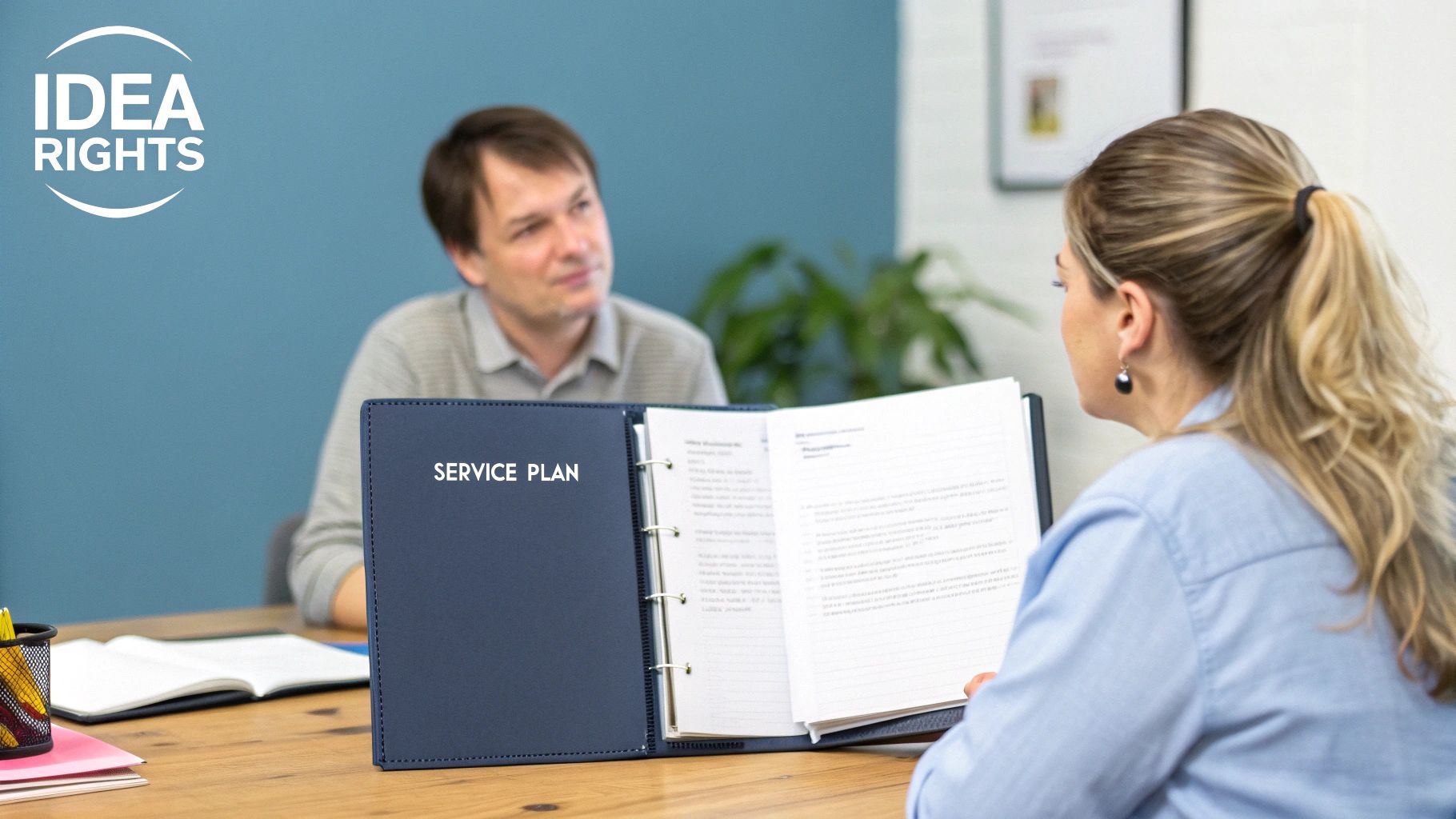
This support has never been more vital. The number of students needing these services is growing faster than ever, with nearly 8 million students now eligible for support under IDEA. Between fall 2021 and 2023 alone, schools saw an increase of over half a million IDEA-eligible students. That's a 3.4% annual increase that far outpaces historical trends and puts a spotlight on the need for funding. You can explore the data on rising special education enrollment to get a better sense of this national shift.
The Critical Consultation Process
So how do you tap into these services? It all hinges on a formal process known as “timely and meaningful consultation.” Each year, the LEA is required to reach out to private schools in its jurisdiction to start a dialogue. If you want to secure support for your students, your participation in this conversation isn't just a good idea—it’s essential.
This is your chance to come to the table and collaboratively plan for your students.
During this consultation, you and the LEA will hash out the details:
- Child Find: The process the LEA will use to identify students with disabilities in your school.
- Services Offered: Which specific services will be provided, such as speech therapy, occupational therapy, psychological services, or specialized instruction.
- Service Delivery: The logistics of how and where services will be delivered (e.g., on your campus by a public school employee or a third-party contractor).
- Funding Allocation: A clear explanation of how the amount of funding for these services is calculated.
This consultation is your primary forum for advocating for your students' needs. A well-prepared, collaborative approach is the key to maximizing the support your students receive.
Make no mistake, this process is a negotiation. While the LEA makes the final decisions, your input—backed by clear data on your students' needs—is a required and influential part of the process.
Service Plans vs. IEPs
It’s vital that you, your staff, and your parents understand a key distinction in the paperwork. A student in a public school with a qualifying disability receives an Individualized Education Program (IEP). An IEP is a comprehensive, legally binding contract that details every service, accommodation, and goal the district is obligated to provide.
When that same student is enrolled in a private school, their right to a full IEP from the public district doesn't transfer. Instead, if they are deemed eligible for equitable services, they receive a Service Plan (sometimes called an Individual Services Plan or ISP).
Here’s a simple way to think about the difference:
| Feature | IEP (Public School) | Service Plan (Private School) |
|---|---|---|
| Legal Status | A legally binding contract under IDEA. | Outlines services offered; not a legal entitlement. |
| Scope | Comprehensive, covering all educational needs. | Limited to the specific services the LEA agrees to provide. |
| Development | Created by a full team, including parents and staff. | Developed by the LEA, often in consultation with the school. |
| Primary Goal | To provide a Free Appropriate Public Education (FAPE). | To provide equitable participation in IDEA-funded programs. |
Understanding this difference helps manage expectations for everyone involved. While a Service Plan isn't as extensive as an IEP, it is the designated vehicle for delivering valuable, publicly funded support directly to your students on your campus.
Mastering the nuances of IDEA is the first step toward building a robust support system. To ensure you're fully prepared for your next LEA consultation and to explore every available funding avenue, book a call with JAG Consulting at https://link.jagconsultingservices.com/widget/bookings/prospective/school/consultation/zoom or visit our website to learn more.
Leveraging State Vouchers and Scholarship Programs
While IDEA funding provides a baseline of support, the real game-changer for many private schools is tapping into state-level voucher and scholarship programs.
These programs—which go by names like vouchers, tax-credit scholarships, and Education Savings Accounts (ESAs)—completely flip the script on funding. Instead of your school having to negotiate for a slice of the public district's pie, these programs put the money directly into parents' hands.
This shift is huge. Families receive state-allocated funds and can then use them to pay for tuition and specialized services at the private school that’s the right fit for their child. It’s a model that empowers parents and, for schools equipped to serve these students, opens up a significant and reliable revenue stream.
And this isn't a niche opportunity. It’s a massive, growing movement. For the 2023-24 school year, there are 78 private school choice programs in 32 states, Washington D.C., and Puerto Rico, serving over 900,000 students. The trend is clear: this is a vital funding channel for private schools.
Becoming an Approved Provider
Before you can welcome a single student with a state scholarship, your school has to get on the approved provider list. Think of it like becoming an in-network doctor for an insurance plan. It’s the state’s way of verifying that you meet their standards and can be trusted with public funds.
This isn’t just a rubber stamp. The application process is designed to ensure you’re a legitimate, safe, and stable educational institution.
You’ll typically need to show proof of:
- Accreditation or Licensing: The state wants to see that you’re a recognized educational entity, either through state licensing or a reputable accrediting body.
- Health and Safety Compliance: This is about proving your campus is up to code and provides a safe environment for students.
- Financial Stability: You'll need to demonstrate that your school is on solid financial ground and can manage its operations responsibly.
- Non-Discrimination Policies: A commitment to fair and equitable practices in admissions and hiring is almost always a requirement.
Getting this approval is the non-negotiable first step. It’s your ticket into the system and signals to both the state and potential families that you’re a credible partner in education.
Guiding Families and Managing Administration
Once your school is approved, your role evolves. You become a crucial guide for families trying to navigate what can be a confusing system. Parents of children with disabilities are already juggling a lot; a complicated voucher application can feel overwhelming.
This is where your school can truly shine. By providing clear guidance on deadlines, paperwork, and eligibility, you become an indispensable resource. This hands-on support not only helps families secure the funding they need but also builds incredible trust and loyalty before their child even steps into a classroom.
Successfully managing a voucher or scholarship program requires a dual focus: robust support for families on the front end and meticulous administrative management on the back end. Both are essential for long-term success.
On the administrative side, you absolutely must have a rock-solid system for tracking payments, documenting the services you provide, and meeting all state reporting requirements. This is where schools often get into trouble. Without strong internal processes, you risk compliance issues and financial headaches.
Tapping into state-specific programs is one of the most powerful ways to fund your special education services, but it demands real expertise. To build a system that works—from getting approved to managing the day-to-day administration—book a call with the experts at JAG Consulting at https://link.jagconsultingservices.com/widget/bookings/prospective/school/consultation/zoom. You can also visit our website for more essential resources.
Don't Just Rely on Government Funding—Diversify with Grants and Partnerships
Relying solely on government programs for special education funding is a bit like trying to run your school on a single, temperamental generator. When it works, it's fine. But when it sputters, everything can grind to a halt. A truly resilient financial model for your special ed program requires diversification. It’s time to look beyond mandated services and tap into the powerful combination of grants and strategic community partnerships.
This approach is about more than just finding extra cash; it's about unlocking the door to innovative programs, better resources, and a more stable future. Private and corporate foundations are a massive, often overlooked, source of support. In fact, foundation giving in the U.S. reached an estimated $105.21 billion in 2022, with many organizations specifically looking to fund disability services and inclusive learning environments.
Identifying and Securing Grant Funding
Winning grant money starts with smart prospecting. You have to find foundations whose missions genuinely align with what your school is trying to accomplish. Don't waste your team's valuable time sending out generic, scattershot applications. The key is to focus on organizations that have a proven track record of supporting projects just like yours.
Your grant proposal is your most critical tool. Think of it less like a request for money and more like the story of the impact you’re going to make. It needs to be compelling, clear, and convincing.
A proposal that gets funded almost always includes:
- A Crystal-Clear Needs Statement: Use a mix of hard data and powerful anecdotes to paint a picture of the challenges your students face. Show funders the specific gap you're uniquely positioned to fill.
- Well-Defined Objectives: Be specific about what you'll achieve. Use measurable goals like, "Improve reading fluency scores by 15% for students with dyslexia" or "Provide 200 hours of on-site occupational therapy."
- A Detailed, Transparent Budget: Break down exactly how every single dollar will be spent. Show them the plan for personnel, the new technology you need, or the specialized materials that will bring your program to life.
- A Solid Sustainability Plan: This is crucial. Show the grant-makers how their initial investment will create lasting value and continue to pay dividends long after their check has been cashed.
A successful grant proposal doesn’t just demonstrate a need. It presents a clear, actionable, and sustainable solution. It convinces funders that an investment in your school is a smart investment in the community's future.
The Power of Strategic Partnerships
Partnerships are about more than just money—they're a force multiplier for your resources, expertise, and impact. These alliances can open up opportunities that would be simply impossible for your school to achieve on its own.
Think of these partnerships as building a dedicated support network around your school. Each new connection you forge adds another layer of strength, capability, and resilience to your special education program.
Consider forging alliances with:
- Local Therapy Clinics: Partnering to co-locate services on your campus can be a huge win-win. It reduces overhead for both you and the clinic, gives your students incredibly convenient access to top-tier physical, occupational, or speech therapy, and can even create a new revenue stream for your school.
- University Special Education Departments: A partnership with a local university can create a steady pipeline of talented student teachers and interns. This gives you access to fresh perspectives and the latest research-backed practices, often at a significantly reduced cost.
- Community Non-Profits: Find a non-profit focused on disability advocacy and apply for grants together. A joint application is almost always stronger and can open the door to much larger funding pools than either of you could access alone.
These collaborative moves do more than just expand what you can offer. They build your school's reputation as a true community hub for special education excellence.
Building this kind of multi-faceted funding strategy is absolutely essential for long-term stability. If you're ready to create a more diverse and resilient financial future for your special education program, book a call with JAG Consulting at https://link.jagconsultingservices.com/widget/bookings/prospective/school/consultation/zoom or visit our website to see how we can help you find and secure these vital resources.
Building a Sustainable Financial Model for Special Education
A truly exceptional special education program isn't built on good intentions alone. It demands a rock-solid, sustainable financial foundation. For your program to thrive long-term, you have to move from a reactive to a proactive approach to budgeting. That means creating a detailed financial model that anticipates every cost, aligns it with specific funding sources, and keeps your school on solid ground.
The first step is a no-stone-unturned forecast of your expenses. This goes way beyond just teacher salaries. A robust model for special ed funding has to account for every single layer of support your students require.
Accurately Forecasting Program Costs
Think of your budget as the detailed blueprint for your entire program. The more precise you are with your cost estimates, the stronger your financial structure will be. It’s absolutely crucial to look past the obvious expenses and itemize everything.
Your forecast should meticulously detail the costs for:
- Specialized Staff: This isn't just one line item. Break it down into salaries and benefits for special education teachers, paraprofessionals, behavior specialists, and all your therapists (speech, occupational, physical).
- Assistive Technology: Factor in every expense, from devices and adaptive equipment to the recurring software licenses needed to make them work for your students.
- Professional Development: Great staff need ongoing training. Allocate real dollars to ensure your team stays current with the best practices and certifications in the field.
- Curriculum and Materials: This includes everything from specialized instructional materials and sensory tools to any adapted resources needed in the classroom.
This detailed breakdown isn’t just an internal spreadsheet exercise. It becomes the hard evidence you use to justify your tuition structures, write grant proposals that get funded, and advocate for resources during those critical LEA consultations.
A well-documented financial model transforms your funding requests from abstract asks into concrete, evidence-based plans. It demonstrates foresight and fiscal responsibility, building trust with parents, donors, and partners.
This chart illustrates the different funding streams private schools can tap into to support their special education programs.

As the visualization shows, a strong financial model relies on a diversified approach, blending grants, foundational support, and strategic partnerships to create a stable base.
Mapping Expenses to Funding Streams
Once you have a crystal-clear picture of your costs, the next move is to strategically map them to the various funding sources we've been discussing. Think of it like a puzzle. IDEA equitable services might cover speech therapy for a student, while a state voucher helps a family with tuition, and a private grant you secured funds a brand-new assistive technology lab. The goal is to create a mosaic of funding that covers your entire program.
It’s also critical to have realistic expectations about federal support. While the Department of Education's fiscal year 2025 request included $14.8 billion for IDEA Part B grants, that money is stretched thin. It still only covers a fraction of the true cost of providing services.
The federal contribution averages out to around $1,810 extra per student. That figure pales in comparison to the total expense of educating the nearly 8 million eligible students nationwide. To see the numbers for yourself, you can learn more about the federal education budget.
To make this tangible, let's map out how specific costs align with different funding sources. This isn't just about balancing a budget; it's about building a strategic financial plan where every dollar has a purpose and a source.
| Expense Category | Description | Potential Funding Source(s) |
|---|---|---|
| Specialized Staffing | Salaries and benefits for special education teachers, paraprofessionals, and therapists. | Tuition (Base or Tiered), IDEA Equitable Services, Private Donations, School Operating Budget |
| Assistive Technology | Devices, software licenses, adaptive equipment, and maintenance. | Specific Grants (Technology-focused), IDEA Funds, Parent Contributions, Capital Campaigns |
| Professional Development | Ongoing training, certifications, and workshops for staff. | IDEA Proportional Share for Private Schools, Foundation Grants, School Operating Budget |
| Curriculum & Materials | Specialized textbooks, sensory tools, adapted classroom resources. | IDEA Equitable Services, Private Donations, Parent Fundraising Initiatives |
| Facility Modifications | Ramps, accessible restrooms, sensory rooms, and other physical adaptations. | Capital Campaigns, Foundation Grants (Facilities-focused), Community Partnerships |
| Therapeutic Services | Speech, occupational, physical, or behavioral therapy provided by specialists. | IDEA Equitable Services, Medicaid Reimbursement (if applicable), Tiered Tuition Models, Private Pay |
This table helps illustrate how a diversified approach works in practice. By aligning each cost category with one or more funding streams, you create a more resilient and sustainable financial model for your program.
Designing Transparent Tuition Structures
For many private schools, a tiered tuition model is the most equitable and sustainable path forward. This structure simply aligns the cost of attendance with the level of support a student actually needs. A student who requires minimal accommodations would be in a lower tuition tier than a student who needs daily, one-on-one support from a dedicated paraprofessional.
The key to making this work is absolute transparency. Parents must have a crystal-clear understanding of what services are included at each tier. Provide detailed service descriptions and be prepared to walk families through the evaluation process that determines their child’s placement. This level of clarity prevents misunderstandings down the road and builds a trusting relationship from the very start.
Building a durable financial model is a complex but essential task. If you need expert guidance to forecast costs, structure tuition, and align your budget with a diversified funding strategy, we can help. Book a call with JAG Consulting at https://link.jagconsultingservices.com/widget/bookings/prospective/school/consultation/zoom today or visit our website for more resources.
Create Your Special Ed Funding Action Plan
Knowing the rules of the game is one thing. Actually winning is another. All the knowledge we’ve covered is just the starting point; the real work begins now, turning that knowledge into a concrete action plan that secures the future of your special education program.
Let’s be clear: finding and securing special ed funding isn’t a one-and-done task you can check off a list. It’s a continuous cycle of research, outreach, and relentless follow-through.
Think of it like building a support structure for your school. Each funding stream—IDEA equitable services, state vouchers, private grants—is a different pillar. Your action plan is the blueprint that shows you how to place each pillar perfectly, so they work together to hold up your entire program, making it strong and resilient for years to come.
Your First Moves to Funding Success
Before you ask for a single dollar, you need to get your own house in order. The journey always begins with a thorough internal audit because you can't advocate effectively for funding until you have an undeniable command of the facts on the ground. You have to know exactly who you serve and what they need to thrive in your classrooms.
Your very first step is a deep dive into your student population to identify every child with a diagnosed disability. For private schools, this data is your single most powerful tool. It’s the hard evidence you’ll bring to consultations, the emotional core of your grant proposals, and the unshakable justification for every line item in your budget.
Once you have that internal data locked down, it’s time to turn your focus outward. Your next critical move is to become an expert on your local public school district (your LEA). You need to find out their specific procedures for the annual IDEA consultation, their exact timelines, and who your point of contact is. Being proactive here isn't just a good idea—it's non-negotiable.
Building Your Strategic Checklist
To keep your efforts organized and prevent anything from slipping through the cracks, you need an actionable checklist. This isn't just busywork; it's a framework that guides your team through every key activity needed to build a diversified funding portfolio for your special education program.
Here’s a step-by-step plan to get you moving:
- Conduct a Needs Assessment: Don't just guess—document the specific services your students with disabilities require. Quantify everything you can. How many hours of speech therapy are needed weekly? How many students require specific assistive technology? The more specific your data, the more compelling your case.
- Master Local IDEA Procedures: Get a meeting on the calendar with your LEA’s special education director well before the official consultation window opens. The goal is to build a relationship and get absolute clarity on their process before the clock is ticking.
- Explore State Voucher Programs: Start researching your state’s scholarship, voucher, or ESA programs today. Find out the eligibility rules and application timelines. If you aren’t already an approved provider, you need to start that process immediately.
- Identify Grant Opportunities: Create a master calendar of grant deadlines from local and national foundations that support education and disability services. Assign a point person on your team to start drafting a compelling master proposal you can adapt for different opportunities.
- Review Your Budget and Tuition Model: Take a hard look at your current financial model. Could a tiered tuition structure better align your costs with the specialized services you provide? This analysis is crucial for ensuring your long-term sustainability.
Securing funding is not a passive activity. It demands persistent, organized effort. This action plan provides the structure you need to turn your goals into financial reality, ensuring you can deliver on your school's mission for every single student.
Trying to navigate this complex world alone can be overwhelming, and mistakes can be costly. Let our expertise bring clarity to your financial strategy and accelerate your success.
Take the first concrete step toward securing your school's future. Book a consultation with JAG Consulting at https://link.jagconsultingservices.com/widget/bookings/prospective/school/consultation/zoom to develop your customized funding plan, or visit our website for more essential resources for private school leaders.
Frequently Asked Questions About Special Ed Funding
Even with a solid plan, specific questions about special ed funding always pop up. Let's tackle some of the most common practical concerns we hear from private school leaders. Getting clear, direct answers here will help you sidestep common pitfalls and advocate more effectively for your students.
Can Our Private School Directly Receive IDEA Funds?
No, and this is probably the biggest misconception out there. Private schools don't get a direct check for IDEA funds.
Instead, the public school district—the Local Education Agency (LEA)—where your school is located receives and controls all the money. The LEA is then required to use a portion of those funds to provide "equitable services" to eligible students enrolled at your school. This means the money pays for the services themselves, like speech therapy or specialized tutoring. Those services are then delivered to your students, often right on your campus, by the LEA's staff or contractors they hire.
What Is the Difference Between a Service Plan and an IEP?
Understanding the distinction here is critical for managing expectations with both parents and your own staff. An IEP (Individualized Education Program) is a comprehensive legal document for a student in a public school that spells out every service the district is legally obligated to provide. It's the whole package.
A student whose parents choose to place them in a private school does not have a federal right to an IEP from the public district. If that student qualifies for equitable services, the LEA creates a Service Plan instead. Think of a Service Plan as a much more limited document; it only outlines the specific, targeted services the LEA has agreed to provide. It is nowhere near as exhaustive as a full IEP.
How Can We Best Prepare for the LEA Consultation Meeting?
Your success in securing services for your students almost always comes down to preparation. Showing up to the annual consultation meeting with the LEA unprepared is a massive missed opportunity. The schools that get the best outcomes are the ones that are organized, informed, and collaborative from the very beginning.
Preparation transforms the consultation from a procedural meeting into a strategic opportunity. Your data and clarity on student needs are your most powerful advocacy tools.
To make sure your meeting is productive, nail these essential steps:
- Compile Accurate Data: Before you even think about the meeting, identify every student with a diagnosed disability and gather specific data on their needs. The more precise your numbers, the stronger your case.
- Review LEA Policies: Do your homework. Research your local district’s published policies on providing equitable services to private school students. Knowing their own framework helps you frame your requests in a language they understand.
- Document Everything: Walk into that meeting with a clear, written list of your students' needs and the services you're requesting. Afterward, send a follow-up email summarizing the discussion. This creates a written record and ensures everyone is on the same page.
Effectively navigating the world of special education funding requires both expertise and persistence. But you don't have to do it alone.
To build a robust and sustainable funding strategy for your school, trust the experts at JAG Consulting. Take the next step by booking a complimentary consultation or visiting our website at https://link.jagconsultingservices.com/widget/bookings/prospective/school/consultation/zoom to learn more.

I'm Dr. Jeannie Gudith, Founder and CEO of JAG Consulting. We help you develop, improve, buy or sell your private school.
I'm so glad you're here
Hello!


