


Boost Student Outcomes with social and emotional learning sel
Social and emotional learning (SEL) is the process we all go through to understand and manage our emotions, set and achieve positive goals, feel and show empathy for others, build and maintain good relationships, and make responsible decisions. For private schools, it's not just another program—it's the very foundation for developing well-rounded, resilient, and academically successful students.
Why Social and Emotional Learning Matters in Education Today
In an era so focused on academic scores, it’s easy to lose sight of the skills that truly prepare students for life’s inevitable challenges.
Think of it this way: traditional education is like teaching a student how to build a powerful engine. Math, science, and literature are all essential components. But without a skilled driver who understands the rules of the road, knows how to navigate unexpected detours, and can interact safely with other drivers, that powerful engine is stuck in the garage.
Social and emotional learning (SEL) is the driver's education for life. It provides the essential, often-overlooked skills that allow students to actually use their academic knowledge. It’s the "how" behind the "what"—how to manage frustration over a tough math problem, how to collaborate effectively on a group history project, and how to make ethical choices when no one is watching.
For private schools committed to shaping future leaders, SEL isn't some optional add-on. It's a core component of a complete, meaningful education, with research showing that the long-term return on investment for SEL programs is an impressive $11 for every $1 spent.
The Five Pillars of a Thriving School
The Collaborative for Academic, Social, and Emotional Learning (CASEL) is the leading authority in this field, and their framework is the gold standard for schools across the country. They’ve broken down SEL into five core competencies that create a supportive environment benefiting students, adults, and the entire school community.

Here’s a quick look at what those five competencies look like in the real world of a student.
The Five Core Competencies of Social and Emotional Learning
| Core Competency | What It Means for Students |
|---|---|
| Self-Awareness | Recognizing their own emotions, understanding their strengths and weaknesses, and having a well-grounded sense of confidence. |
| Self-Management | Managing stress, controlling impulses, and motivating themselves to persevere through challenges to achieve personal and academic goals. |
| Social Awareness | Taking the perspective of and empathizing with others, including those from diverse backgrounds and cultures. |
| Relationship Skills | Communicating clearly, listening well, cooperating with others, resisting inappropriate social pressure, and seeking help when needed. |
| Responsible Decision-Making | Making constructive choices about personal behavior and social interactions based on ethical standards, safety, and social norms. |
When you intentionally teach and model these skills, they don’t just exist in isolation. They weave together to build a positive school culture where students feel safe, valued, and ready to learn.
The data backs this up. This isn't just a "feel-good" initiative.
Research consistently shows that students in schools with strong, evidence-based SEL programs demonstrate not only significant improvements in behavior but also an 11-percentile-point gain in academic achievement.
This powerful statistic proves that SEL isn't a distraction from rigorous academics; it's a direct contributor to it. By intentionally fostering these skills, private schools create an environment where emotional intelligence and academic excellence reinforce each other. The result is a student body better equipped for success in college, their future careers, and their personal lives.
The Proven Benefits of SEL for Student and School Success
Investing in social and emotional learning is far more than a feel-good initiative—it’s a strategic decision that delivers measurable returns across your entire school community. For private schools, where demonstrating value is everything, the data behind strong SEL programs makes a compelling case to parents, board members, and accreditation bodies alike.
This isn't about choosing between character development and academic rigor. It’s about recognizing that one directly fuels the other.
When students learn to manage their emotions, navigate social dynamics, and make sound decisions, they walk into the classroom more focused, confident, and ready to engage. That shift is the foundation for everything else you want to achieve.
Driving Academic Excellence
A common myth we hear is that time spent on social and emotional learning sel takes away from core academics. The evidence proves the exact opposite. SEL skills act as a catalyst for academic achievement, giving students the tools they need to succeed—things like perseverance, focus, and collaboration.
A massive synthesis of studies covering over one million students confirmed this powerful link. It found that students in SEL programs showed an average 11 percentage point increase in academic achievement compared to their peers. These weren't just small bumps; the gains showed up in better test scores, improved classroom conduct, and even higher graduation rates down the road. You can dig into the full research on SEL's academic impact to see the numbers for yourself.
The data makes it clear: SEL is one of the most effective investments a school can make to boost academic performance.
Cultivating a Thriving School Climate
Beyond individual student gains, SEL fundamentally changes the feel of your entire school. For private schools, a positive and inclusive climate is a huge differentiator, and SEL provides the framework to make that vision a reality.
When SEL is woven into the fabric of the school, it reduces conflict, builds a genuine sense of belonging, and creates a culture of respect. Studies confirm that schools with robust SEL implementation see a 10% decrease in bullying and a significant improvement in classroom behavior. This environment not only supports student mental health but also improves teacher retention by making the school a more positive and collaborative place to work.
A school where students feel emotionally and physically safe is a school where real learning can happen. This positive climate becomes a cornerstone of your school's identity and a key reason families choose to enroll—and stay—in your community.
Preparing Students for a Complex Future
Ultimately, a private education is about preparing students for success long after they leave your campus. The skills built through social and emotional learning sel are precisely the competencies that colleges and employers are desperate to find.
Think about the real-world skills that define long-term success:
- Resilience: The ability to bounce back from setbacks and push through challenges.
- Collaboration: Working effectively in diverse teams to solve messy, complex problems.
- Adaptability: Navigating change and ambiguity with confidence, not fear.
- Ethical Judgment: Making responsible decisions that align with personal and community values.
These aren’t just "soft skills"; they are career-defining competencies. By embedding SEL into your educational model, you’re giving your students a distinct and durable advantage, preparing them not just to succeed but to lead.
Ready to explore how a dedicated SEL strategy can elevate your school's outcomes? Book a call with JAG Consulting to discuss your unique goals, or visit our website to learn more about our approach.
Bringing the Five Core SEL Competencies to Life
Knowing the definition of social and emotional learning sel is one thing. Seeing it actually happen on your campus is something else entirely. These skills aren’t just abstract concepts for a faculty meeting; they are real, observable behaviors that show a student is learning to handle their world with confidence.
For private school leaders, the real challenge—and opportunity—is translating these ideas into scenarios your teachers and parents can actually see and understand.
Think of the competencies as different muscles. Each one needs specific exercises to grow, and when they’re all strong, you get a well-rounded, capable student. Let’s move past the textbook definitions and look at what these skills look like in the day-to-day life of your students, from the lower school art room to the upper school debate stage.
Self-Awareness in the Classroom
Self-awareness is a student’s internal compass. It’s the honest ability to recognize their own emotions and thoughts, understand their own values, and see how all of it shapes their behavior. This is the bedrock; every other SEL skill is built right on top of it. A student with strong self-awareness doesn't just feel an emotion—they can name it, figure out where it’s coming from, and see how it’s affecting their focus.
For example, a middle schooler might:
- Recognize Anxiety: Before a big presentation, she feels that knot in her stomach. Instead of panicking, she identifies it as anxiety about public speaking, not as a sign she’s going to fail.
- Identify Strengths: A student working on a group project knows he’s great at organizing the research but struggles with pulling it all together into a conclusion. That empowers him to ask a teammate for help where he needs it most.
- Maintain Self-Confidence: After getting a lower grade than he hoped for, a self-aware student can separate that one result from his overall self-worth. He sees it as a data point for what to study next, not as a personal failure.
Self-Management Under Pressure
If self-awareness is knowing what you feel, self-management is deciding what you do about it. This is all about regulating emotions and impulses to handle stress, stay focused, and motivate yourself toward a goal, even when things get tough.
A student who is building this skill can create a little space between a trigger and their reaction. That tiny pause is where growth happens, and you see it in your hallways and classrooms every single day.
In the high-stakes environment of many private schools, self-management isn't just a nice-to-have; it's a critical tool for success. Research consistently shows that students with strong emotional regulation skills are far better equipped to manage academic stress, which leads directly to better mental health and stronger performance.
Think of a high school junior juggling AP courses. She shows self-management by creating a study schedule, using breathing exercises to calm her nerves before a final, and fighting the urge to procrastinate. This is social and emotional learning sel in its most practical, powerful form.
Social Awareness and Empathy
Social awareness is the ability to see things from someone else’s perspective and feel empathy for them, especially for people from different backgrounds. It’s about being able to "read the room"—to pick up on social cues, understand unspoken rules, and act with compassion. In a tight-knit private school community, this skill is absolutely essential for creating a genuine sense of belonging.
- You see it when a student notices a classmate sitting alone at lunch and invites them over to their table.
- It happens in a group project when a student actively listens to a teammate’s idea—even if they disagree—to understand their point of view before pushing their own.
- In literature class, a student shows it by thoughtfully discussing why a character made a certain choice, connecting that fictional experience to real human emotions.
Relationship Skills and Responsible Decisions
Finally, relationship skills and responsible decision-making are where all the internal work becomes external action. Relationship skills are what students use to build and maintain healthy connections—things like clear communication, listening, cooperation, and resolving conflict without drama. Responsible decision-making is about making constructive choices based on ethics, safety, and a respect for others.
These two skills are deeply connected. A student uses relationship skills to talk through a disagreement with a friend, then uses responsible decision-making to find a solution that works for both of them. This is the culmination of social and emotional learning sel—giving students the tools they need to build positive communities and act with integrity.
Feeling inspired to bring these competencies to life in your school? Book a call with JAG Consulting today or visit our website to see how we help private schools build exceptional SEL programs from the ground up.
A Strategic Roadmap for Implementing SEL in Your School
Weaving social and emotional learning into the fabric of your school takes more than good intentions. It demands a clear, deliberate plan. For private school leaders, a structured approach is what turns SEL from a powerful idea into a sustainable practice that elevates your school's unique mission. This roadmap lays out the essential steps for building an effective, school-wide SEL initiative from the ground up.
The journey doesn’t start with buying a new curriculum; it starts with gathering your people. The very first step is to assemble a dedicated SEL leadership committee. This group should be a cross-section of your community—administrators, teachers, support staff, and even a few engaged parents. They will be the champions and navigators for the entire process, making sure the vision for SEL is shared, understood, and consistently pursued.
Once your team is in place, you need to establish a baseline. Before you can map out where you’re going, you have to know exactly where you are. This means conducting a thorough school climate assessment.
Taking Stock of Your School's Climate
Think of a climate assessment as a diagnostic tool for your school's emotional health. It’s all about gathering honest feedback from students, staff, and families about their real experiences with the school environment, their relationships, and their sense of belonging. Anonymous surveys and small focus groups are fantastic for uncovering crucial insights you might otherwise miss.
This data helps you answer the big questions:
- What are the existing strengths in our community that we can build on?
- What specific social and emotional challenges are our students actually facing?
- Do our current policies and day-to-day practices support a positive and inclusive climate?
- How prepared do our teachers feel to support students' emotional needs right now?
Answering these questions gives you the foundation for a truly responsive SEL strategy, not just a one-size-fits-all program pulled off a shelf.
As you plan, it's helpful to remember that SEL competencies develop over time. This visual provides a simple guide for focusing on age-appropriate skills.
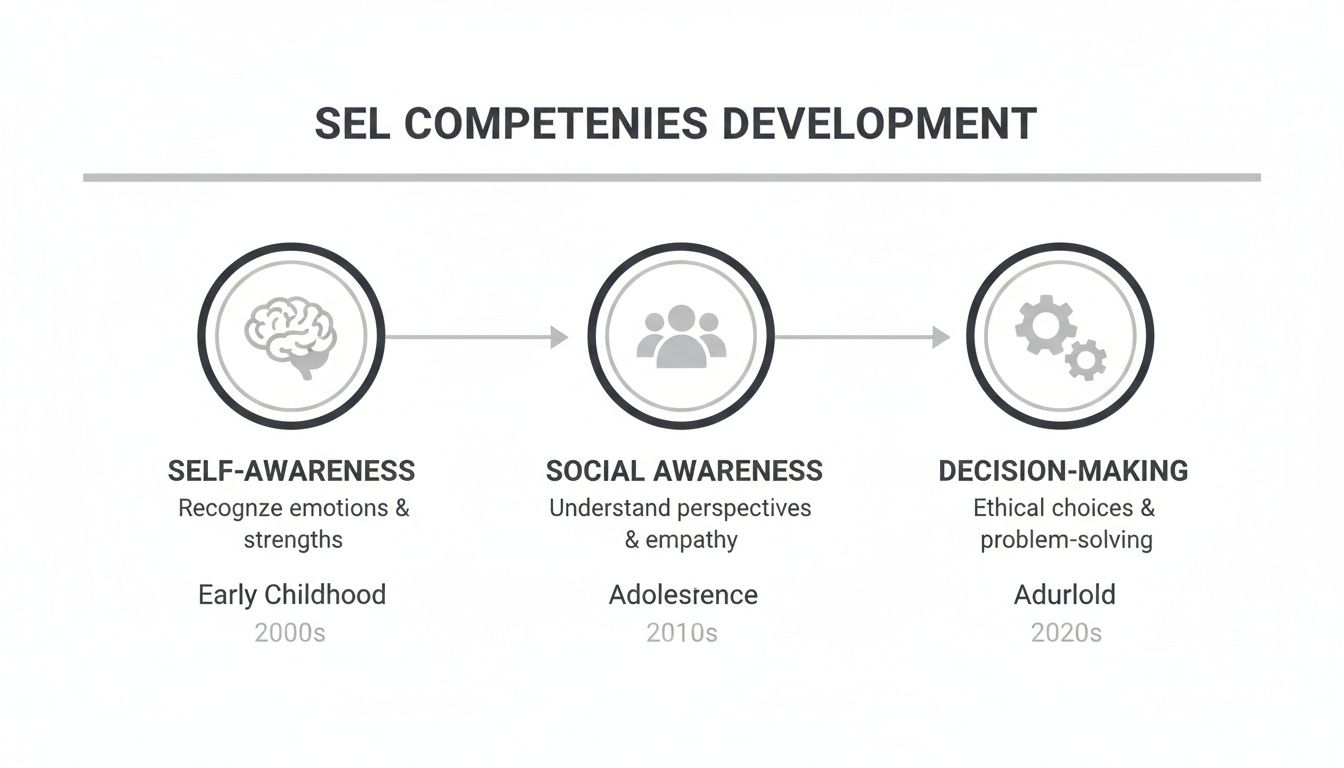
It highlights a natural progression, from building foundational self-awareness in the early years to honing more complex social awareness and decision-making skills as students mature.
Choosing Your Implementation Model
With a clear picture of your school's needs, you can choose the right implementation model. There is no single "correct" way to do SEL. The best approach is always the one that aligns with your school's culture, resources, and academic philosophy.
Two primary models stand out for private schools:
-
Integrated Approach: This model weaves SEL skills directly into existing academic subjects. A history class might discuss empathy when studying different historical perspectives, or a science lab could explicitly emphasize collaboration and shared problem-solving. This approach ensures SEL isn’t seen as "one more thing" on a teacher's plate but as an essential part of great teaching.
-
Explicit Curriculum: This involves adopting a dedicated, evidence-based SEL curriculum taught during a specific class period or advisory block. This guarantees every student receives consistent, structured instruction on core competencies. A 2022 meta-analysis confirmed that programs with explicit, sequenced instruction show consistently positive results.
Of course, many of the most successful schools use a hybrid model, combining direct instruction with school-wide integration to reinforce the learning in every possible context.
A critical factor in any model is professional development. For SEL to truly take hold, every single adult in the building must be on the same page. Research consistently shows that ongoing, high-quality training for teachers and staff is one of the strongest predictors of a successful SEL program.
Engaging Parents as Essential Partners
Finally, a truly effective strategy has to extend beyond the school walls. Private schools thrive on strong community partnerships, and parents are your most important allies on this journey. When you engage families, you ensure that the language and skills students learn at school are understood, valued, and reinforced at home.
You can bring them on board through:
- Workshops and Info Sessions: Host events that explain what SEL is (and isn't) and provide practical, easy-to-use strategies parents can try at home.
- Regular Communication: Use your newsletters, emails, and parent-teacher conferences to share what students are learning in SEL and how it connects to their academic progress.
- Resource Libraries: Create a dedicated section on your school website with articles, books, and videos to support parents in fostering their child’s emotional growth.
By building a strategic plan that includes a dedicated team, a clear assessment, a thoughtful implementation model, and robust family engagement, you create a powerful framework for success.
Sample Phased SEL Implementation Timeline
Bringing a comprehensive SEL program to life is a marathon, not a sprint. A phased approach ensures the rollout is thoughtful, sustainable, and tailored to your community's needs. Below is a high-level, 18-month timeline that illustrates how a private school might move from initial exploration to full integration.
| Phase | Timeframe | Key Activities and Goals |
|---|---|---|
| Phase 1: Foundation & Planning | Months 1-3 | Assemble SEL Leadership Team. Conduct school climate assessment (surveys, focus groups). Define school-wide SEL vision and goals. Research evidence-based curricula and models. |
| Phase 2: Professional Development & Pilot | Months 4-9 | Select SEL model/curriculum. Provide foundational training for all staff. Launch a pilot program with a small group of teachers/grade levels. Gather initial feedback and make adjustments. |
| Phase 3: School-Wide Rollout | Months 10-15 | Expand professional development based on pilot findings. Implement SEL practices school-wide (integrated and/or explicit instruction). Launch parent engagement initiatives (workshops, resource library). |
| Phase 4: Integration & Sustainability | Months 16-18+ | Establish system for ongoing data collection and review. Integrate SEL into school policies, mission, and culture. Plan for continuous staff training and coaching. Celebrate successes and share progress with the community. |
This timeline provides a flexible structure, allowing your leadership team to build momentum, learn from experience, and ensure that SEL becomes a deeply embedded part of your school's identity.
Ready to design a roadmap tailored to your school's unique vision? Book a call with JAG Consulting or visit our website to learn how we can help.
Measuring the Impact of Your SEL Program
In the world of private schools, results are everything. You can feel the positive shift in your school's culture from a strong social and emotional learning sel program, but your parents, board members, and accrediting bodies want to see the proof.
Measuring the impact of your SEL efforts is what elevates it from a well-intentioned initiative to a data-backed asset. It's how you showcase your school's real value. The goal is to move past simple observation and build a compelling story with both numbers and narratives, proving exactly how your investment in student well-being is paying off.
Blending Hard Data with Human Stories
The most powerful measurement strategies don't just rely on one type of data. Relying only on numbers or only on anecdotes gives you an incomplete picture of what’s really happening.
Think of it like a student report card. You wouldn’t base a student's entire grade on a single test score. You look at their classwork, their participation, and their project-based learning to see the whole picture. The same principle applies here.
You need both hard numbers (quantitative data) and human stories (qualitative data) to show the full impact.
-
Quantitative tools give you the "what." These are the measurable, objective data points that let you track trends over time. Think school climate surveys, attendance records, and disciplinary incident reports.
-
Qualitative tools give you the "why." These are the stories, observations, and personal accounts that add context and depth to your numbers. Think student focus groups, teacher observations, and parent testimonials.
When you put them together, you create a rich, detailed narrative of your program's success.
Key Measurement Tools for Your School
To get this comprehensive picture, several effective tools are at your disposal. Each one captures a different facet of your school's climate, giving you a 360-degree view of your program's effectiveness.
1. School Climate Surveys
Anonymous surveys for students, staff, and parents are the bedrock of SEL measurement. These instruments gauge critical perceptions of safety, belonging, and relationships within your community. When you track this data year-over-year, you can spot powerful trends. Research shows that schools effectively implementing SEL can improve students' social skills by 22%—a number that resonates with parents and board members alike.
2. Student Self-Assessments
These tools give students a voice, allowing them to reflect on their own growth in core SEL competencies. Using age-appropriate checklists or reflection journals, you gather invaluable insights into how students see their own progress in managing stress, collaborating with peers, or making responsible choices.
3. Behavioral Observations and Data
This is where the rubber meets the road. Track concrete school metrics that are directly influenced by strong SEL skills. Look for clear trends in:
- Attendance rates
- Disciplinary referrals
- Bullying incidents
- Participation in extracurricular activities
A noticeable drop in negative incidents alongside a rise in positive engagement are powerful indicators that your social and emotional learning sel program is taking root.
By systematically collecting this data, you're not just checking a box. You are building a powerful case that directly links your SEL efforts to improved student behavior, a stronger community, and a more positive learning environment—all key differentiators for any private school.
This data-driven approach allows you to report on SEL outcomes with confidence. It transforms your mission-driven work into a powerful asset for marketing, student retention, and accreditation.
Ready to build a measurement strategy that showcases your school's success? Book a call with JAG Consulting to explore how we can help you turn your SEL data into a compelling story, or visit our website for more information.
How SEL Creates a Competitive Advantage for Your School
In the packed private school market, top-tier academics are table stakes. It’s what parents expect, not what makes you stand out. Today’s families are looking for something more. They want an education that prepares their child for the real world by building character, resilience, and emotional intelligence.
This is where a robust social and emotional learning (SEL) program becomes your school’s most powerful differentiator.
When you frame SEL as a core piece of your school’s value, you speak directly to what modern parents are looking for. They know that future success isn’t just about test scores. It’s about being able to collaborate on a team, manage stress during finals week, and make tough ethical choices. When you can show them exactly how your school builds these skills, you immediately separate yourself from the competition.

This isn’t just a passing trend. It's a fundamental shift in what parents demand from an independent education, and the market growth proves it.
Meeting a Growing Market Demand
The global demand for social and emotional learning is exploding. The market is currently valued somewhere between USD 3.13 to 3.99 billion and is on track to grow at a compound annual rate of nearly 25% starting in 2025. North America is leading the charge, holding about 39% of the entire market thanks to widespread investment from schools and supportive policies. You can explore more data on this incredible growth and what it signals for the future of education.
But this isn’t just an abstract economic forecast. It reflects a real, tangible demand from the very families you want to attract and keep.
By investing in a high-quality SEL program, you are not just enhancing your educational model—you are aligning your school with a clear and powerful market force. You are positioning your institution as a forward-thinking leader that understands what it truly takes to prepare students for the future.
This strategic positioning is priceless. During school tours, in your viewbook, and in every enrollment conversation, SEL becomes a compelling part of your school’s story. It gives you a concrete, powerful answer to the question every parent asks: "What makes your school different?"
Articulating Your Unique Selling Proposition
Your commitment to SEL is a story that needs to be told confidently and consistently. Here’s how to make your program a clear competitive advantage:
- During Admissions Tours: Don't just tell—show. Point out SEL in action. "Here in our fifth-grade science lab, students aren't just learning the scientific method; they're practicing essential relationship skills as they collaborate on these complex experiments."
- In Marketing Materials: Shift your language to highlight whole-child development. Feature testimonials from parents and students talking about how these skills have made a real difference in their confidence and well-being.
- In Board and Donor Meetings: Bring the data. Connect your SEL initiatives directly to improved academic outcomes, a more positive school climate, and enhanced student well-being. These are the metrics that prove long-term enrollment stability and institutional health.
By embracing social and emotional learning (SEL) as a strategic pillar, your school does more than just educate students—it builds a reputation for developing the confident, compassionate, and capable leaders of tomorrow.
Ready to make SEL your school's defining advantage? Book a call with JAG Consulting today or visit our website to learn how we can help you build and market an exceptional program.
Partnering for Success in Social and Emotional Learning
Rolling out a meaningful SEL program is a serious undertaking. It’s more than a new curriculum; it’s a shift in school culture. But you don’t have to build it from the ground up, alone.
The right partner doesn’t just give you a binder of activities. They help you weave SEL into the very fabric of your school, accelerating your progress and making sure the final program is a true reflection of your unique mission. An expert partner turns a great idea into a structured, successful reality.
At JAG Consulting, we specialize in helping private schools design and integrate SEL frameworks that actually move the needle. We bring the strategic support, the professional development for your faculty, and the practical tools you need to build a thriving, emotionally intelligent school community. Our work with schools shows that expert guidance helps them implement programs 50% faster and with far greater buy-in from staff.
Ready to make your school’s commitment to holistic education a reality?
Schedule a consultation today to talk about how we can partner on this essential journey, or visit our website to learn more about our dedicated services for private schools.
Common Questions We Hear About Implementing SEL
When private school leaders start exploring a social and emotional learning (SEL) initiative, a few practical, "rubber-meets-the-road" questions always come up. Answering these honestly and with clear, evidence-based insights is the key to building real momentum and getting your entire community on board.
Let's tackle the big ones.
Will SEL Take Time Away From Academics?
This is, without a doubt, the number one concern we hear from Heads of School and academic deans. The good news? It’s based on a false premise. Effective SEL doesn't replace academics; it amplifies them.
When you weave SEL skills into your core subjects—think teaching collaborative problem-solving during a science lab or self-management during a long-term history project—students build the very skills that boost academic performance. Focus, persistence, and teamwork aren't "soft skills"; they are learning skills.
The research on this is definitive: schools with strong SEL programs see an average 11-percentile-point gain in academic achievement. The goal isn't to add another block to an already-packed schedule, but to enrich the instruction you’re already delivering.
How Do We Get Teacher Buy-In? (And What Does It Cost?)
The second big question is always about the faculty. How do you get buy-in from teachers who already feel stretched thin? The key is framing SEL for what it is: a tool that makes their jobs easier and more rewarding, not another box to check.
When teachers see firsthand how SEL improves classroom dynamics, reduces behavioral issues, and helps prevent their own burnout, enthusiasm follows. It stops being an "initiative" and starts being "the way we do things here."
Finally, leaders always ask about the bottom line. The cost of an SEL program is flexible and can be adapted to fit your school’s budget. You can start with a minimal investment, leveraging existing resources and high-quality in-house training. Or you can invest more significantly in a comprehensive, evidence-based curriculum.
A smart first step is a simple needs assessment. This helps you target resources where they'll have the biggest impact, allowing for a phased, budget-conscious rollout that aligns perfectly with your school's strategic priorities.
At JAG Consulting, we specialize in helping private schools navigate these questions and build SEL programs that deliver real, measurable results. Ready to move forward with confidence? Book a call with JAG Consulting or visit our website.

I'm Dr. Jeannie Gudith, Founder and CEO of JAG Consulting. We help you develop, improve, buy or sell your private school.
I'm so glad you're here
Hello!


© 2025 JAG CONSULTING.
all rights reserved. privacy policy + REFUND POLICY. TEMPLATE by sugar studios + Showit
