


A Guide to Nonprofit Board Roles and Responsibilities for Private Schools
When it comes to the governance of a successful private school, the structure of your nonprofit board is the bedrock. It's what defines who leads, who guards the finances, and who makes sure the school stays on the right side of the law. The most common lineup includes the Board Chair, Vice-Chair, Treasurer, and Secretary, and each one has a specific job to do that helps steer the whole institution forward.
Defining the Core Roles on Your School's Board
A private school's board of directors is the ultimate governing body, the team responsible for making sure the institution stays true to its mission. Think of the board as the ship's command crew. While the Head of School is the captain navigating the day-to-day journey, the board is the one setting the destination, charting the course, and ensuring the ship has all the resources it needs to get there.
If these roles are fuzzy, the whole structure can start to wobble, leading to confusion, inefficiency, and missed opportunities. Strong governance starts with a crystal-clear understanding that every single board member—especially the officers—has a vital and unique part to play. These aren't just fancy titles; they're active commitments that directly shape your school's future. For a private school, where the trust of parents and the broader community is everything, that clarity is non-negotiable.

The Board Chair: The Strategic Leader
The Board Chair is the primary leader and the public face of the board. This isn't a solo gig; the Chair works in a close, critical partnership with the Head of School to make sure the board's big-picture vision gets translated into effective action. A great Chair keeps the board focused, productive, and moving in the right direction.
Key duties usually include:
- Presiding over meetings: The Chair is responsible for setting the agenda, guiding productive discussions, and making sure meetings run smoothly and on time. They keep the conversation on track.
- Serving as a liaison: This role is the main communication channel between the board and the Head of School. Fostering a strong, collaborative relationship here is one of the most important things a Chair does.
- Guiding strategic planning: The Chair leads the charge in setting long-term goals and priorities that are deeply aligned with the school’s mission.
The Vice-Chair: The Successor and Supporter
The Vice-Chair is much more than just a backup. This person is the designated successor to the Chair, ready to step in at a moment's notice. But a truly engaged Vice-Chair is also a key partner to the Chair, often taking the lead on special projects or heading up critical committees.
The Vice-Chair provides essential support by:
- Assuming Chair duties: They need to be fully prepared to lead meetings and handle all the Chair's responsibilities if they're absent.
- Overseeing key initiatives: It's common for the Vice-Chair to lead a crucial task force, like a strategic planning committee or a capital campaign oversight group.
- Mentoring new members: This leader often plays a big role in getting new trustees up to speed, helping them understand their roles and the board’s unique culture.
The Treasurer: The Financial Guardian
The Treasurer is tasked with the high-level oversight of the school's financial health. They aren't expected to be the day-to-day bookkeeper, but they absolutely must be able to read and interpret financial statements, ask tough questions, and clearly explain the school's financial position to the rest of the board.
Financial mismanagement is a major risk for any nonprofit school. The Treasurer's oversight is the first line of defense, ensuring the school’s resources are protected and used to advance its educational mission. This diligence is fundamental to maintaining public trust and long-term sustainability.
The Secretary: The Keeper of Records
The Secretary is responsible for maintaining the official records of the board's actions. This is a critical legal and organizational function. It involves taking accurate meeting minutes, ensuring the board formally approves them, and storing them securely for future reference.
Precise documentation is what protects the school, serving as proof of compliance with bylaws and legal standards. These records become the institutional memory of the board’s most important decisions.
To help you visualize how these key roles work together, here's a quick summary of their primary functions.
Key Officer Roles at a Glance
| Board Officer Role | Primary Responsibility | Key Contribution to the School |
|---|---|---|
| Board Chair | Leads the board, partners with the Head of School, and facilitates meetings. | Provides strategic direction and ensures the board operates effectively. |
| Vice-Chair | Supports the Chair, leads special committees, and prepares for succession. | Strengthens board leadership and manages critical, focused initiatives. |
| Treasurer | Oversees the school's financial health, reporting, and compliance. | Safeguards financial assets and ensures long-term fiscal sustainability. |
| Secretary | Maintains accurate records, meeting minutes, and official documentation. | Ensures legal compliance and preserves the board's institutional memory. |
Understanding these core nonprofit board roles and responsibilities is the first and most important step toward building a high-performing governance team that can truly guide your school to success.
Ready to strengthen your school's governance structure? Book a call with JAG Consulting or visit our website to explore how we empower private school leaders.
Upholding Your Fiduciary Responsibilities
Beyond specific titles like Chair or Treasurer, every single person serving on a private school’s board shares a profound legal and ethical obligation. These are known as your fiduciary responsibilities—a formal, binding commitment to act solely in the best interests of the institution.
Getting this right isn't just about good governance; it's the very foundation of your service. It’s the ethical compass that guides every decision, from reviewing the annual budget to approving a new campus expansion. Neglecting these duties can have serious consequences. A study by the Association of Certified Fraud Examiners revealed that nonprofits, including educational institutions, lose an estimated 5% of their revenues to fraud each year, often stemming from a breakdown in this fundamental oversight.
Let's break down the three core duties every board member must master.
The Duty of Care
The Duty of Care is simple: show up prepared and pay attention. It requires you to be informed, ask tough questions, and participate actively in governance. The legal standard is to exercise the same reasonable care that an ordinarily prudent person would in a similar situation.
This doesn’t mean you need to be an expert in every facet of school operations. Instead, it’s about diligence. Think of it like a teacher preparing a lesson plan—they wouldn’t just walk into a classroom without reviewing the material and having a clear objective.
A board member fulfills the Duty of Care by reading the entire board packet before a meeting, asking clarifying questions, and engaging thoughtfully in every discussion. It’s the duty to do your homework.
The Duty of Loyalty
Next is the Duty of Loyalty, which demands that a board member’s allegiance is to the school—and only the school. Every decision must be made with the institution's best interests at heart, completely free from any personal or professional conflicts of interest.
Imagine your school needs a new catering vendor for its annual fundraising gala. If a board member’s spouse owns a catering company, the Duty of Loyalty requires that board member to immediately disclose the relationship and almost certainly recuse themselves from the discussion and the vote.
This isn't just a suggestion. It's a critical practice to avoid even the appearance of a conflict.
The Duty of Loyalty is the ultimate test of a board member's integrity. It ensures that personal gain never overshadows the school's mission, preserving the trust that students, parents, and donors place in the institution's leadership.
This principle is about putting the school first, always. It guarantees that board decisions are objective and focused squarely on advancing the school's goals.
The Duty of Obedience
Finally, the Duty of Obedience obligates you to ensure the school remains faithful to its mission and complies with all applicable laws and regulations. It’s the promise to honor the school's foundational purpose and its governing documents, like its bylaws and articles of incorporation.
This duty is what prevents "mission creep," where an organization slowly drifts away from its core purpose. For a private school with a specific educational philosophy—say, Montessori or classical—the board must ensure that its strategic plan, curriculum approvals, and financial decisions all directly align with that founding mission.
The Duty of Obedience is the anchor that keeps the school grounded in its unique identity.
Mastering these three duties is not optional; it’s the fundamental requirement of board service. If you need guidance on implementing strong governance policies that uphold these fiduciary responsibilities, schedule a complimentary consultation with JAG Consulting or visit our website.
Distinguishing Governance from Management
Of all the friction points that can crop up in a private school, none is more common—or more damaging—than the blurred line between the board's work and the Head of School's work. Getting this right is the secret to a healthy, productive partnership. When the boundaries are fuzzy, you get board members meddling in daily operations or a Head of School left without clear strategic direction. Both outcomes stall a school's progress.
Here’s the simplest way to explain it: the board is the architect, and the Head of School is the builder.
The architect creates the blueprint. They dream up the design, set the vision, approve the long-term strategic plan, and establish the overall budget. The builder then takes that blueprint and makes it real—hiring the crew, managing the day-to-day construction, and executing the plan.
This dynamic keeps the board focused on the big-picture "what" and "why," empowering the Head of School to be the expert on the "how."
The Board Governs
Governance is the high-level, strategic work that ensures the school stays true to its mission and remains healthy for the long haul. The board's job is to look at the horizon, not at the hundred small details of running the school today. This forward-looking perspective is absolutely essential for sustainability and growth.
Key governance responsibilities really boil down to a few core functions:
- Setting Strategic Direction: This means approving the school's mission, vision, and the multi-year strategic plan that will guide its future.
- Ensuring Financial Health: The board approves the annual budget, but their main job is reviewing high-level financial reports and audits to ensure the school is on solid ground.
- Hiring and Supporting the Head of School: This is arguably the board's most important job—recruiting, hiring, evaluating, and supporting their sole employee, the Head of School.
- Establishing Policies: The board creates the guardrails, like broad conflict-of-interest or investment policies that guide the school's operations.
The Head of School Manages
Management, on the other hand, is all about execution. It's the operational work of turning the board’s strategic vision into reality. The Head of School and their administrative team are responsible for translating those big-picture goals into tangible results on the ground, every single day. This requires deep expertise in education, personnel, and daily problem-solving.
This chart breaks down the foundational fiduciary duties—Care, Loyalty, and Obedience—that underpin every single governance decision a board member makes.
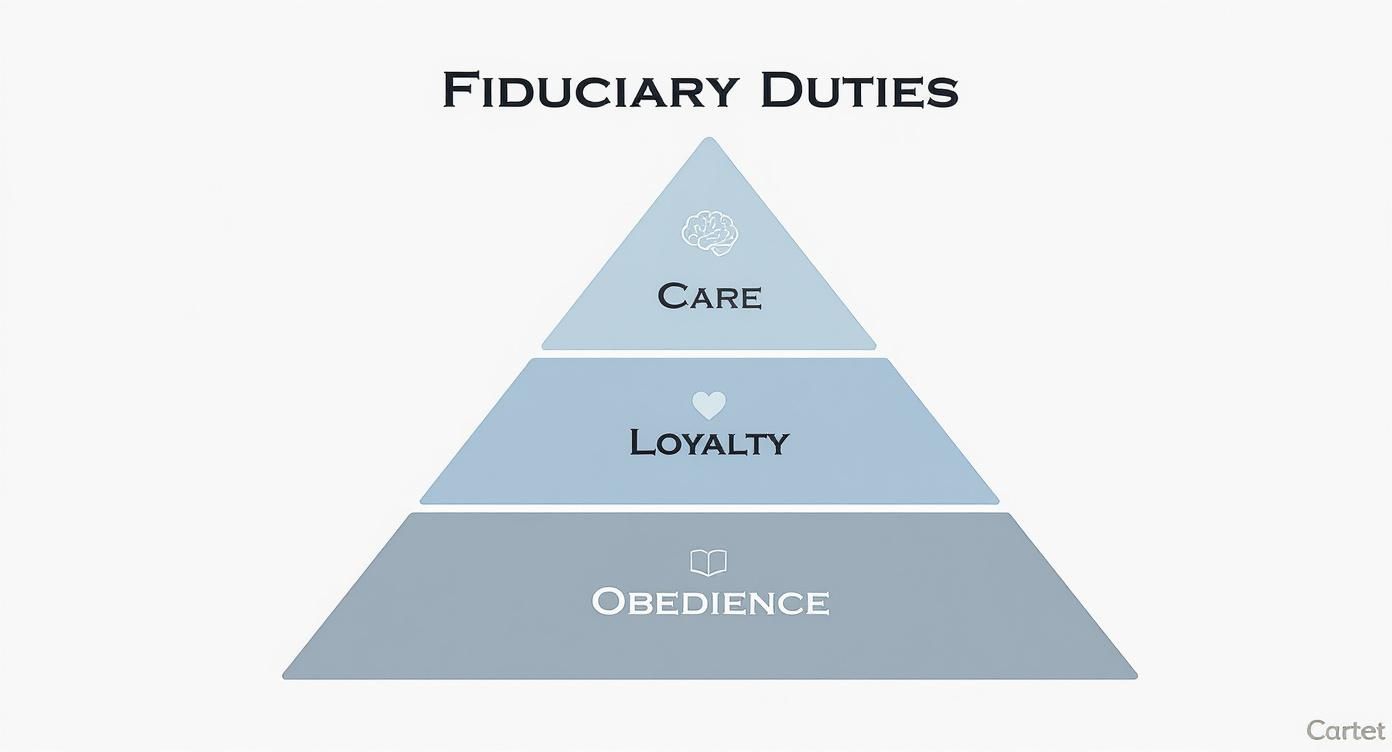
This pyramid shows that every action must be taken with diligence (Care), with undivided allegiance to the school (Loyalty), and in faithfulness to the mission (Obedience).
So, what does management look like in practice?
- Implementing the Strategic Plan: The Head of School is the one who translates the board's goals into actionable steps, programs, and initiatives.
- Managing the Budget: They oversee departmental spending and day-to-day financial operations within the budget the board approved.
- Leading Staff and Faculty: This covers all hiring, evaluation, and professional development for every school employee except the Head of School.
- Overseeing Daily Operations: This is everything else—from curriculum development and student admissions to campus safety and parent communications.
A strong partnership between the board and the Head of School is built on mutual trust and a crystal-clear understanding of these distinct roles. When the board governs and empowers the Head to manage, the entire school thrives. This separation gives leadership the space to lead effectively, knowing they have the full strategic support of the board.
Understanding and respecting this fundamental division of labor is one of the most important responsibilities a board member has.
If your private school is struggling to define these crucial boundaries, expert guidance can make all the difference. Book a call with JAG Consulting or visit our website to see how we help schools build strong governance frameworks that last.
Building an Effective Board with Strategic Recruitment
Building the right board is easily one of the most critical nonprofit board roles and responsibilities. A school's long-term health isn’t just about having great academic programs or a beautiful campus; it's shaped by the collective wisdom and commitment of the people governing it.
Strategic recruitment isn't about filling empty chairs. It's about assembling a cohesive team of leaders who have the skills, perspective, and passion to steer the school toward a mission-driven future. It all starts with an honest look at what your board actually needs.
Just like a coach builds a team by recruiting for specific positions—a strong defense, a sharp offense—a board needs to pinpoint the skills and viewpoints it’s missing. This is where you move from reactive recruiting to intentional governance.
Identifying Gaps with a Board Skills Matrix
The single best tool for this is a board skills matrix. Think of it as a diagnostic chart for your board’s collective talent. It’s just a simple grid listing your current members down one side and the essential areas of expertise your school needs across the top.
When you map out your current strengths, the gaps become immediately obvious. For most private schools, the must-have skill sets include:
- Finance and Accounting: For solid budget oversight, audits, and long-range financial planning.
- Fundraising and Development: You need people who can help secure the resources to grow.
- Legal Expertise: Invaluable for navigating contracts, compliance, and risk.
- Marketing and Communications: To guide enrollment strategy and protect the school's reputation.
- Education Leadership: Provides firsthand experience in the school's core mission.
- Community Connections: To build bridges with local leaders, businesses, and potential partners.
Using a matrix like this stops you from making the common mistake of recruiting someone based on enthusiasm alone. It ensures your board has the well-rounded expertise needed to handle whatever challenges come its way.
Here’s a sobering reality check from BoardSource research: 49% of nonprofit chief executives feel they don’t have the right board members to build community trust. The study found that only 32% of boards prioritize knowledge of the community when recruiting, creating a significant gap between the school's leadership and the families it serves. You can dig into the full findings on these governance challenges.
Cultivating a Diverse Pipeline of Candidates
Once you know what you’re looking for, the real work begins: cultivating a pipeline of potential candidates. This has to be an ongoing process, not a last-minute scramble when someone’s term is up. The Governance Committee should always have its radar on, networking and identifying individuals who not only have the needed skills but also genuinely connect with the school's mission.
Look beyond the usual suspects. Great candidates are often found among current parents and alumni, of course, but also among local business leaders and experts from entirely different nonprofit sectors. The goal is to build a board that brings a rich variety of professional experience and personal perspective to the table.
Structuring a Robust Onboarding Process
Getting a "yes" from a new recruit isn't the finish line—it's the starting line. A thoughtful onboarding process is what turns a willing volunteer into an engaged and effective leader. A rushed or non-existent orientation is a massive missed opportunity that almost always leads to confusion and disengagement.
A structured onboarding process is the bridge between a new member's potential and their actual contribution. It sets the tone for their entire tenure, ensuring they feel welcomed, prepared, and empowered to fulfill their governance duties from day one.
A truly comprehensive onboarding program should always include these three things:
- A Board Handbook: This is their go-to resource. It should contain the bylaws, strategic plan, recent financials, meeting minutes, and a full directory of board and key staff members.
- A Mentor or "Board Buddy": Pair the new member with a seasoned trustee. This gives them a personal connection and a safe person to go to with the "dumb" questions they might hesitate to ask the whole group.
- Meetings with Key Leaders: New members must meet one-on-one with the Board Chair and the Head of School. This is crucial for them to grasp the school’s strategic priorities and understand the all-important partnership between governance and management.
By investing in strategic recruitment and a welcoming, thorough onboarding process, your school can build a board that isn't just a collection of impressive résumés, but a powerful, unified force for your mission.
Is your board recruitment process as strategic as it could be? Book a call with JAG Consulting to discuss how to build a high-performing board tailored to your school's unique mission, or visit our website to learn more.
How Board Committees Drive Progress
If you want to know where the real work of a private school board happens, don't look at the full board meeting agenda. Look at the committees.
While the full board is responsible for the final vote, the deep, detailed work that makes those decisions possible rarely happens in a large group. The real engine of progress is your committee structure. These are the small, focused workgroups that dive into specific areas, allowing for much more thorough analysis and smarter recommendations.
Think of it this way: the full board meeting is the main stage presentation. The committees are the backstage crews, meticulously preparing every detail to make sure the final performance is a success. This structure allows the board to handle its wide-ranging responsibilities without getting stuck in the weeds during its limited meeting time.

This focused approach isn't just a good idea; it's a hallmark of effective governance. Research shows that most nonprofits rely on core committees like nominating, finance, and executive committees. What's telling is that 43% of organizations also create specialized committees to tackle specific needs, like strategic planning. You can dig deeper into these common governance structures in not-for-profit organizations.
The Essential Committees for a Private School
For a private school, a few standing committees are simply non-negotiable. They create the backbone of sound governance and are critical for the school's long-term health and strategic vision.
-
The Finance Committee: This group is your financial watchdog. They meet regularly with the school's business officer to pour over monthly statements, challenge budget assumptions, and oversee the annual audit. Their diligence ensures that by the time financial reports get to the full board, they've already been pressure-tested.
-
The Governance Committee: Sometimes called the Committee on Trustees, this group is in charge of the health and performance of the board itself. Their job includes identifying and recruiting new members, running the onboarding process for new trustees, providing ongoing training, and leading periodic board self-assessments. They are the guardians of board culture and effectiveness.
-
The Development (or Fundraising) Committee: This committee provides strategic leadership for the school's fundraising efforts. They work hand-in-hand with the Head of School and development team to set fundraising goals, track progress, and—most importantly—lead by example with their own giving. This group ensures the school has the fuel it needs to deliver on its mission.
How Committees Empower Strategic Thinking
By delegating the detailed work to these smaller groups, the full board frees up its most precious resource: time to focus on what matters most. That means high-level, strategic thinking.
Instead of debating individual line items in a budget, the board can discuss the long-term financial trends the Finance Committee has already identified and analyzed.
Effective committees transform board meetings from operational reviews into strategic conversations. They are the key to an efficient, forward-thinking board that can truly guide a school's future.
This structure also makes the most of the specific expertise sitting around your board table. The CPA on your board can provide tremendous value on the Finance Committee, while a marketing executive's talents are best applied to a committee focused on enrollment or advancement. It ensures every member's skills are put to their highest and best use, making their service more meaningful and their impact more powerful. A strong committee structure is the foundation for fulfilling your nonprofit board responsibilities with excellence.
Is your board’s committee structure maximizing its potential? Book a call with JAG Consulting to optimize your governance framework, or visit our website to learn how we help private schools thrive.
Optimizing Board Structure and Dynamics
A high-performing private school board isn’t just a collection of impressive résumés. It's a thoughtfully constructed team operating within a smart, intentional framework. The structure of your board—how you decide its size, how long members serve, and how committed you are to self-improvement—directly fuels its ability to govern well.
Think of it this way: just as a school curriculum needs regular updates to stay relevant, a board's structure needs intentional design to maintain its vitality and focus. Defining this structure is a core part of fulfilling nonprofit board roles and responsibilities. Without clear rules of engagement, even the most passionate group can fall prey to stagnation, groupthink, or just plain inefficiency. By getting these foundational dynamics right, your school ensures its leadership stays sharp, engaged, and aligned with its mission for years to come.
Finding the Right Board Size
One of the first structural questions every school has to answer is simple: how big should our board be? There’s no magic number, but the goal is to strike a critical balance. A board that’s too small often lacks the diverse skills and perspectives needed for robust, healthy debate. On the flip side, an oversized board can become unwieldy, making it nearly impossible for every voice to be heard and for decisions to be made efficiently.
Recent BDO research gives us a window into what’s common across the nonprofit world. Interestingly, 45% of all nonprofits have more than 20 board members, making it the most frequent size. You can dig into more governance insights from this research to see how your school stacks up. For most private schools, the sweet spot tends to fall somewhere between 15 and 25 members. This range is large enough to build a deep bench of expertise but agile enough to get things done.
The Strategic Value of Term Limits
If there’s one tool that can single-handedly keep a board dynamic and forward-thinking, it’s term limits. When trustees can serve indefinitely, a subtle but real risk of complacency can creep in. New ideas face a higher bar, institutional memory can calcify into “the way we’ve always done it,” and the board can slowly become disconnected from the current needs of the school community.
Term limits are the built-in mechanism for renewal. They create a natural, predictable cycle that brings fresh perspectives to the table, ensuring the board continuously benefits from new energy and expertise. This isn't a radical idea anymore; it's a best practice. The same BDO data reveals that 54% of nonprofits now cap board service, with the most common structure being two consecutive three-year terms.
Implementing term limits isn't about pushing good people out; it's about creating a sustainable system for bringing great new people in. This proactive approach prevents stagnation and ensures the board’s leadership reflects the evolving needs of the school.
This structure also makes succession planning a whole lot easier. When the Governance Committee knows exactly when a trustee’s term will end, they have a clear runway to identify, cultivate, and recruit the next generation of leaders. It turns transitions from a reactive scramble into a seamless and strategic process.
Driving Accountability with Board Evaluations
The final piece of an optimized structure is a genuine commitment to regular performance evaluation. A truly high-performing board holds itself accountable. An annual board self-assessment is a powerful tool for reflection and improvement, giving members a structured opportunity to honestly evaluate their collective performance.
This process helps shine a light on what’s working and what isn’t. It forces the board to ask tough but necessary questions:
- Are our meetings truly productive, or are we getting bogged down in the weeds?
- Do we have the right committee structure to support our strategic goals?
- Is our board culture inclusive and encouraging of healthy, respectful debate?
- Are we living up to our fundraising responsibilities as a board?
By embracing this cycle of self-assessment, your board moves from being a group that simply meets to a team that intentionally grows, year after year.
To help your trustees stay on track, a simple annual checklist can be incredibly effective. It serves as a personal roadmap, reminding each member of their core duties and encouraging consistent engagement throughout their term.
Sample Board Member Annual Checklist
Here is a sample checklist you can adapt to help private school board members track their key responsibilities over the course of a year.
| Task/Responsibility | Frequency | Status (Checkbox) |
|---|---|---|
| Governance & Meetings | ||
| Review and approve the annual budget. | Annually (Spring) | ☐ |
| Attend at least 75% of scheduled board meetings. | Ongoing | ☐ |
| Actively participate in at least one board committee. | Ongoing | ☐ |
| Review meeting materials thoroughly before each meeting. | Per Meeting | ☐ |
| Participate in the annual board self-assessment. | Annually (Fall) | ☐ |
| Complete and sign the annual Conflict of Interest disclosure. | Annually | ☐ |
| Fiduciary & Fundraising | ||
| Make a personal financial contribution to the school. | Annually | ☐ |
| Participate actively in fundraising initiatives (e.g., annual fund, capital campaign). | Ongoing | ☐ |
| Introduce potential new donors or supporters to the school. | Ongoing | ☐ |
| Attend at least one major fundraising or community event. | Annually | ☐ |
| Stewardship & Ambassadorship | ||
| Act as a positive ambassador for the school in the community. | Ongoing | ☐ |
| Attend a school event (e.g., play, athletic game, art show). | Per Semester | ☐ |
| Stay informed about key school programs and strategic initiatives. | Ongoing | ☐ |
| Participate in the onboarding of new board members. | As Needed | ☐ |
This checklist isn't just a to-do list; it's a tool for accountability and a reminder that effective governance is an active, year-round commitment.
Strengthening your board’s structure is a direct investment in your school’s future. To learn how to implement these best practices effectively, schedule a complimentary consultation with JAG Consulting or visit our website for more resources.
It All Comes Down to Leadership
A high-performing board isn't just a nice-to-have; it's the single most valuable strategic asset your private school can have. We've walked through the pillars of effective governance and the specific nonprofit board roles and responsibilities that make a school thrive. These aren't just abstract ideas—they're the practical framework for your school's long-term success.
Getting this right starts with absolute clarity, from the Board Chair to the newest committee member. When every leader knows exactly what their role is (and isn’t), the whole operation runs more smoothly. That clarity is anchored by an unwavering commitment to the three fiduciary duties—Care, Loyalty, and Obedience—which serve as the ethical and legal foundation for every single decision.
The Real Difference Between Good and Great Schools
Just as critical is maintaining the respectful, productive boundary between governance and management. The board’s job is to focus on the long-term "what," empowering the Head of School to master the "how." When that partnership clicks, something powerful happens: the school becomes both mission-driven and operationally excellent.
A strong board directly translates into a stronger school. The evidence is clear: effective governance leads to better fundraising, smarter strategic decisions, and the kind of stable environment where both students and faculty can do their best work. It's the invisible architecture that supports everything you do.
The ultimate measure of a board's success is the health and vitality of the school it serves. By embracing clear roles, fiduciary diligence, and a strategic focus, your board becomes the primary engine driving your school toward a sustainable and impactful future.
Building this kind of leadership team takes real intention and dedication. It’s a continuous cycle of recruitment, onboarding, self-assessment, and strategic planning. But make no mistake: investing in your board is a direct investment in every student who walks through your doors. A stronger school begins with stronger governance.
Ready to build a board that drives exceptional results for your school? JAG Consulting specializes in helping private school leaders implement best practices in governance. Book a call with JAG Consulting today to build a high-performing board tailored to your school's unique mission, or visit our website.

I'm Dr. Jeannie Gudith, Founder and CEO of JAG Consulting. We help you develop, improve, buy or sell your private school.
I'm so glad you're here
Hello!


© 2025 JAG CONSULTING.
all rights reserved. privacy policy + REFUND POLICY. TEMPLATE by sugar studios + Showit
