

The Core Responsibilities of a Principal Explained
The job of a private school principal isn’t what it used to be. The role has exploded far beyond traditional administration, now demanding strategic leadership across a dozen complex areas at once.
A modern principal is the chief architect of the school’s success. They have a direct hand in everything from the quality of classroom instruction to the long-term financial health of the institution. It’s a job that requires a rare blend of educational passion and sharp business sense. For the approximately 32,000 private schools in the United States, effective leadership is the key differentiator in a competitive market.
The Principal as a Strategic Leader
In today’s competitive private school landscape, the principal isn’t just a manager—they are the central figure driving the school’s entire mission and vision forward.
Think of them as the conductor of a symphony. Their job is to harmonize dozens of different sections—academics, operations, finance, fundraising, and community relations—to create a seamless and thriving educational experience. The quality of that leadership has a direct, measurable impact on school performance and student success.
This job demands a unique and multi-faceted skill set. A principal must be an instructional mentor for teachers, a financial steward for the board, a welcoming ambassador for parents, and a forward-thinking planner for the school’s future. Research consistently shows that a principal’s influence on student achievement is second only to the teacher in the classroom. That fact alone underscores the immense weight of the role.
The diagram below really brings home how interconnected these core responsibilities are.
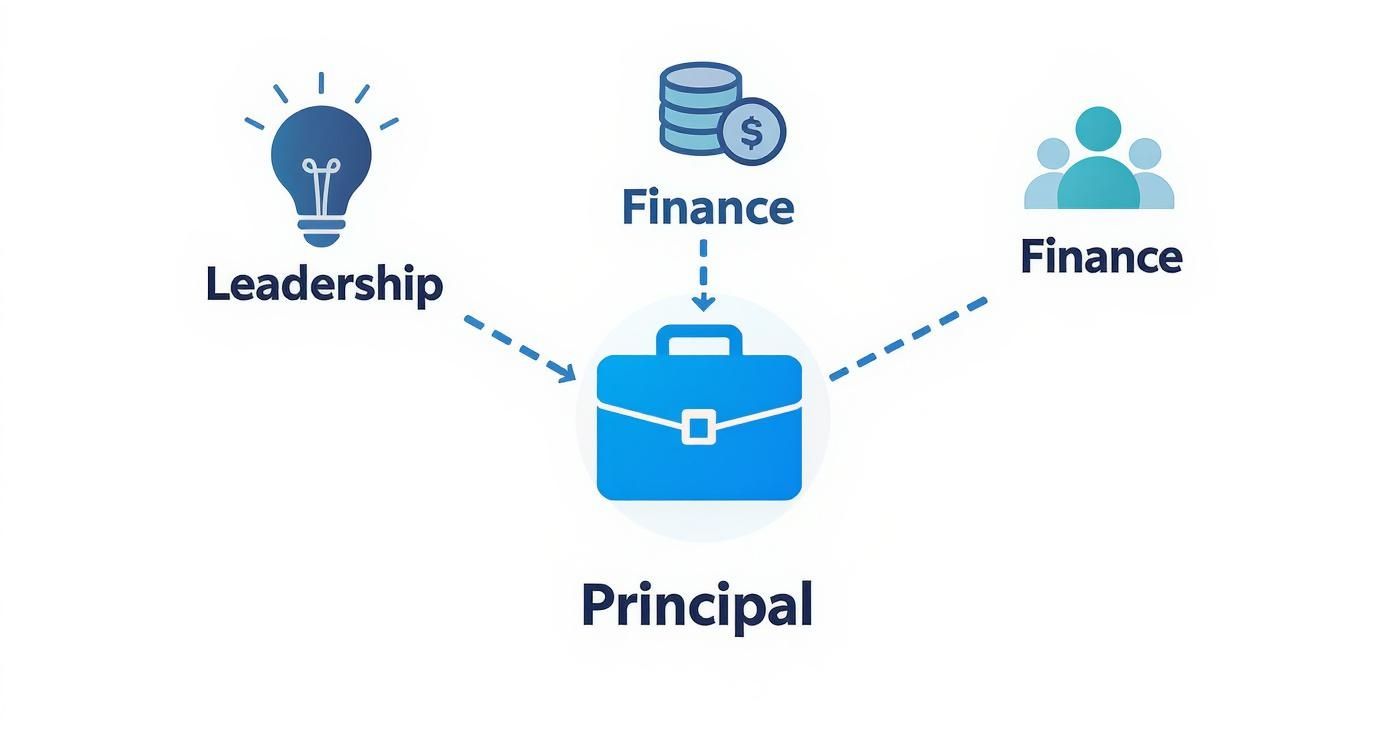
As you can see, leadership, finance, and community engagement aren’t separate silos. They are interwoven functions that all flow from the principal’s central role. Each spoke represents a critical area where the principal must provide clear direction to keep the entire school moving forward as one.
The Seven Key Domains of Responsibility
To really wrap your head around the scope of the job, it helps to break it down into seven critical domains. While they all overlap in the real world, each one requires a distinct focus and set of skills.
Here’s a quick overview of the main responsibility areas every private school principal owns.
| Principal’s Core Responsibility Areas at a Glance |
| :— | :— |
| Responsibility Area | Primary Focus |
| Instructional Leadership | Shaping the academic vision, overseeing curriculum, and championing professional growth for faculty. |
| Operations Management | Ensuring the smooth, safe, and efficient day-to-day running of the school, from facilities to technology. |
| Financial Stewardship | Managing the budget, setting tuition, leading fundraising efforts, and ensuring long-term financial health. |
| Human Resources | Recruiting, hiring, evaluating, and retaining a top-tier, mission-aligned faculty and staff. |
| Governance and Compliance | Working with the board, meeting accreditation standards, and navigating the private school legal landscape. |
| Community Relations | Serving as the face of the school, engaging parents, alumni, and the wider community to build a strong support network. |
| Strategic Planning | Developing and executing the long-range plans that guide the school’s growth, innovation, and sustainability. |
Mastering these seven areas is no small feat. It requires a leader who can think strategically about the five-year plan while simultaneously managing the day-to-day details that keep the lights on.
A landmark study by the Wallace Foundation found that effective principals can boost student test scores by as much as 10 percentile points in a single school year. This just goes to show the very real, tangible outcomes that great leadership produces.
If you’re looking to strengthen your school’s leadership and build a more strategic direction, the experts at JAG Consulting can help. Book a complimentary consultation with us today or visit our website to see how we help schools like yours thrive.
Driving Academic Excellence Through Instructional Leadership
While a principal certainly wears a lot of hats, the most fundamental one is being the school’s chief academic officer. This is where the mission hits the classroom. Real instructional leadership goes way beyond just managing schedules and budgets; it’s about actively building a powerful academic culture that defines the school’s reputation and, most importantly, drives student success.
This isn’t a passive role. It demands that the principal be the architect of the school’s academic vision, making sure every single teacher, student, and parent knows what excellence looks like and how to get there. It’s one of those core responsibilities of a principal that separates a good school from a truly great one.

This vision isn’t just a fancy statement on your website. It has to live and breathe in your curriculum, your teaching methods, and the professional development you offer your faculty. A strong instructional leader ensures the curriculum is both rigorous and relevant, preparing students not just for the next test, but for a future we can’t even fully predict yet.
Fostering a Culture of Growth
A school is only as strong as its teachers. Because of that, a principal’s key function is to create an environment where teachers feel empowered and are constantly growing. This is about more than just a once-a-year training day; it means building a genuine system of continuous improvement.
Great instructional leaders champion this kind of ongoing professional development. And it’s not just a nice-to-have; it’s a global standard. In fact, 73% of countries expect principals to actively support staff development. This commitment helps teachers stay on top of best practices and constantly refine their craft, which lifts the quality of instruction in every single classroom. You can read more about the global perspective on principals as instructional leaders to see just how critical this is worldwide.
Instructional leadership is a critical dimension of a principal’s responsibilities across the globe. More than 50% of students internationally attend schools where principals dedicate significant time to promoting educational goals and monitoring their implementation by teachers.
So, what does this look like in practice? It comes down to a few key actions:
- Observing Classrooms: Getting into classrooms regularly and constructively to see teaching in action, understand what’s working, and spot areas for growth.
- Providing Actionable Feedback: Delivering specific, supportive feedback that actually helps teachers improve. The goal is to inspire, not discourage.
- Facilitating Collaboration: Creating time and space for teachers to learn from each other through things like peer observation, mentorship programs, and shared planning sessions.
Using Data to Inform Instruction
In private schools, data is an incredibly powerful tool for driving academic excellence. An effective instructional leader doesn’t just use student performance data for report cards or board meetings; they use it as a diagnostic tool to make smarter decisions about teaching and learning.
This means looking beyond the raw test scores to understand the story behind the numbers. A principal should be guiding their teachers to analyze data to pinpoint learning gaps, tweak their instructional strategies, and give targeted support to students who need it most.
For instance, let’s say the data shows a group of students is really struggling with a specific math concept. The principal can work with the math department to:
- Review the curriculum materials for that specific unit.
- Bring in targeted professional development on new strategies for teaching that concept.
- Implement small-group interventions for the students who are falling behind.
- Track their progress to make sure the new strategies are actually working.
This data-informed approach is what transforms a principal from a manager into a strategic academic leader. By focusing on curriculum, teacher growth, and the smart use of data, a principal fulfills their most important duty: ensuring every student gets the best possible education.
Feeling overwhelmed by the scope of instructional leadership? JAG Consulting specializes in helping private school leaders build robust academic frameworks and effective professional development programs. Book a call with our experienced consultants or visit our website to learn how we can help you drive academic excellence.
Ensuring a Thriving School Through Financial Stewardship
Beyond the classroom, one of the most critical responsibilities of a principal at a private school is to step into the shoes of a chief operating and financial officer. A private school is a unique hybrid: it’s a mission-driven educational community that absolutely must run with the discipline of a successful business. Strong financial stewardship isn’t just about balancing the books; it’s about pouring the concrete foundation that every academic program, faculty position, and student experience is built upon.
Without a sound financial model, even the most inspiring educational vision will crumble. The principal is at the helm, tasked with steering the school through complex financial waters—from setting tuition rates that are both competitive and sufficient, to managing multimillion-dollar budgets. This requires a sharp, real-world understanding of the school’s unique economic landscape.

This role is about much more than just accounting. It’s about strategic resource allocation and making sure every single dollar spent directly supports the school’s mission and enhances student learning. It’s a constant balancing act between investing in innovative new programs and maintaining the core infrastructure that keeps the school running safely and smoothly day in and day out.
Building a Defensible Budget
A school’s budget is more than a spreadsheet; it’s a moral document that shows exactly what the school values. The principal must lead the charge in creating a defensible budget that lines up financial resources with strategic goals. This means getting in the trenches with department heads, the business office, and the board to forecast revenue and expenses with precision.
Key components of this responsibility include:
- Tuition Setting: Analyzing market data, what competitors are charging, and the school’s own value proposition to set tuition fees that can fund operations without pricing out the families you want to attract.
- Expense Management: Diligently overseeing every expenditure, from faculty salaries—which can easily account for up to 80% of a private school’s budget—all the way down to smaller operational costs.
- Financial Reporting: Clearly and consistently communicating the school’s financial position to the board and other key stakeholders, which builds trust through transparency and accountability.
A huge part of financial health is bringing in money from more than just one place. While tuition is the primary engine, it rarely covers the full cost of educating a student. This is where fundraising and donor cultivation become absolutely essential.
A study on private school finances revealed that, on average, fundraising and auxiliary programs can contribute between 10% and 20% of a school’s annual operating revenue. This highlights the principal’s vital role in development and building a culture of philanthropy.
Overseeing Operations and Infrastructure
Financial health is directly tied to operational excellence. The principal oversees the management of the school’s entire physical and technological infrastructure to ensure a safe, efficient, and modern learning environment. This is a massive undertaking that touches everything from campus maintenance to cybersecurity.
A principal’s operational playbook has to cover:
- Facilities Management: Making sure the buildings are safe, clean, and truly conducive to learning. This involves managing maintenance schedules, planning for big-ticket capital repairs, and overseeing any campus improvement projects.
- Technology Integration: Managing the school’s entire tech infrastructure, from network security to the effective use of educational software in the classroom. This requires staying current with what’s happening in tech and making smart investment decisions.
- Vendor and Contract Management: Negotiating and managing contracts for critical services like transportation, food service, and cleaning to ensure the school is getting high quality at a cost-effective price.
Ultimately, strong financial and operational oversight provides the stability needed for academic excellence to truly flourish. It ensures teachers have the resources they need, students have a safe and inspiring place to learn, and the school remains viable for generations of families to come.
If you are looking to strengthen your school’s financial model or streamline its operations, our team at JAG Consulting has decades of hands-on experience. Schedule a consultation with our team or visit our website to explore our services.
Building Your Team and Navigating School Governance
If the school’s finances are its foundation, then its people are its heart and soul. A huge part of a principal’s job is acting as the chief of human resources—tasked with building a team of talented people who are genuinely aligned with the school’s mission. This isn’t just an administrative task; it’s a core function that directly shapes the school’s culture and its very ability to deliver on its promise to families.
This responsibility runs the gamut, covering the entire lifecycle of an employee. From hunting for top-tier educators to putting fair and effective evaluation systems in place, the principal is the conductor of the school’s human orchestra. Creating a positive, professional culture that doesn’t just attract but also keeps great teachers is everything for long-term success.
At the same time, the principal has to navigate the often-tricky world of school governance. This means building a strong, collaborative partnership with the school’s board of directors. This relationship is the bedrock of the school’s strategic vision, making sure it stays compliant, protected, and focused on the future.
Cultivating a High-Performing Faculty
A principal’s greatest legacy is often the team they leave behind. It all starts with strategic recruitment—finding educators who not only have incredible skills but who also truly get and believe in the school’s unique mission. In the cutthroat private school market, getting the right fit is make-or-break.
Once you’ve got them on board, the game shifts to growth and retention. The best principals create systems for professional evaluation that feel supportive, not like a “gotcha.” This means regular classroom visits, constructive feedback that actually helps, and personalized professional development that empowers teachers to become masters of their craft.
Key strategies for building a killer faculty include:
- Structured Onboarding: Don’t just hand new hires a key and a map. Create a comprehensive onboarding process that immerses them in the school’s culture, curriculum, and community from day one.
- Mentorship Programs: Pair new teachers with seasoned veterans. This gives them a trusted guide for advice and support, taking a huge weight off their shoulders.
- Clear Evaluation Rubrics: Use transparent and consistent criteria so teachers know exactly what’s expected and how they can hit the mark. No one likes guessing games.
Keeping great teachers is a massive challenge, with turnover costing schools billions every year. Research consistently shows that supportive leadership is one of the biggest factors in a teacher’s decision to stay. A principal who actively builds a positive work environment can slash turnover by as much as 40%.
Navigating Governance and Compliance
Beyond leading the team, the principal is the main link between the school’s day-to-day hustle and its governing board. A healthy relationship here is built on trust, total transparency, and a shared understanding of roles—the board governs, the principal manages. Simple as that.
This partnership is essential for navigating the complex legal and regulatory landscape of private schools. The principal ensures the school meets all accreditation standards, which are vital for its reputation. They also oversee the creation and enforcement of key policies that protect everyone in the community.
These policies aren’t just paperwork; they cover critical ground:
- Student Safety Protocols: Having rock-solid procedures for everything from campus security to emergency drills.
- Data Privacy and Protection: Safeguarding sensitive student and staff information in a world of ever-changing privacy laws.
- Legal Compliance: Keeping up with employment law, admissions rules, and all the other legal requirements that affect private schools.
It’s worth noting that a principal’s duties can look dramatically different from one country to the next, especially in areas like staff development and curriculum. A global analysis of 211 education systems found major differences in how much authority principals have, which just goes to show how critical it is for leaders to understand their specific context. You can discover more about this global snapshot of the role of a school leader to get a feel for these international variations.
Ultimately, mastering HR and governance is what makes a school not just a great place to learn, but also a safe, compliant, and well-oiled organization.
If you need expert guidance in strengthening your school’s governance model or building a more effective leadership team, JAG Consulting can help. Book a call with our experienced consultants or visit our website to learn more.
Becoming the Face of the School Community
A private school’s success is rarely contained within its campus walls. The principal isn’t just an internal manager; they are the school’s chief storyteller, primary brand ambassador, and the public face of its mission. This external-facing role is easily one of the most critical responsibilities of a principal, directly shaping public perception, driving enrollment, and building a loyal community that will sustain the school for decades.
In this role, the principal has to skillfully weave together parent communication, alumni engagement, and public relations into a single, compelling story. That story needs to scream the school’s unique value, making it the obvious choice for prospective families in what’s often a crowded market. It’s all about building a brand that resonates with integrity, excellence, and a deep sense of community.
Mastering Communications and Community Engagement
Clear, consistent communication is the lifeblood of any strong school. Today’s parents don’t just want information; they expect timely, transparent, multi-channel communication that feels like a genuine dialogue, not a broadcast.
But real engagement goes far beyond newsletters and social media updates. It demands a visible, approachable presence from the school’s leader.
- Parent Partnerships: This means creating genuine partnerships with parents, who can become a school’s most powerful advocates. Research consistently shows that schools with strong family and community ties see higher student achievement and better teacher morale.
- Alumni Relations: It’s about building a robust alumni network that does more than just donate. A great network provides mentorship for current students and becomes a reliable source of philanthropic support for the future.
- Wider Community Building: This involves establishing the school as a valuable local institution through partnerships, community events, and service projects that enhance its reputation and goodwill.
Strong community engagement directly fuels a private school’s sustainability. A positive reputation can increase enrollment inquiries by as much as 20-30% and is a game-changer in successful fundraising campaigns.
Aligning Strategy with a Vision for the Future
Beyond the day-to-day communications, the principal’s most significant external role is to be the school’s chief visionary. This isn’t about dreaming; it’s about developing and executing a comprehensive strategic plan that sets a clear, actionable course for the future. A well-crafted plan is a living roadmap, not a static document collecting dust on a shelf. It guides every major decision, from new academic programs to campus expansion.
This strategic plan must set ambitious but achievable goals for core areas like enrollment growth, academic innovation, and facility improvements. It translates the school’s mission into a series of actionable steps, ensuring every initiative is purposeful and locked into the long-term vision. This is the forward-looking leadership that secures a school’s legacy.
Differentiating Strategic Focus by School Size
A principal’s strategic priorities and day-to-day focus can look dramatically different depending on the size of the school. A savvy leader knows how to adapt their approach to meet the unique challenges and opportunities presented by their school’s scale.
Here’s a look at how those priorities often shift:
Principal’s Strategic Focus by School Size
| Responsibility Area | Small School Focus (Under 200 Students) | Medium School Focus (200-500 Students) | Large School Focus (500+ Students) |
|---|---|---|---|
| Community Relations | Building a tight-knit, family-like culture where every parent feels known and heard. The principal is highly visible and personally involved in most interactions. | Systematizing communication and creating formal parent organizations (e.g., PTO/PTA) to maintain a strong sense of community as the school grows. | Delegating community relations to a leadership team while serving as the high-level visionary and primary liaison to the board and major donors. |
| Admissions & Marketing | Primarily driven by word-of-mouth marketing and personal tours led by the principal. Every family interaction is a critical marketing opportunity. | Developing a formal marketing plan, investing in digital advertising, and hiring dedicated admissions staff to manage a larger pipeline of prospective families. | Overseeing a full admissions department, focusing on brand management, market positioning, and long-range enrollment forecasting. |
| Strategic Planning | Focusing on establishing core programs, achieving initial accreditation, and building a sustainable enrollment base. The plan is often more tactical and immediate. | Expanding program offerings, planning for campus improvements, and building a more robust fundraising program to support long-term growth and innovation. | Leading comprehensive, multi-year strategic plans involving capital campaigns, endowment growth, and long-term campus master planning. |
Ultimately, whether you’re leading a small, scrappy school or a large, established institution, your ability to build community and steer the ship with a clear strategic vision is what separates the good principals from the great ones.
If you need expert assistance in developing a powerful strategic plan or aligning your admissions and marketing efforts, the team at JAG Consulting is here to help. Book a call with us today or visit our website to learn how we guide private schools toward a secure and prosperous future.
Mastering the Art of Prioritization and Delegation
The sheer volume of responsibilities a principal juggles is staggering. On any given day, you’re bouncing between urgent student matters, long-term strategic planning, and a dozen other “fires” that pop up unexpectedly. Without a system to manage this relentless demand, burnout isn’t just a risk; it’s a near certainty.
This is why mastering prioritization and delegation isn’t a soft skill—it’s a critical survival tool for effective school leadership. The goal is to shift your focus from doing everything to ensuring everything gets done right. This frees you up for the high-impact, visionary work that only you can do.
This challenge is amplified by a heavy administrative load. Globally, principals are drowning in paperwork instead of focusing on instructional leadership. In fact, data from the Teaching and Learning International Survey (TALIS) shows that roughly 60% of principals spend a staggering 30-54% of their work time on administrative duties.
This administrative burden is a key driver of leader burnout and raises serious questions about the sustainability of the role. You can learn more about these findings on principal responsibilities and see just how deep the problem runs.
A Framework for Prioritization
To cut through the daily noise, a proven framework like the Eisenhower Matrix is invaluable. It’s a simple tool that helps you categorize every task by urgency and importance, giving you a clear path forward.
For a private school principal, this might look like:
- Urgent & Important (Do Now): These are the non-negotiables that demand your immediate attention. Think of a student safety issue, a critical parent meeting, or an accreditation report deadline.
- Important, Not Urgent (Schedule): This is where real leadership happens. We’re talking strategic planning sessions, developing next year’s budget, or mapping out teacher professional development. You have to proactively block time for these, or the “urgent” will always crowd them out.
- Urgent, Not Important (Delegate): These tasks feel pressing but don’t require your specific expertise. This includes routine administrative paperwork, organizing event logistics, or fielding standard parent questions that your team can handle.
- Neither Urgent Nor Important (Eliminate): Be ruthless here. Cut out inefficient meetings, tasks that don’t align with school goals, or anything that adds little real value to your mission.
Empowering Your Team Through Delegation
Great delegation is about empowerment, not just offloading tasks. The secret is to delegate outcomes, not methods. Trust your leadership team—from assistant principals to department heads—to take ownership and find the best way to get the job done.
The core principle of effective leadership is not to do more, but to build capacity in others. By delegating effectively, you multiply your impact and develop future leaders within your school.
When deciding what to delegate, ask yourself who has the right skills, context, and capacity. A well-delegated responsibility not only frees up your time but also becomes a powerful professional growth opportunity for your staff.
Struggling to find the right balance between doing and leading? The experts at JAG Consulting specialize in helping school leaders optimize their structures and workflows. Schedule a consultation with our team or visit our website to learn how we can help you lead more effectively.
A Few Common Questions About the Principal’s Role
Running a private school is a balancing act, and we often hear the same questions from school leaders and board members trying to navigate the complexities of the job. The principal’s responsibilities are huge, blending a clear academic vision with the hard realities of running a business. Here are some straightforward answers to the most common questions we get.
What’s the Single Most Important Part of the Job?
While everything is connected, it all comes back to instructional leadership. A principal’s number one job is to make sure great teaching and learning are happening every single day. Everything else—the budget, the open houses, the board meetings—is there to support that core mission.
Studies consistently show that a principal’s leadership is the second most significant school-related factor in student success, right after classroom instruction. This underscores why focusing on academic excellence is paramount.
When a principal is a strong instructional leader, teachers feel supported and are far more likely to stay. In fact, great leadership can slash staff turnover by as much as 40%. That kind of stability is the bedrock of any great school.
How Is a Private School Principal’s Job Different from a Public School Principal’s?
The heart of the job—the academic leadership—is pretty similar. The biggest difference is that private school principals have to wear a business hat much more often.
The key distinctions usually fall into three areas:
- Financial Management: Private school principals are right in the thick of it—setting tuition, building the budget, and leading the fundraising that keeps the lights on.
- Admissions and Enrollment: They’re not just educators; they’re the chief marketers and recruiters, responsible for filling classrooms to keep the school financially healthy.
- Governance: The relationship with a board of directors is absolutely central. This requires a knack for collaboration, clear reporting, and keeping everyone aligned with the school’s long-term vision.
In short, a private school principal has to be both an educator and an entrepreneur, constantly balancing the school’s mission with the realities of the market.
Can One Person Realistically Do All of This?
Absolutely not, and they shouldn’t even try. The sheer scope of the role makes effective delegation a non-negotiable survival skill.
The best principals I’ve worked with are masters at building a strong leadership team. They surround themselves with talented assistant principals, department heads, and business managers and then—this is the crucial part—they give them real authority to get things done.
The principal’s job isn’t to do everything; it’s to make sure everything gets done well. By handing off the day-to-day operational tasks, they free themselves up to focus on the big-picture work that only they can do: coaching teachers, cultivating major donors, and steering the strategic direction of the school. That’s where they create the most value.
Navigating these multifaceted responsibilities requires specialized expertise. At JAG Consulting, we provide school leaders with the strategic frameworks and practical support needed to thrive. To discuss your school’s unique challenges, book a complimentary consultation or visit our website.

I'm Dr. Jeannie Gudith, Founder and CEO of JAG Consulting. We help you develop, improve, buy or sell your private school.
I'm so glad you're here
Hello!


