

Accreditation vs Certification: A Guide for Private Schools
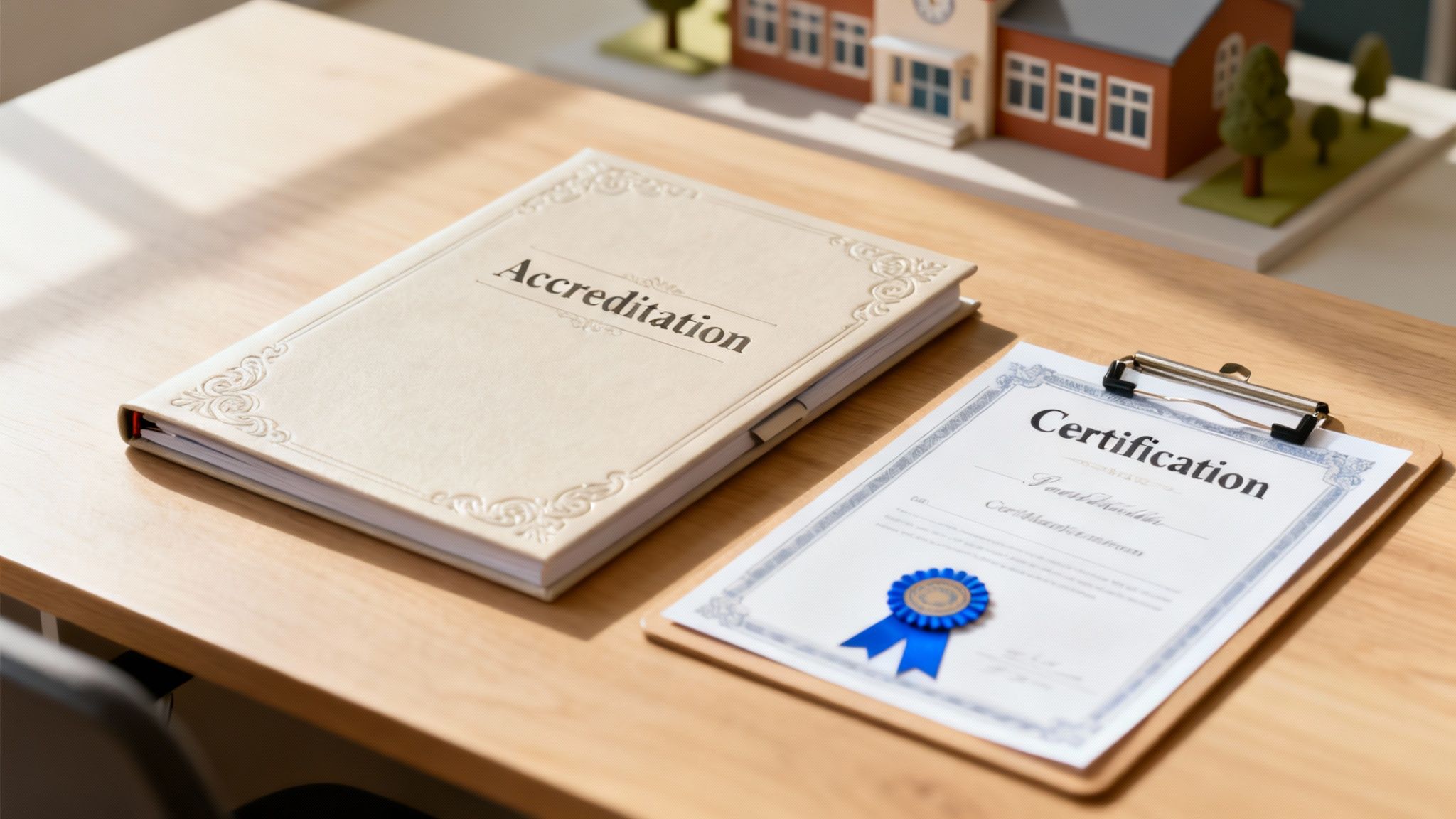
The real difference boils down to this: Accreditation evaluates your entire school, while certification puts a specific program, process, or person under the microscope. For private school leaders, think of accreditation as the foundational endorsement of your school's overall quality, and certification as a spotlight on specialized excellence.
Understanding Accreditation vs Certification in Education
School leaders often use the terms accreditation and certification interchangeably, but they represent two very different pathways for demonstrating quality. Getting this right isn’t just about semantics—it’s critical for your strategic planning, how you market your private school, and its long-term health.
Accreditation asks a big-picture question: "Is this school delivering a quality education and operating effectively as a whole?" It's a comprehensive, top-down validation from a recognized agency that looks at everything from your mission and governance to your financial stability and student outcomes. This is the process that builds foundational trust with parents, colleges, and the community. A 2021 survey confirmed that 74% of parents rated school reputation as a top factor when choosing a private school—a reputation that accreditation directly builds.
Certification, on the other hand, asks a much more focused question. Think: "Does our early childhood program meet specific developmental benchmarks?" or "Is our faculty trained in a particular project-based learning method?" It highlights excellence in a single area, which can be a powerful way to stand out in a crowded market.
Core Distinctions for School Leaders
Making the right decision for your private school means getting a clear view of how these credentials actually compare in practice. One builds your school's fundamental reputation, while the other adds compelling layers of specialized appeal. This choice directly impacts how you allocate resources, what you prioritize, and how you tell your school's story to prospective families.
A recent study in the healthcare field found a similar dynamic, showing that accredited hospitals had quality compliance scores of 66.9%, a good deal higher than certified-only institutions at 60.0%. This really highlights the broader and more rigorous nature of a full institutional accreditation.
To make this even clearer, let's break down the key differences.
At a Glance Accreditation vs Certification for Schools
This table offers a direct comparison to help you quickly see how institutional accreditation and specific certifications differ in a private school context.
| Attribute | Accreditation (Institutional) | Certification (Programmatic or Systemic) |
|---|---|---|
| Scope | Evaluates the entire institution (governance, finance, curriculum, student services). | Focuses on a specific program, department, system, or individual skill set. |
| Purpose | To validate overall institutional quality, integrity, and viability. | To verify that a specific component meets defined, technical standards of excellence. |
| Outcome | Endorsement of the school's credibility, enabling credit transfers and diploma recognition. | Recognition of specialized expertise or operational efficiency in a targeted area. |
| Example | Regional accreditation from a body like the New England Association of Schools and Colleges (NEASC). | A certified STEM program, an ISO 9001 quality management system, or a National Board Certified Teacher. |
Ultimately, the choice isn't about picking one over the other. For most private schools, the smartest strategy involves securing accreditation as the baseline for institutional credibility, then pursuing targeted certifications to showcase your unique strengths and signature programs.
Navigating this landscape can feel complex. If you need an expert to help you build a credentialing strategy that truly aligns with your school's mission, we can help. Book a call with JAG Consulting https://link.jagconsultingservices.com/widget/bookings/prospective/school/consultation/zoom to chart a clear path forward or learn more about our services on our website.
Why Accreditation Is a Strategic Imperator
For a private school, accreditation isn't just another bureaucratic hoop to jump through. Think of it as the bedrock of your school's credibility. This isn't about just checking a box; it's a rigorous peer-review process that serves as powerful, third-party validation that your school is delivering on its promise of educational quality. It sends a clear signal to parents, donors, and colleges that your mission, curriculum, and operations have been thoroughly vetted and approved by other experts in the field.
That validation has real, tangible consequences. An accredited status is often the key that unlocks opportunities for your students, making it much easier to transfer credits and significantly strengthening their college applications. For many families weighing their options, knowing their child’s diploma will be recognized and respected isn't just a bonus—it's a dealbreaker. In fact, 85% of private school parents view college preparation as a primary reason for their choice, and accreditation directly underpins this value proposition.
Building Credibility and Ensuring Quality
Pursuing accreditation signals a deep, institutional commitment to getting better every single year. The process itself—which involves a detailed self-study and an external review by fellow educators—forces a private school to hold up a mirror and critically assess its own strengths and weaknesses. This structured evaluation is what drives meaningful, lasting change, ensuring your programs stay relevant and effective.
It demonstrates to your entire community that you are dedicated to a standard of excellence that goes far beyond the minimum requirements. That commitment resonates deeply with discerning families who are looking for the absolute best for their children.
While accreditation is a holistic review of an entire institution, research shows a strong correlation with higher compliance in quality and safety systems. One study, though focused on healthcare, found that accredited organizations hit a 66.9% compliance score. That's significantly higher than certified organizations at 60.0% and leaps and bounds above institutions with no external assessment, which came in at just 51.2%. This highlights how the comprehensive nature of accreditation fosters a stronger culture of quality across the board. You can dive into the full findings of this quality systems research to see the data for yourself.
Key Takeaway: Accreditation isn't just about meeting a set of standards. It’s about building a cycle of self-reflection and improvement into your school's DNA, elevating everything from classroom instruction to boardroom governance.
The Tangible Return on Investment
Beyond academic credibility, accreditation delivers a concrete return on investment that directly impacts your private school’s financial health and long-term viability. Many private foundations and government grant programs list accreditation as a non-negotiable prerequisite. Without it, your school is automatically shut out of major funding opportunities that could support new programs, scholarships, or campus improvements.
This credential also plays a huge role in attracting top talent. High-caliber educators and administrators are naturally drawn to institutions with a proven commitment to professional standards. An accredited school is seen as a more stable, professional, and rewarding place to build a career, making it far easier to attract and retain the best faculty and staff.
This ability to secure funding and attract exceptional teachers creates a powerful positive feedback loop:
- Better Funding: Access to grants and major gifts allows for enhanced resources, better facilities, and innovative programs.
- Stronger Faculty: Talented, mission-aligned educators improve student outcomes and elevate the quality of your academic programs.
- Enhanced Reputation: Improved results and resources attract more of the right-fit families, strengthening your community and enrollment pipeline.
In a crowded private school market, accreditation becomes one of your most powerful marketing tools. It provides a clear, defensible answer to the question every parent asks: "Why should we choose your school?" It underpins your enrollment strategy, justifies your tuition levels, and gives families and donors the assurance they need to invest in an institution of proven quality.
Navigating the accreditation process can be a formidable task, requiring dedicated resources and expert guidance. If your school is ready to pursue this strategic imperative but needs a clear roadmap, we can help. Book a call with JAG Consulting https://link.jagconsultingservices.com/widget/bookings/prospective/school/consultation/zoom to discuss your accreditation readiness, or visit our website to see how we’ve guided other schools to success.
What About Specialized Certifications?
While broad institutional accreditation is about confirming your private school's overall health and quality, specialized certifications act like spotlights. They illuminate specific pockets of excellence for prospective families to see. It’s a targeted approach that moves beyond general validation to showcase true mastery in the areas that matter most to your market. This is how you prove your school doesn't just meet standards, but excels in them.
Think of it this way: accreditation is the strong foundation of your school's reputation. Certifications are the custom-built features that make your school truly unique and desirable. They offer tangible proof of a specific capability or commitment, helping you stand out in an incredibly competitive private school market.
This distinction is crucial. When a family is weighing two well-regarded, accredited private schools, a specialized certification can absolutely become the deciding factor. It signals a deeper, more intentional investment in a particular program or philosophy, which resonates powerfully with parents seeking the absolute best fit for their child.
Differentiating Your School with Programmatic Excellence
One of the most effective ways to leverage certifications is to validate your signature programs. A private school with a robust science and technology curriculum, for instance, can pursue a STEM program certification. This credential does a lot more than just look impressive on a brochure; it verifies that your curriculum, your faculty, and your resources all meet rigorous, third-party benchmarks for excellence in that specific field.
This provides an immediate competitive advantage. It tells families passionate about STEM that your school has a proven, high-quality program, not just a handful of interesting science classes. The same logic holds true for other areas:
- Arts Program Certification: Validates the depth and quality of your fine arts, music, or theater departments.
- Special Education Certification: Demonstrates a verified capacity to support students with diverse learning needs, building immense trust with families who need it most.
- Language Immersion Certification: Confirms the effectiveness and authenticity of your bilingual education model.
These certifications transform your marketing claims into verified facts, giving your enrollment team a powerful and credible story to tell.
Proving Faculty Quality and Operational Rigor
Certifications aren't limited to student-facing programs. They can also highlight the quality of your faculty and the efficiency of your school's operations—two areas that are critically important to discerning parents and potential investors.
Teacher-specific credentials, like National Board Certification, are a perfect example. This highly respected certification is a voluntary, advanced teaching credential that goes far beyond basic state licensure. When you can state that a significant percentage of your faculty is National Board Certified, you're providing concrete evidence of teacher expertise and a deep dedication to the craft of teaching. In fact, private schools that highlight having 25% or more of their faculty with advanced degrees or certifications see a noticeable boost in enrollment inquiries.
For private schools, promoting the number of National Board Certified teachers on staff is a powerful marketing tool. It directly answers a key parental concern: 'How do I know my child will have the best possible teachers?'
On the operational side, a credential like ISO 9001 demonstrates a school's commitment to quality management systems. It shows that your administrative processes—from admissions and records to parent communication—are streamlined, consistent, and focused on continual improvement. The global demand for this kind of verification is growing fast. According to the ISO Survey 2022, there were 1,265,216 ISO 9001 certificates issued worldwide, a 44% increase from previous years, showing just how many organizations are using it to sharpen their competitive edge. You can dig into this trend by reading the full ISO Survey 2022 report.
Ultimately, certifications add layers of proven excellence on top of your accredited foundation. They allow your private school to build a multi-faceted brand that appeals to a wider range of families while showcasing a deep commitment to quality in every part of your institution.
If you are looking to identify which certifications will have the greatest impact on your school's brand and enrollment, expert guidance can make all the difference. Book a call with JAG Consulting https://link.jagconsultingservices.com/widget/bookings/prospective/school/consultation/zoom to create a strategic plan, or visit our website to learn more.
Comparing the Path to Accreditation and Certification
Private school leaders often ask us whether accreditation or certification is the "better" path. The honest answer? It depends entirely on your goals. While both are powerful signals of quality, the journey to achieve them couldn't be more different in terms of scope, intensity, and the resources you'll need to commit.
Think of it this way: accreditation is a marathon. It’s an intensive, all-hands-on-deck process that pulls in your entire community—from the board and faculty right down to parents and staff. Certification, on the other hand, is more like a targeted sprint, focused on a specific program or system with a much clearer, more contained finish line.
Deconstructing the Accreditation Journey
The accreditation process is deliberately exhaustive. Its goal is to validate your entire institution, forcing a period of deep self-reflection that can easily take 12 to 24 months to complete. This isn't a simple audit; it's about institutional transformation and building a sustainable culture of continuous improvement.
Key stages typically include:
- Candidacy Status: This is the starting block. You prove to the accrediting body that your school is operationally stable, has a clear mission, and is ready for the rigorous self-study process.
- The Self-Study: Here's the heavy lifting. This phase often consumes a full academic year as committees gather evidence, analyze data, and write a massive report evaluating every aspect of your school against the agency's standards.
- Peer Review Team Visit: A team of experienced educators from other accredited schools spends several days on your campus. They're there to verify the claims in your self-study, observing classes and interviewing everyone from board members to students.
- Commission Review and Decision: The accrediting body’s commission reviews your self-study and the peer review team's report to make their final decision: grant, defer, or deny accreditation.
- Ongoing Reporting: Accreditation isn't a one-and-done award. You'll need to submit regular reports and prepare for a full re-evaluation every 5 to 10 years to keep your status.
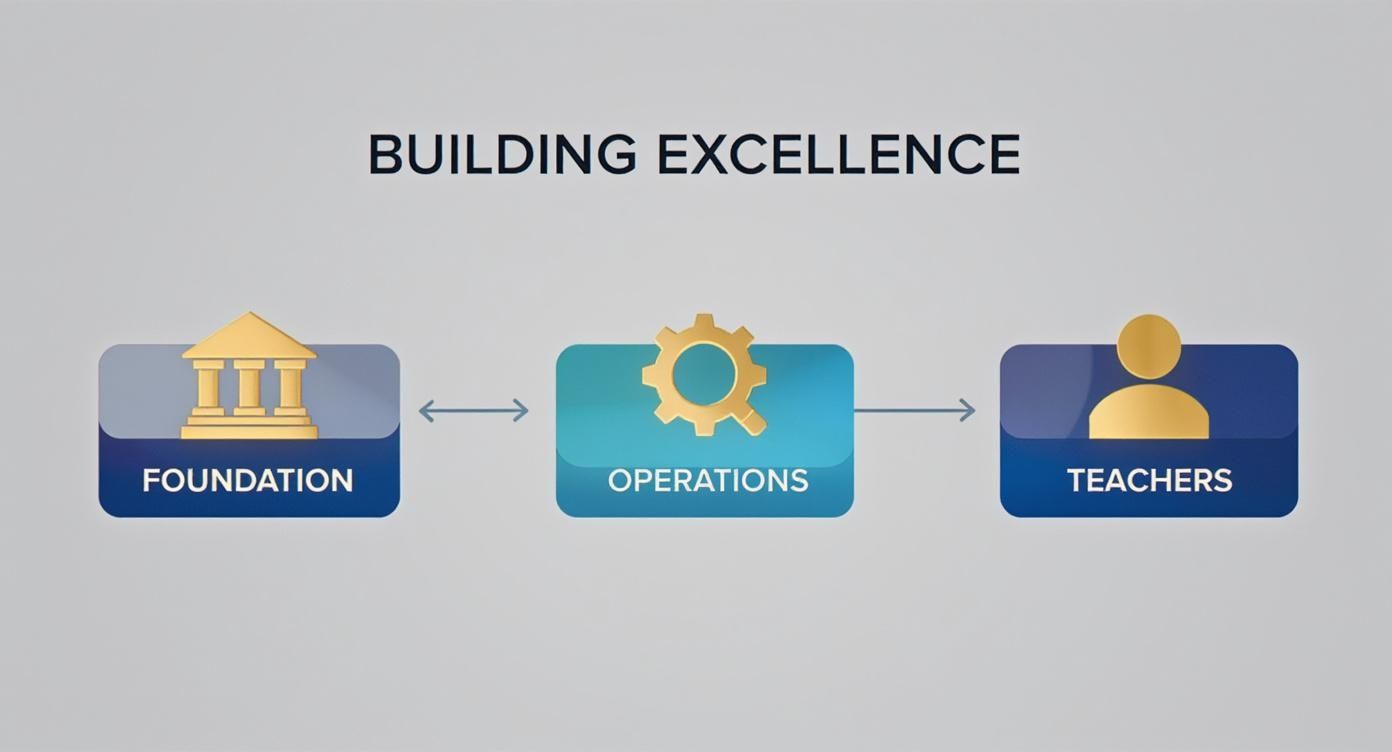
As you can see, a strong institutional foundation—often cemented through accreditation—is the essential first step before you can effectively refine operations and showcase teacher excellence through certifications.
The More Focused Certification Process
The path to certification is far more contained and technical. It’s laser-focused on proving compliance with a specific, predetermined set of standards for a single program, like a STEM curriculum or an operational system like ISO 9001.
Because the scope is so much smaller, the timeline is typically much shorter, often just 3 to 9 months. It also involves a smaller, more specialized team within your school.
The process usually follows these steps:
- Gap Analysis: Your internal team assesses a specific program against the certification standards to see where you measure up and where you fall short.
- Implementation and Documentation: This is the "fix-it" stage. Your team works to close any identified gaps, creating and documenting the necessary processes to meet the standard.
- External Audit: A certified auditor conducts a formal review, poring over your documentation and performing an on-site inspection to see the standards in action.
- Certification Award: If you pass the audit, certification is granted.
- Surveillance Audits: To maintain certification, you'll typically undergo annual surveillance audits, with a full recertification audit required every 3 years.
A key difference in the accreditation vs certification debate is personnel involvement. Accreditation requires widespread faculty and staff participation over many months, while certification often relies on a small team of subject-matter experts for a shorter, more intense period.
To give you a clearer picture of what each journey entails, here's a side-by-side breakdown of the process.
Process Breakdown: Accreditation vs. Certification Journey
| Process Stage | The Accreditation Journey | The Certification Journey |
|---|---|---|
| Scope & Focus | Entire institution: mission, governance, finance, curriculum, student life. Holistic and strategic. | Specific program, system, or department. Narrow and technical. |
| Typical Timeline | 12–24 months for the initial process; re-accreditation every 5–10 years. | 3–9 months for initial certification; surveillance audits annually and re-certification every 3 years. |
| Personnel Involved | "All hands on deck": Board, Head of School, admin, faculty committees, staff, parents, students. | Small, dedicated team: program director, subject-matter experts, and relevant staff. |
| Primary Activity | Deep institutional self-study, evidence gathering, collaborative report writing, and peer review. | Gap analysis, process implementation, documentation, and a formal external audit. |
| Typical Cost | $10,000 to $50,000+ in fees, plus significant soft costs of staff time. | Varies by standard but is generally lower and more predictable than accreditation. |
| Key Outcome | Public validation of institutional quality, eligibility for funding/credits, and a roadmap for continuous improvement. | Verification of compliance with a specific, recognized standard, enhancing a particular program's credibility. |
The financial investment also tells a story. Accreditation fees can range from $10,000 to over $50,000 for the initial process, not including the immense "soft costs" of staff time. Certification costs are generally lower and more predictable, tied directly to the scope of the program being audited.
Making the right choice requires an honest look at your private school's current resources and strategic priorities. Jumping into a process that misaligns with your capacity can lead to frustration, burnout, and wasted effort.
If you need help mapping out the resources, timelines, and strategic planning required for your school's credentialing journey, expert guidance is invaluable. Book a call with JAG Consulting https://link.jagconsultingservices.com/widget/bookings/prospective/school/consultation/zoom to create a practical roadmap, or visit our website to learn more about our accreditation and strategic planning services.
How These Credentials Shape Your School’s Future
Thinking about accreditation versus certification isn't just an administrative task—it’s one of the most critical business decisions you'll make for your private school. The credentials you hold directly impact your school's financial health, shaping everything from enrollment numbers and fundraising power to the long-term market value of your institution. They are powerful signals that communicate trust, quality, and a clear identity to every single stakeholder.
Accreditation is your foundational trust signal. For prospective families weighing your tuition costs, it provides the third-party validation that your school delivers a high-quality, legitimate education. This credibility is absolutely essential for stabilizing enrollment. A 2021 survey confirmed this, revealing that 74% of parents rated school reputation as a top factor when choosing a private school—a reputation that accreditation directly builds.
This institutional seal of approval reaches far beyond your admissions office. When your private school needs to secure funding from philanthropic foundations or financing from lenders, accreditation is often a non-negotiable prerequisite. It assures potential partners that your governance is sound, your finances are stable, and your operations are effective, dramatically lowering their perceived risk.
Building Your Brand with Specialized Excellence
While accreditation builds that broad, institutional trust, specialized certifications are what create a distinct and compelling brand. They let you move beyond general statements of quality and offer concrete proof of excellence in specific, high-demand areas. This is how you capture the attention of families looking for something unique for their child.
A private school that earns a specialized STEM certification, for instance, can build its entire marketing narrative around innovation and future-readiness. This immediately attracts a specific type of family and student passionate about science and technology, creating a powerful marketing edge. The same goes for a certification in world-language immersion or an arts conservatory program—it can transform your school into a destination.
These certifications give your enrollment team tangible, verifiable talking points that set your school apart from other accredited institutions in your area.
Accreditation tells families your school is a sound educational choice. Certification tells them exactly why your school is the perfect choice for their child’s specific interests and talents.
The Synergy of Combining Both Credentials
The most powerful strategy for securing your private school’s future is to combine the broad credibility of accreditation with the focused distinction of certification. One is not a substitute for the other; they work together to create a multi-layered message of quality that is incredibly difficult for competitors to replicate. Accreditation provides the bedrock of institutional trust, while certifications add layers of specialized appeal.
This dual approach creates a powerful synergy that enhances your brand and secures your financial health. The concept is proven across other industries. For example, companies certified to a standard like ISO 22000 (Food Safety Management) that also use accredited labs for testing gain huge competitive advantages. This combination fosters both operational excellence and deep consumer trust, leading to long-term growth. You can explore more on the combined benefits of accreditation and certification to see how this dynamic plays out globally.
For a private school, this means you can confidently justify tuition, attract mission-aligned families, recruit top-tier faculty drawn to your specialized programs, and build a compelling case for donors and investors. This strategic layering of credentials ensures your school not only survives but thrives, building a legacy of excellence for years to come.
Understanding how to sequence and leverage these credentials for maximum impact is a complex strategic process. If you're ready to build a credentialing roadmap that aligns with your school's unique mission and financial goals, expert guidance can be invaluable. Book a call with JAG Consulting https://link.jagconsultingservices.com/widget/bookings/prospective/school/consultation/zoom to develop a clear strategy, or visit our website to learn more about how we help schools achieve sustainable success.
Making the Right Strategic Choice for Your School
It's time to move past the definitions. Deciding between accreditation and certification is a strategic leadership decision for your private school, and the right answer depends entirely on your school's immediate needs and five-year vision. Let's frame this choice with a few pointed, real-world questions.
Is your top priority validating your school’s overall academic quality for college admissions offices and ensuring your students’ credits transfer without a hitch? If the answer is yes, then accreditation is your non-negotiable foundation. It’s the credential that speaks to your school’s comprehensive integrity.
Or, are you trying to prove excellence in a new, high-demand program—like a robotics lab or a specialized arts conservatory—to capture a specific niche of families? In that case, certification is your most direct and powerful tool. It provides targeted, third-party validation that can become the centerpiece of a new marketing campaign.
Building Your Credentialing Strategy
For the vast majority of private schools we work with, this isn't an "either/or" question. The smartest path forward is a "both/and" approach, but it has to be sequenced correctly.
The clear conclusion for most institutions is that accreditation serves as the essential bedrock for long-term credibility, parent trust, and operational stability. It’s the credential that secures your school’s place as a legitimate and respected educational institution.
Once that foundation is firmly in place, certifications become powerful strategic enhancers. They are the tools you use to build upon that solid base, creating layers of distinction that make your school stand out in a crowded market.
Think about these strategic pairings:
- Accreditation + STEM Certification: This one-two punch signals both institutional quality and a specific focus on future-ready skills, attracting families deeply invested in technology and science.
- Accreditation + ISO 9001 Certification: This combination tells a compelling story of commitment to both educational excellence and operational efficiency, building tremendous confidence with parents and potential investors.
This screenshot shows the first step in getting expert guidance to build your school's unique strategy.
This simple booking interface makes it easy for school leaders to schedule a dedicated session to map out their accreditation and certification roadmap with specialists.
Navigating this complex landscape requires a clear-eyed view of your private school's unique mission, market position, and strategic goals. A credentialing strategy that aligns with your vision isn't just nice to have—it's critical for sustainable growth. If you’re ready to create a clear, actionable path forward, it's time to seek expert guidance.
Don't leave your school's reputation and strategic positioning to chance. Book a call with JAG Consulting https://link.jagconsultingservices.com/widget/bookings/prospective/school/consultation/zoom to develop a credentialing roadmap tailored to your school's specific needs, or visit our website to learn more about how we empower private schools worldwide.
Answering Your Top Questions About School Credentials
When you're deep in the weeds of strategic planning for your private school, the distinction between accreditation and certification can get a little fuzzy. Let's clear up some of the most common questions school leaders ask us.
Can a School Pursue Both Credentials?
Absolutely. In fact, for private schools looking to build an ironclad reputation, pursuing both is a powerful strategy. It's not uncommon for a private school to be fully accredited by a major regional body while also holding a specific certification, like ISO 9001, for its operational systems.
Think of it this way: the dual approach signals comprehensive quality. Accreditation speaks to your school's broad institutional integrity, while a certification—say, for a nationally recognized arts program—highlights verified, specific excellence. Together, they create a multi-layered brand of trust that resonates with discerning families.
Which Is More Important for College Admissions?
Hands down, accreditation is significantly more important for college admissions. When an admissions officer reviews a transcript from a private school, they look to regional accreditation to validate its academic rigor. It’s the gold standard.
This credential is the handshake between your high school and the university, confirming that the student's diploma is credible and their coursework meets widely accepted standards. For families focused on higher education pathways, this is a non-negotiable factor that ensures their child’s credits are easily transferable.
How Long Do These Credentials Last?
This is a key operational difference. The renewal cycles for accreditation and certification are worlds apart.
Accreditation is a marathon, not a sprint. Evaluation cycles typically last between 5 to 10 years, reflecting a long-term commitment to institutional quality. Even so, most accrediting bodies require interim progress reports to ensure the school is maintaining standards and actively working on its improvement plans.
Certifications, on the other hand, operate on a much shorter leash. They almost always require annual surveillance audits to ensure ongoing compliance, with a full-blown recertification audit every 3 years. This tight loop ensures that the certified program or system consistently meets the specific, rigorous standard it claims to uphold.
Deciding on the right credentialing strategy is a critical step in securing your private school's future. The experts at JAG Consulting can provide the clarity and guidance needed to align your goals with the right credentials. Book a call with JAG Consulting https://link.jagconsultingservices.com/widget/bookings/prospective/school/consultation/zoom or visit our website to learn how we help private schools thrive.

I'm Dr. Jeannie Gudith, Founder and CEO of JAG Consulting. We help you develop, improve, buy or sell your private school.
I'm so glad you're here
Hello!


