


accreditation for private schools: Your Essential Guide
For private school leaders, the word "accreditation" can sound daunting. It's a voluntary process, a rigorous review by an outside agency, designed to certify that your school meets a high standard of quality. But it's much more than that. Think of it as a powerful seal of approval, signaling to parents, colleges, and your community that your school delivers a credible and effective education.
This endorsement is absolutely crucial for building trust and ensuring your school's long-term health.
What Accreditation Really Means for Your School
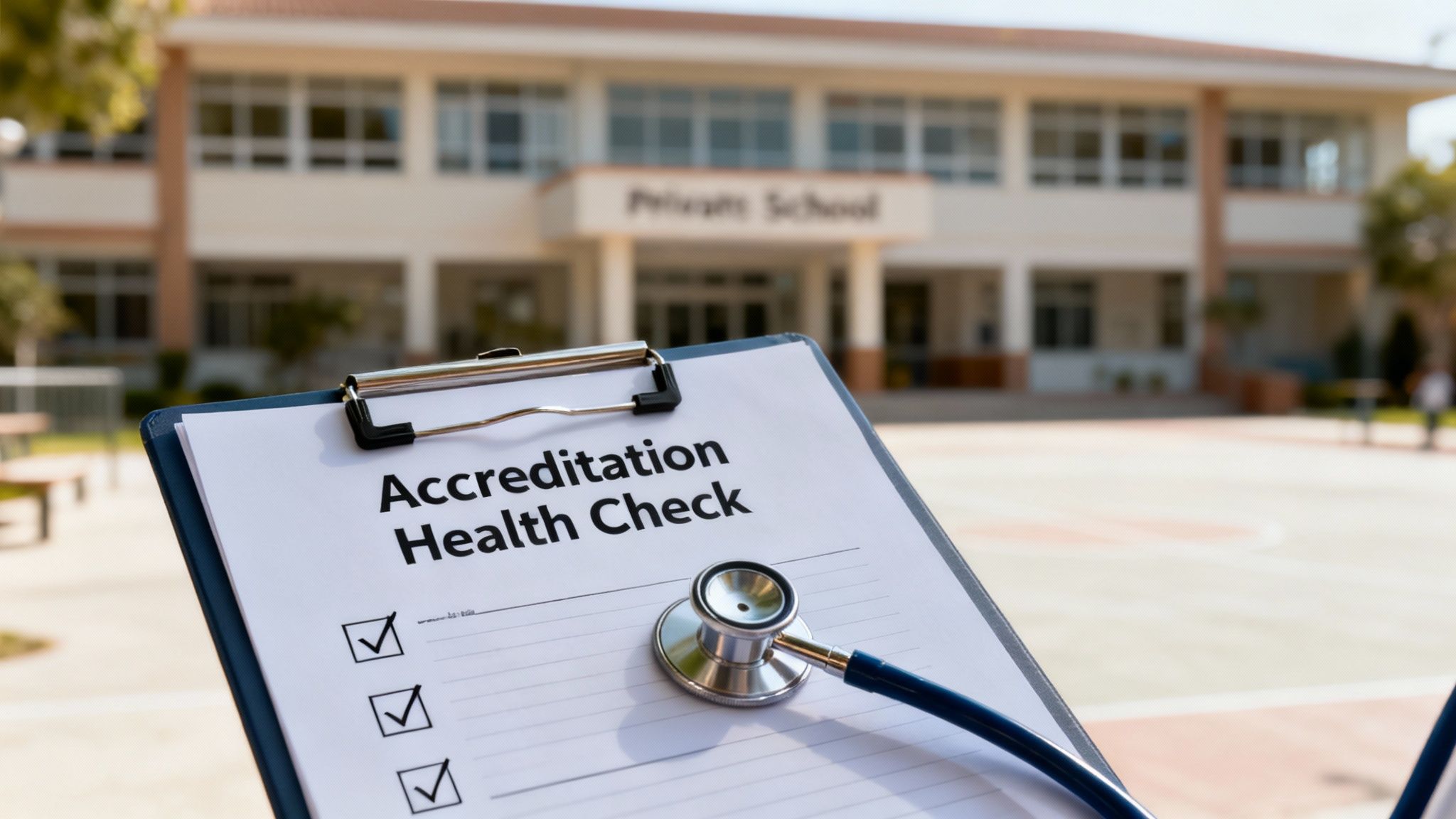
Let's cut through the jargon. Accreditation is like a comprehensive health check-up for your private school. A doctor examines every system to make sure a patient is healthy; an accrediting agency assesses every facet of your institution to verify its vitality.
This isn't about ticking boxes on some compliance form. It's a strategic move that validates your school’s commitment to excellence and proves you're serious about continuous improvement.
Accreditors dig deep. They move way beyond surface-level evaluations to scrutinize the core components of a high-quality learning environment. They look at everything from the rigor of your curriculum and the qualifications of your faculty to the stability of your finances and the effectiveness of your long-term strategic plan.
A Roadmap for Institutional Growth
The journey toward accreditation for private schools forces an institution to do something incredibly valuable: engage in deep self-reflection. The required self-study is a chance to identify your real strengths, confront your weaknesses head-on, and build a unified vision for the future.
It becomes a practical roadmap. It guides your strategic decisions and fosters a culture of accountability and excellence that ripples through your entire school community.
While not always mandatory, the benefits are huge. For parents, it provides confidence that their tuition is a sound investment. For educators, it signals a professional environment committed to high standards. And for students, it ensures their hard work will be recognized by colleges and universities down the road.
Accreditation is often considered a form of quality assurance—when a school is accredited, it has met strict standards indicating that it’s a high-quality institution. Meeting these standards shows current and future students and families that a school is academically fit to meet their needs.
Building Trust in a Competitive Market
In an increasingly crowded educational market, accreditation is a powerful differentiator. It serves as an impartial, third-party endorsement of your school's integrity and quality. This external validation is invaluable for a few key reasons:
- Attracting and Retaining Families: Savvy parents actively look for accredited schools. It's a non-negotiable sign of educational quality and a major factor in their enrollment decisions.
- Recruiting Top-Tier Educators: The best teachers want to work at the best schools. High-caliber educators are drawn to institutions with a proven commitment to excellence and professional standards.
- Validating Student Credentials: Colleges and universities pay attention to accreditation when evaluating student transcripts, which can give your graduates a real edge in the admissions process.
Ultimately, the process is a profound investment in your school's reputation and sustainability. It sets the stage for long-term success, helping you build a resilient institution that is recognized for its excellence.
Ready to explore how accreditation can elevate your school? Book a call with JAG Consulting today to discuss your readiness, or visit our website to learn more about our expert guidance.
Picking Your Partners: Navigating the World of Accrediting Bodies
Choosing the right accrediting body is one of the most critical strategic decisions your private school will ever make. Think of it like joining a professional guild. Your choice signals your school's core educational philosophy, defines your peer group, and broadcasts your commitment to a specific set of standards. The world of accreditation for private schools is surprisingly diverse, with regional, national, and international agencies all offering a different flavor of validation.
This decision directly shapes your school’s identity and reputation in the marketplace. For instance, a school with a global student body might seek out an organization like the Council of International Schools (CIS) to cement its international standing. That single choice tells prospective families and universities precisely what your school values and where it fits in the educational landscape.
Understanding the differences isn't just academic—it's essential. Your school's unique mission, student demographics, and long-term vision should be the compass that guides you to the accrediting partner that provides the most meaningful endorsement for your community.
Regional vs. National Accreditation
The most common fork in the road is the choice between regional and national accrediting bodies. Regional agencies, as the name implies, have deep roots in a specific geographic area of the United States. You've likely heard of the major players, like the Middle States Association (MSA) or the New England Association of Schools and Colleges (NEASC).
Historically, regional accreditation has been viewed as the gold standard, especially for traditional, college-preparatory schools. Its recognition among U.S. universities is rock-solid and universally understood.
National accreditation, on the other hand, typically serves schools with a more specialized focus, like a particular religious affiliation or a unique teaching model. Organizations under the umbrella of the National Association of Independent Schools (NAIS) commissions, for example, operate across the entire country. They create powerful networks of schools that share a similar mission or educational DNA, regardless of where they are on the map. The choice really boils down to whether your school identifies more with its geographic neighbors or with a nationwide tribe of like-minded institutions.
The Rise of International Recognition
For schools serving a diverse, international population—or those located outside the U.S. altogether—international accreditation isn't a "nice-to-have." It's a necessity. It provides a globally recognized seal of quality, ensuring that a student's diploma carries weight no matter where their family moves next. This is a massive selling point for expatriate families who demand educational continuity.
Gaining this level of recognition elevates a school's profile on the world stage. Top-tier institutions are often highlighted by global authorities like the Spear’s Schools Index, a highly respected resource that identifies the top 100 private schools worldwide. Their evaluations are a great window into how international standards are applied. You can see their methodology in action by exploring the latest index of the world's best private schools.
Choosing an accreditor isn't about finding the "best" one in a vacuum. It's about finding the best fit for your school's specific mission. The right partnership validates your unique identity and amplifies your strengths to the world.
To make the decision a bit clearer, let's break down how each type of accrediting body aligns with different school profiles. The table below offers a straightforward comparison to help you find the right path for your institution.
Comparing Major Accrediting Body Types for Private Schools
This side-by-side look at regional, national, and international accrediting bodies is designed to help you zero in on the best fit for your school's goals and the families you serve.
| Accreditation Type | Primary Focus | Typical School Profile | Key Recognition Benefit |
|---|---|---|---|
| Regional | Geographic peer review and adherence to standards common within a U.S. region. | Traditional K-12 private schools, college preparatory institutions. | Widely accepted by U.S. colleges and universities, strong local reputation. |
| National | A specific mission, educational philosophy, or religious affiliation across the U.S. | Schools with a unique model (e.g., Montessori, Waldorf), faith-based schools. | Connection to a network of similar schools, validation of a specialized approach. |
| International | Global standards of excellence, intercultural understanding, and mobility. | International schools, schools with a large expatriate student body. | Global recognition for student transcripts, appeal to an international market. |
Ultimately, this choice demands some serious soul-searching about your school's identity and where you want to go. Whether you need a guide to navigate this complex decision or you're ready to start preparing for the journey, our experts can help map out the road ahead. Book a call with JAG Consulting to get your school's accreditation journey started on the right foot.
The Accreditation Journey Timeline and Costs
Pursuing accreditation is a serious commitment. There’s no way around it. It’s a major investment of both time and money, and going in with a clear-eyed view of the process is the only way to succeed. This isn't a quick project you can knock out in a semester; it's a multi-year strategic undertaking that will fundamentally reshape and validate your school.
From the day you make that first inquiry to the moment you get the final approval, you should expect the entire process to take anywhere from 18 months to three years. In some cases, it can take even longer, depending on the agency and just how ready your school is to dive in. This is a marathon, not a sprint, and it demands sustained effort from your entire team.
The Phased Approach to Accreditation
The path to earning that official seal of approval is thankfully a structured one. It’s broken down into distinct phases, each with its own goals, tasks, and timeline. This progression is designed to be thorough, helping schools build momentum and fix any weak spots before the final evaluation.
Here are the key phases you can expect:
- Application and Candidacy (3-6 months): This is where it all begins. You'll submit your application, provide some initial documentation, and essentially prove that your school is a viable candidate. The agency looks at your basic operational health to see if you're even ready for the full journey.
- The Self-Study (12-18 months): Get ready, because this is the most intensive part of the process. Your school will form committees to conduct a deep, evidence-based dive into every single aspect of your operations, measuring it all against the accreditor's standards. This means a significant number of staff hours dedicated to research, data collection, and writing.
- Peer Review Site Visit (3-5 days): Once you’ve submitted your self-study report, a team of fellow educators from other accredited schools will visit your campus. Their job is to verify everything you claimed in your report, see your school in action, and talk to everyone—faculty, parents, students, and board members.
- Commission Review and Decision (2-4 months): The visiting team takes their findings and recommendations back to the accrediting commission. The commission then reviews all the evidence and makes the final call. The outcome could be full accreditation, but it could also be a deferment with a list of things you need to address.
This visual timeline shows how a school might level up its recognition over time, moving from local to global as its mission and student body evolve.
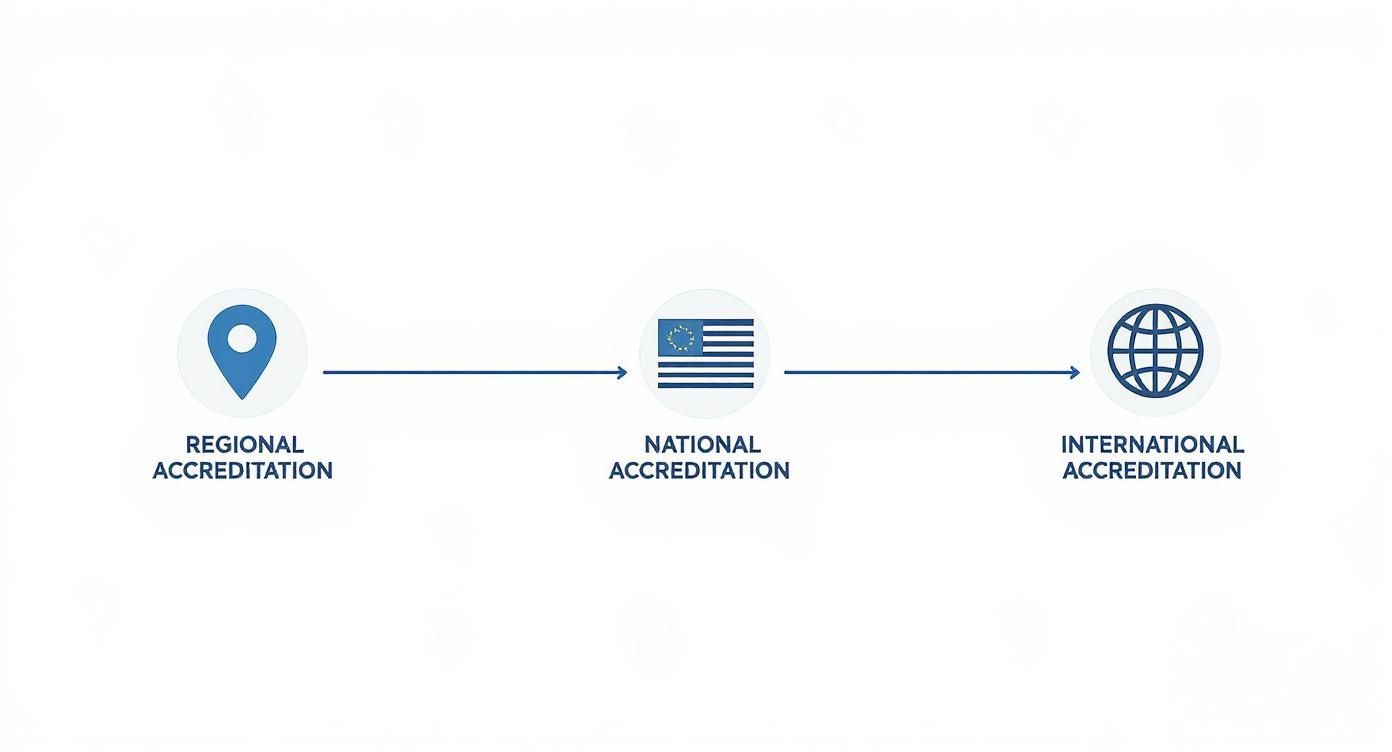
As a school's ambitions grow, its accredited status can grow right alongside it, making sure its credentials match its strategic goals.
Budgeting for the Real Costs
Beyond the calendar, the financial investment is a massive factor. The direct and indirect costs are substantial and need to be budgeted for with absolute clarity from day one.
While the price tag can feel high, it's essential to frame these expenses not as a cost, but as a strategic investment in your school's long-term credibility, marketability, and institutional health.
Here’s a realistic breakdown of where the money goes:
- Application & Candidacy Fees: Just to get in the door, you'll pay one-time fees ranging from $1,000 to $5,000, sometimes more.
- Annual Dues: Once you're accredited, you pay annual dues to maintain your status. This can run from $2,000 to $10,000+, and it's often tied to your school's enrollment size.
- Site Visit Expenses: Your school is on the hook for all the travel, lodging, and meal expenses for the peer review team. This can easily add another $5,000 to $15,000 to the bill.
- Indirect Costs: This is the big one, and it's almost always underestimated. It's the value of the countless hours your staff will dedicate to the self-study and all the preparation. This is a massive operational cost.
Mapping out these financial and time commitments isn't optional—it's essential for success. Feeling ready to tackle the journey? Book a call with JAG Consulting to get a clear picture of what it will take, or visit our website for more resources.
Meeting the Standards: Core Requirements and Common Pitfalls
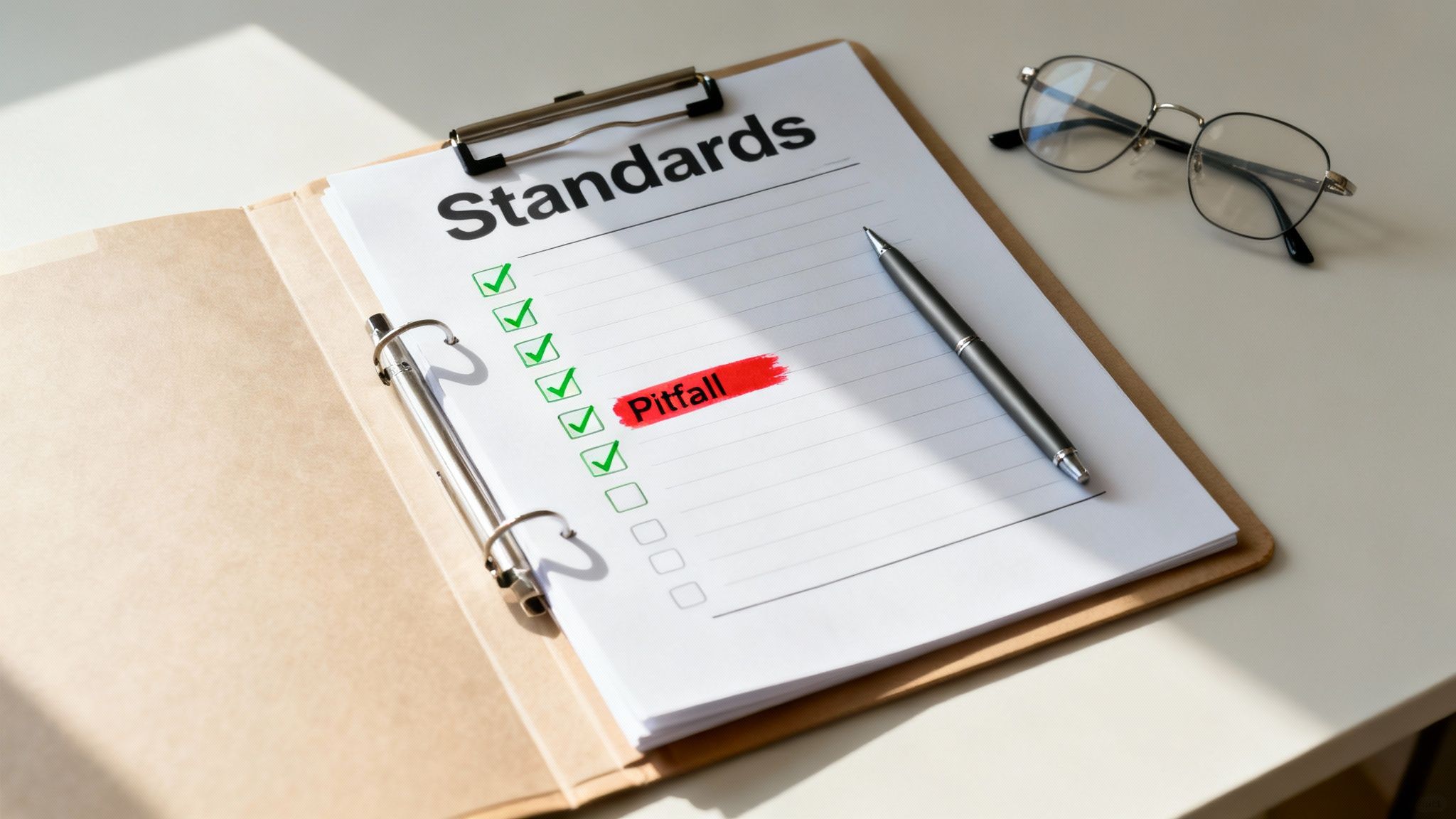
Let’s be clear: accrediting agencies aren’t looking for perfection. What they are looking for is proof of a healthy, functioning, and mission-driven school. Think of their standards as the vital signs of your institution; each one tells a story about its overall well-being.
While every agency has its own unique rulebook, they almost all evaluate a core set of operational pillars. Getting these areas right is the absolute heart of preparing for accreditation for private schools and is non-negotiable for a successful review.
The Core Pillars of an Accreditation Review
Accreditors will conduct a deep dive across several key domains. Your job is to provide clear, compelling evidence that demonstrates your school’s strength and commitment to getting better every year.
Here are the areas they will absolutely focus on:
- Governance and Leadership: Is there a clear governance structure? A defined mission and vision? They'll want to see board policies, effective leadership, and a robust strategic plan that is actually guiding your school's future—not just sitting on a shelf.
- Curriculum and Instruction: This is your academic core. The review team will assess if your curriculum is well-documented, genuinely aligned with your mission, and delivered effectively by qualified teachers to produce real, measurable student learning.
- Faculty Qualifications and Development: Agencies need to verify that your teachers have the right credentials and expertise. But just as important, they want to see a real commitment to ongoing professional development that keeps your faculty sharp and current.
- Student Support Services: A healthy school supports the whole child. This standard covers everything from academic advising and college counseling to health services and support for students with diverse learning needs.
- Financial Stability: Your school must be on solid financial ground. Accreditors will pour over budgets, audits, and financial plans to make sure the institution is sustainable and has the resources to deliver on its promises for the long haul.
The accreditation process is designed to be a mirror, not a hammer. Its primary goal is to help your school see itself clearly—identifying both its strengths and its opportunities for growth—in a structured, supportive way.
Navigating the Most Common Pitfalls
Knowing where other schools stumble is your greatest advantage. So many of the roadblocks that can derail an accreditation review are entirely avoidable with some smart, proactive planning.
It's also worth noting that the game is changing. A recent report found that 66% of accreditation decision reports now require schools to enhance their strategic societal impact. The bar is higher. Yet, overall school satisfaction with the process remains incredibly high, between 92% and 98%, which tells you that schools find immense value in the journey. You can dig into these findings and learn about current accreditation trends.
By anticipating these common challenges, you can address them head-on and position your school for a much smoother, more successful outcome.
Key Stumbling Blocks to Avoid
- Weak or Inconsistent Documentation: If it isn't written down, it didn't happen. This is a classic mistake. Schools often fail to provide organized, consistent evidence to back up their claims, from board meeting minutes to curriculum maps.
- An Underdeveloped Strategic Plan: A vague or outdated strategic plan is a major red flag. Accreditors need to see a living document that clearly outlines your goals, the steps you're taking to achieve them, and how you measure success along the way.
- Failure to Demonstrate Student Outcomes: It’s not enough to say students are learning; you have to prove it with data. This means having systematic processes for assessing student achievement and, crucially, using that data to improve what you do in the classroom.
- Misalignment Between Mission and Practice: This is one of the quickest ways to run into trouble. A review team will spot a disconnect between what your mission statement says and what actually happens in the classrooms and hallways every single day.
Navigating these standards and avoiding the pitfalls requires expertise and a detailed game plan. If you’re ready to ensure your school is fully prepared for its accreditation review, our team at JAG Consulting can provide the expert guidance you need. Book a call with JAG Consulting today or visit our website to learn more about our accreditation readiness services.
Your Accreditation Readiness Checklist

Let's be honest: preparation is everything. When it comes to accreditation, a proactive, organized approach is the difference between a rewarding journey and a frantic scramble. It allows your team to walk into the process with confidence and clarity, rather than scrambling last-minute to find documents and answer tough questions.
Think of this checklist as a high-level internal audit. It hits the core operational areas that accrediting teams always scrutinize, helping you spot your strengths and, more importantly, pinpoint the areas needing attention before you even think about submitting that application for accreditation for private schools.
Governance and Strategic Planning
This is where it all starts. Accreditors need to see that your school isn’t just drifting along but is guided by a clear mission and a functional, forward-thinking leadership team. Your governance framework can't just be a formality on paper; it has to be the engine driving your school’s success and long-term health.
Ask your leadership team these critical questions:
- Is our school mission alive? Do we actively use it to guide real-world decisions?
- Are our board policies current, well-documented, and consistently applied?
- Do we have an up-to-date strategic plan with goals we can actually measure?
- Is there clear evidence of serious financial oversight and long-term fiscal planning?
A school without a clear strategic plan is like a ship without a rudder. Sure, it might be moving, but it has no direction—and that’s a massive red flag for any visiting team.
Curriculum and Student Achievement
Your academic program is the heart and soul of your school. You have to prove not only what you teach but that students are genuinely learning and growing. This means moving beyond feel-good stories and presenting concrete, data-driven proof of student achievement and instructional quality.
Dig into these points:
- Is our curriculum fully documented? Is it aligned both vertically (from grade to grade) and horizontally (across subjects), and does it reflect our mission?
- Do we have a systematic way to collect, analyze, and actually use student achievement data?
- Are our teaching practices regularly evaluated to ensure they’re effective and consistent?
- Are faculty credentials and professional development records complete and easy to pull up?
Failing to provide robust, organized evidence is a classic pitfall. The mantra for accreditation readiness should be: "If it isn't documented, it didn't happen." This applies to everything from board meeting minutes to student assessment data.
Essential Preparatory Steps
Once you've done a quick gut check on your readiness, the next phase is to build the internal structure for success. This is all about mobilizing your team and setting up a clear project management framework to guide your efforts from start to finish.
- Form an Internal Steering Committee. Pull together a diverse team of leaders, faculty, and staff to own the process. This group will oversee the self-study and keep the entire project from going off the rails.
- Establish a Clear Project Timeline. Work backward from your target submission date. Create a detailed timeline with key milestones for research, data gathering, writing, and—crucially—internal reviews.
- Communicate the "Why" to Your Community. Make sure everyone, from board members to parents, understands why accreditation is so valuable. This builds the buy-in you'll desperately need and encourages people to actively participate.
Taking these steps ensures your school isn't just ticking boxes for compliance, but is truly ready to shine. If you feel you need an expert partner to guide your self-assessment and preparation, book a call with JAG Consulting. We’re here to help streamline this critical process.
Why Accreditation Is Worth the Investment
The road to accreditation is a serious undertaking. It asks for a significant commitment of your time, your team's effort, and your school's resources. So, is it actually worth it?
The answer is a clear and resounding yes. When you move past the abstract idea of "quality," accreditation delivers real, tangible returns that directly impact your school's financial health and long-term future. Think of it as an investment that pays dividends in credibility, opportunity, and institutional strength for years to come.
In an increasingly crowded educational market, accreditation is one of the most powerful ways to set your school apart. It acts as an impartial, third-party endorsement that speaks volumes to prospective families. For parents weighing their options, this seal of approval provides the critical assurance that your school meets rigorous, proven standards, making their decision to enroll their child that much easier.
It transforms your school from just another option into a trusted choice.
Boosting Credibility and Market Position
Accreditation is one of the most effective marketing tools you have. It immediately elevates your school’s reputation and builds a deep well of trust with parents, donors, and the wider community.
This credibility is crucial in a sector that's growing fast. The global K-12 private education market is projected to surge from roughly $397 billion to $609 billion by 2029. In this expanding landscape, accreditation ensures your school stands out as a verified leader in educational excellence. You can dig into the numbers by exploring the full private education market report.
This external validation also opens doors for your students, providing a clear advantage. Key benefits include:
- Simplified Credit Transfers: When students move, their credits from an accredited school are far more likely to be accepted by other institutions, ensuring a smooth academic transition.
- Enhanced College Admissions: College admissions officers know and respect accreditation. A diploma from an accredited high school carries more weight, giving your graduates a distinct edge in their applications.
- Access to New Opportunities: Many grants, scholarships, and even high-level athletic competitions are exclusively available to students from accredited schools.
A Catalyst for Internal Improvement
Perhaps the most profound benefit of pursuing accreditation for private schools is the internal transformation it ignites. The required self-study process forces your entire community—from the board down to the newest faculty member—to engage in deep, honest self-reflection. It’s an unparalleled opportunity to hold every aspect of your operations up against proven standards of excellence.
Accreditation is far more than a certificate to hang on the wall. It's a strategic process that fosters a culture of continuous improvement, aligning your entire team around a shared vision and holding everyone accountable for achieving it.
This rigorous internal review becomes your roadmap for meaningful change. It helps you identify hidden weaknesses, celebrate unacknowledged strengths, and build a more cohesive, forward-looking strategic plan. The process unifies your community around a common purpose, creating a stronger, more resilient institution prepared for whatever comes next.
The effort results in a school that isn't just better on paper, but better in practice.
Ready to invest in your school’s future and unlock these profound benefits? Book a call with JAG Consulting today or visit our website to learn how we can guide you through every step of this rewarding journey.
Questions We Hear All the Time About Accreditation
When school leaders start digging into accreditation, the same questions always bubble to the surface. It's a complex world, and leaders, board members, and even savvy parents want to get beyond the basics. We've compiled the most common questions we get from schools that are just starting to think seriously about this journey.
Think of it like this: you’ve seen the architect’s blueprint for the new building, but now you need to know where the plumbing connects and which walls are load-bearing. Getting these details right from the start saves a world of headaches later on.
Can a Brand New School Get Accredited?
This is, without a doubt, the number one question from ambitious school founders. The short answer? No, not right away. Accreditation isn't about your plans or promises; it's about your track record. It's a validation of quality that has been demonstrated over time. An accreditor needs to see you in action, which means you typically need at least two full academic years under your belt to generate the data and prove the stability they need to see.
But that doesn't mean you're left out in the cold. Nearly every accrediting agency offers a "candidacy" or "pre-accreditation" status. This is a formal, guided pathway where a new school works hand-in-hand with the agency to build the systems and practices needed to meet full standards. Earning candidacy status is a huge signal to prospective families that you're serious about quality and are on a direct path to the real thing.
State Approval Versus Voluntary Accreditation
It's incredibly easy to mix these two up, but they play fundamentally different roles.
- State Approval (or Licensing): This is the mandatory stuff. It’s the baseline you have to meet just to legally operate. Think fire codes, teacher background checks, and basic health and safety rules. State approval is the floor—it says you’re allowed to open your doors.
- Voluntary Accreditation: This is the optional, high bar. It’s a rigorous peer-review process that digs deep into your academic quality, institutional health, and commitment to getting better every year. Accreditation is the ceiling—it’s a mark of distinction that proves your school goes far beyond the bare minimum.
Put simply, state approval says you can run a school. Accreditation tells the world you run a school well.
A recent analysis of private school choice programs in eight states found something telling. In states without strict accreditation rules, over 80% of private schools were available to families using choice funds. But in states with rigid accreditation requirements, that number dropped to just over 50%. This shows just how much accreditation is seen as the dividing line for quality participation.
What Happens if We Don't Meet a Standard?
Let’s be realistic: failing to nail every single standard on your first go is more common than you'd think. Accrediting bodies are partners in improvement, not judges looking to punish. If a review team finds some weak spots, the outcome is almost never an outright "no."
Instead, the commission will likely grant a "deferment" or place the school on "probation." This means you still get accredited, but you're required to submit a detailed follow-up report showing how you've fixed the specific issues they identified. They'll give you a clear timeline, usually one to two years, to show proof of improvement. It’s a process that turns a potential failure into a focused, structured opportunity to make your school stronger exactly where it needs it.
Navigating the twists and turns of accreditation requires more than just good intentions—it demands a clear strategy and expert guidance. JAG Consulting lives and breathes this process. We specialize in getting private schools ready for this demanding but deeply rewarding journey, making sure you’re set up for a successful outcome from day one.
Ready to take the next step and validate your school's excellence? Book a call with JAG Consulting or visit our website to see how our readiness services can clear your path to accreditation.

I'm Dr. Jeannie Gudith, Founder and CEO of JAG Consulting. We help you develop, improve, buy or sell your private school.
I'm so glad you're here
Hello!


© 2025 JAG CONSULTING.
all rights reserved. privacy policy + REFUND POLICY. TEMPLATE by sugar studios + Showit
