


Top 7 example teacher evaluation models for private schools
In the competitive landscape of private education, attracting and retaining exceptional faculty is paramount. An effective teacher evaluation process is not merely an administrative task; it's the cornerstone of professional growth, instructional excellence, and institutional health. Yet, many private schools struggle with outdated, compliance-driven models that fail to inspire improvement or align with their unique mission.
Research indicates that effective teacher evaluation systems can boost student achievement by the equivalent of several months of learning. Furthermore, schools with strong, supportive evaluation systems see up to a 25% increase in teacher retention, a critical metric for institutional stability and student outcomes. A well-designed example teacher evaluation framework moves beyond a simple checklist, transforming observations into meaningful, data-driven conversations that cultivate faculty talent. This shift is essential for maintaining a competitive edge and delivering on the promise of a superior educational experience.
This article moves beyond theory to provide a practical toolkit for private school leaders. We will dissect seven distinct example teacher evaluation models, complete with annotated templates, strategic implementation advice, and customizable rubrics tailored specifically for the nuanced environment of private schools.
Whether you lead a preschool, a K-12 institution, or a specialized academy, these examples will provide a clear roadmap for building a system that fosters genuine growth and drives student success. Inside, you'll find downloadable resources and actionable strategies for:
- Aligning evaluations with your school's specific mission and values.
- Implementing frameworks like the Danielson FFT, Marzano Model, and 360-Degree Feedback.
- Customizing scoring rubrics for different roles, from early childhood educators to subject-matter specialists.
- Ensuring your process supports both accreditation requirements and legal best practices.
Let's explore the models that can help you build a culture of continuous improvement. To discuss how these frameworks can be tailored to your institution's specific needs, book a complimentary consultation with JAG Consulting today or visit our website for more information.
1. Danielson Framework for Teaching (FFT)
Developed by renowned educator Charlotte Danielson, the Framework for Teaching (FFT) is one of the most respected and comprehensive models for teacher evaluation. It is built on the premise that effective teaching is a complex, multi-faceted practice that extends beyond classroom instruction. This research-based framework provides a common language for educators and administrators, promoting reflective practice and professional growth, making it a staple in both public and private school settings.
The FFT organizes the complexities of teaching into four distinct domains, each with specific components and elements:
- Domain 1: Planning and Preparation: This focuses on what a teacher knows and does before instruction even begins. It includes demonstrating knowledge of content, pedagogy, and students, as well as designing coherent instruction and assessments.
- Domain 2: The Classroom Environment: This domain addresses the culture of the classroom, focusing on creating an environment of respect and rapport, establishing a culture for learning, managing classroom procedures, and managing student behavior.
- Domain 3: Instruction: This is the core of teaching practice, covering how a teacher engages students in learning. Key components include communicating with students, using questioning and discussion techniques, engaging students in learning, and using assessment in instruction.
- Domain 4: Professional Responsibilities: This domain encompasses the wider professional roles of a teacher, such as reflecting on teaching, maintaining accurate records, communicating with families, and contributing to the school community.
Performance is rated on a four-level scale: Unsatisfactory, Basic, Proficient, and Distinguished. This detailed structure makes it an excellent example of a teacher evaluation system that can be adapted for private school settings, which often value a holistic view of educator effectiveness.
Strategic Analysis & Application
The strength of the Danielson Framework lies in its structured, evidence-based approach. For private schools aiming to build a culture of continuous improvement, the FFT offers a clear roadmap. It moves evaluation from a simple checklist to a meaningful professional conversation.
Key Insight: The FFT's power is not just in summative ratings but in its formative potential. The detailed rubrics give teachers specific, actionable language to understand their practice and identify precise areas for growth, which is invaluable for targeted professional development.
Many private schools adapt the FFT to align with their unique mission and values. For instance, a school with a strong focus on character education might add specific "look-fors" or evidence examples related to fostering virtues within the Classroom Environment domain.
Actionable Takeaways for Private Schools
- Customize for Mission Alignment: Review the FFT's components and rubrics. Add or modify language to reflect your school's unique philosophy, whether it's project-based learning, faith integration, or a specific pedagogical approach.
- Invest in Consistent Training: Ensure all administrators and instructional leaders who will act as evaluators receive thorough training. A 2018 study found that evaluator training significantly improves the reliability of observation scores. Consistent application is key to fairness and buy-in.
- Use it as a Growth Tool: Frame the FFT as a tool for professional growth, not just accountability. Use pre- and post-observation conferences to facilitate reflective conversations, collaboratively setting goals based on evidence gathered against the rubrics.
The Danielson Framework provides a robust, flexible, and well-researched system that can elevate the quality of teaching and professional dialogue in any private school.
Ready to implement a powerful teacher evaluation system tailored to your school's unique needs? Book a call with JAG Consulting today or visit our website to explore how we can help you build a culture of excellence.
2. Marzano Teacher Evaluation Model
Developed by leading educational researcher Dr. Robert J. Marzano, this model is a research-based system designed to directly link teacher practices to student achievement outcomes. It is predicated on the idea that specific instructional strategies have a measurable impact on student learning. The model provides a clear framework for observing, evaluating, and improving teacher effectiveness, a goal for all educational institutions, including private schools.

The Marzano model is organized around four primary domains, broken down into 60 distinct instructional elements:
- Domain 1: Classroom Strategies and Behaviors: This is the most extensive domain, focusing on the routine instructional strategies that occur in the classroom. It includes elements for creating an environment for learning, helping students develop understanding, and helping students extend and apply knowledge.
- Domain 2: Planning and Preparing: This domain covers the "behind-the-scenes" work of teaching. It involves planning for lessons and units, using effective strategies for diverse learners, and planning for the use of available resources and technology.
- Domain 3: Reflecting on Teaching: This domain centers on the teacher as a reflective practitioner. It includes evaluating personal performance and actively seeking opportunities for professional growth.
- Domain 4: Collegiality and Professionalism: This encompasses the teacher’s role within the broader school community, including promoting a positive environment, fostering relationships with families, and contributing to the school and district.
Performance for each element is assessed on a five-level scale: Not Using, Beginning, Developing, Applying, and Innovating. This granular approach makes it an excellent example of a teacher evaluation system for schools that want to focus intensely on specific, high-impact instructional techniques.
Strategic Analysis & Application
The Marzano Model's core strength is its direct and explicit connection between observable teacher actions and expected student outcomes. For private schools driven by academic results and data-informed instruction, this model provides a highly specific and actionable framework. It shifts the evaluation focus from general pedagogy to the precise strategies that research suggests will elevate student learning.
Key Insight: The Marzano Model excels at providing a shared, precise vocabulary for instruction. When an evaluator and teacher can discuss a specific element like "identifying critical information," the feedback becomes concrete and immediately applicable, moving beyond vague suggestions to targeted coaching.
Private schools often adapt the Marzano framework by prioritizing specific elements that align with their pedagogical philosophy. For instance, a school emphasizing inquiry-based learning might place a greater weight on elements related to "organizing students to interact with new knowledge" and "engaging students in cognitively complex tasks."
Actionable Takeaways for Private Schools
- Focus on High-Impact Elements: Instead of trying to implement all 60 elements at once, identify a focused set of 10-15 high-yield strategies that align with your school's immediate academic goals. This prevents overwhelm and allows for deeper coaching.
- Integrate with Professional Development: Use the Marzano Center's extensive resources and research to build your professional development plan. If observation data shows a school-wide need in "checking for understanding," you can provide targeted training directly linked to the evaluation tool.
- Calibrate Evaluators Regularly: Given the model's specificity, it is crucial that all evaluators are calibrated to score consistently. A 2013 study by the U.S. Department of Education found that regular calibration and training for observers is essential for reliable evaluation outcomes. Hold monthly or quarterly sessions where administrators score video lessons and discuss their evidence.
The Marzano Teacher Evaluation Model offers a detailed, strategy-focused system that empowers schools to improve instruction with research-backed precision.
Ready to implement a powerful teacher evaluation system tailored to your school's unique needs? Book a call with JAG Consulting today or visit our website to explore how we can help you build a culture of excellence.
3. Instructional Rounds Model (City, Elmore, Fiarman)
Pioneered by educators like Richard Elmore, the Instructional Rounds model shifts teacher evaluation from a top-down, individual assessment to a collaborative, peer-driven process. Inspired by the medical rounds model, it brings teachers and administrators together to observe classroom instruction, analyze teaching practices, and collectively identify patterns of strength and areas for school-wide improvement. This approach is highly effective in private schools seeking to foster a culture of shared ownership and continuous learning.

The Instructional Rounds process typically follows a clear cycle:
- Problem of Practice: The group identifies a specific, persistent challenge related to student learning (e.g., student engagement in higher-order thinking).
- Observation: A small group of peers and leaders conducts short, non-evaluative classroom visits, focusing specifically on collecting evidence related to the problem of practice.
- Debrief: The observation group meets to share and analyze the evidence collected. The discussion is descriptive, not judgmental, focusing on what they saw students and teachers doing.
- Next Level of Work: The group identifies patterns and trends across classrooms and predicts the impact on student learning. They then brainstorm systemic, school-wide actions to address the identified problem.
Its emphasis on collective analysis makes it a compelling example teacher evaluation alternative for private schools committed to building a collaborative professional culture.
Strategic Analysis & Application
The primary strength of Instructional Rounds is its ability to depersonalize feedback and build collective efficacy. For private schools that prize a tight-knit community and collaborative spirit, this model transforms evaluation into a shared inquiry, strengthening professional relationships and aligning the entire faculty around common instructional goals.
Key Insight: Instructional Rounds shifts the focus from "fixing" individual teachers to improving the "instructional core," which consists of the teacher, the student, and the content. This systemic view helps schools address root causes of instructional challenges rather than just surface-level symptoms.
Private schools can leverage this model to tackle mission-specific pedagogical goals. A school dedicated to inquiry-based learning, for example, could use rounds to analyze how often students are formulating their own questions versus answering the teacher's, leading to targeted professional development that directly supports the school's core mission.
Actionable Takeaways for Private Schools
- Establish Clear Protocols: Before the first round, define the purpose, roles, observation focus, and discussion norms. This ensures psychological safety and keeps the process focused on learning, not judgment.
- Train Participants: Provide training for all participants on how to collect objective, non-evaluative evidence and engage in productive, evidence-based discussions. This is crucial for maintaining a positive and effective process.
- Connect Rounds to Professional Development: Use the patterns and data gathered during rounds to design your professional development plan. A 2017 study by the RAND Corporation highlighted the effectiveness of job-embedded professional learning, and rounds provide the perfect data to make that learning relevant and impactful.
The Instructional Rounds model offers a dynamic, collaborative framework for improving teaching and learning across an entire school community.
Ready to build a collaborative and effective teacher evaluation system that reflects your school's unique mission? Book a call with JAG Consulting today or visit our website to learn how we can help you foster a culture of professional growth and excellence.
4. LEAP Model (Look, Evaluate, Analyze, Plan)
The LEAP Model is a simplified, teacher-friendly evaluation template designed to guide observers through a clear, four-step process. It strips away the complexity of larger frameworks, focusing instead on a cycle of observation and collaborative reflection. This model is often favored in progressive or smaller private school settings that prioritize teacher autonomy and a less intimidating, growth-oriented evaluation process.
The LEAP framework is built on a direct and logical progression that makes the evaluation cycle transparent for both the teacher and the administrator:
- Look: The evaluator observes classroom practice, gathering specific, objective evidence of teaching and learning. This is the data-collection phase, focusing on what is actually happening in the classroom.
- Evaluate: The observer assesses the collected evidence against a set of predetermined, clear teaching standards or school-specific goals. This step connects observation to expectations.
- Analyze: The evaluator and teacher collaboratively analyze the evidence to identify strengths and pinpoint specific areas for growth. This is a crucial dialogue-driven stage.
- Plan: Together, they develop a concrete, actionable plan with measurable goals to support the teacher's professional development. The plan outlines next steps, resources, and a timeline.
This straightforward structure makes it an excellent example of a teacher evaluation system for private schools aiming to build a strong culture of coaching and continuous improvement without the administrative weight of more extensive models.
Strategic Analysis & Application
The primary strength of the LEAP Model is its accessibility and focus on partnership. By simplifying the process into four distinct steps, it demystifies evaluation and positions it as a supportive tool. This is particularly effective in private schools that want to foster a close-knit, collaborative faculty culture.
Key Insight: LEAP's power lies in its cyclical nature and emphasis on joint planning. It shifts the dynamic from a top-down judgment to a side-by-side coaching conversation, which can significantly increase teacher buy-in and ownership of their professional growth.
For a private school, this model can be easily adapted to align with specific pedagogical philosophies, such as Montessori or Reggio Emilia, by customizing the "look-fors" in the observation stage.
Actionable Takeaways for Private Schools
- Develop Clear "Look-For" Tools: Before implementing LEAP, collaboratively create a simple checklist or guide that defines what effective instruction looks like at your school. This ensures the "Look" and "Evaluate" stages are consistent and aligned with your mission.
- Train for a Coaching Stance: Ensure all evaluators are trained not just on the four steps but on how to facilitate a non-judgmental, coaching-focused conversation during the "Analyze" and "Plan" stages. The quality of this dialogue determines the model's success.
- Integrate It into Regular Practice: Use the LEAP cycle for both formal evaluations and informal, low-stakes walkthroughs. A 2019 TNTP report highlighted the impact of frequent, brief observations paired with immediate feedback, a practice for which the LEAP model is perfectly suited.
The LEAP Model provides a streamlined yet rigorous approach, making it an ideal choice for private schools seeking a powerful, collaborative, and easy-to-implement system for teacher development.
Ready to implement a powerful teacher evaluation system tailored to your school's unique needs? Book a call with JAG Consulting today or visit our website to explore how we can help you build a culture of excellence.
5. iObserve Teacher Evaluation Template
In an era of data-driven decision-making, digital platforms like iObserve represent a shift from paper-based checklists to dynamic, technology-enabled evaluation systems. These are cloud-based solutions that provide digital templates, real-time observation tools, and comprehensive data management. The system is designed to streamline the entire evaluation cycle, from scheduling observations to generating summative reports, making it highly applicable to the modern private school.
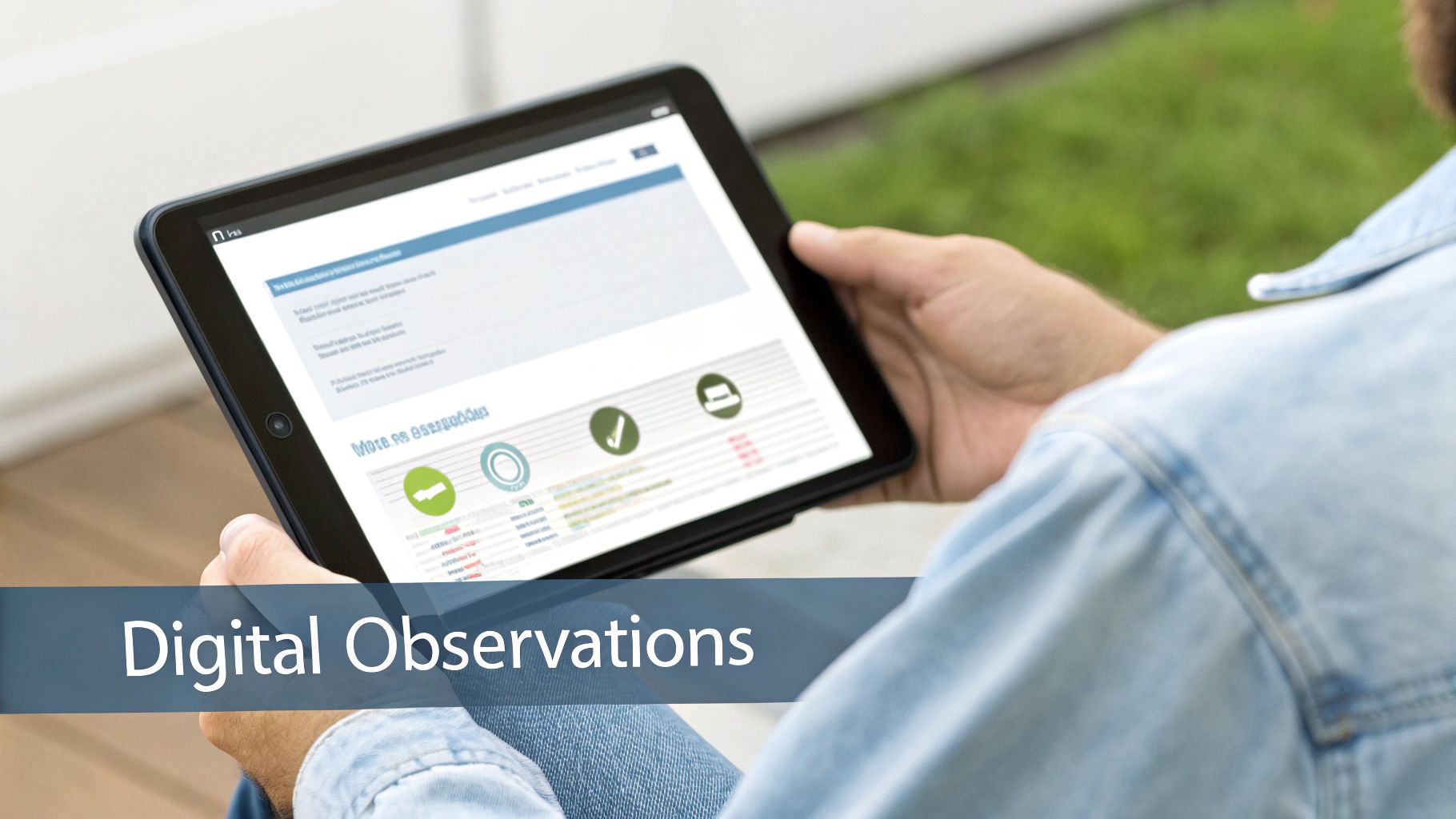
Digital platforms digitize existing evaluation frameworks, allowing administrators to conduct walkthroughs and formal observations on a tablet or laptop. Key features often include:
- Customizable Templates: Schools can build digital versions of their chosen rubrics, whether it's a model like Marzano, Danielson, or a completely bespoke framework.
- Multimedia Evidence Collection: Evaluators can capture text notes, photos, and video clips directly within the observation, linking evidence to specific performance indicators.
- Data Aggregation: The platform consolidates data from multiple sources, such as classroom observations, student growth metrics, and even student or parent surveys, into a unified dashboard.
- Automated Reporting: The system generates detailed reports that visualize teacher performance trends over time, simplifying data analysis for professional development planning and summative reviews.
This technology is a powerful example of a teacher evaluation system that centralizes data, making the process more efficient, transparent, and impactful for tracking growth.
Strategic Analysis & Application
The core advantage of a digital platform is its efficiency and data integration capabilities. For private school leaders who wear multiple hats, it dramatically reduces administrative overhead. It transforms evaluation from a series of isolated events into a continuous, data-rich narrative of professional practice.
Key Insight: The true power of a digital platform is its ability to reveal patterns and trends that are invisible in paper-based systems. By analyzing aggregated data, school leaders can identify campus-wide strengths and pinpoint specific areas where targeted, group professional development is most needed.
Private schools can leverage this technology to create a more collaborative and transparent evaluation culture. Teachers can be given access to their own data dashboards, empowering them to monitor their progress, review observation evidence, and take ownership of their professional growth goals.
Actionable Takeaways for Private Schools
- Prioritize Framework Before Software: Choose and fully develop your evaluation framework first. The software is a tool to implement your vision, not a substitute for a well-defined pedagogical philosophy.
- Ensure Robust Training: A 2019 Learning Policy Institute report emphasized that for evaluation systems to be effective, both teachers and administrators must be thoroughly trained. Invest in comprehensive onboarding for all users on the platform’s features, from data entry to report interpretation.
- Establish Clear Data Protocols: Create clear, documented guidelines for how and when data will be collected, who has access to it, and how it will be used in summative evaluations. Transparency is critical for building trust and ensuring the system is perceived as a fair and supportive example teacher evaluation tool.
By integrating technology thoughtfully, private schools can create a more efficient, insightful, and growth-oriented evaluation process.
Ready to harness the power of data to elevate your teacher evaluation system? Book a call with JAG Consulting today or visit our website to explore how we can help you integrate the right tools and strategies for your school's success.
6. Standards-Based Teacher Evaluation (State Standards Alignment)
This evaluation model directly ties teacher performance to state-mandated teaching standards and professional competencies. This approach is highly relevant for private schools seeking state accreditation, participating in state programs, or simply wishing to align with widely recognized educational benchmarks. It assesses educators on their mastery of specific frameworks that define effective teaching.
While specific requirements vary by state, these frameworks typically outline core competencies across several domains, often mirroring the structure of models like Danielson's but customized with state-specific language and priorities. The evaluation process involves collecting evidence (observations, artifacts, student data) to measure a teacher's performance against each standard.
- Domain 1: Planning & Preparation: Often focuses on aligning lesson plans with state academic standards (e.g., Common Core, state-specific standards) and demonstrating knowledge of child development.
- Domain 2: Classroom Management: Addresses creating a safe, organized, and productive learning environment that meets state guidelines for student conduct and engagement.
- Domain 3: Instruction: Evaluates the delivery of instruction, including differentiation, use of technology, and assessment strategies that are aligned with state learning objectives.
- Domain 4: Professional Responsibilities: Covers compliance with school policies and professional ethics, communication with stakeholders, and engagement in continuous professional learning.
Performance levels are often rated on a scale like Ineffective, Developing, Effective, and Highly Effective. This system provides a clear, standardized benchmark for performance, making it a powerful example of a teacher evaluation system when external validation is a priority for a private school.
Strategic Analysis & Application
The primary strength of a standards-based model is its clarity and external alignment. For private schools that must meet state accreditation requirements, offer state-recognized diplomas, or participate in state-funded programs (like voucher or scholarship programs), adopting or adapting a state-style framework is often a strategic choice. It ensures compliance and simplifies accountability reporting.
Key Insight: Aligning with established standards demystifies the evaluation process and provides a direct link between teacher performance and professional development. It creates a unified language of practice that is understood by accrediting bodies and educators alike.
Private schools can leverage this structure to their advantage. By mastering a respected framework, a private school can demonstrate a commitment to quality that is on par with, or exceeds, other institutional benchmarks, which can be a powerful marketing and recruitment tool.
Actionable Takeaways for Private Schools
- Master Your Chosen Framework: Do not just read the standards; deeply understand the rubrics, evidence requirements, and scoring methodologies. Use available training materials and resources to ensure your evaluators are calibrated and consistent.
- Integrate, Don't Just Adopt: While you may align with an external framework, you must infuse your school's unique mission. Add "look-fors" or evidence examples to the rubric that reflect your school's specific values, such as faith integration, project-based learning, or global citizenship competencies.
- Use it for Strategic PD Alignment: Since the competencies are clearly defined, you can easily source or design professional development that directly addresses areas for improvement identified in evaluations. This creates a highly efficient, targeted growth plan for your faculty.
A standards-based evaluation system provides a robust framework for ensuring accountability and demonstrating educational quality, making it an essential tool for many private schools.
Looking to align your teacher evaluations with accreditation requirements while maintaining your unique school culture? Book a call with JAG Consulting today or visit our website to ensure your approach is both compliant and mission-driven.
7. 360-Degree Feedback Teacher Evaluation Model
The 360-Degree Feedback model moves beyond the traditional top-down evaluation, creating a more holistic and democratic view of a teacher's performance. It is a comprehensive process that gathers confidential feedback from a full circle of stakeholders: administrators, peer teachers, students, parents, and the teacher’s own self-assessment. This multi-rater approach provides a well-rounded picture of educator effectiveness, highlighting strengths and growth areas that a single observation might miss.
This model is particularly effective in private schools that prioritize a strong community culture and stakeholder engagement. It frames evaluation as a collective responsibility and fosters a shared commitment to school-wide improvement. The primary components of a 360-Degree system typically include:
- Self-Evaluation: The teacher reflects on their practice against established teaching standards or school-specific goals.
- Administrator Review: A formal observation and evaluation from a principal or instructional leader, providing the administrative perspective.
- Peer Feedback: Colleagues provide insights into collaboration, professional contributions, and instructional practices they may have observed.
- Student Surveys: Age-appropriate surveys give students a voice, offering direct feedback on classroom climate, clarity of instruction, and engagement.
- Parent/Guardian Surveys: Parents provide feedback on communication, support for student learning, and their overall perception of the teacher's effectiveness.
Performance data from these sources is compiled to create a comprehensive profile. Rather than a single score, the result is a rich tapestry of qualitative and quantitative feedback, often rated on a scale like Needs Development, Meets Expectations, and Exceeds Expectations across various competencies.
Strategic Analysis & Application
The core strength of the 360-Degree model is its capacity to build trust and foster a profoundly reflective professional culture. For private schools aiming to differentiate themselves through strong community ties, this approach reinforces the message that every voice matters. It shifts the evaluation dynamic from judgment to collaborative problem-solving.
Key Insight: This model's true value is in uncovering blind spots. A teacher might excel in instructional delivery (seen by an administrator) but may need to improve parent communication (revealed by parent feedback). This multi-source data provides a complete diagnostic for targeted, meaningful professional development.
While powerful, successful implementation requires careful planning. Confidentiality is paramount to ensure honest feedback. A 2019 study on 360-degree feedback in education found that when participants trust the anonymity of the process, the quality and honesty of the feedback improve significantly. Private schools often use validated third-party survey instruments to manage data collection and ensure objectivity.
Actionable Takeaways for Private Schools
- Pilot with a Volunteer Group: Before a school-wide rollout, pilot the 360-Degree model with a small, willing cohort of teachers and administrators. This allows you to refine survey questions, test the technology, and build buy-in by demonstrating the process’s value.
- Invest in Facilitator Training: Do not simply hand teachers a report filled with raw feedback. Train instructional coaches or administrators to facilitate debriefing sessions. Their role is to help teachers interpret the results constructively, identify patterns, and create a realistic growth plan.
- Frame it as Formative: Emphasize that the primary purpose of the 360-Degree feedback is developmental, not punitive. Link the results directly to professional growth opportunities, coaching cycles, and resource allocation rather than tying them directly to high-stakes decisions like salary or contract renewal, especially during the initial implementation phase.
The 360-Degree Feedback model is an excellent example of a teacher evaluation system that can cultivate deep reflection and strengthen the entire school community.
Ready to implement a powerful teacher evaluation system tailored to your school's unique needs? Book a call with JAG Consulting today or visit our website to explore how we can help you build a culture of excellence.
7-Model Teacher Evaluation Comparison
| Model | 🔄 Implementation complexity | ⚡ Resource requirements | ⭐ Expected outcomes | 📊 Ideal use cases | 💡 Key advantages / Tips |
|---|---|---|---|---|---|
| Danielson Framework for Teaching (FFT) | High — multi-domain rubrics, time‑intensive observations | High — extensive PD, observation time, documentation systems | ⭐⭐⭐⭐ — robust formative & summative evidence for growth | Formal evaluations & PD-aligned systems in private schools. | 💡 Transparent criteria; require evaluator calibration and multiple observations |
| Marzano Teacher Evaluation Model | High — 60+ elements, data integration complexity | High — assessment data, tech platform, trainer support | ⭐⭐⭐⭐ — strong linkage to student growth and instructional practice | Data-driven private schools emphasizing measurable student gains. | 💡 Balance walkthroughs with formal observations; use calibration sessions |
| Instructional Rounds Model | Moderate — protocol-driven peer observations and analysis | Medium — time for rounds and collaborative meetings (lower tech) | ⭐⭐⭐ — builds shared instructional understanding and improvement | Private schools prioritizing collaborative culture and peer learning. | 💡 Establish clear protocols; focus on problems of practice and pattern documentation |
| LEAP Model (Look, Evaluate, Analyze, Plan) | Low — simple four-step structure, easy to adopt | Low — minimal training and documentation needs | ⭐⭐ — effective for formative feedback and trust-building; less depth for high‑stakes | Small private schools, teacher-friendly formative systems, pilot programs. | 💡 Use consistently, document action plans, and revisit progress regularly |
| iObserve Teacher Evaluation Template | Moderate–High — platform setup and customization | High — licensing, integration, reliable connectivity, training | ⭐⭐⭐ — speeds data collection and enables campus-wide analytics | Private schools needing scalable digital evaluation and data management. | 💡 Provide thorough training, secure data backups, involve teachers in data review |
| Standards-Based Teacher Evaluation | Moderate — depends on framework complexity | Medium — alignment efforts, training and reporting | ⭐⭐⭐ — consistent, accreditation-linked accountability across schools | Private schools seeking accreditation or aligning with state benchmarks. | 💡 Align PD with competencies; document evidence in consistent language |
| 360-Degree Feedback Teacher Evaluation Model | High — coordinates multiple raters and instruments | High — survey design, analysis tools, facilitation and confidentiality measures | ⭐⭐⭐ — holistic perspective that reduces single-rater bias | Private schools emphasizing stakeholder engagement and comprehensive feedback. | 💡 Ensure anonymity, use validated surveys, provide trained facilitators and pilot first |
From Evaluation to Evolution: Implementing Your Ideal System
Choosing the right example teacher evaluation framework from the models we've explored, whether it's the comprehensive structure of the Danielson Framework or the collaborative nature of Instructional Rounds, is a critical foundational step for any private school. However, the true measure of success lies not in the template you select, but in the culture you build around it. The journey from evaluation to genuine professional evolution requires a strategic shift from a compliance-focused mindset to one centered on continuous growth, support, and collaboration.
The most effective private schools recognize that a teacher evaluation form is merely a tool. Its power is unlocked only through thoughtful implementation, clear communication, and an unwavering commitment to professional development. This process is not a seasonal event but an ongoing cycle of meaningful dialogue between educators and academic leaders.
Key Insights: Synthesizing the Models
Across the diverse examples provided, from the data-driven Marzano model to the holistic 360-Degree Feedback approach, several core principles emerge as non-negotiable for a successful system in a private school setting:
- Clarity and Consistency: Your chosen framework must be clearly understood by all stakeholders. The criteria, scoring, and process should be transparent and applied consistently across all faculty members. This builds trust and ensures fairness.
- Focus on Growth, Not Just Judgment: While accountability is essential, the primary goal should be to identify areas for growth and provide targeted support. Research from the Bill & Melinda Gates Foundation's Measures of Effective Teaching (MET) project found that combining multiple measures, including classroom observations and student feedback, provided a much more reliable and constructive view of teacher performance than any single method alone.
- Actionable Feedback: Vague comments are unhelpful. Feedback must be specific, evidence-based, and linked to concrete next steps. The LEAP model's "Look, Evaluate, Analyze, Plan" structure is a prime example of building actionability directly into the evaluation process.
Your Actionable Next Steps
Translating these concepts into practice requires deliberate action. As you move forward from reviewing an example teacher evaluation to implementing your own, prioritize these steps to build a system that fosters excellence:
- Customize, Don't Just Copy: Use the provided templates and frameworks as a starting point. Adapt the language, criteria, and focus areas to reflect your school’s unique mission, vision, and pedagogical philosophy. A system for a Montessori preschool will look vastly different from one for a rigorous IB Diploma Programme.
- Invest in Administrator Training: Your academic leaders are the linchpins of this process. They need robust training on how to conduct effective observations, provide constructive and motivating feedback, and coach teachers toward improvement. An untrained evaluator can undermine even the best-designed system.
- Link Evaluation to Professional Development: The evaluation cycle should directly inform your professional development plan. If observations reveal a school-wide need for better differentiation strategies, for example, your PD calendar should reflect that. This closes the feedback loop and demonstrates that evaluation is a tool for collective improvement.
- Establish a Clear Timeline and Communication Plan: From the outset, communicate the what, why, and how of the evaluation process to your faculty. Provide a clear calendar for observations, conferences, and goal-setting meetings to eliminate anxiety and foster a sense of partnership.
Ultimately, mastering the art of teacher evaluation is about more than just compliance or risk management. It is about honoring the professional craft of teaching and creating an environment where every educator feels seen, supported, and empowered to achieve their full potential. This commitment is the most profound investment you can make in the quality of your students' education and the long-term health and reputation of your private school.
Navigating the complexities of designing and implementing a bespoke teacher evaluation system can be a formidable task. JAG Consulting specializes in helping private schools develop and refine academic systems that drive faculty growth and student achievement. To ensure your evaluation process is legally sound, mission-aligned, and truly effective, book a complimentary consultation with our expert team today or visit our website for more information.

I'm Dr. Jeannie Gudith, Founder and CEO of JAG Consulting. We help you develop, improve, buy or sell your private school.
I'm so glad you're here
Hello!


© 2025 JAG CONSULTING.
all rights reserved. privacy policy + REFUND POLICY. TEMPLATE by sugar studios + Showit
