


Unpacking the Average Cost of a Private School
Trying to pin down the average cost of a private school can feel like hitting a moving target. But the latest data gives us a solid place to start. For 2025, the national average tuition for a private school in the United States is sitting right around $13,302 per year.
That number, however, is just the beginning of the story. Costs swing wildly depending on the grade level and, most importantly, where the school is located.
A Snapshot of Private School Costs Across the US
While the national average is a handy benchmark, the numbers get much more real when you look at them through a regional lens. The financial commitment for a private school education is heavily shaped by geography, with tuition in some states nearly doubling what it is in others.
This gap is usually tied to local economic realities—things like the cost of living, teacher salary expectations, and just how many private schools are competing in a given area.
How Location Shapes Tuition
The difference between a high-cost state and a more affordable one can easily top $10,000 a year for a single student. This is precisely why school founders and investors have to dig into localized market research before they even think about setting tuition or projecting revenue. Relying on a national average is a recipe for a flawed financial model.
Let's break it down. High-cost states like New York see an average tuition of $21,903, which jumps to a steep $27,724 for secondary education. Rhode Island and California aren't far behind, with averages around $19,770 and $17,242, respectively.
On the other end of the spectrum, states with a lower cost of living offer much more manageable tuitions. Places like Arizona and Oregon see annual averages hover around $10,700. You can discover more insights about private school costs by state and see exactly how your region stacks up.
This bar chart drives the point home, showing the stark contrast between the U.S. average, a high-cost state, and a low-cost one.
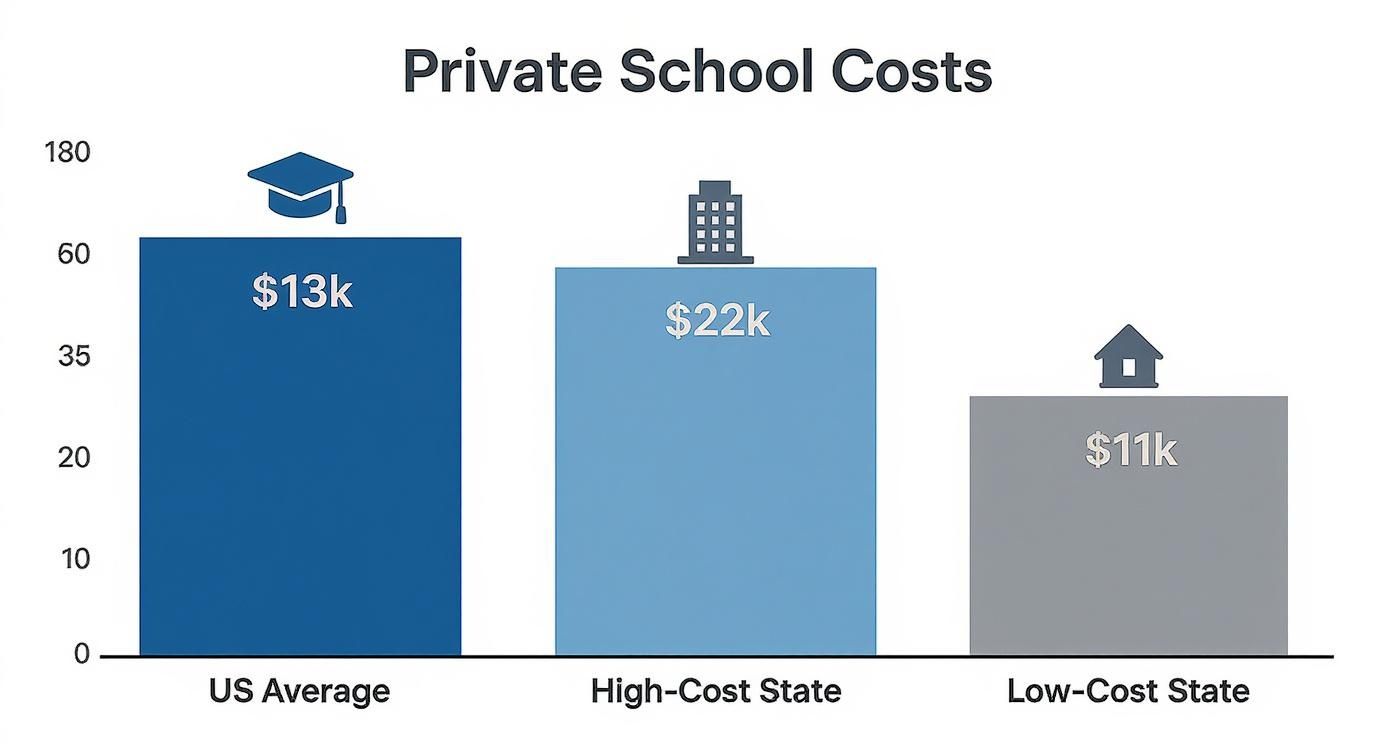
As you can see, where you plan to operate is one of the most critical financial factors you'll face.
Average Private School Tuition Snapshot by State
To give you a clearer picture of this regional variance, here’s a look at how average annual tuition compares across a few high-cost, mid-range, and low-cost states.
| State | Average Annual Tuition | Average Elementary Tuition | Average High School Tuition |
|---|---|---|---|
| New York | $21,903 | $22,090 | $27,724 |
| California | $17,242 | $13,913 | $22,544 |
| Texas | $11,836 | $10,879 | $13,541 |
| Florida | $10,503 | $9,892 | $11,894 |
| Arizona | $10,700 | $10,211 | $13,534 |
Notice how high school tuition is consistently higher than elementary, reflecting the increased costs of specialized faculty and more complex programs. This table underscores the need to move beyond national averages and analyze the specific market where your school will compete.
Key Takeaway: The "average cost of a private school" isn't one number; it's a wide spectrum. Your school's location will be a primary driver of both your operating expenses and your potential tuition revenue, making regional data absolutely essential for accurate financial modeling.
Getting a handle on these initial figures is the first step. But building a sustainable financial plan from the ground up requires deep expertise. If you're ready to create a detailed, data-driven budget for your future school, Book a call with JAG Consulting or visit our website. We help turn educational visions into financial realities.
What Really Drives the Cost of a Private School?
That national average figure? It’s a useful starting point, but it doesn’t begin to tell the real story. To get a true handle on the financial realities of running a private school, you have to look past that single number and dig into the powerful forces shaping a school's budget.
Think of the average cost like the sticker price on a car. It gives you a ballpark idea, but the final cost really depends on the model, the engine, and all the features you choose. The same is true for schools.
The average cost of a private school is a direct result of its unique DNA and the community it calls home. These cost drivers are the essential building blocks of your school’s financial identity, dictating everything from tuition rates to long-term viability. Getting a firm grip on them is the very first step toward building a financial model that actually works.
The Unmistakable Impact of Geography
As we touched on earlier, location is probably the single biggest factor. A school’s physical address creates its own financial ecosystem with a unique set of rules. Operating in a major urban hub like Houston, where 2025-2026 private school tuition is hitting an average of $27,952, is a completely different financial ballgame than opening a school in a quiet suburb or a rural town.
This geographical premium seeps into nearly every line item on your budget:
- Real Estate: The cost to buy or lease property is dramatically higher in metro areas. No surprise there.
- Salaries and Benefits: To bring in and keep top-tier teachers and staff in high-cost-of-living regions, you have to offer much more competitive compensation.
- Vendor and Service Costs: Everything from your cleaning crew to your marketing agency is going to command a higher price in an urban market.
School Type and Programmatic Focus
While location shapes your external costs, your school’s educational model dictates its internal financial structure. Your mission and philosophy translate directly into specific, and often significant, expenses. A one-size-fits-all budget is a fantasy.
For example, a Montessori school needs a huge inventory of specialized—and often pricey—didactic materials. A special needs school, on the other hand, has to budget for highly trained specialists, much smaller class sizes, and adaptive technologies, all of which push the per-student cost way up.
Boarding schools are in a league of their own. They represent one of the highest-cost models because their budgets cover not just academics but the entire residential experience. We're talking dorms, 24/7 staffing, dining services, and weekend activities—all massive expenses that day schools simply don't have.
Grade Levels and Curriculum Complexity
The grade levels you serve also play a massive role in your operating costs. The resources you need for an elementary school are worlds apart from what's required to run a fully-equipped high school.
As students get older, the curriculum gets more specialized and resource-heavy. This progression adds new layers of expense:
- Specialized Faculty: High schools need teachers with advanced degrees in specific subjects like physics, calculus, or foreign languages, and those experts command higher salaries.
- Advanced Facilities: Science labs, tech centers, art studios, and athletic complexes are major capital investments and ongoing maintenance headaches that are far more common at the secondary level.
- Extracurricular Programs: Competitive sports teams, robotics clubs, and debate squads require significant funding for coaches, equipment, and travel.
This is exactly why high school tuition is always higher than elementary school tuition. In Houston, for instance, the average twelfth-grade tuition is over $30,287, while kindergarten averages $23,440. Every grade level you add to your school introduces a new layer of financial complexity that needs to be planned for meticulously.
These three core drivers—geography, school type, and grade levels—are all interconnected, creating a unique financial profile for every single private school. A deep, honest analysis of these factors isn't just a good idea; it's non-negotiable for anyone serious about building a sustainable educational institution.
Trying to balance all these variables to create a sound financial plan can feel overwhelming. If you're ready to turn your school's vision into a viable budget, we can help. Book a call with JAG Consulting today or visit our website to see how we guide founders through this critical process.
Budgeting Your School's Startup Journey
Launching a private school is a lot like building a custom home. You’d never break ground without a detailed blueprint and a rock-solid budget, right? The same exact principle applies here. Before you can even think about welcoming your first student, you have to account for the major one-time costs that turn your vision into a real, operational school.
These startup costs are the foundational investments needed just to get the doors open. They’re completely separate from your ongoing operational budget and represent the first big financial mountain every founder has to climb. Getting this number wrong can put the entire project in jeopardy before it even starts.
Breaking Down Capital Expenditures
Your single largest startup investment will almost certainly be the facility. Whether you buy a property outright or sign a long-term lease, securing a physical space is a massive line item. And it’s not just about the rent or mortgage—it’s the extensive renovations, zoning permits, and all the work required to make the building compliant with education and safety codes.
Once you have the building, you have to fill it with everything a modern learning environment needs. This is where the budget can balloon if you’re not managing it carefully.
Key startup purchases typically include:
- Furniture and Fixtures: Think desks, chairs, library shelves, office furniture, and specialized equipment for science labs or art studios.
- Technology Infrastructure: This covers everything from servers and Wi-Fi networks to student laptops or tablets, interactive whiteboards, and the administrative software that runs the school. Technology is a huge ongoing expense, so getting the initial setup right is critical.
- Curriculum and Learning Materials: This is the initial bulk purchase of textbooks, digital licenses, library books, and specialized resources for programs like Montessori or special education.
- Initial Marketing and Enrollment: You have to budget to announce your arrival. This means website development, digital ad campaigns, open house events, and the promotional materials needed to attract your very first group of families.
Crucial Insight: So many founders get laser-focused on the building and curriculum but completely underestimate what it costs to find the first students. Remember, a beautiful school with no one in it isn’t a school at all. A significant marketing budget isn't a "nice-to-have"—it's a non-negotiable for a successful launch.
Sample Private School Startup Budget Line Items
To give you a clearer picture, the table below outlines some estimated cost ranges for a small to mid-sized private school. Of course, the actual numbers will swing wildly based on your location, school size, and specific programs. For example, the average cost of a private school in a major city like Houston will drive real estate and renovation expenses way up compared to a school in a smaller town.
| Expense Category | Estimated Cost Range (USD) | Key Considerations |
|---|---|---|
| Real Estate & Renovations | $150,000 – $1,000,000+ | Depends on leasing vs. buying, local market rates, and the extent of construction needed to meet code. |
| Furniture & Equipment | $75,000 – $300,000 | Costs are driven by student capacity, specialized rooms (labs, art studios), and quality of furnishings. |
| Technology Setup | $50,000 – $150,000 | Includes network infrastructure, devices for students and staff, and essential software licenses. |
| Curriculum & Library | $40,000 – $120,000 | Varies based on grade levels, educational model (e.g., IB, Montessori), and digital vs. print resources. |
| Initial Marketing & Enrollment | $30,000 – $100,000 | Covers branding, website, digital campaigns, and events needed to secure the first year's student body. |
| Legal & Administrative Fees | $20,000 – $75,000 | Includes incorporation, accreditation applications, insurance setup, and other professional services. |
Navigating this complex financial landscape takes more than a spreadsheet; it demands strategic foresight and real-world experience. If you’re ready to build a detailed, realistic startup budget that truly reflects your vision, we provide the expert guidance to get it right.
Book a call with JAG Consulting or visit our website to see how we help school founders build from the ground up.
Planning Your Annual Operating Budget
Once your school’s doors are officially open, the focus shifts from one-time startup investments to the ongoing financial rhythm of your annual operating budget. Getting this right is the key to long-term sustainability and delivering on your educational promise year after year.
Think of the startup budget as building the car; the operating budget is the fuel that keeps it running every single day. Miscalculating these recurring costs is a common pitfall that can jeopardize even the most well-funded new school. A precise understanding of your operational burn rate is essential for setting tuition that accurately reflects the average cost of a private school experience you want to provide.
Salaries: The Undisputed Budget Heavyweight
When you look inside any private school’s financial statements, one line item consistently towers over all others: personnel costs. Salaries, benefits, and payroll taxes for your entire team will typically eat up anywhere from 60% to 80% of your annual operating budget. This makes your staffing model the single most significant financial decision you'll make.
The quality of your teachers directly translates to the quality of your education, so this isn't the place for aggressive cost-cutting. Instead, smart planning is everything. Your student-to-teacher ratio is a powerful lever; a lower ratio creates a premium, intimate experience but dramatically inflates your salary expenses. Balancing educational excellence with fiscal reality is the core challenge here.
And don't forget: you must offer competitive compensation to attract and retain top talent, especially in high-cost-of-living areas. This isn’t just about base salary. It includes health insurance, retirement contributions, and professional development opportunities that show you’re invested in your people.
Beyond Payroll: Other Critical Operating Expenses
While salaries take the largest slice of the pie, a host of other recurring expenses are vital for keeping things running smoothly. Underestimate these, and you'll find yourself in a cash crunch that compromises the student experience. A well-built budget accounts for every predictable cost.
Expert Insight: Many schools find themselves in a tight spot when the gap between tuition revenue and operating expenses widens. Data shows this gap increased by nearly 14% between FY2023 and FY2024, putting immense pressure on schools to fill it through fundraising and endowment draws.
This reality highlights just how critical it is to meticulously budget for every single operational category.
Key Recurring Cost Categories
A sustainable operating budget is all about the details. Beyond your staff, you must plan for these essential ongoing costs that keep your school humming:
- Facilities and Maintenance: This is a huge category. It includes your rent or mortgage, property insurance, daily custodial services, landscaping, and—crucially—a fund for both routine repairs and long-term capital improvements.
- Utilities: These are the non-negotiables. Think electricity, heating and cooling, water, internet service, and waste management. They are the cost of keeping the lights on and the doors open.
- Curriculum and Supplies: Unlike the initial startup purchase, this budget covers annual renewals for software licenses, new textbooks to replace aging ones, and all the consumable classroom supplies like paper, art materials, and lab chemicals.
- Ongoing Marketing and Admissions: Your marketing efforts don’t stop on opening day. This budget funds the year-round activities needed to maintain enrollment, including digital advertising, open house events, and admissions staff salaries.
- Insurance and Professional Services: This bucket covers everything from general liability and directors and officers (D&O) insurance to workers' compensation. It also covers retainers for your lawyer and accountant.
Building a financial model that can weather economic shifts and fully support your school's mission is a complex task. It demands a deep understanding of industry benchmarks and a truly strategic approach to planning.
Don't leave your school's financial future to chance. Book a call with JAG Consulting to get expert guidance on creating a robust and sustainable operating budget, or visit our website to learn how we empower school leaders.
How Your School Model Dictates Your Budget
Trying to find a single "average cost to start a private school" is a bit like asking for the average cost of a vehicle. Are we talking about a scooter or a freightliner? The answer depends entirely on the model you choose.
Your educational model is the blueprint for your entire financial reality. A sprawling boarding school has a fundamentally different cost structure than a nimble online academy, just like a skyscraper has a different budget than a single-family home. Getting this right from the start—aligning your vision with a realistic financial plan—is one of the most critical steps you'll take.
Let's break down how the most common private school models create wildly different financial pictures.
Brick and Mortar vs. Virtual Academies
The biggest line item on almost any school's budget comes down to one thing: a physical building. It’s the single greatest cost variable.
Traditional brick-and-mortar schools carry the immense financial weight of real estate, whether you’re leasing, buying, or building from scratch. And that’s just the beginning. Once you have the keys, you're on the hook for a lifetime of maintenance, utilities, insurance, and security costs.
Virtual academies, on the other hand, simply erase this entire category of expenses. This is precisely why their cost structure is so much lower. Yes, they make significant investments in technology, robust curriculum platforms, and highly skilled remote faculty, but these expenses are just a fraction of what it costs to own and operate a physical campus.
The national average private K-12 school tuition for 2025 is around $14,903 per year—a figure driven almost entirely by traditional schools. In sharp contrast, online private schools average just $10,952 annually. That’s a savings of nearly 27%, and it all comes back to the real estate. You can learn more about how online school costs compare to traditional models.
This cost advantage is what allows online schools to offer more accessible tuition, opening the door to private education for families who might otherwise be priced out.
Day Schools vs. Boarding Schools
If virtual schools sit at one end of the cost spectrum, boarding schools are firmly planted at the other. Think of it this way: running a day school is like running a business, but running a boarding school is like running a small town.
Your budget has to cover far more than just academics. You are responsible for the entire 24/7 residential experience, which introduces massive new expense categories that day schools never have to consider.
- Residential Facilities: You’re not just buying a school; you’re buying dormitories, dining halls, and recreational centers that all need constant upkeep.
- Around-the-Clock Staffing: Your payroll explodes. You now need residential life staff, overnight supervisors, full-time healthcare professionals, and a complete kitchen crew.
- Comprehensive Services: The budget must cover three meals a day, seven days a week. It has to fund weekend activities, transportation, and a much higher level of security.
Because of this incredible overhead, boarding school tuition is consistently the highest in the private education world, often costing several times more than a comparable day school. If you're a founder considering this path, you have to recognize you’re committing to a far more complex and capital-intensive financial journey.
Ultimately, the model you choose will define your school's financial destiny. Whether you dream of a bustling physical campus, an innovative online academy, or a full-service boarding institution, understanding the built-in cost structure from day one is the key to building something that lasts.
Navigating these financial models to create a viable plan is a serious challenge. To get expert guidance tailored to your specific vision, Book a call with JAG Consulting or visit our website to explore our services.
Ready to Build Your School's Financial Future?
Understanding the numbers behind private school costs is a great starting point, but it's just that—a start. The real work begins when you translate that data into a smart financial plan that builds a thriving, sustainable school for the long haul. From nailing down your startup capital to managing the day-to-day operational budget, it's a complex process. But with the right partner, it's completely manageable.
You don't have to figure this out alone. At JAG Consulting, our entire focus is helping school founders, investors, and leaders like you turn a powerful educational vision into a financial reality. We bring the expert guidance you need to model your budget, plan for sustainable growth, and secure your school’s future.
Your Financial Blueprint Starts Here
A successful school is built on a rock-solid financial foundation. This is so much more than just plugging numbers into a spreadsheet; it’s about deeply understanding how your local market realities drive every single cost.
In the 2023-2024 school year, private school enrollment saw a significant increase, with 30% of schools reporting higher numbers than the previous year. This growing demand creates opportunity, but also intensifies the need for precise financial planning to stand out in a competitive market.
A financial plan that ignores these local nuances isn't just a bad plan—it's a plan set up to fail. Your budget has to be a living document, tailored to your specific community, your unique educational model, and your long-term goals.
This is exactly where expert guidance makes all the difference. We help you connect the dots, making sure your financial model is not only realistic but resilient. We’ll get in the weeds with you, analyzing everything from faculty salaries to facility maintenance to create a clear, confident path forward.
Are you ready to stop guessing and start building a sustainable financial future for your school?
Don't leave your success to chance. Book a call with a JAG Consulting expert today, or head over to our website to see the full range of services we offer private schools.
Your Top Questions About Private School Costs, Answered
When you're building or leading a private school, the numbers can feel daunting. We get it. Here are some of the most common questions we hear from founders and school leaders, with straight answers to help you navigate the financial side of your mission.
Why Does Private School Tuition Seem to Go Up Every Single Year?
It’s a consistent trend, and for good reason. The single biggest driver is the cost of attracting and keeping fantastic teachers and staff. To stay competitive, schools have to offer salaries and benefits that keep pace with the market and the rising cost of living. You can't deliver an exceptional education without exceptional people.
Beyond salaries, the day-to-day operational costs are always climbing. Think utilities, insurance, campus maintenance, and essential technology upgrades. Data from the National Business Officers Association (NBOA) shows that the median operating expense per student shot up by 5.4% between 2023 and 2024 alone. That's a serious increase that often outpaces what schools can reasonably ask for in tuition hikes.
How Does Offering Financial Aid Actually Affect the School's Budget?
This is a big one. Offering financial aid is a strategic choice that pits your mission against your bottom line. While it does directly reduce your net tuition revenue, it's also one of the most powerful tools you have to build the student body you want—one that's diverse, talented, and fully enrolled. A strong financial aid program can be a major competitive advantage.
So, where does the money come from? Schools typically fund aid from three main sources:
- The Operating Budget: A slice of tuition revenue is set aside specifically for financial aid.
- Fundraising: Annual giving campaigns and targeted scholarship drives are crucial.
- Endowment Income: For more established schools, the endowment can be a significant and sustainable source of aid funding.
The trick is to model your financial aid budget with precision. You have to ensure it’s sustainable and helps you hit your enrollment targets without torpedoing your operating budget.
What’s a Normal Profit Margin for a Private School?
The term "profit margin" can be a bit of a misnomer here, because the vast majority of private schools are registered non-profits. This means any surplus revenue isn't paid out to owners or shareholders; it's reinvested right back into the school's mission.
While for-profit schools exist, they're a tiny slice of the private school world. For non-profits, the goal isn't profit—it's sustainability. A healthy operating surplus is what allows a school to fund campus improvements, build a rainy-day fund for emergencies, and invest in the future. A good target for that surplus is around 3% to 5% of your total operating budget.
That surplus isn't just extra cash; it's the lifeblood of a healthy school, giving you the breathing room to not just survive, but to continually improve the experience for your students.
Getting these financial details right is the foundation of a successful school. At JAG Consulting, we work with founders and leaders every day to cut through the complexity and build financially strong, mission-driven institutions.
Ready to build a financial plan that secures your school’s future? Book a call with a JAG Consulting expert today and let's get started.

I'm Dr. Jeannie Gudith, Founder and CEO of JAG Consulting. We help you develop, improve, buy or sell your private school.
I'm so glad you're here
Hello!


© 2025 JAG CONSULTING.
all rights reserved. privacy policy + REFUND POLICY. TEMPLATE by sugar studios + Showit
