


A Practical Account Reconciliation Example for Private Schools
Let’s start with a simple example. At its most basic, account reconciliation is just comparing your private school's internal cash records to your monthly bank statement. You’d go line by line, checking off every deposit and withdrawal that matches up, flagging any discrepancies—like an uncashed check to a vendor—and making adjustments until both records show the exact same final balance.
Why Reconciliation Is More Than Just Balancing the Books for Private Schools
Think of account reconciliation as a regular financial health checkup for your private school. It’s way more than a tedious, box-checking exercise. It’s the fundamental process of making sure the money you think you have in an account is actually what’s there. This comparison is your first line of defense against costly mistakes—a crucial function given that studies show human error accounts for a significant portion of accounting discrepancies. This process gives you the reliable data you need to make smart strategic decisions for your school's future.
It’s just like balancing your checkbook at home. You wouldn’t just assume your bank account is right without looking. You’d compare your own notes on income and spending against the bank statement to catch that time the grocery store accidentally charged you twice or to remember an automatic bill payment you forgot about. Account reconciliation is the same commonsense logic, just applied to your school's finances on a much larger and more critical scale.
The Core Purpose of Reconciliation in Education
For private schools, this process is absolutely non-negotiable. It’s how you guarantee that every single dollar—from tuition payments and fundraising drives to payroll and big-ticket capital projects—is tracked with precision. Without it, your financial statements could be dangerously misleading, making it impossible to build an accurate budget or forecast your enrollment needs for next year.
Regular and meticulous reconciliation transforms a routine accounting task into a powerful tool for financial stewardship. It provides the clarity and control necessary to protect your school's assets and uphold its mission for the long term.
This diligence is only becoming more important as financial oversight and regulatory pressures increase. In fact, the global market for account reconciliation software is expected to hit USD 10.38 billion by 2033, a surge driven by the demand for greater accuracy and transparency. This trend shows a clear shift toward using technology to ensure financial integrity—a principle that is vital for any educational institution. You can explore more about these market trends to see where financial management is headed.
Key Accounts Private Schools Must Reconcile Monthly
While every transaction matters, some accounts demand your team's attention every single month to keep your school’s finances healthy. Focusing on these core areas is the best way to stop small issues from spiraling into major problems.
Here’s a quick look at the non-negotiables for any private school's finance office.
Key Accounts Private Schools Must Reconcile Monthly
| Account Type | What You Are Comparing | Why This Reconciliation Matters for Your School |
|---|---|---|
| Bank Accounts | Your internal cash ledger vs. the official bank statement. | This is the big one. It confirms your actual cash position, catching bank errors, unauthorized transactions, or missed deposits immediately. |
| Credit Card Accounts | Your internal expense records vs. the monthly credit card statement. | This tracks every purchase made on school cards, preventing fraud or unauthorized spending and ensuring all expenses are captured. |
| Tuition Revenue | Payments recorded in your SIS vs. your general ledger vs. bank deposits. | This crucial check ensures every family's payment has been received, recorded correctly, and actually made it to the bank. |
| Donations & Grants | Donation records from your development office vs. your general ledger. | Verifies that all donor funds (both restricted and unrestricted) are accounted for and allocated exactly as the donor intended. |
| Accounts Payable | Your list of vendor invoices vs. the checks or payments you've issued. | This makes sure you've paid your vendors the right amount and haven't missed or duplicated payments for supplies, curriculum, or services. |
Getting these core reconciliations right every month builds a rock-solid financial foundation for your school. Once you master this rhythm, you’re ready to dive into the practical, step-by-step examples that follow.
Ready to ensure your school's financial processes are as strong as its academic programs? Book a complimentary consultation with JAG Consulting today or visit our website to see how we help private schools build sustainable financial frameworks.
A Step-By-Step Bank Account Reconciliation Example
Alright, we’ve covered the ‘why’ behind reconciliation. Now let's get our hands dirty with the ‘how.’ Theory is one thing, but seeing it in action is where the lightbulb really goes on.
This walkthrough will be your blueprint. We'll follow the business manager at a fictional private school, Northwood Academy, as she reconciles the books for the month. You can follow this exact process for your own school.
Imagine it's the end of March, and Ms. Evans at Northwood Academy needs to close out the month and reconcile the school's main checking account. She grabs the two essential documents for this task: the school's internal cash ledger and the official bank statement.
Setting the Stage: The Documents
Before any numbers get crunched, Ms. Evans lays out her two source documents. This is always the first step.
- The General Ledger: This is Northwood's own record of every cash transaction for March, pulled straight from their accounting software. It shows a closing balance of $96,445.
- The Bank Statement: This is the official monthly statement from Northwood's bank. It shows a closing balance of $95,500.
Right away, there’s a difference. Don't panic. This is completely normal and exactly why we reconcile. The goal isn't to worry about the gap but to systematically find the items that explain it.
The Reconciliation Process in Action
Ms. Evans starts by comparing every deposit and withdrawal on both documents, one line at a time. Think of it like a matching game. She methodically checks off the identical items that appear on both her ledger and the bank statement.
As she goes, she highlights several items that show up on one document but not the other. These are the reconciling items, and they’re the key to solving the puzzle.
Here’s what she found:
- Deposits in Transit: The school's ledger shows a $5,000 deposit from the spring fundraiser bake sale on March 31st. Since it was deposited late in the day, it hasn't hit the bank statement yet.
- Outstanding Checks: She spots three checks recorded in the school's ledger that haven't been cashed yet, so they haven't cleared the bank.
- Check #1255 to "Curriculum Innovators" for $2,500
- Check #1257 to "Campus Landscaping" for $1,200
- Check #1258 to "Office Supply Co." for $300
- Bank Service Charges: The bank statement lists a $45 monthly service fee. This is the first time the school is seeing it, so it's not in the ledger yet.
- Interest Earned: The bank also paid $100 in interest on the account balance, which Northwood hasn't recorded yet.
These are the usual suspects—timing differences and transactions that one party doesn't know about yet. They are almost always the reason for mismatched balances. This process shows how reconciliation moves from simply catching errors to ensuring your financial data is solid, which in turn leads to better leadership decisions.
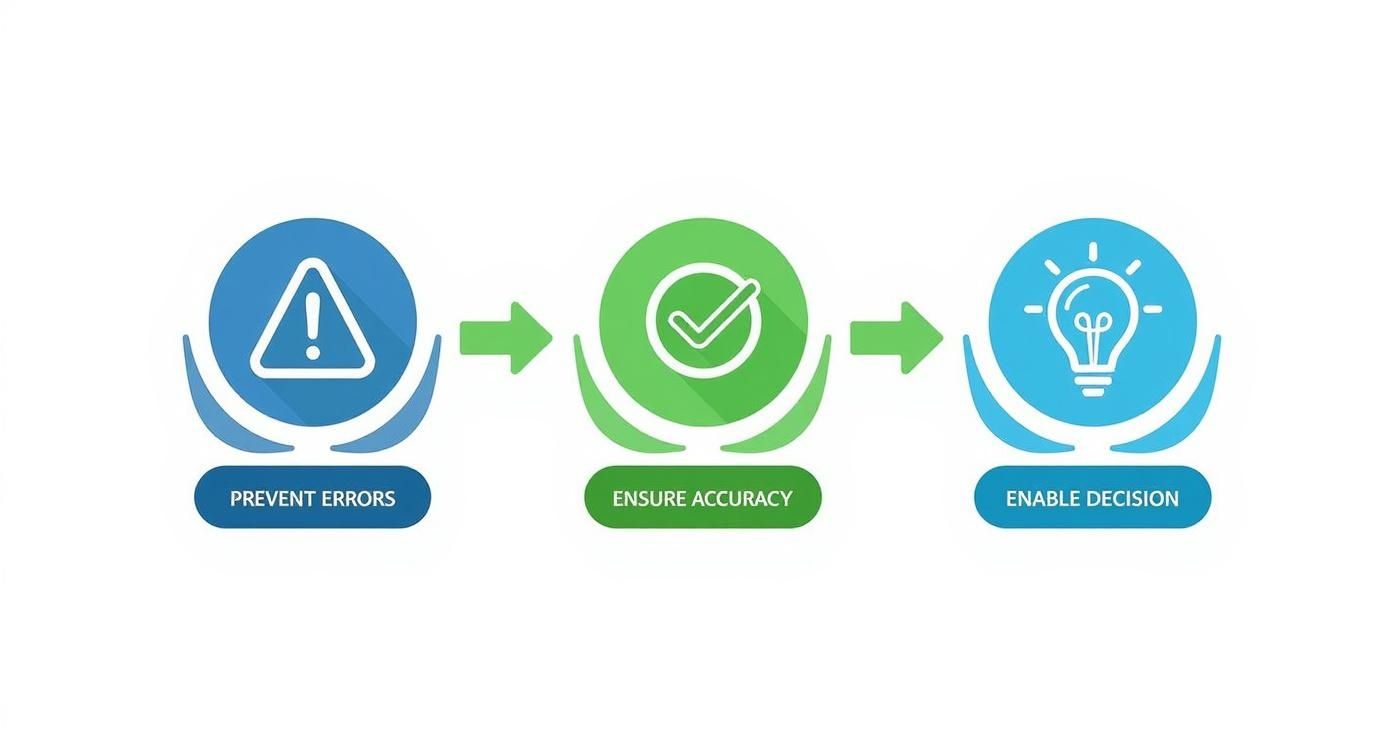
This flow is the core of financial control. By spotting things like outstanding checks or bank fees, a school guarantees its data is accurate, which empowers the leadership team to make smart, informed decisions.
Adjusting the Balances to Reconcile
With all the reconciling items identified, the final step is to adjust both balances until they agree. The key is to remember which side you're adjusting. You adjust each balance using the items that the other side doesn't know about yet.
You never actually change the bank statement itself. Instead, you create a report that starts with the bank's balance and makes adjustments to find the "true" cash position. On the other hand, the school's internal ledger will require new journal entries for things like bank fees and earned interest.
Let’s watch Ms. Evans calculate the adjusted balances.
Bank Balance Reconciliation
| Item | Amount |
|---|---|
| Bank Statement Balance | $95,500 |
| Add: Deposits in Transit | + $5,000 |
| Less: Outstanding Checks | |
| (Check #1255) | – $2,500 |
| (Check #1257) | – $1,200 |
| (Check #1258) | – $300 |
| Adjusted Bank Balance | $96,500 |
Now, she adjusts the school's book balance to account for the items she just learned about from the bank statement.
Book Balance Reconciliation
| Item | Amount |
|---|---|
| General Ledger Balance | $96,445 |
| Add: Interest Earned | + $100 |
| Less: Bank Service Fees | – $45 |
| Adjusted Book Balance | $96,500 |
Success! Both sides now land on the exact same number: $96,500. The books are reconciled. This proves that Northwood Academy's financial records are accurate and reliable, and every dollar is accounted for.
Building this kind of robust financial process is critical for your school's health. If you're ready to implement airtight financial controls, book a call with JAG Consulting at https://link.jagconsultingservices.com/widget/bookings/prospective/school/consultation/zoom or visit our website to learn more.
Reconciling Tuition Revenue Beyond Bank Deposits
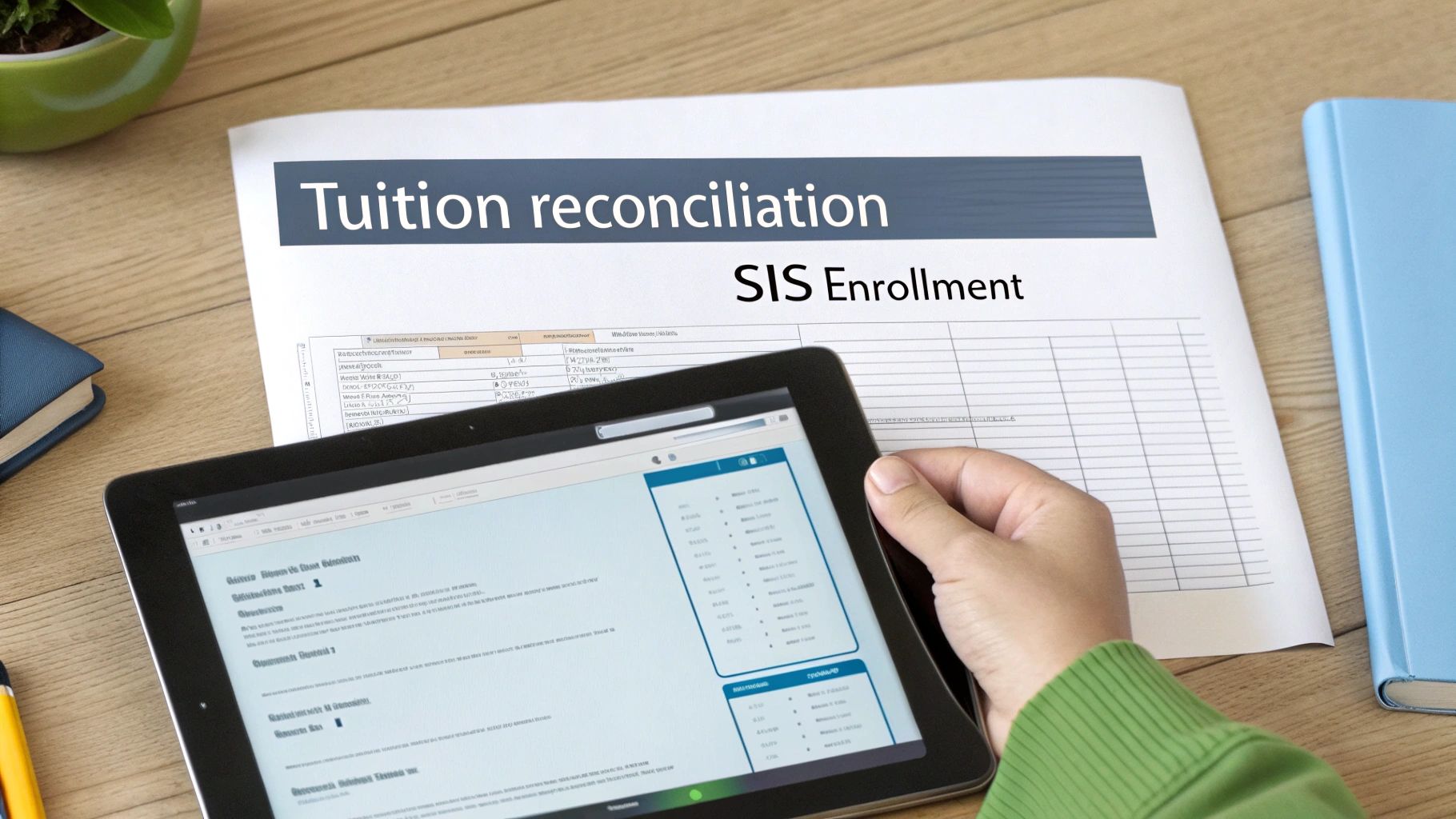
While reconciling your bank statement is a good start, it’s just scratching the surface. Your private school’s most important revenue stream—tuition—demands a much deeper dive. Simply matching deposits to your bank statement leaves huge blind spots. A true tuition revenue reconciliation means pulling data from three different places to make sure every single dollar is accounted for.
This three-way check connects the dots between your Student Information System (SIS), your accounting software's general ledger, and your bank records. The SIS tells you what you should have collected from families. The ledger shows what your business office recorded. The bank shows what you actually deposited. When all three line up, you know your financial picture is accurate.
A Practical Tuition Reconciliation Example
Let's walk through a real-world scenario for a private school. Imagine it’s the end of February at Northwood Academy, and the business manager needs to reconcile tuition revenue. She pulls three reports to get started:
- SIS Enrollment Report: This lists every student enrolled and their tuition payment due for February. The total expected revenue is $250,000.
- General Ledger Revenue Report: The accounting software shows all tuition revenue posted for the month. The total recorded revenue is $245,000.
- Bank Statement: The bank statement shows all deposits coded as "Tuition Payments" for February. The total amount deposited is $239,500.
Right away, you can see the problem. None of the numbers match. This is exactly why the three-way reconciliation is so critical—it’s the only way to find out where things went wrong.
Finding the Discrepancies
By digging into the line-by-line details of each report, the business manager starts to piece together the story behind the numbers.
- SIS vs. General Ledger: First, she compares the student list from the SIS against the payments recorded in the ledger. There’s a $5,000 gap. After a quick review, she finds it: the Johnson family’s payment was never entered into the accounting system, even though they’re marked as active in the SIS.
- General Ledger vs. Bank Statement: Next, she looks at the ledger versus the bank. The ledger shows $245,000 recorded, but the bank only has $239,500 in deposits—a difference of $5,500. The investigation reveals the Smith family’s check bounced (an NSF check), but the bank’s notification never made it to the business office. The revenue was recorded, but the cash never actually arrived.
This example shows how reconciliation is less about balancing numbers and more about finding broken processes. These are operational gaps that could easily go unnoticed for months, causing major headaches down the line. It’s this need for precision that drove the banking sector to pioneer reconciliation software; in fact, the bank reconciliation segment is projected to hold the largest share of the account reconciliation software market. You can read more about the growth of reconciliation technology and its financial impact.
This multi-system reconciliation is essential for accurate enrollment forecasting and reliable budgeting. If your SIS shows 250 students but you only collect revenue for 248, your financial projections for the entire year could be flawed.
Reconciling Financial Aid Awards
The process doesn't stop with tuition payments. Private schools must apply the same rigor to financial aid and scholarships.
This means comparing two key figures:
- The total financial aid promised to students (from your admissions or financial aid office records).
- The total aid applied as a credit against tuition charges in your general ledger.
If those numbers don't match up, it might mean a student was given the wrong award amount. Or worse, an awarded scholarship was never credited to a family’s account, leading to billing errors and frustrated parents. This check ensures your school is honoring its commitments and tracking scholarship expenses accurately.
By performing these detailed reconciliations, your school moves from simple bookkeeping to strategic financial management, making sure every dollar you’ve earned is actually in the bank.
Ready to build a stronger financial foundation for your private school? Book a no-obligation call with JAG Consulting to discuss your school's unique needs or visit our website to learn more about our services for private schools.
Solving Common Reconciliation Challenges in Private Schools
Even the most buttoned-up business office will run into discrepancies during reconciliation. Don't think of these as failures. See them for what they are: opportunities to sharpen your financial detective skills. This section is your field guide for troubleshooting the unique, real-world challenges that pop up in private schools, with practical ways to get them sorted out.

From misplaced checks to miscoded donations, every mismatch tells a story about a process that could be stronger. Hitting these issues head-on keeps them from becoming recurring headaches that eat up your team's time and resources.
Misplaced Parent Checks and Miscoded Donations
One of the most common issues we see in private schools involves payments that just don't line up with the records. A parent might write a single check to cover both tuition and a gift to the annual fund, but the entire amount gets booked to tuition. This creates a shortfall in your donations account and an overage in tuition revenue, throwing your budget reports out of whack.
The fix is a straightforward two-step process:
- Trace it Back to the Source: Pull the deposit slip or the digital payment record. Compare that against the parent’s payment history in your Student Information System (SIS) and any notes from the development office.
- Make a Correcting Journal Entry: Once you confirm how the funds were meant to be split, create a journal entry to reclassify the payment. This moves the donation portion out of the tuition revenue account and into the proper donation account, making both records accurate.
Confusing Credit Card Processing Fees
This one trips up a lot of schools. Credit card processors like Stripe or Square often batch payments together and pull their fees out before depositing the money into your bank account. That means the lump sum that hits your bank is less than the total tuition payments you recorded in your ledger for that day.
The key is to treat processing fees as a distinct expense. Never simply adjust the revenue down to match the deposit. Doing so understates your true tuition revenue and hides the operational cost of accepting credit card payments.
To handle this correctly, record the full tuition payment as revenue. Then, create a separate journal entry to recognize the processing fees as an expense, usually under "bank fees" or "merchant fees." This gives you a crystal-clear picture of both your earned income and your costs.
Timing Differences from Fundraising Events
Timing differences are another classic culprit for private schools. Imagine your school's annual gala is on March 31st. You collect a mountain of checks and credit card payments that night, and your team correctly records this revenue in the March ledger. But the bank run doesn't happen until April 1st. This creates a classic reconciling item: a deposit in transit.
This isn't an error, but it requires careful notes. Your March bank reconciliation report should clearly list this deposit as an addition to the bank balance, allowing you to arrive at your true, adjusted cash position for the month.
A Quick Troubleshooting Guide for Schools
When you're staring at numbers that don't add up, it's usually one of a handful of common school-specific issues. This table is a quick-reference guide to help you diagnose and fix the most frequent discrepancies we see in the field.
Troubleshooting Common School Reconciliation Discrepancies
| The Discrepancy | The Likely Cause | How to Correct It |
|---|---|---|
| Bank deposit is less than daily revenue recorded. | Credit card processing fees were deducted before the deposit was made. | Record the full revenue amount. Create a separate journal entry to book the processing fees as a "Bank Fees" expense. |
| Revenue for an event is in the ledger but not on the bank statement. | This is a deposit in transit. Funds from a month-end event (like a gala) were recorded but not deposited until the next month. | This is not an error. List the deposit as an "addition to the bank balance" on your reconciliation report to account for the timing. |
| A deposit contains an odd amount that doesn't match any single payment. | A single parent check was likely split between tuition and a donation but was coded entirely to one account. | Trace the payment to the source (deposit slip, parent account). Create a correcting journal entry to reclassify the funds correctly. |
| A check is recorded in the ledger but hasn't cleared the bank. | This is an outstanding check. The check was written and sent, but the recipient hasn't deposited it yet. | This is also a normal timing difference. List the check as a "deduction from the bank balance" on your reconciliation report. |
| A small, unexpected deposit or withdrawal appears on the bank statement. | This is likely bank interest earned or a monthly bank service fee that wasn't recorded in the school's ledger. | Create a journal entry to record the interest income or the bank fee expense in your general ledger. |
Getting comfortable with these common scenarios turns reconciliation from a chore into a powerful tool for maintaining financial integrity. It's about building a process you can trust.
Of course, many of these manual snags can be minimized with modern accounting tools. The industry is moving quickly toward automation, which can handle up to 95% of the reconciliation process, with transaction auto-match rates hitting 90%. This lets finance teams boost productivity by 50% and achieve up to 99% reconciliation precision. You can discover more insights about the power of balance sheet reconciliation tools and see how they are changing financial management.
By understanding these common puzzles, your school can turn reconciliation from a frustrating task into a valuable financial control.
Ready to solve your private school’s unique financial puzzles? Schedule a complimentary consultation with JAG Consulting or visit our website to learn more.
Building Financial Controls with a Monthly Checklist
Doing a one-off reconciliation is a good start, but the real power comes from building a consistent, repeatable process. This is how your private school moves from just completing a task to creating a rock-solid system of internal financial controls. A reliable monthly process turns reconciliation from a reactive chore into a proactive strategy that safeguards your school's assets and financial health.
Strong controls are your first line of defense against both honest mistakes and potential fraud, giving your board, donors, and families peace of mind. For a private school, this isn’t just a nice-to-have; it's a core part of your stewardship. By establishing clear policies, you ensure every reconciliation is done right, reviewed thoroughly, and properly documented for your auditors.
Key Internal Control Practices for Private Schools
To build a truly robust system, you need to bake two non-negotiable principles into your process. These create the accountability and transparency essential for any private school managing tuition, donations, and expenses.
-
Segregation of Duties: This is the big one. The person who records daily transactions—entering tuition payments in your SIS, cutting checks for vendors—should never be the same person who reconciles the bank account. This separation creates a natural check and balance, ensuring an independent set of eyes is verifying the work. It dramatically lowers the risk of both accidental errors and intentional fraud.
-
Formal Review and Sign-Off: Once a reconciliation is finished, it must be reviewed and formally approved by a supervisor. This could be the Director of Finance, Head of School, or a designated board treasurer. This second look confirms the process was followed correctly and that every reconciling item has a valid explanation. A physical or digital signature provides a clear audit trail, proving the review happened.
Strong internal controls are essential for financial accuracy. Research shows that organizations with weak controls are significantly more susceptible to fraud, with 77% of fraud cases occurring at organizations with inadequate internal controls. For private schools, where reputation is paramount, this risk is unacceptable.
Your Monthly Reconciliation Checklist
Consistency is your best defense against financial surprises. To help your private school put these controls into action, we’ve created a downloadable monthly checklist. This simple tool walks your business office through every step, from gathering documents to finalizing the report, making sure nothing gets missed.
It helps standardize your workflow, which makes it much easier to train new staff and maintain high standards month after month. Ultimately, this checklist helps you create a consistent, transparent, and defensible reconciliation process every single time.
Ready to strengthen your school's financial framework? Book a free consultation with JAG Consulting to see how we can help implement these critical controls, or visit our website to learn more about our services for private schools.
Common Questions from the Private School Business Office
When you're in the trenches of private school finance, a few questions about reconciliation pop up again and again. Here are straightforward answers to the most common ones we hear from school administrators and business managers.
How Often Should Our Private School Reconcile Accounts?
The short answer: monthly. Every single time.
All your key accounts—especially bank accounts, credit cards, and tuition revenue—need a monthly reconciliation. Sticking to this schedule is the single best way to catch errors or discrepancies before they snowball into a much bigger problem.
Think of it this way: a consistent monthly check-up makes your year-end reporting and audit process infinitely smoother. It’s all about preventing major financial surprises down the road.
What Software Can Help Automate Reconciliation?
Many modern accounting platforms are perfect for the private school environment and can take a lot of the manual work off your plate. Software like QuickBooks Online and Xero have fantastic bank feed and reconciliation tools that automate most of the transaction matching.
These tools are a game-changer. They slash manual data entry, dramatically reduce the chance of human error, and free up your business office staff to focus on more strategic work. Many school-specific management systems also have similar features built-in, tailored to handle things like tuition payments and fundraising income.
Who Should Review and Approve Reconciliations?
This is a big one for internal controls at a private school. Ideally, the person who reviews and approves the final reconciliation should be someone completely separate from the day-to-day bookkeeping. This segregation of duties is a non-negotiable cornerstone of a strong financial system.
For most private schools, this responsibility falls to the Head of School, Director of Finance, or a dedicated board treasurer. Their independent sign-off isn't just a formality; it provides crucial oversight and holds everyone accountable.
What Are the Biggest Red Flags to Look For?
As you work through any account reconciliation example, certain things should make you pause and dig deeper immediately. Keep an eye out for these warning signs:
- Checks clearing the bank out of numerical order.
- Payments or electronic transfers to vendors you don’t recognize.
- Bank deposits that are noticeably smaller than the revenue your records show for that day.
- Journal entries or adjustments that don't have clear, logical documentation explaining why they were made.
These could be simple mistakes, but they can also be early indicators of fraudulent activity. Never ignore them.
Strengthening your private school's financial processes is absolutely critical for its long-term health and ability to fulfill its mission. The team at JAG Consulting specializes in building robust, practical financial frameworks for private schools just like yours.
Ready to make sure your financial controls are airtight? Book a call with JAG Consulting today or visit our website and let's talk about building a stronger future for your school.

I'm Dr. Jeannie Gudith, Founder and CEO of JAG Consulting. We help you develop, improve, buy or sell your private school.
I'm so glad you're here
Hello!



© 2025 JAG CONSULTING.
all rights reserved. privacy policy + REFUND POLICY. TEMPLATE by sugar studios + Showit
