

What is a performance assessment: A practical guide for private schools
Think about the difference between memorizing the parts of a car engine and actually building one that starts. That’s the core of a performance assessment. It’s an evaluation that asks students to apply what they’ve learned to complete a complex task or create something real, rather than just circling answers on a test.
This method is all about measuring what students can do, not just what they can recite. For private schools, it's a powerful way to demonstrate the superior, real-world education you provide.
Going Beyond the Grade

For private school leaders, understanding performance assessment is about recognizing a powerful shift in education. It’s a move away from evaluation as a passive, one-time event—like a standardized test—and toward an active, engaging process that reveals true understanding.
Instead of asking a student to simply bubble in the causes of the American Revolution, a performance assessment might challenge them to write and perform a short play from the perspective of a colonist debating independence. The difference is profound.
This approach is fundamentally designed to measure higher-order thinking skills that are nearly impossible to capture with a simple letter grade. A well-designed task shows you a student's ability to think critically, solve messy problems, collaborate with others, and communicate complex ideas with confidence.
From Memorization to Application
The whole point of this model is to make learning visible and meaningful. A traditional math test can confirm a student has memorized a formula. A performance task, on the other hand, requires them to actually use that formula to solve a real-world problem, like designing a blueprint for a new community garden.
This distinction is crucial for private schools, especially when your value proposition rests on delivering a superior educational experience. Families today are looking for outcomes that go far beyond test scores. They want proof that their children are developing the durable skills they’ll need for college, careers, and life.
Performance assessments provide tangible evidence of these advanced skills. Research shows that schools emphasizing this approach see much higher levels of student engagement. Some studies have found that engagement rates can increase by as much as 71% when learning environments prioritize active application over passive recall.
The Value for Private Schools
Let's be clear: implementing performance assessments allows your school to demonstrate its commitment to deep, authentic learning. It’s a powerful way to show, not just tell, prospective families how you are preparing students for a complex and demanding world.
This method directly measures the skills that matter most:
- Critical Thinking: Can students analyze information, evaluate arguments, and form their own reasoned conclusions?
- Problem-Solving: Are they able to navigate ambiguity and devise creative solutions when the answer isn't in the back of the book?
- Effective Communication: Can students articulate their ideas clearly and persuasively, both on paper and in person?
- Collaboration: Do they know how to work effectively in a team to achieve a common goal?
By moving beyond simple recall, these assessments give you a far richer, more accurate picture of what a student is truly capable of.
Ready to explore how performance assessments can elevate your school's academic program and strengthen your market position? Book a complimentary consultation with JAG Consulting today or visit our website to learn more about our strategic academic planning services.
Putting Performance Assessments Into Practice

Understanding the theory behind performance assessments is one thing. Actually bringing them to life in your classrooms? That's a whole different challenge. For private schools ready to move beyond theory, the key is making a strategic shift from concept to application. This isn't about adopting a single, rigid model; it's about choosing the right tools for the right job.
The best private schools don't rely on a one-size-fits-all approach. They build a flexible toolkit with four powerful assessment types, each designed to measure different skills and showcase student mastery in a tangible way. These methods are what turn learning from a passive exercise into an active, dynamic demonstration of what a student truly knows and can do.
Let’s get practical and explore these four models, complete with real-world examples you can adapt for your own school. This is how we demystify what is a performance assessment—by seeing it in action.
Authentic Tasks
The whole idea behind an authentic task is to get students to tackle the kinds of messy, complex problems they’ll face in the real world. These aren’t abstract exercises; they require students to apply their knowledge to solve a challenge that has meaning and relevance beyond the classroom walls.
- In an Economics Class: Forget the multiple-choice test on market theory. Instead, task students with creating a complete, sustainable business plan for a local startup. They’ll have to conduct actual market research, build financial projections, and deliver a persuasive pitch.
- In an Environmental Science Class: Have students analyze water quality data from a local stream and then prepare and present a remediation plan to the city council. This single task measures data analysis, scientific reasoning, and public speaking all at once.
Portfolios
A portfolio isn't just a folder of work; it's a curated story of a student's growth over time. It’s a powerful narrative that showcases progress, reflection, and achievement in a way a single grade never could. Portfolios are especially effective in subjects where the journey of learning is just as important as the final destination.
In an English class, a writing portfolio might contain early drafts and final versions of essays, poems, and stories from the entire year. Crucially, the student would also write a reflective introduction analyzing their own growth as a writer—a vital metacognitive skill. A digital design student could do the same, compiling a portfolio of projects that shows their evolving command of both the tools and the creative principles of their craft.
A portfolio moves evaluation from a single event to an ongoing story. This method not only assesses the final product but also the process, effort, and reflection a student invests, which are crucial indicators of deep learning.
Performance Tasks
While they sound similar to authentic tasks, performance tasks are typically more structured, multi-step projects that build toward a specific product or presentation. They are carefully designed to assess a clear set of skills and knowledge standards in a more integrated and creative way. Think of them as a final performance where students have to pull together everything they’ve learned.
Here are a couple of examples:
- For a History Class: Students could be assigned to create a museum exhibit on a historical period. This would involve curating artifacts (either real or created), writing descriptive placards, and then acting as docents to guide other students through their exhibit.
- For a Robotics Club: A classic performance task is to build and program a robot to navigate a complex maze or accomplish a series of specific objectives. It's a direct, hands-on demonstration of engineering, coding, and problem-solving skills.
Systematic Observations
Finally, systematic observation is where teachers use a structured framework—almost always a rubric—to evaluate students' skills as they are happening live. This method is perfect for assessing those critical competencies that are nearly impossible to measure on paper, like collaboration, public speaking, or laboratory techniques.
A science teacher could use a detailed rubric to score students as they conduct a complex lab experiment, evaluating their precision, their adherence to safety protocols, and how they solve problems as a team. In a humanities class, a teacher might use a similar rubric to assess a student’s performance during a formal debate, focusing on their use of evidence, the logic of their arguments, and their rhetorical skill.
By thoughtfully blending these four types of performance assessments, private schools can create a much richer, more accurate, and more meaningful picture of true student achievement.
Ready to design an assessment framework that truly reflects your school's commitment to excellence? To explore how we can help, book a call with JAG Consulting at https://link.jagconsultingservices.com/widget/bookings/prospective/school/consultation/zoom or visit our website to learn more.
The Strategic Advantage for Private Schools
Let's be honest. For a private school, choosing how to assess students isn’t just an academic decision—it’s a business decision. In a crowded market where families are scrutinizing every dollar of their investment, you need more than a high GPA to prove your worth. Performance assessments give you that proof.
They shift the conversation from “What did my child score on the test?” to “What can my child do with what they know?” This is how you demonstrate that your school is genuinely preparing students for the complexities of college, careers, and life, not just teaching them to memorize facts for an exam.
Deeper Learning That Drives Motivation
Think about the difference between a student filling out a multiple-choice worksheet on the American Revolution versus a student team tasked with creating a museum exhibit that argues a specific point of view about it. Which one is more engaging? Which one builds skills in research, collaboration, and persuasive communication?
This is the core of performance assessment. The work becomes real, it becomes meaningful, and students take ownership of it. You’re moving them from being passive recipients of information to active creators of knowledge.
This is the secret to unlocking genuine student engagement. When kids see how their learning applies to a tangible project or a real-world problem, their motivation skyrockets. That deeper connection leads to better retention—both of the material and of the students themselves.
This is the kind of educational experience that discerning families are actively searching for. It creates a powerful value proposition that’s easy to talk about but incredibly difficult for your competitors to copy. You stop being a school that produces good test-takers and become known as a school that builds capable, confident, and creative thinkers.
Connecting Classroom Outcomes to Your School's Bottom Line
A well-designed performance assessment program does more than just improve learning; it directly fuels your school's most important strategic goals. By measuring the skills that truly matter, you collect powerful evidence that strengthens your institution from the inside out.
- Elevate Your Academic Reputation: When you can show accreditation teams and college admissions officers portfolios of sophisticated student work, it speaks volumes more than a transcript ever could.
- Boost Student Retention: An engaged student is a happy student. When learning is exciting and relevant, students feel a stronger connection to their school, which has a direct impact on your re-enrollment numbers. Statistics show that a 5% increase in student retention can increase profitability by 25% to 95%.
- Create a Compelling Marketing Story: Stop using generic phrases like "we teach critical thinking." Instead, showcase a video of a student defending their capstone project or a link to a digital portfolio. That’s marketing that sells.
This strategic alignment is only becoming more important. The professional world is rapidly moving toward more dynamic, skill-based evaluations. By 2025, a staggering 75% of organizations plan to use AI-driven tools in their performance reviews. Companies already using them report a 71% increase in employee engagement and a 50% jump in goal achievement. If you want to dive deeper, you can find more insights in these performance management statistics.
The message is clear: the world is moving beyond bubble tests. By embracing performance assessments now, private schools can position themselves as forward-thinking leaders. You’re not just tweaking your curriculum; you’re building a more resilient, reputable, and successful school for the years to come.
Ready to use performance assessments as a strategic tool for your school's growth? To explore how a custom program can deliver measurable results, book a call with JAG Consulting at https://link.jagconsultingservices.com/widget/bookings/prospective/school/consultation/zoom or visit our website to learn more.
Designing Assessments That Truly Measure Learning
Shifting to performance assessments is a smart move, but let’s be honest: its success hinges entirely on thoughtful design. An impressive-looking project that doesn't actually measure the intended learning standards is just a glorified arts and crafts activity. To truly understand what your students know and can do, the design process has to be deliberate and rigorous.
For private schools, this isn't just about pedagogy; it's about delivering on your promise of a superior education. A well-designed performance assessment is a tangible product of that promise. It provides clear, undeniable evidence of the advanced skills your school cultivates, turning abstract goals into measurable student outcomes.
This takes more than just a creative idea for a project. It requires a structured approach that ensures every single assessment is fair, accurate, and perfectly aligned with your school's core academic mission. Let’s break down the essential pillars of getting this right.
Ensuring Clear Alignment with Learning Objectives
The first and most critical step is alignment. Every single task you create must be directly and explicitly linked to a specific learning objective or standard. Before you even think about the project itself, you have to ask: "What specific skill or piece of knowledge do I want to measure with this?"
If the goal is to assess a student's ability to analyze historical evidence, a diorama of a Civil War battle just won't cut it. A much better choice would be a research task where students must defend a historical argument using primary source documents. One measures craft skills; the other measures critical thinking.
A study on curriculum design found that schools with strong alignment between standards, instruction, and assessment see significantly better student outcomes. One analysis noted that tightly aligned curricula can lead to gains equivalent to an additional three months of learning per school year.
Without this direct link, even the most engaging project is academically adrift. You must be able to draw a straight, unbroken line from the task right back to the standard it’s designed to evaluate.
The infographic below shows how this intentional design process directly builds your school's strategic advantage—moving from deeper learning to enhanced motivation and, ultimately, a stronger reputation.
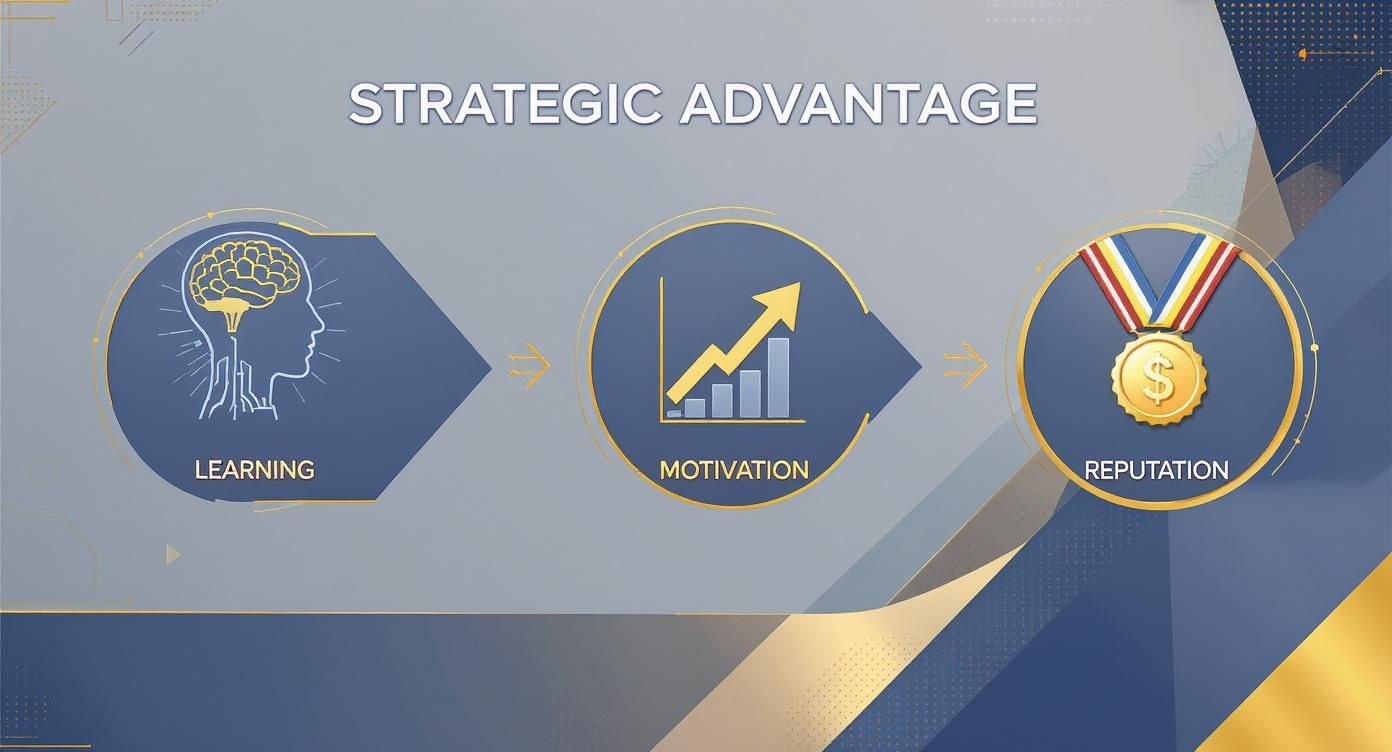
This flow makes it clear: a robust assessment design is the engine that drives tangible institutional benefits. It makes academic rigor a cornerstone of your school's brand.
Building Robust and Transparent Rubrics
Once you have an aligned task, the next non-negotiable step is creating a high-quality rubric. A rubric is not just a grading tool; it's a communication tool. It provides a clear, objective roadmap for success, telling students exactly what excellence looks like before they even begin their work.
A strong rubric accomplishes several key things:
- Defines clear criteria: It breaks down the assessment into its core components (e.g., "Use of Evidence," "Clarity of Argument," "Presentation Skills").
- Describes performance levels: For each criterion, it details what constitutes different levels of achievement (e.g., "Exemplary," "Proficient," "Developing").
- Ensures fairness and consistency: It allows teachers to evaluate complex, subjective work objectively, reducing bias and ensuring all students are assessed on the same standards.
This kind of transparency empowers students to take ownership of their learning. They can self-assess their work as they go, making revisions and improvements based on the crystal-clear expectations you've set.
Guaranteeing Validity and Reliability
Finally, your assessments must be both valid and reliable. These two concepts are the bedrock of any trustworthy evaluation system. Think of them as the quality control checks for your assessments.
- Validity asks the simple question: Does the assessment actually measure what it claims to measure? A multiple-choice test on basketball rules might be reliable, but it isn't a valid measure of a student's ability to actually play basketball.
- Reliability asks: Would the assessment produce consistent results? If two different teachers used the same rubric to grade the same project, would they arrive at a similar score? If not, the tool isn't reliable.
Achieving both requires careful planning, crystal-clear rubrics, and ongoing professional development for your faculty. By starting with a pilot program, you can test and refine your assessments, gather teacher feedback, and build the institutional muscle needed to implement this approach school-wide.
Ready to design an assessment framework that truly measures what matters? To get expert guidance, book a call with JAG Consulting at https://link.jagconsultingservices.com/widget/bookings/prospective/school/consultation/zoom or visit our website.
Using Rubrics to Provide Meaningful Feedback
Grading a multi-step project isn't like grading a quiz. The goal completely shifts. Instead of just slapping a score on the final product, our job is to give students a clear roadmap showing them how to get better. This is exactly where rubrics become the most valuable tool in the shed for any private school serious about performance assessment.
A well-designed rubric pulls back the curtain on the grading process, making it transparent, consistent, and fair for everyone. It takes those big, abstract expectations floating in a teacher's head and breaks them down into clear, actionable criteria. Suddenly, feedback isn't just a judgment—it’s the engine that drives real student growth.
For private schools, that level of clarity is non-negotiable. It gives teachers a reliable framework for evaluation and, just as importantly, shows students precisely what "excellent" looks like before they even begin.
Blending Formative and Summative Feedback
Truly effective assessment is a conversation, not a final verdict delivered from on high. Rubrics are perfect for facilitating this dialogue because they seamlessly blend two critical types of feedback: formative (the in-process guidance) and summative (the final evaluation).
Think of it like coaching a basketball team. The formative feedback is everything that happens during practice—the small adjustments to a player's shot, the strategic advice, the drills to build specific skills. The summative feedback is simply the final score of the game. A great coach knows you can't win the game without having a great practice.
A rubric allows a teacher to provide targeted, formative feedback all through a project. By pointing to a specific row on the rubric, they can say, “Your research here is solid, but let’s focus on the ‘Analysis of Evidence’ criteria to push your work to the next level.” This transforms a generic grade into specific, actionable advice.
This process ensures that the final, summative evaluation is never a surprise. Students get to the finish line having been guided, supported, and challenged to do their best work at every stage.
Translating Assessments for Parents and Colleges
One of the biggest hurdles private schools face when adopting performance assessments is explaining their value to the outside world. How do you translate a rich, complex project score into something that makes sense on a traditional report card or a college transcript?
The key is clear, confident communication backed up by solid documentation.
Your school profile—that document you send to colleges with every single transcript—becomes an incredibly powerful tool. Use it to explain your assessment philosophy. Highlight how your methods measure the very skills admissions officers are desperate to see: critical thinking, collaboration, and complex problem-solving.
This shift isn't happening in a vacuum; it mirrors what's happening in the professional world. As companies ditch outdated annual reviews for more dynamic metrics, schools must also evolve. In a recent survey, a staggering 5% of HR leaders said they were satisfied with traditional performance reviews, signaling a massive demand for more meaningful ways to evaluate skills. You can dig into how professional metrics are changing by exploring the latest performance management statistics.
For parents, hosting workshops where you walk them through a sample project and its rubric can be a game-changer. When they see the depth of thinking and the level of skill a project demands, the lightbulb goes on. They start to realize that a performance assessment provides a far more complete and insightful picture of their child’s abilities than a simple test score ever could.
Ready to build a feedback and reporting system that showcases the true value of your academic program? Book a call with JAG Consulting at https://link.jagconsultingservices.com/widget/bookings/prospective/school/consultation/zoom or visit our website to learn how we can help.
A Strategic Imperative for School Leadership
For heads of school, board members, and senior leadership, the conversation around performance assessment has to be bigger than what happens in the classroom. This isn't just a pedagogical tactic; it's a strategic conversation about the health, market position, and long-term survival of your institution.
Shifting to this model isn't a minor curriculum tweak—it's an institutional imperative. A well-integrated performance assessment program gives you the concrete proof you need to strengthen your school where it matters most. It builds a powerful, unified story that resonates with accreditors, prospective families, and your own board, handing you a serious advantage in a crowded market.
Strengthening Your Position for Accreditation
Accreditation isn't a checkbox exercise anymore. Accrediting bodies are digging deeper, demanding real proof of student-centered learning and curriculum innovation. They want to see that your school is actually building the skills students need for the future, not just reciting content from the past.
Performance assessments are the single most compelling piece of evidence you can put on the table. A portfolio of sophisticated student projects, detailed rubrics, and data showing measurable growth in critical thinking speaks volumes more than standardized test scores alone. It proves an institutional commitment to authentic learning and continuous improvement.
When you can showcase exactly how your assessments measure complex problem-solving and collaboration, you provide tangible proof that your school’s mission is alive and well in its classrooms. This elevates the accreditation conversation from a compliance headache to a showcase of excellence.
Driving a Powerful Enrollment Strategy
In a competitive private school market, you have to stand out. Every school promises "academic excellence," but performance assessments let you prove it. Families are looking for a clear return on their significant investment, and generic marketing language just doesn't cut it anymore.
Imagine your admissions team moving beyond the usual talking points. Instead of just saying you teach critical thinking, they can share examples of student-led Socratic seminars or showcase a digital portfolio of impressive design work. They can even play a video of a senior defending their capstone project. This is how you turn an abstract claim into a tangible, undeniable reality for prospective parents.
This approach mirrors what's happening in the professional world, where skill demonstration is everything. Companies that use modern feedback systems report a 39% better talent attraction rate compared to those stuck in old methods. The same logic applies to schools. When you showcase advanced assessment, you attract mission-aligned families who value deep learning over rote memorization. You can dig deeper into this trend by reviewing the state of performance management.
Informing More Effective Governance
Finally, a robust performance assessment system gives your board and leadership team far more meaningful data to work with. Standardized test scores offer a narrow, one-dimensional snapshot. Performance data, on the other hand, paints a rich, detailed picture of what’s actually happening with student learning across your entire school.
This allows for much smarter governance and strategic planning. Instead of just reacting to a dip in test scores, your team can analyze data from performance tasks to pinpoint specific strengths and weaknesses in your curriculum. This data empowers your leadership to make better, more informed decisions about where to allocate resources, what kind of professional development is needed, and the long-term academic strategy for the school.
Ultimately, when you frame performance assessment as a strategic imperative, you align your entire institution—from the classroom to the boardroom—around a shared commitment to deep, meaningful, and measurable student achievement.
Are you ready to make performance assessment a cornerstone of your school's strategy? Book a complimentary consultation with JAG Consulting today at https://link.jagconsultingservices.com/widget/bookings/prospective/school/consultation/zoom or visit our website to learn how we can help you achieve your institutional goals.
Common Questions About Performance Assessments
Even after seeing the clear benefits, shifting your school's entire assessment philosophy can feel like a monumental task. It’s only natural for school leaders, teachers, and especially parents to have some tough questions. The key to building the consensus you need for a smooth transition is meeting those concerns head-on with clear, confident answers.
Let’s walk through some of the most common questions we hear from private school leaders when they start exploring what a performance assessment program could really mean for their school.
Are Performance Assessments as Rigorous as Standardized Tests?
Absolutely. In fact, you could argue they're even more rigorous. When designed well, performance assessments demand a much higher level of thinking than most traditional tests. They’re built to measure what students can do with their knowledge—challenging them to apply, analyze, and create, not just memorize and spit back information.
The rigor isn't found in a tricky multiple-choice question; it's baked into the complexity of the task itself and the depth of understanding a student needs to succeed. A detailed, transparent rubric is what ensures this rigor is measured objectively and consistently. It provides a far richer picture of a student's true capabilities than a bubble sheet ever could.
How Do Colleges View Performance-Based Grades on Transcripts?
Admissions officers at the most selective colleges and universities are hungry for applicants who can prove they have real-world skills. Transcripts that showcase performance-based grades are actually a huge advantage, especially when you support them with a school profile that clearly explains your assessment philosophy.
These assessments offer concrete proof that a student can think critically, manage a complex project, and communicate effectively—all non-negotiable skills for success in higher education. Many private schools find this approach actually helps their graduates stand out in an incredibly crowded and competitive applicant pool.
How Can We Implement This Without Overwhelming Our Teachers?
This is a critical question, and the answer is all about a strategic, supportive rollout. The fastest way to sink this initiative is with a top-down mandate that lands on teachers' desks with a thud. Instead, you need to foster a collaborative, phased-in approach.
- Start Small: Don't try to boil the ocean. Launch a pilot program with one or two willing departments. This gives you a chance to test the waters, learn from mistakes, and build momentum.
- Provide Dedicated Support: Offer meaningful professional development that’s actually helpful—focused on assessment design, building great rubrics, and giving effective feedback.
- Create Time for Collaboration: You have to give teachers the time and space to work together, co-create projects, and share what's working with their colleagues. Time is the most valuable resource you can provide.
Your job as a leader is to provide the time, resources, and unwavering encouragement to make sure your faculty feels empowered by this shift, not buried by it. The goal is a thoughtful evolution, not an overnight revolution.
At JAG Consulting, we specialize in guiding private schools through these kinds of strategic transitions. We can help you audit your current systems, develop a phased implementation plan that works for your culture, and provide the faculty training needed for long-term success.
Ready to start the conversation? Book a call with JAG Consulting at https://link.jagconsultingservices.com/widget/bookings/prospective/school/consultation/zoom or visit our website to learn more.

I'm Dr. Jeannie Gudith, Founder and CEO of JAG Consulting. We help you develop, improve, buy or sell your private school.
I'm so glad you're here
Hello!


