


How to Buy a School The Definitive Acquisition Guide
So, you're thinking about buying a private school.
It’s one of the most significant professional decisions you can make—a move that marries smart financial investment with a genuine commitment to education. But let's be clear: this isn't your typical business acquisition. Buying a private school is an investment in a community's future and taking on the stewardship of an educational legacy.
Whether you're a seasoned educator ready to lead or an investor who sees the immense potential in the private education space, the path forward requires a specific roadmap. It's a journey that demands a focused strategy covering everything from finding the right opportunity to navigating the intricate details of due diligence, valuation, financing, and a seamless operational transition.
Why the Private School Market is So Compelling Right Now
The private education sector isn't just stable—it's growing at an impressive clip. In the U.S. alone, there are over 30,000 private schools serving approximately 4.7 million students. Parents are actively seeking out specialized learning environments, from STEM-focused academies to schools with deep roots in the arts. This demand is creating a fertile ground for well-run private schools to thrive.
And because the market is so fragmented, it’s ripe with opportunities for smart operators looking to build a network of schools under a unified mission.
The acquisition process itself breaks down into three core phases. Think of it as a funnel: you start broad by identifying opportunities, narrow down during due diligence, and finally focus on integrating your new school into your vision.
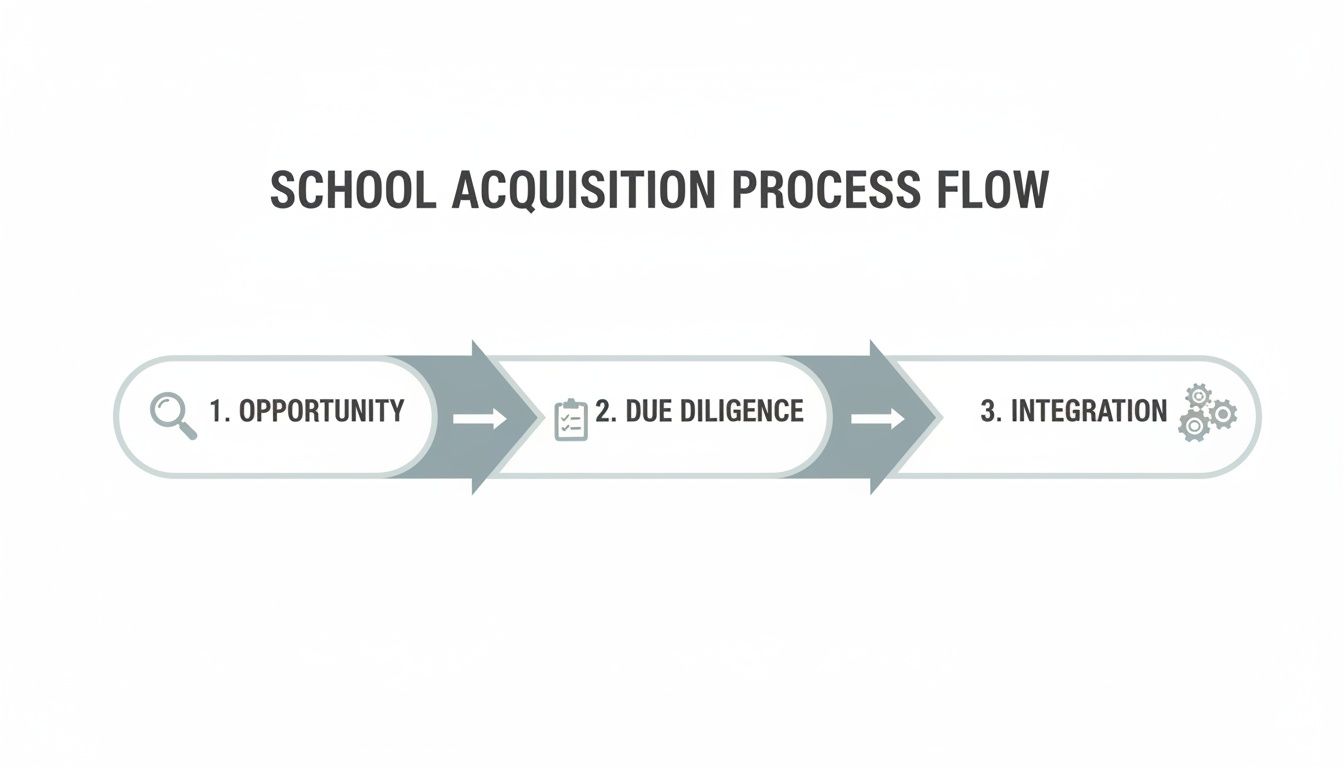
This simple roadmap—Opportunity, Due Diligence, and Integration—is the foundation for every successful private school purchase.
Understanding the Growth Trajectory
The numbers tell a powerful story. The global K-12 private education market is projected to grow from roughly USD 431.46 billion in 2025 to USD 609.22 billion by 2029. That's a compound annual growth rate (CAGR) of 9%.
This isn’t some fleeting trend. It reflects a sustained global demand for high-quality, alternative education, making now a very interesting time to get into the market. For a deeper dive, you can check out a detailed K-12 private education market report.
But capital alone isn't enough. The most successful acquisitions I've seen are led by people who respect the school’s existing culture while strategically implementing improvements. It’s about stewardship, not just short-term financial engineering.
The Essential Roadmap for Buyers
Every deal has its own quirks, but the fundamental stages of buying a private school are consistent. It all starts with finding the right opportunity—a school that actually aligns with your financial goals and your educational vision.
A successful acquisition hinges on balancing the tangible assets, like property and enrollment figures, with the intangible ones, such as community reputation and staff morale. Neglecting the latter is a common and costly mistake.
Once you have a target, the real work begins. You’ll dive deep into due diligence, scrutinizing everything from financial statements and legal compliance to academic standards and operational workflows. This is where you uncover the real story behind the numbers.
From there, it's about valuation, negotiation, securing financing, and, crucially, planning for a smooth post-purchase transition. That final integration phase is where you win or lose the trust of staff, students, and parents.
To give you a clearer picture, here’s a high-level overview of the journey.
Key Stages of a School Acquisition
| Phase | Key Activities | Primary Goal |
|---|---|---|
| 1. Sourcing & Evaluation | Define criteria, search for schools, conduct initial screening, sign NDAs. | Identify a viable private school that aligns with your financial and educational goals. |
| 2. Due Diligence | Analyze financials, review legal compliance, assess operations, evaluate academics. | Uncover risks, confirm the school's value, and validate the investment thesis. |
| 3. Valuation & Offer | Apply valuation methods (SDE, DCF), structure a formal offer (LOI). | Arrive at a fair purchase price and present a compelling offer to the seller. |
| 4. Financing & Negotiation | Secure funding (SBA, private equity), negotiate the purchase agreement. | Finalize the deal terms and secure the capital needed for the acquisition. |
| 5. Closing & Integration | Complete legal transfer, manage accreditation, plan operational transition. | Ensure a seamless handover and set the stage for long-term success. |
This table provides a bird's-eye view, but each step has layers of complexity that require expert handling.
Navigating this process alone can be incredibly daunting. The team at JAG Consulting provides the specialized guidance needed to move through every stage with confidence. If you're serious about buying a private school, I encourage you to book a consultation. Let's talk about how we can help bring your vision to life.
Finding and Vetting the Right School to Buy
Let’s get one thing straight: the perfect private school to acquire almost never shows up on a public listing. If you’re just scrolling through generic business-for-sale websites, you’re missing the real opportunities. The best deals are unearthed through quiet conversations, deep industry connections, and working with advisors who live and breathe the private education market.
Finding the right fit means you have to be proactive. While some schools are formally on the market, many of the most attractive targets are off-market opportunities. These are schools where the owners are thinking about retirement or a change of scenery, but they haven't put a "for sale" sign on the lawn just yet.
Sourcing Your Ideal School Acquisition
To find these hidden gems, you need to cast a wide net. Relying on a single source will leave you with limited, and likely mediocre, options. A multi-channel approach is non-negotiable.
Here’s where the best opportunities come from:
- Industry-Specific Brokers: Don't waste your time with general business brokers who sell everything from laundromats to franchises. Specialists like JAG Consulting have spent years building relationships with private school owners. They know the players, understand the unique challenges of the sector, and hear about potential sales long before anyone else.
- Professional Networks: Get out there. Go to education conferences, join private school associations, and talk to administrators and board members. These conversations are where you’ll get the real market intelligence and hear the whispers about who might be ready to sell.
- Direct Outreach: If you know exactly what you’re looking for—say, a K-8 private school in a specific county—a respectful, well-crafted direct outreach campaign can work wonders. This isn't about spamming people; it’s about tactfully presenting yourself as a credible successor.
The U.S. private school landscape is ripe for this kind of strategic acquisition. After a recent dip, the market is poised for a recovery, creating a prime window for savvy buyers. The sector is incredibly fragmented, with approximately 25,433 separate businesses. This means there are massive opportunities for consolidation, whether you're an investor or an experienced operator. For a deeper dive into the numbers, check out the latest industry analysis on private schools in the US.
Creating Your Target Profile
Before you even think about looking at specific schools, you have to define what a "win" looks like for you. A crystal-clear target profile is your most important filter. It stops you from wasting months chasing opportunities that were never the right fit to begin with.
Get specific. Your profile needs to cover more than just revenue.
- School Type: Are you after a Montessori preschool, a rigorous K-8 prep school, a niche arts academy, or a traditional K-12 institution?
- Enrollment Size: Define your sweet spot. Are you looking for a small, tight-knit community of under 100 students or a larger school with 500+?
- Geographic Location: Pinpoint the states, cities, or even neighborhoods that align with your strategy.
- Financial Health: Set your parameters. What are your minimums for revenue and profitability? What tuition levels are you comfortable with?
A classic mistake is to only chase highly profitable schools. Sometimes the golden opportunity is a school with a fantastic brand and a loyal community that's just being mismanaged financially. Those are problems you can fix.
The Initial Vetting Checklist
Once a potential school is on your radar, it's time for the initial screen. This isn't deep due diligence; it's a quick, high-level look to see if it’s even worth signing a Non-Disclosure Agreement (NDA) and digging into the confidential numbers.
Let’s play out a real-world scenario. You find two private schools. School A is turning a nice profit, but a quick search reveals a trail of negative parent reviews and you hear whispers about high teacher turnover. School B is just breaking even, but it has a stellar reputation in the community, a waitlist for key grades, and a beloved Head of School.
On paper, School A looks better. But in reality, School B is likely the far superior long-term investment. You can fix operational issues and improve profitability. Fixing a toxic reputation can take years, if it can be fixed at all.
This initial vetting is all about assessing the foundation. Is the school’s mission solid? Is the parent community engaged and supportive? Is its academic reputation an asset you can build on?
Answering these questions first will tell you whether it’s worth committing the time and money for a full deep-dive. If you need help building your target profile or vetting those first few opportunities, the team at JAG Consulting can bring the clarity you need to focus on what really matters. Schedule a call today to get started.
Mastering School-Specific Due Diligence
You've found a promising private school. The idea feels right. Now comes the part where you trade excitement for investigation. This is the due diligence phase, and it’s where a potential acquisition goes from an interesting idea to a smart, viable investment.
This isn't just about checking boxes on a list. It’s an intense, sleeves-rolled-up process where you systematically verify every claim the seller has made and, more importantly, uncover the risks hiding beneath the surface. When you buy a private school, you're not just acquiring buildings and bank accounts; you're taking on a legacy, a community, and a complex operational machine. A thorough investigation protects your capital and sets you up for a smooth transition.
Let’s break this down into the three critical pillars you have to get right: financial, operational, and regulatory.

The Financial Deep Dive
Going through a few years of tax returns isn't enough. Financial due diligence is about understanding the real financial health and sustainability of the school. You need to get forensic, scrutinizing every line item to find the strengths and the hidden weaknesses that could torpedo your investment down the road.
Start with the primary revenue stream: tuition. For most private day schools, tuition can account for 80-90% of annual revenue. That heavy reliance makes it a critical area to probe. How stable is enrollment, really? What are the historical retention rates, year over year? A private school hemorrhaging students has a deeper problem that a P&L statement won't show you.
Beyond tuition, you need to dissect the other income sources like annual funds, capital campaigns, and endowment draws.
- Donor Concentration: Is the school propped up by a few major donors? If one generous family contributes 25% of the annual fund, their child’s graduation could blow a massive hole in your budget.
- Endowment Health: Get your hands on the endowment's investment policies and historical performance. Are there strings attached? You need to know if there are restrictions on how those funds can be used.
- Deferred Maintenance: Look for what’s not in the budget. A pristine-looking campus could be hiding a seven-figure HVAC system that’s on its last legs. You have to find those ticking time bombs before you sign.
Scrutinizing School Operations
This is where you figure out how the school actually runs. Operational due diligence is about assessing the people, the processes, and the physical plant that create the educational experience. A private school can look great on paper but be a terrible investment if its operations are a mess or its culture is toxic.
The faculty and staff are the heart of any school. High staff turnover is a five-alarm fire. While industry benchmarks for private school teacher turnover can be around 15% annually, a rate significantly higher than that means you need to dig into the school's culture, leadership, and compensation. Ask for anonymized data on staff tenure and, if you can get them, exit interview summaries.
The real value of a school often walks out the door every afternoon. Understanding the stability and morale of your faculty and administrative leadership is just as critical as analyzing the balance sheet.
Beyond the people, you have to kick the tires on the core operational components:
- Curriculum and Academic Outcomes: Is the curriculum documented and current? Or is it all in one veteran teacher's head? Look at standardized test scores, college acceptance lists, and any internal academic audits.
- Admissions and Marketing: How do they get new students in the door? Analyze their admissions funnel, their marketing spend, and—crucially—their reputation in the local community.
- Facility Conditions: Don't just walk the grounds. Hire a professional to do a full building inspection. This covers everything from the roof and boilers to the Wi-Fi infrastructure.
Navigating the Regulatory Labyrinth
Finally, you have to tackle the legal and regulatory side. This is where you ensure the private school is compliant with all relevant laws and, critically, its accreditation standards. A misstep here can lead to fines, a damaged reputation, or even losing the license to operate. This is non-negotiable; you need expert legal counsel.
Your team must verify the school’s accreditation status with the appropriate regional or national bodies. An impending accreditation review is a massive undertaking, and you need to know if you'll be walking straight into that fire after the deal closes. You’ll also want to review all faculty and staff contracts to make sure they're buttoned up and compliant with employment law.
To make sure you cover all your bases, resources like The Ultimate Due Diligence Checklist can provide a solid framework that you can adapt for a private school acquisition. A structured approach ensures no stone is left unturned.
This deep-dive investigation is your best defense against ugly post-acquisition surprises. It's a demanding, exhaustive phase, but it’s absolutely essential to making an informed decision. Navigating these complexities requires a team of experts who know what to look for. Visit our website or book a call with JAG Consulting to ensure your due diligence process is as thorough as your investment deserves.
Valuing the School and Structuring Your Offer
So, you’ve done the hard work of due diligence. You’ve combed through the financials, toured the campus a dozen times, and have a clear picture of the private school's strengths and weaknesses. Now comes the million-dollar question—literally. How do you put a price on a legacy?
Valuing a private school is a blend of art and science. You can't just plug numbers into a spreadsheet and get a definitive answer. It’s about translating everything you’ve learned into a defensible valuation and, ultimately, a compelling offer. This process is about respecting the intangible assets that make a school special while ensuring the deal makes solid financial sense for you.
For most for-profit schools, the starting point is a multiple of Seller's Discretionary Earnings (SDE). This isn't just net profit. SDE gives you the total financial benefit a single owner-operator would get from the business. You calculate it by taking the pre-tax net profit and adding back interest, taxes, depreciation, amortization, and the owner’s salary and benefits.
But let's be honest, a school is not a corner store. Its real value extends far beyond its immediate cash flow.
Beyond the Spreadsheet Valuation
The numbers on the balance sheet don't tell the whole story. Several qualitative factors can dramatically swing a private school's final purchase price, and these are often the things that determine future success. A stellar brand reputation in the community, for instance, is an asset that can take decades to build and is worth its weight in gold. It’s what keeps new applications flowing in year after year.
Here are the key value drivers I always look for:
- Student Waitlist: Is there a line out the door to get into certain grades? A long and consistent waitlist is the clearest sign of high demand and pricing power you can find. It’s your safety net against enrollment dips.
- Accreditation Status: Prestigious, long-standing accreditation is a seal of quality that parents instinctively trust. It’s a huge intangible that justifies higher tuition and helps you attract top-tier faculty.
- Strength of Leadership: A school with a strong, stable Head of School and senior admin team that plans to stay through the transition is inherently more valuable. Leadership turmoil can sink an acquisition before it even gets off the ground.
It also helps to zoom out and look at the bigger picture. The global education sector, valued at $7.3 trillion in 2025, is on track to hit $10 trillion by 2030. At the same time, online learning is expected to more than double its market penetration from 5.5% to 12.0%. This isn't just trivia; it highlights the massive potential for well-positioned private schools. You can read more about the trends shaping the global education market to see how an acquisition fits into this broader growth story.
Structuring a Strategic Offer
Once you have a clear valuation in mind, it's time to structure the offer. One of the first and most critical decisions is whether to propose an asset purchase or a stock purchase. The choice has massive implications for liability, taxes, and how you'll operate the school post-closing.
From a buyer's perspective, an asset purchase is almost always preferred. You're buying specific assets—the real estate, furniture, curriculum, brand name—while leaving the corporate entity and its potential hidden liabilities with the seller. It’s a much cleaner way to start, giving you significant protection from past issues.
A stock purchase, on the other hand, means you're buying the company itself, warts and all. That includes all its assets and all its liabilities, both known and unknown. Sellers often push for this route for tax advantages, but it means your due diligence needs to be absolutely bulletproof. You have to be certain there are no skeletons hiding in the closet.
Your initial offer, usually laid out in a Letter of Intent (LOI), does more than just state a price. It sets the entire tone for the negotiation. It should be competitive but prudent, clearly reflecting your due diligence findings while leaving some room for a good-faith discussion.
Negotiation Tips for a Win-Win Outcome
Negotiating the purchase of a private school is a delicate dance. You're often dealing with a founder or a long-term owner whose identity is deeply intertwined with the institution. The conversation is as much about legacy as it is about money. Building genuine rapport and showing that you'll be a worthy steward of what they've built is just as important as haggling over the price tag.
Come to the table prepared to articulate why your valuation is what it is. Use specific data points from your due diligence to back up your position. For example, if you've uncovered significant deferred maintenance costs, show them exactly how that discovery impacts your final offer. This approach transforms the negotiation from a battle of wills into a logical, fact-based discussion.
Navigating valuation and structuring an offer is arguably the most complex part of buying a school. The experts at JAG Consulting can help you arrive at a fair price and craft an offer that protects your interests. To make sure your approach is both strategic and respectful, book a call with our team today or visit our website to learn more.
Securing Financing and Closing the Deal
Buying a private school isn’t like buying any other small business, and financing one is a whole different ballgame. Lenders don't just see a balance sheet; they see an institution built on enrollment numbers and community trust. Your funding strategy has to speak their language.
Getting this right means understanding your options inside and out and building a loan package that directly addresses a lender's biggest concerns about a private school's unique revenue model. The journey almost always leads down a few common financial paths. The right one for you will depend entirely on the deal itself, your own financial standing, and how flexible the seller is willing to be.
Exploring Your Funding Pathways
Most buyers start with traditional bank loans and SBA-backed financing. The SBA 7(a) loan, for example, is a workhorse for business acquisitions and can come with pretty good terms. But be prepared for a rigorous application process.
Lenders will put your business plan under a microscope. They need to see realistic, multi-year financial projections that prove you have a firm grip on managing tuition revenue, keeping expenses in check, and, of course, servicing the debt. One recent study highlighted that insufficient collateral is a top reason for loan denials, impacting nearly 33% of applicants. This makes your business case—the story you tell with your numbers—absolutely critical.
Beyond the usual suspects, don't forget about more creative solutions. For instance, exploring potential owner financing arrangements can be a game-changer, often leading to more flexible terms. This is where the seller essentially invests in your success by carrying a note for part of the purchase price. It’s a powerful vote of confidence in both the school's future and your ability to lead it.
The most compelling loan applications are not just spreadsheets and projections; they are narratives. They tell the story of a viable educational institution under new, capable leadership, articulating a clear vision for sustainable growth and community impact.
Your financing proposal needs to be bulletproof. It must lay out your operational strategy, enrollment forecasts, and a clear, detailed plan for managing the transition. This is your moment to prove you've done the homework and are a low-risk borrower.
Navigating the Closing Process
Once your financing is locked in, you’re in the home stretch: the closing. This isn’t a single event but a carefully choreographed legal process that ends with the official transfer of ownership. Think of it as a series of crucial steps, all managed by your attorney and an escrow agent.
The central document here is the definitive Purchase Agreement. This is the legally binding contract that spells out every single detail—the final price, what assets are included, and every condition that has to be met before the deal is done. You and the seller, along with your respective lawyers, will spend a ton of time negotiating this document to make sure everyone's interests are protected.
Here are the critical pieces you'll be managing during the closing phase:
- Finalizing Legal Documents: This is more than just the Purchase Agreement. It includes the Bill of Sale and any non-compete agreements with the seller.
- Coordinating with Escrow: An escrow company acts as a neutral third party. They hold all the funds and critical documents safely until every last condition of the sale has been met.
- Executing the Transfer: On closing day, the funds are released, the final documents are signed, and the keys are officially handed over. It's a big day.
This final leg of the journey is complex and demands meticulous attention to detail. One missed step can trigger costly delays or, in the worst-case scenario, put the entire deal at risk.
Securing the right financing and pulling off a smooth closing are the final hurdles. Having an experienced advisor in your corner can make all the difference. The team at JAG Consulting specializes in structuring these deals and can help you build a loan package that wins. Book a free consultation today or visit our website to learn how we can support your vision.
Your First 100 Days After the Acquisition
Closing the deal is the starting line, not the finish. The moment you get the keys to the private school you’ve worked so hard to buy, a new and arguably more critical phase begins.
Your first 100 days will set the tone for your entire tenure as the new owner. It’s a period that will shape perceptions, build trust (or erode it), and ultimately determine the trajectory of your investment.
This isn’t the time for sweeping, radical changes. Instead, think of it as a delicate exercise in listening, learning, and communicating with absolute clarity. Your mission is to show you respect the school’s legacy while paving the way for sustainable growth.
Establishing Trust Through Communication
First things first: you have to manage the natural anxiety that comes with any change in leadership. Staff, parents, and even students will be wondering what this transition means for them personally. A proactive communication plan isn't just nice to have; it's essential to calm fears and build immediate goodwill.
Meet with faculty and staff on day one. Your message should be simple and direct: acknowledge their importance, express your respect for the school's culture, and make it crystal clear that your initial goal is to understand their work, not disrupt it. A recent study on organizational change found that transparent leadership can increase employee trust by over 70%—a vital metric when staff retention is paramount.
The most effective new owners spend their first month asking questions, not giving orders. They hold town halls with parents, meet with student leaders, and have one-on-one conversations with key faculty members to absorb the institutional knowledge that doesn't appear on a balance sheet.
Balancing Legacy and Progress
While you’re building relationships, you also need to start integrating systems and identifying opportunities for smart improvements. The key is to respect what works while strategically upgrading what doesn't. Rushing to change the school mascot or overhaul the morning drop-off procedure is a recipe for instant backlash.
Instead, focus on "quick wins" that demonstrate positive change without threatening the school's core identity. These are often behind-the-scenes improvements that make life easier for everyone.
- Streamline Administrative Systems: Begin the careful process of integrating financial software or student information systems. This improves efficiency without being disruptive to the daily classroom experience.
- Address Deferred Maintenance: Fixing a leaky roof in the gym or upgrading the notoriously slow campus Wi-Fi are tangible improvements. They show you're investing in the school's physical plant and care about the daily experience.
- Support the Staff: Announce a small but meaningful investment in professional development resources or new classroom technology. This signals that you value your educators and are committed to their growth.
These early actions build momentum and create a foundation of trust. They show the community that you are a thoughtful steward, dedicated to honoring the school's past as you lead it into a successful future.
This initial period is your best chance to prove that your decision to buy a school was about more than just a transaction—it was about building on a legacy.
Successfully navigating this transition is a complex challenge. If you need a strategic partner to help you plan your first 100 days, book a call with JAG Consulting or visit our website to learn more.
Burning Questions About Buying a School
As you dive into the process of buying a private school, you're bound to have questions. Everyone does. Below, I’ve tackled some of the most common ones I hear from prospective owners, offering straight answers to help you move forward with clarity.

So, How Long Does This Actually Take?
Plan for 6 to 12 months. That's the realistic timeframe from starting your search to getting the keys. It’s not a quick process, and rushing it is a recipe for disaster.
Here’s a rough breakdown of what that looks like in practice:
- Finding & Vetting: You’ll likely spend one to three months just identifying promising private schools and doing your initial evaluation.
- Due Diligence & Negotiation: Once you sign a Letter of Intent (LOI), the real deep-dive begins. This is an intense two-to-three-month period where you're in the weeds of financials, operations, and contracts.
- Financing & Closing: The final leg of the race involves securing your funding and finalizing all the legal paperwork, which typically takes another two to four months.
What are the Biggest Landmines to Avoid?
Two things can sink a deal faster than anything: overpaying because of a bad valuation and uncovering massive liabilities during due diligence. But the risk that truly keeps me up at night for new owners is a post-acquisition culture clash.
When the community—staff, students, and parents—doesn't buy into the new leadership, you get a mass exodus. Losing key people like the head of school or beloved senior teachers can destabilize everything. A sudden drop in enrollment because parents are spooked by the change is just as devastating.
Your best defense? Incredibly thorough due diligence and a rock-solid transition plan that puts people first.
Can You Buy a Non-Profit School?
Yes, but it's a completely different animal. You can't "buy" a non-profit in the traditional sense and walk away with equity. The transaction is almost always structured as an asset purchase.
Your company, whether it’s a for-profit or another non-profit, buys the school’s assets—the building, the brand, the curriculum, everything. The money from that sale doesn't go to an owner; the selling non-profit must transfer it to another non-profit organization.
These deals almost always require a sign-off from the state's Attorney General, who is there to make sure the public's interest is protected.
A common misconception is that non-profit school acquisitions are simpler. In reality, they involve unique regulatory hurdles that demand specialized legal and financial expertise from the very beginning.
The path to buying a school is filled with complex questions and critical decisions. Having an experienced partner to guide you can make all the difference. The experts at JAG Consulting have the specialized knowledge to help you navigate every stage with confidence.
Ready to take the next step? Book a complimentary consultation with our team or visit our website to learn more.

I'm Dr. Jeannie Gudith, Founder and CEO of JAG Consulting. We help you develop, improve, buy or sell your private school.
I'm so glad you're here
Hello!


© 2025 JAG CONSULTING.
all rights reserved. privacy policy + REFUND POLICY. TEMPLATE by sugar studios + Showit
