


Boost Outcomes with professional development for teachers
Investing in your faculty’s professional development isn't just a line item in the budget—it's a strategic move that directly impacts teacher retention, student success, and your school's ability to compete. It’s about moving beyond simple training sessions to build a culture of genuine, continuous growth.
For private schools, where reputation and faculty quality are paramount, a deep-seated commitment to helping your educators grow is probably the single most powerful tool you have for attracting and keeping top-tier talent. According to a 2022 survey, a staggering 80% of teachers reported that access to high-quality professional development is important for them to stay in the profession.
Why Teacher Development Is a Strategic Imperative
In the hyper-competitive private school world, professional development can sometimes feel like a necessary expense. The most successful schools, however, see it for what it truly is: a strategic imperative that delivers a massive return on investment. This mindset shift is absolutely critical, especially as we navigate a tough global education market.
The numbers tell a sobering story. A recent UNESCO report revealed a staggering global need for an additional 44 million teachers by 2030. What’s worse, primary teacher dropout rates nearly doubled to 9.06% in 2022, driven by burnout, a lack of support, and poor working conditions. For a private school, this isn’t just a statistic—it’s a direct threat to your stability and the quality of your program.
But this challenge also presents a huge opportunity. By investing in high-quality professional development, private schools can set themselves apart as employers of choice. You can directly address the very issues causing teachers to leave the profession and build a reputation as an institution that truly supports and values its faculty.
Moving Beyond Compliance to Cultivate Excellence
Let's be honest: generic, one-size-fits-all training days rarely spark lasting change. They often feel completely disconnected from the real, day-to-day challenges your teachers are wrestling with in their classrooms. True strategic development is different. It’s bespoke, targeted, and relevant.
A thoughtfully designed professional development program doesn't just check a box for accreditation; it builds a culture of continuous improvement, innovation, and shared purpose that becomes a school's most valuable asset.
This kind of approach zeroes in on the actual needs of your faculty, giving them skills they can put to use immediately. The benefits are tangible and far-reaching:
- Reduced Teacher Attrition: When your educators feel supported and can see a clear path for their own growth, they are far more likely to stay. This dramatically slashes the high costs tied to recruiting, hiring, and onboarding new staff.
- Enhanced Student Outcomes: Empowered, knowledgeable teachers create more dynamic and effective learning environments. That translates directly into better student achievement, stronger critical thinking skills, and overall academic success. Research has found that student achievement can improve by as much as 21 percentile points as a result of teacher professional development.
- Stronger School Reputation: A school known for its excellent faculty and commitment to innovation doesn't just attract top teaching talent. It also attracts discerning families who are looking for the very best education for their children.
- Smoother Accreditation Process: Accreditation bodies want to see hard evidence of continuous improvement. A robust, well-documented professional development plan provides concrete proof of your school’s commitment to maintaining the highest standards.
The Tangible ROI of Investing in Your Faculty
Let's break down the return on this investment. Imagine your private school has 50 teachers. If you can achieve even a 5% improvement in retention through better support and development, that's two or three fewer teachers you have to replace each year. The savings in recruitment fees, advertising, and lost productivity can easily outstrip the cost of the entire development program.
This visual from UNESCO drives home just how widespread teacher shortages are, highlighting the urgency for smart retention strategies.
This isn't just about feeling good; it's a sound financial and operational decision. To get a better handle on the possibilities, it’s worth your time to explore different professional development program models and see how they can be adapted to fit your school's unique culture and needs. It’s about building institutional resilience from the inside out.
Ultimately, professional development is the engine of school improvement. When you nurture your faculty's skills and passion, you are directly investing in the quality of your educational product and the long-term health of your school.
Designing a High-Impact Professional Development Framework
A truly effective professional development program starts with a solid blueprint. You can't just pull a generic, off-the-shelf solution and expect it to resonate. Your private school has its own unique DNA—its own challenges, culture, and opportunities—and your PD framework needs to reflect that.
This isn't about finding a perfect pre-made plan. It's about building one from the ground up, starting with a meaningful needs analysis. Without a clear picture of where your faculty currently stands, any training initiative is just a shot in the dark.
This is why we see the process as a strategic flow. Investing in your people directly impacts your ability to keep them, which is the cornerstone of achieving the excellence you're after.
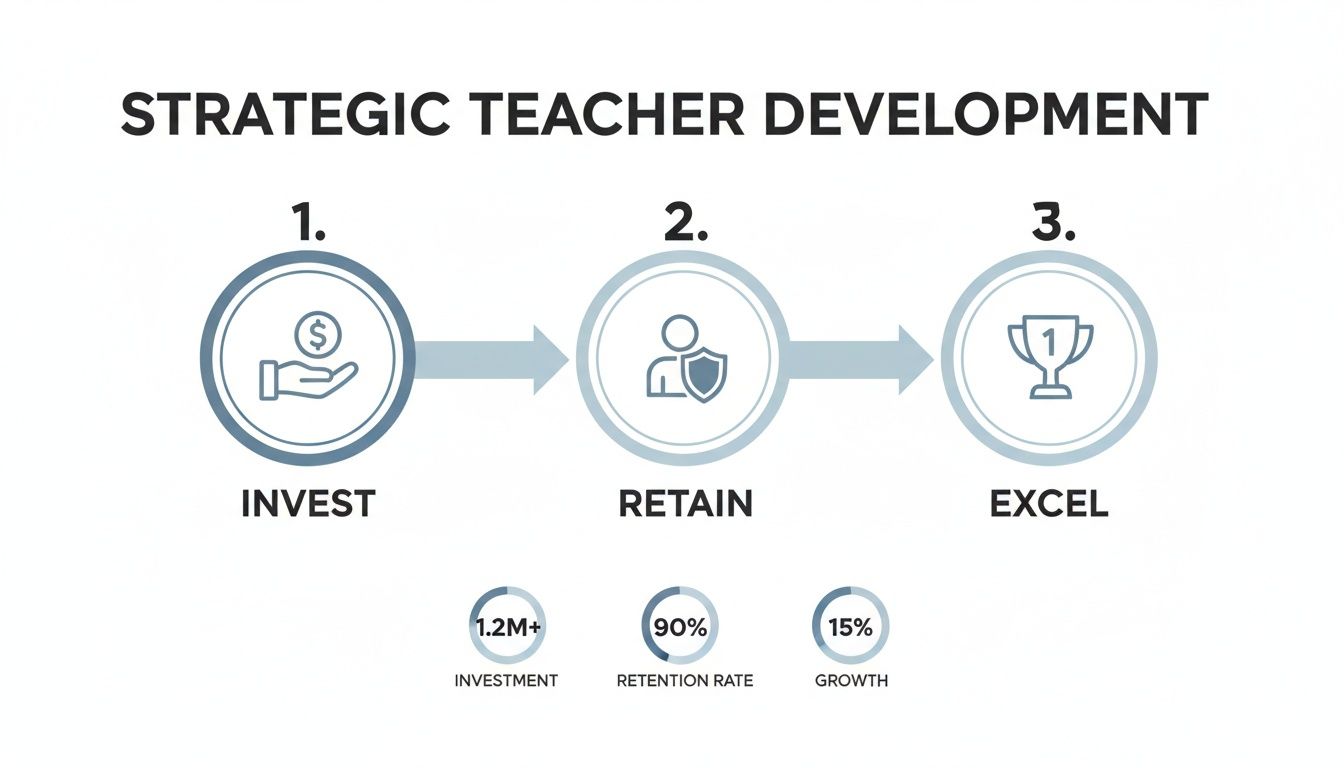
As you can see, strategic investment is the engine. It drives your ability to retain top talent, which is the only way to build a high-performing institution.
Pinpointing Real Skill Gaps
To figure out what your teachers actually need, you have to gather data from several key sources. Triangulating this information is crucial for moving past assumptions and addressing the real performance gaps.
- Faculty Surveys: Go deeper than simple satisfaction ratings. Ask targeted questions about which areas of their practice they feel least confident in. What new student challenges are they facing? What specific skills do they genuinely want to develop right now?
- Student Data: Look for trends in assessment scores, engagement metrics, and even qualitative feedback. If you notice a consistent dip in writing scores across an entire grade level, for instance, that’s a clear signal for a need to develop writing instruction.
- Classroom Observations: When done right, non-evaluative, supportive observations are invaluable. They can reveal patterns in instructional strategies or classroom management that even the most reflective teachers might not see in themselves.
This holistic approach is what turns your decision-making from guesswork into an evidence-based strategy. It ensures the professional development for teachers you design is not only relevant but truly impactful.
Selecting the Right Program Models
Once you've identified the needs, the next step is choosing the right delivery model. In my experience, a blended approach almost always works best, offering a mix of formats that cater to different learning styles, schedules, and personalities.
Thinking about what that mix could look like is key. Instead of just one-off workshops, consider weaving together several proven models that build on each other.
Comparing Professional Development Models for Private Schools
Choosing the right professional development model can feel overwhelming. This table breaks down some of the most effective options to help you decide which combination best fits your private school's goals, budget, and culture.
| Model Type | Best For | Pros | Cons | Estimated Cost |
|---|---|---|---|---|
| Peer-Led Learning Circles | Fostering collaboration, deep-diving into specific topics, and building a culture of shared practice. | Highly cost-effective, builds internal capacity, promotes sustained learning. | Requires skilled facilitation, can lack structure if not managed well. | $ (Low) |
| Mentorship Initiatives | Onboarding new teachers, developing leadership skills in veteran staff, providing targeted, ongoing support. | Strengthens school culture, personalized support, highly effective for retention. | Can be time-intensive, requires careful matching of mentors and mentees. | $ (Low) |
| Expert-Led Workshops | Introducing new skills (e.g., AI integration), addressing school-wide challenges, bringing in fresh perspectives. | Access to specialized expertise, can create immediate energy and buy-in. | Can be expensive, one-off events may lack follow-through. | $$$ (High) |
| Self-Paced Digital Courses | Building foundational knowledge, technical skill-building (e.g., LMS training), offering scheduling flexibility. | Flexible and convenient for teachers, scalable, often cost-effective. | Lacks collaborative element, completion rates can be low without accountability. | $$ (Medium) |
As you can see, there's no single "best" model. The magic happens when you combine them. For instance, you could bring in an expert for a workshop and then use peer learning circles to help teachers implement the new strategies in their classrooms over the following semester.
When you do bring in outside experts, remember that the quality of the session hinges on more than just their knowledge. Using powerful workshop facilitation techniques can transform a standard lecture into an engaging, hands-on experience that actually sticks.
Aligning Goals with Your School's Vision
Here’s the final, and most critical, piece of the puzzle: setting clear, measurable goals that connect directly to your school’s wider strategic objectives. Your PD program shouldn't exist in a vacuum; it should be one of the primary engines driving your mission forward.
Effective professional development is not an event, but a continuous cycle of learning, implementation, and refinement that is woven into the very fabric of the school's culture.
For example, if your private school is pursuing IB accreditation, a core PD goal would naturally be to increase faculty proficiency in inquiry-based learning. The metric to track this isn't vague—it could be a 25% increase in observed inquiry-based lessons over the academic year.
Or, let's say you're a faith-based school aiming to deepen your character education program. A clear goal would be for all faculty to complete training on integrating virtues into their core curriculum. You could then measure success by analyzing lesson plans and observing student interactions.
This alignment ensures every dollar and every hour spent on teacher development directly pushes your institution's most important priorities forward.
Creating a Curriculum Teachers Actually Want to Attend
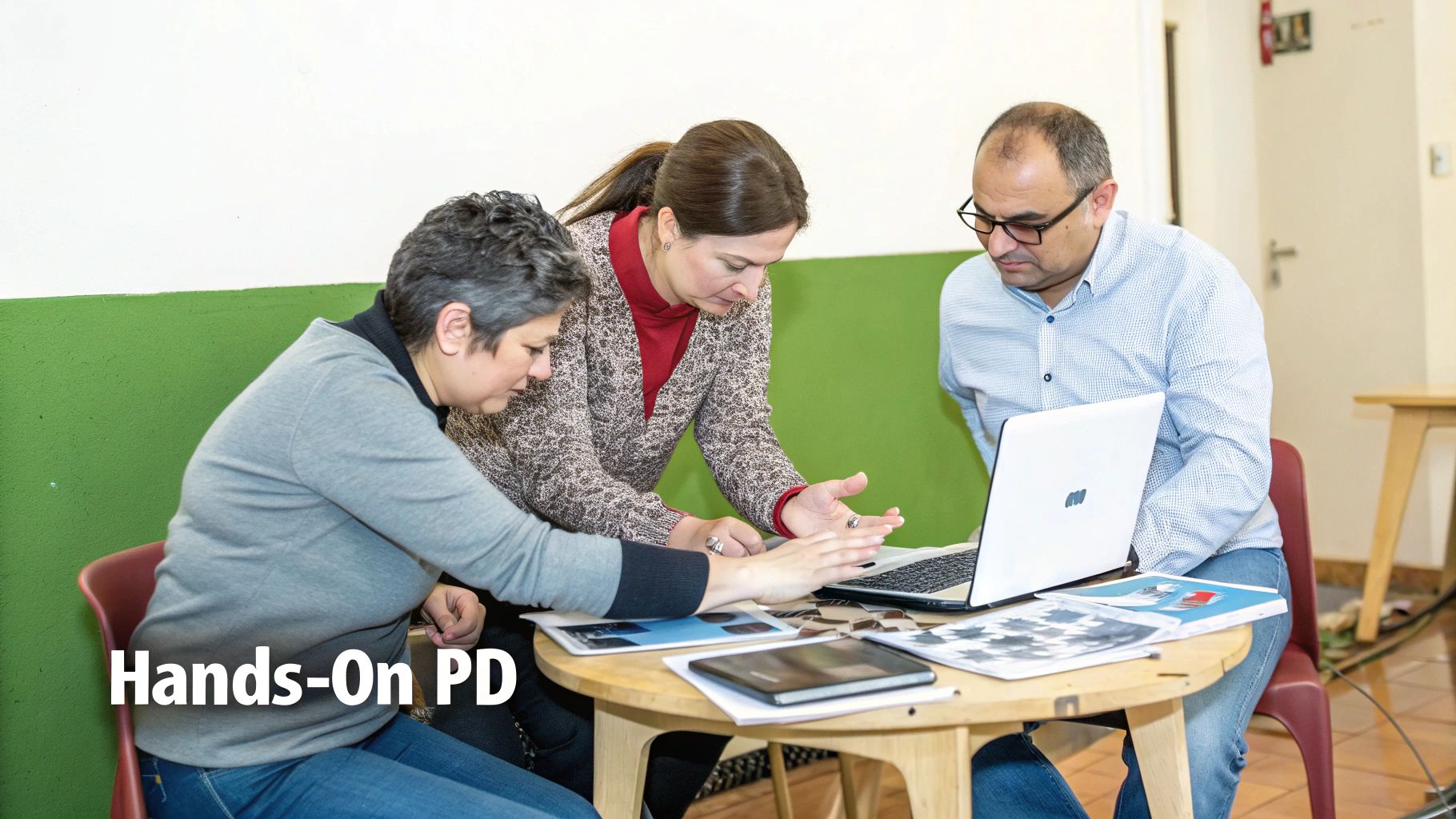
You can have the perfect schedule and a generous budget, but if the content of your professional development doesn't hit home, it's all for nothing. The curriculum is the heart and soul of your program. Without sessions that feel exciting, inspiring, and—most importantly—immediately useful, even the best-laid plans will fall flat.
Let’s be honest: many teachers have sat through lackluster PD that felt completely disconnected from their daily reality. That’s where frustration and disengagement take root. Our goal is to design a curriculum that moves past abstract theory and delivers practical skills that solve the real problems teachers are facing in their classrooms right now.
Focusing on Today’s Critical Classroom Topics
Generic, recycled topics just don't cut it anymore. If you want to earn your teachers' attention and investment, your curriculum has to tackle modern educational challenges head-on. This means zeroing in on the areas that directly impact classroom dynamics and student success.
Here are a few high-impact areas that should be on every private school’s radar:
- Practical AI Integration: Forget the hype. Teachers need hands-on training for using AI tools to streamline lesson planning, create differentiated assignments, and find engaging materials. The focus must be on ethical, effective, and time-saving classroom applications.
- Strategies for Supporting Neurodiverse Students: With a growing awareness of neurodiversity, our faculty needs specific, actionable strategies for supporting students with ADHD, autism, dyslexia, and other learning differences inside a mainstream classroom. Statistics show that roughly 1 in 5 children in the U.S. have learning and attention issues, making this a core competency for every private school teacher.
- Fostering Student Mental Health and Well-being: Our educators are on the front lines of the youth mental health crisis. Training on trauma-informed practices, simple social-emotional learning (SEL) integration, and how to recognize signs of distress is no longer optional. It's essential.
When you build your curriculum around what truly matters, you send a clear signal to your faculty: we see your challenges, and we're committed to giving you the tools to meet them. That relevance is the number one driver of buy-in.
Differentiating for Every Career Stage
We expect our teachers to differentiate for their students every single day. Why wouldn't we do the same for them? The needs of a brand-new teacher are worlds apart from those of a 20-year veteran. A one-size-fits-all approach is a guaranteed way to miss the mark for most of your staff.
Implementing a tiered or choice-based system empowers educators to select sessions that actually align with their personal growth goals and experience level. This is a powerful way to honor their professionalism and ensure their time is respected.
Effective professional development meets teachers where they are. It provides foundational support for those starting their journey and offers meaningful leadership opportunities for those ready to share their expertise.
Consider creating distinct learning tracks for different career stages:
- For Early-Career Teachers (Years 1-3): Stick to the fundamentals. Sessions on classroom management routines, effective parent communication, and curriculum mapping are what build confidence and prevent burnout. A solid mentorship program is non-negotiable here.
- For Mid-Career Teachers (Years 4-10): Offer pathways for deepening their craft. This is the time for advanced training in a specific subject, workshops on project-based learning, or earning certifications in high-impact educational technology.
- For Veteran Educators (Years 10+): Empower them to become leaders. Provide training on instructional coaching, mentoring new teachers, or spearheading curriculum development committees. This leverages their incredible talent and provides a fulfilling new challenge that can re-energize a long career.
Sample Session Outlines for Hands-On Learning
Theory has its place, but teachers are desperate for practical application. The most successful workshops are the ones where people walk away with a resource, a lesson plan, or a new strategy they can literally use the next morning.
Here’s what a hands-on, high-need session might look like:
Workshop Title: Practical Strategies for Supporting Executive Function in the Classroom
- Objective: Equip teachers with 3-5 evidence-based strategies to help students with planning, organization, and self-monitoring.
- Activity 1 (15 min): Quick overview of what executive function skills are, followed by a collaborative "pain points" discussion where teachers share specific challenges they see in their students.
- Activity 2 (30 min): Interactive modeling of strategies like "backward planning" for long-term projects and using visual checklists for daily routines. Let them see it in action.
- Activity 3 (30 min): Teachers break into small groups to adapt one of the modeled strategies for an upcoming lesson in their own curriculum. This is the key step—making it real for them.
- Wrap-Up (15 min): Each group shares their adapted plan. We finish with a quick Q&A and a link to a folder of digital resources and templates.
This kind of collaborative model respects teachers as active learners, not passive listeners. It’s this commitment to practical, relevant, and differentiated content that turns professional development from a mandatory obligation into a genuinely valued opportunity for growth.
Are you ready to design a professional development curriculum that truly energizes and empowers your faculty? Book a complimentary consultation with JAG Consulting today or visit our website to see how we help private schools build cultures of excellence.
Managing the Logistics of Your Program
A brilliant professional development plan is just an idea without a solid operational backbone. This is where your strategic vision meets the real world—managing the budgets, schedules, and staffing that bring it all to life. Nailing these details is what makes a program sustainable, effective, and minimally disruptive to the core mission of teaching and learning.
Great execution starts with a realistic budget. Far too many private schools discover that hidden costs, like substitute teacher coverage, can quickly derail an otherwise well-planned initiative. In fact, a lack of funding for subs is one of the most common reasons that ongoing, job-embedded professional learning never gets off the ground.
Building a Realistic Budget
Your budget has to be more than just the speaker's fee. A proper PD budget is a complete financial picture of the entire program, from the first planning meeting to the final evaluation report. Forgetting key line items is a classic pitfall that can seriously compromise the quality of what you offer your teachers.
To avoid nasty surprises, build your budget around these essential categories:
- Facilitator and Consultant Fees: This is what you'll pay external experts, workshop leaders, or instructional coaches.
- Materials and Resources: Think books, software licenses, printing, and any other physical or digital materials needed for the sessions.
- Technology and Venue Costs: If you're using special online platforms or renting an off-site location, these costs need to be factored in.
- Substitute Teacher Coverage: This is a crucial, non-negotiable expense if you plan to release teachers during contract hours.
- Travel and Accommodation: For guest speakers or sending faculty to conferences, you have to account for transportation, lodging, and meals.
- Stipends or Extended Contracts: If you're asking teachers to participate outside of their regular paid hours, compensating them is essential for buy-in and morale.
A well-constructed budget is really a statement of priorities. Investing adequately in logistics like substitute coverage shows a genuine respect for teachers' time and signals a serious commitment to their growth.
To give you a clearer idea of what this looks like in practice, here's a sample breakdown of how a mid-sized private school might allocate its annual professional development funds.
Sample Annual Professional Development Budget Breakdown
This table illustrates a potential cost allocation for a comprehensive PD program in a mid-sized private school with an annual PD budget of $50,000. This is just a model, of course, but it shows how the different pieces fit together.
| Expense Category | Description | Estimated Cost (Percentage) | Notes |
|---|---|---|---|
| External Experts | Fees for keynote speakers, workshop facilitators, and specialized consultants. | 40% ($20,000) | Tends to be the largest single expense, but it gives you access to specialized knowledge you don't have in-house. |
| Substitute Coverage | Paying for substitute teachers to cover classes during PD days or coaching cycles. | 25% ($12,500) | Absolutely essential for enabling job-embedded learning without piling more work on your teachers. |
| Conferences & Travel | Sending teachers or teams to regional or national conferences for deep learning. | 15% ($7,500) | This is a powerful tool for energizing faculty and bringing fresh, innovative ideas back to the school. |
| Materials & Software | Books for study groups, subscriptions to online learning platforms, and workshop supplies. | 10% ($5,000) | These resources are what support the ongoing application of new skills long after the workshop is over. |
| Internal Stipends | Compensation for teacher-leaders who facilitate peer learning circles or mentor colleagues. | 10% ($5,000) | This recognizes and rewards the development of your own in-house expertise and leadership capacity. |
This kind of balanced approach ensures you're investing not just in one-off events, but in a sustainable system of continuous improvement.
Creative Scheduling That Respects Teacher Time
Time is a teacher's most precious and finite resource. Any program that constantly pulls them away from their planning and instructional duties is doomed to fail. The most successful private schools I've seen use a variety of creative scheduling models that integrate learning right into the natural rhythm of the school year.
Instead of relying on just one model, consider a blended approach that offers flexibility:
- Focused Full-Day Sessions: Use your 2-3 designated in-service days per year for deep dives into big, school-wide initiatives. This is for the heavy lifting.
- "Late Start" Mornings: Schedule a monthly or bi-weekly late start for students. This gives teachers a dedicated 90-minute block for collaborative team meetings or focused learning circles when they're fresh.
- Hybrid Online Modules: Offer self-paced online courses for foundational knowledge, which teachers can complete on their own schedule. Then, use precious in-person time for hands-on application and discussion.
Deciding on Internal vs. External Staffing
Finally, you have to decide who will actually lead these sessions. The truth is, both internal teacher-leaders and external experts bring unique and critical value to your program.
Harnessing the expertise of your own staff—by creating roles for instructional coaches or peer mentors—is incredibly cost-effective and builds sustainable capacity. It empowers your best teachers and fosters a powerful culture of shared ownership over professional growth.
On the other hand, bringing in an external expert can inject new energy, provide specialized knowledge you just don’t have in-house, and offer a fresh, unbiased perspective on those persistent challenges.
The most effective strategy is almost always a balance of both. Use external experts to introduce new frameworks or complex skills, and then empower your internal teacher-leaders to provide the ongoing coaching and support needed to embed those skills into daily practice.
If you need help building a sustainable budget and implementation timeline for your school's unique needs, the team at JAG Consulting is here to help. Schedule a call with us today or visit our website to learn more about our strategic planning services.
Measuring the True Impact of Your Investment
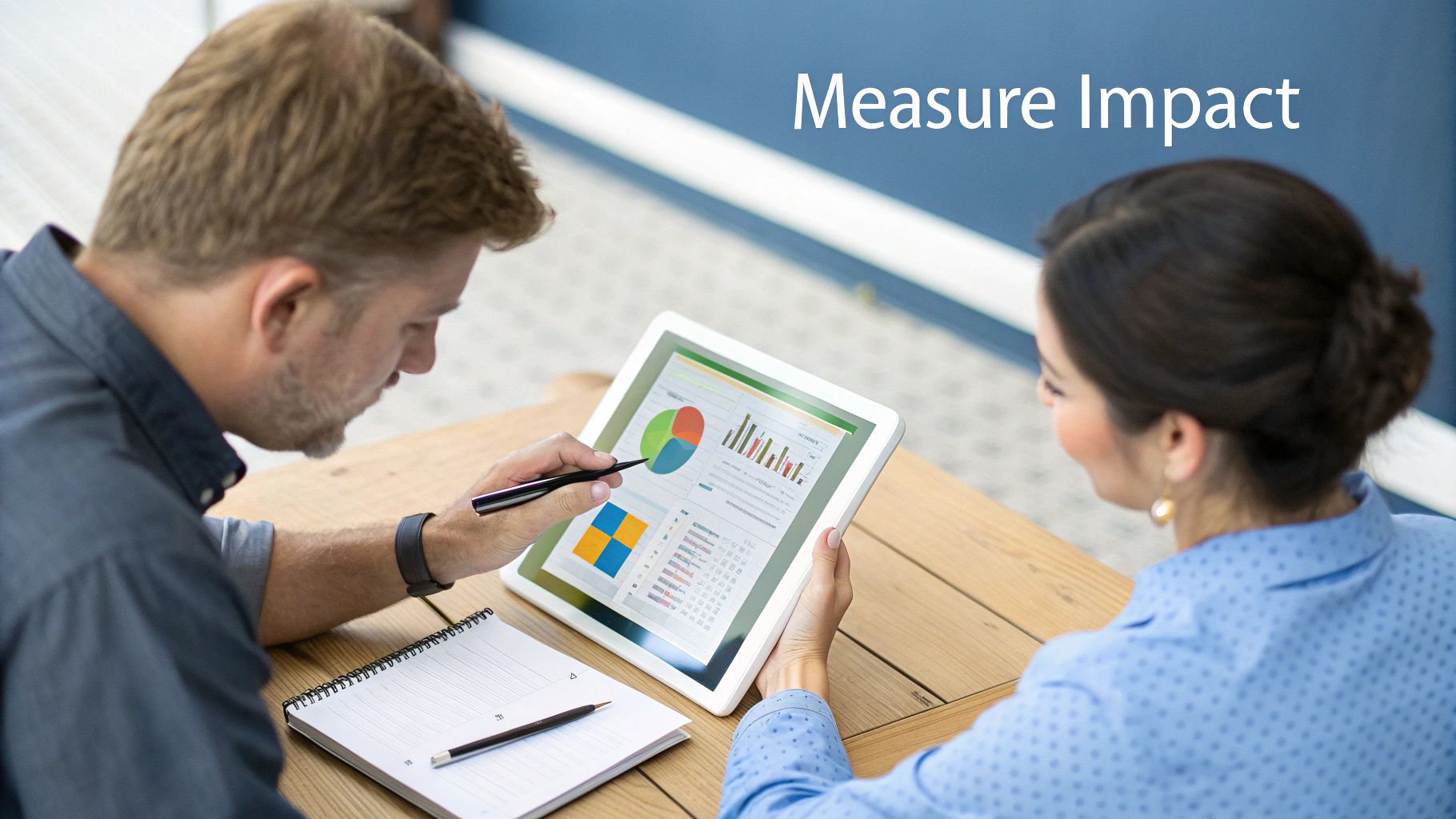
So, you’ve invested in professional development. How do you actually know if it's paying off? It’s tempting to rely on those post-session "smile sheets" for a quick hit of validation, but let's be honest—they tell you very little about whether anything will actually change back in the classroom.
Meaningful evaluation means digging deeper. It requires a shift from measuring satisfaction to measuring impact. This is what separates a good program from a great one and gives you the hard data you need to justify your budget, prove the ROI, and build a powerful feedback loop for continuous improvement. Without it, you’re just hoping your efforts are making a difference.
Moving Beyond Satisfaction Surveys
The first step is recognizing that a happy teacher doesn't automatically equal an effective teacher. While it’s nice to know if your faculty enjoyed a workshop, it's far more critical to know if it changed their behavior in a way that helps students.
This calls for a multi-faceted approach, one that gathers evidence from different sources over time. You're not just looking for an immediate reaction; you're tracking the long-term ripple effects of your investment across the entire school community.
A successful professional development program doesn't end when the workshop is over. Its true value is demonstrated in the observable, positive changes in classrooms and the measurable growth in both students and faculty.
Key Metrics for Tracking Success
To get a clear view of your program's ROI, you need to focus your efforts. Concentrate on tracking a few key areas that provide the hard evidence you need to show your PD is working.
- Changes in Teaching Practices: This is where the rubber meets the road. Are teachers actually using the new strategies? Non-evaluative peer observations are a fantastic tool here. They allow colleagues to look for specific, agreed-upon practices in a supportive, non-threatening context.
- Shifts in Student Data: Ultimately, this is the bottom line. Teacher development has to lead to student growth. Of course, you’ll look at assessment data, but don’t stop there. Dig into student engagement surveys, attendance rates, and even disciplinary referrals. A 15% decrease in behavioral issues in seventh grade after a series of classroom management workshops is a powerful, concrete data point.
- Faculty Retention and Morale: Never underestimate this one. High-quality professional learning is a massive driver of teacher retention. Track your annual faculty turnover rate, for sure. But also use confidential climate surveys to monitor shifts in morale and job satisfaction. We know from research that teachers who feel their school invests in their growth are far more likely to stay.
Connecting Outcomes to Accreditation
For private schools, this data-driven approach pays another huge dividend: it's exactly what accreditation bodies want to see. Demonstrating a clear, documented link between your PD initiatives, changes in teacher practice, and improved student outcomes is the gold standard for any continuous improvement plan.
Imagine walking into your accreditation review with a report showing how a targeted literacy coaching program led to a 20% increase in the number of third-graders reading at or above grade level. That kind of concrete evidence is infinitely more compelling than just listing the workshops you offered. It proves your commitment to excellence and positions your private school as a leader.
This process creates a virtuous cycle. The data you collect doesn’t just prove your program's worth—it also points you toward where you need to focus next year. It ensures your professional development for teachers remains dynamic, responsive, and tightly aligned with your school's most critical strategic goals.
If you’re ready to build a professional development evaluation framework that delivers clear, measurable results, we can help. Book a complimentary call with JAG Consulting to discuss how we can help you measure the true impact of your investment, or visit our website to learn more about our services.
Ready to Bring This Vision to Life?
Investing in your teachers is, without question, a direct investment in the future of your private school. When you build a professional development program that is dynamic, supportive, and genuinely focused on growth, you’re doing more than just improving test scores. You’re building a resilient, motivated faculty that feels valued and empowered.
That’s what sets a good school apart from a great one. A truly strategic professional development program becomes your competitive advantage, elevating your school’s reputation and securing its long-term health.
Remember, research shows that sustained professional development of 20 or more hours is significantly more effective than one-off workshops. It leads to real, lasting changes in teaching practice and, ultimately, in student achievement.
If you’re ready to move beyond the occasional workshop and design a program that delivers measurable results, our team at JAG Consulting is here to help. We specialize in empowering private schools to hit their strategic goals by focusing on their most important asset: their faculty. We'll work alongside you to build a framework that fits your unique culture, challenges, and aspirations.
Let's build a brighter future for your students and teachers, together.
Ready to take the next step? Book a complimentary consultation with the experts at JAG Consulting, or visit our website to learn how we can help transform your school from the inside out.
Answering the Tough Questions About Teacher PD
Even the best-laid plans run into questions on the ground. When you're rolling out a new approach to professional development, your faculty and board will naturally have concerns. Anticipating these questions and having thoughtful, honest answers ready is key to building the trust you need to make the program a success.
Here are some of the most common questions we hear from private school leaders, along with some practical ways to think about them.
How Much Should We Really Be Budgeting for This?
There’s no magic number, but a solid benchmark for professional development for teachers is 1-2% of your school's total operating budget.
But honestly, thinking about it as a line-item cost is the wrong frame. It's an investment. The real question is, what's the return on that investment?
Think about it this way: a well-designed program that improves teacher morale and retention can save your school tens of thousands in recruitment and onboarding costs. The savings from keeping just one or two great teachers often pay for the entire PD program. When you look at it like that, it's one of the smartest financial decisions a private school can make.
How Do We Get Teachers to Actually Buy In?
You can't demand buy-in; you have to earn it. And the single most effective way to do that is through co-creation. When teachers are part of the planning process from day one, they feel a sense of ownership. It’s their program, not just another top-down mandate.
True buy-in happens when professional development isn't something being done to your teachers, but something being done with and for them.
Here’s how you make that happen:
- Ask and Listen: Use surveys and small focus groups to ask teachers about their biggest challenges. What skills do they actually want to build? Their answers are your road map.
- Give Them Choices: Whenever you can, offer options. Let teachers pick from a menu of workshops or choose a learning track that fits their own career goals. Autonomy is a powerful motivator.
- Make It Immediately Useful: Nothing builds momentum like a teacher leaving a session with a strategy they can try in their classroom the very next day. Theory is fine, but practical, applicable tools are what really win hearts and minds.
How Can We Do This Without Taking Away So Much Teaching Time?
This is the big one, and it's a critical concern. The answer is to get creative and flexible with your scheduling. Relying only on those full-day, pull-out sessions is disruptive and, frankly, often impractical for private schools. A blended approach is far more respectful of everyone's time.
Try mixing and matching a few different models:
- "Late Start" or "Early Release" Days: Carving out a dedicated 90-minute block once or twice a month creates a regular rhythm for learning without losing an entire instructional day.
- Voluntary After-School Workshops: Offer optional, deep-dive sessions on hot topics. If you can offer a small stipend for their time, it sends a powerful message that you value their commitment.
- Self-Paced Online Learning: Use asynchronous online modules for the foundational, need-to-know content. This lets teachers learn on their own schedule, which frees up your precious face-to-face time for what really matters: hands-on practice, discussion, and collaboration.
By taking a thoughtful, multi-faceted approach, you can build a vibrant professional learning culture that empowers your team and drives real, lasting improvement for your private school.
Ready to design a professional development program that delivers measurable results and sets your school apart? The team at JAG Consulting specializes in empowering private schools to achieve their strategic goals through targeted faculty development.
Book a call with JAG Consulting today or visit our website to learn how we can help you build a brighter future for your students and teachers.

I'm Dr. Jeannie Gudith, Founder and CEO of JAG Consulting. We help you develop, improve, buy or sell your private school.
I'm so glad you're here
Hello!


© 2025 JAG CONSULTING.
all rights reserved. privacy policy + REFUND POLICY. TEMPLATE by sugar studios + Showit
