

Board of Directors Training: A Guide for Private Schools
Exceptional board of directors training is more than just a line item in your school's budget—it’s a direct investment in its long-term health. It’s what transforms governance from a reactive, check-the-box exercise into a proactive force for success, equipping your leaders to steer the ship through everything from leadership transitions to complex financial oversight.
This is about future-proofing your school's mission.
Why Board Training Is a Non-Negotiable Investment
In the incredibly competitive private school world, a passive board isn't just ineffective; it's a liability. Simply filling seats around a table does nothing. The real difference between a board that merely presides and one that truly leads with foresight comes down to one thing: continuous education.
Think about this real-world scenario we’ve seen play out: a beloved, well-regarded private school suddenly loses its Head of School mid-year. The unprepared board panics. Their rushed, flawed hiring process damages faculty morale, rattles parent confidence, and creates a leadership vacuum that takes years to fix.
Now, imagine a different board—one that has consistently engaged in training on succession planning. They don’t panic. They have a clear, pre-established protocol ready to go. They manage the transition smoothly, communicating with a stability and purpose that reassures the entire community. That’s the power of proactive governance.
Bridging Critical Governance Gaps
This isn't just anecdotal. The data paints a clear picture. Recent governance surveys reveal a troubling gap between the responsibilities boards carry and how ready they feel to handle them. For instance, directors consistently rate their own preparedness on crucial topics like talent management and institutional culture lower than C-suite executives do.
The disconnect is especially stark when it comes to leadership succession. A staggering 21% of directors rate their CEO succession planning as 'excellent,' according to a detailed survey on corporate directors from PwC. That’s a massive vulnerability, made even worse by high turnover and aggressive recruitment from competing schools.
A well-trained board doesn't just react to crises; it anticipates them. Proactive education on topics like succession planning, risk management, and strategic foresight transforms governance from a procedural requirement into a powerful strategic advantage for the school.
This is precisely why board of directors training must be a core part of your school's operational strategy. It’s not just about learning the bylaws or reading financial statements. It’s about building the collective wisdom to handle the unexpected and guide the school toward sustainable growth.
An effective training program creates a shared language and purpose, making sure every single trustee understands their essential role in:
- Upholding the school’s mission and vision with integrity.
- Providing robust financial oversight and stewardship.
- Supporting, evaluating, and partnering with the Head of School.
- Guiding the long-term strategic direction.
Are you ready to transform your board's effectiveness and truly secure your school's future? The journey begins by acknowledging that this is an ongoing commitment, not a one-time event. To explore how a governance framework tailored to your school's unique culture can make a difference, book a call with JAG Consulting or visit our website.
Designing a Foundational Training Framework
Let's move from theory to action. Building an effective board starts with a solid training structure, and for private schools, that means going way beyond just handing a new trustee a heavy binder and hoping for the best. A smart, structured approach is what ensures every board member—whether brand new or a seasoned veteran—is equipped, aligned, and ready to govern well.
It all begins with a real onboarding process. Just sending over the bylaws and last year's meeting minutes is a recipe for an overwhelmed and ineffective new member. They need a deliberate immersion into your school's unique ecosystem. This is about building context and connection so they can contribute meaningfully from their very first meeting.
Think of it less like a final exam and more like a guided tour. Your onboarding should systematically introduce the new trustee to the school's mission in action, its financial realities, and its distinct culture over their first few months of service.
Crafting a 90-Day Onboarding Plan
A structured 90-day timeline can transform a new member's experience from overwhelming to empowering. The goal here is to build their knowledge and confidence in manageable stages, making sure they truly grasp the nuances of their role.
Here’s a sample timeline we've seen work incredibly well. You can adapt it to fit your school's specific needs and culture.
Sample 90-Day New Board Member Onboarding Timeline
This structured plan outlines key activities and learning objectives for a new private school board member during their first three months. It's designed to build a strong foundation for effective governance.
| Timeframe | Key Activities | Learning Focus |
|---|---|---|
| First 30 Days | – Meet one-on-one with the Head of School and Board Chair. – Tour the campus with a student ambassador. – Review key documents (strategic plan, budget, bylaws). | Grasping the school's mission, culture, and high-level strategic priorities. Understanding the board-head partnership. |
| Days 31-60 | – Sit in on a finance and a governance committee meeting. – Meet key administrators (Admissions, Development, Academics). – Attend a school event (e.g., a play, sporting event, parent meeting). | Understanding the operational and financial engine of the school. Seeing the school's mission in practice. |
| Days 61-90 | – Be assigned a board mentor for Q&A and guidance. – Complete a detailed fiduciary duties training session. – Participate fully in their first official board meeting. | Solidifying understanding of governance responsibilities. Building confidence to engage in strategic discussions. |
This kind of deliberate onboarding process is exactly what helps a board evolve from simply reacting to problems to providing proactive, strategic guidance.
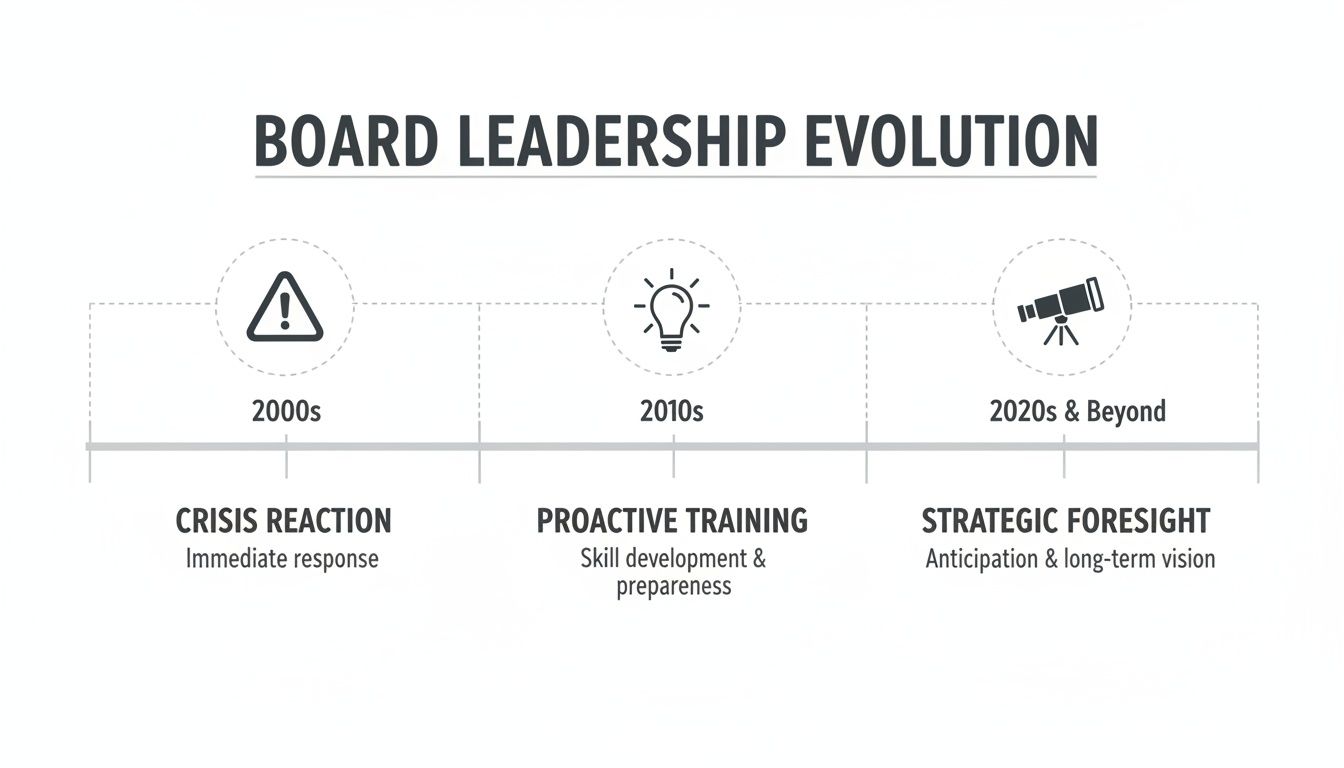
As this timeline shows, effective board of directors training moves a governing body from a state of constant crisis reaction toward one of strategic foresight and opportunity. It’s a powerful shift.
Demystifying Fiduciary Duties
Beyond the welcome lunches and campus tours, the core of any training framework has to get serious about the non-negotiable legal and ethical obligations of a trustee. These fiduciary duties are the absolute bedrock of sound governance. Get these right, and you ensure decisions are always made with the school's best interests at heart. Get them wrong, and you can expose not just the school but individual board members to significant risk.
These aren't just abstract legal concepts; they guide real-world decisions every single day.
Duty of Care: This is the "do your homework" duty. It requires trustees to be informed and act with the diligence a reasonably prudent person would in a similar situation. In practice, this means reading board materials before meetings, asking clarifying questions, and actively participating in discussions. It's about being present and prepared.
Duty of Loyalty: This one is simple: a board member's allegiance is to the school—and only the school. They must act without personal or professional conflict of interest. For example, if a trustee owns a construction company and the school is planning a new building, this duty requires full disclosure and recusing themselves from any vote on the contract. No exceptions.
Duty of Obedience: Trustees must ensure the school stays faithful to its mission and operates in compliance with all applicable laws and its own governing documents. This is what prevents "mission drift" and ensures that donor funds and tuition are used for their intended purpose.
A deep understanding of these three duties—Care, Loyalty, and Obedience—is what separates a group of well-intentioned supporters from a high-functioning governing body. It is the essential legal and ethical foundation for all board work.
For schools looking to organize and track their training programs, exploring the best learning management systems can be a game-changer. These platforms help organize materials, track completion, and ensure every single member receives consistent, high-quality education.
Moving from Oversight to Strategic Leadership
A truly effective board doesn’t just manage the present; it architects the future. The shift from basic oversight to genuine strategic leadership is what separates a good board from a great one. It’s the difference between reviewing last month’s reports and shaping the next decade’s reality.
This means getting out of the operational weeds and into the high-level thinking that steers your private school’s long-term trajectory.
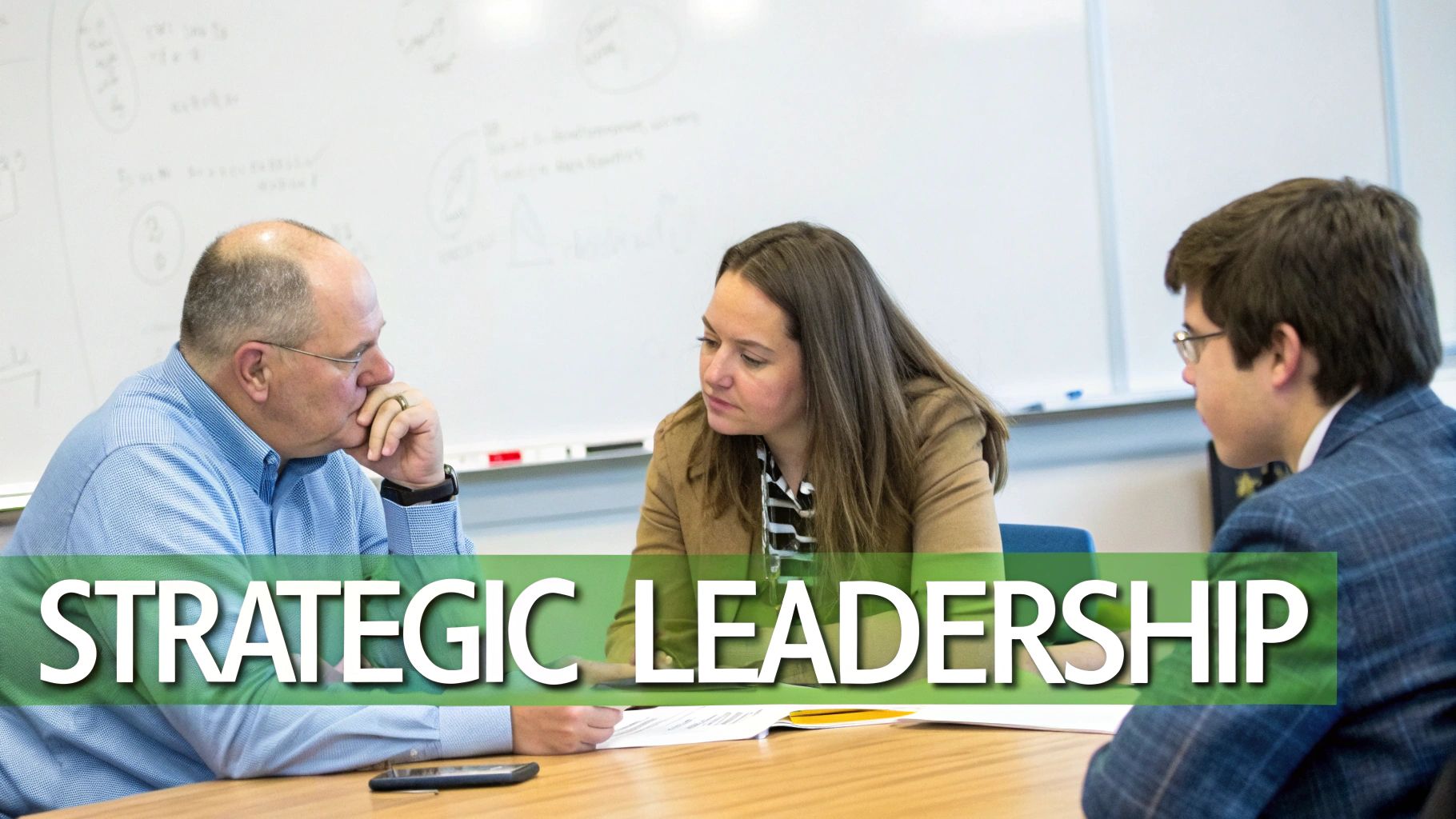
This evolution doesn't happen by accident. It takes intentional board of directors training that focuses on what it really means to govern. It’s about arming your trustees with the skills to run productive strategic planning retreats, analyze key performance indicators (KPIs) that actually matter, and provide visionary direction.
The demand for this kind of focused education is growing. As the world of governance gets more complex, formal board training has become a top recommendation for improving performance. Recent data shows a striking 39% of directors are calling for specialized training tailored to individual members, while another 38% want mandatory education for the entire board. You can dive deeper into these perspectives in the full What Directors Think Report.
From Reactive Reports to Proactive Strategy
Too many board meetings get stuck reviewing the past, spending hours on what’s already happened instead of planning for what comes next. A strategic board flips that script. It reorients its focus from "what happened" to "what if?" and "what's next?"
This isn’t just about a new agenda format; it’s a fundamental shift in mindset.
Instead of just looking at this month’s enrollment numbers, a strategic discussion would dig into multi-year trends, demographic shifts in your feeder communities, and the competitive landscape. The conversation isn't just about the numbers themselves, but what those numbers mean for your school's mission and sustainability five or ten years from now.
This means training your board to:
- Ask generative questions: They learn to move from "Did we hit our target?" to "What trends could disrupt our enrollment pipeline in the next decade?"
- Use data dashboards effectively: Focus shifts to a handful of mission-critical KPIs rather than getting lost in dozens of operational metrics that don't tell the whole story.
- Embrace scenario planning: The board starts discussing potential futures for the school—both positive and challenging—to build the agility needed to thrive no matter what comes.
A Real-World Example: Accreditation Readiness
Think about a private school preparing for its five-year accreditation review. An untrained, operationally-minded board might see this as a huge administrative chore—a giant checklist to get through. They’ll likely wait for the Head of School to deliver reports and then react to problems as they pop up.
A strategically trained board, on the other hand, sees accreditation as a powerful opportunity for reflection and growth. Their training has prepared them to approach the process entirely differently, long before the review team ever sets foot on campus.
They’re ready to:
- Align the strategic plan with accreditation standards: They make sure the school's long-term goals are measurable and directly support the criteria for reaccreditation.
- Champion the self-study process: Board members actively join steering committees, lending their expertise and showing a united front.
- Tackle potential weaknesses proactively: They use the self-study to spot and fix institutional challenges before the visiting team arrives, turning what could have been criticisms into documented strengths.
By treating accreditation as a strategic milestone rather than a compliance hurdle, a well-trained board helps streamline the entire process, reduces stress on administrators, and secures a far better outcome for the school.
Modern Risk Management for School Stability
Strategic leadership also means getting ahead of modern risks that go far beyond simple financial oversight. Today’s private schools face a complicated mix of challenges that demand sophisticated, board-level understanding.
Two of the biggest risks right now are cybersecurity and faculty retention. A data breach can cause incredible reputational and financial harm, while high teacher turnover directly hurts academic quality and the student experience. For private schools, teacher turnover rates can reach as high as 25% annually in some regions, making retention a critical governance issue.
A strategic board doesn't just delegate these issues away. It ensures robust policies are in place, asks tough questions about preparedness, and makes sure resources are allocated to protect these vital institutional assets.
Ultimately, ongoing board of directors training on these advanced topics is what gives your leaders the confidence to truly govern. It provides them with the tools to ask the right questions, anticipate future challenges, and steer your school with foresight.
Ready to elevate your board from oversight to strategic leadership? The first step is a conversation about your unique goals and challenges. Book a call with JAG Consulting today or visit our website to learn how we empower private school boards to lead effectively.
Mastering Board Dynamics and Productive Meetings
Great governance happens in the boardroom. But only if meetings are run with purpose and precision.
The mechanics of how you run your board—from the way you design the agenda to the final rap of the gavel—directly determine whether your trustees can provide the high-level strategic guidance your school deserves. Without an intentional structure, it's amazing how quickly meetings get bogged down in routine reports, leaving zero room for the visionary conversations that actually matter.
Effective board of directors training tackles this problem head-on. It's about teaching members how to transform meetings from passive updates into active, strategic workshops. This is where the real work gets done.

Building a Better Agenda
If you want to improve meeting productivity, the single most powerful tool you have is a well-designed agenda. Too many private school boards fall into the trap of creating agendas dominated by backward-looking committee reports. This format just encourages passive listening, not active engagement.
A strategic agenda flips the script entirely.
Instead of just listing off reports, it frames topics as strategic questions the board needs to wrestle with. For example, a standard agenda might have an item like "Admissions Report." A strategic agenda would rephrase this as, "Discussion: How will demographic trends impact our enrollment strategy over the next five years?" This small change immediately sparks a forward-looking, high-value conversation.
Here’s what that transformation looks like in practice:
| "Before" Agenda Item (Operational) | "After" Agenda Item (Strategic) |
|---|---|
| Finance Committee Report | Decision: Approve capital expenditure for the new science lab? |
| Head of School Update | Discussion: Evaluate progress on Strategic Plan Goal #2. |
| Development Report | Brainstorm: Key themes for the upcoming capital campaign. |
Notice the "after" column? It uses action verbs and focuses on future decisions and discussions. This instantly elevates the nature of the conversation.
Facilitating Inclusive Dialogue
A great agenda is only half the battle. Creating a culture where every single voice is heard is just as critical. Productive board meetings demand skillful facilitation, a role usually led by the Board Chair. The goal is to encourage healthy debate and inclusive dialogue while keeping the discussion focused and moving forward.
Effective facilitation ensures that the most thoughtful voices, not just the loudest, guide the board’s decisions. It is the art of balancing candid debate with respectful collaboration to reach a collective, well-reasoned conclusion.
Facilitation training helps board leaders develop some key skills:
- Encouraging broad participation: This means actively calling on quieter members to share their perspectives.
- Managing dominant personalities: You have to learn how to politely redirect individuals who might monopolize the conversation.
- Synthesizing discussion: A good facilitator summarizes key points and clarifies next steps so everyone leaves the room aligned.
Structuring Committees for Efficiency
A well-structured committee system is the engine of an efficient board. Think of it this way: committees allow small, focused groups to do the deep-dive work on specific issues. They then bring only their findings and recommendations to the full board. This simple step prevents the entire board from getting stuck in the weeds of operational details.
For most private schools, the essential committees include:
- Finance Committee: Oversees the budget, investments, and audit.
- Governance/Trusteeship Committee: Manages board recruitment, training, and self-assessment.
- Development/Advancement Committee: Leads fundraising and philanthropic strategy.
By delegating specific tasks to these groups, the full board can dedicate its limited and valuable time to the most critical strategic issues facing the school.
Strengthening the Head-Board Partnership
Ultimately, the effectiveness of any board meeting comes down to the partnership between the Board Chair and the Head of School. This relationship is everything. It must be built on a foundation of trust, transparency, and crystal-clear communication.
When this partnership is strong, the Head feels supported and empowered, and the board gets the candid information it needs to govern effectively. That synergy is absolutely essential for successful leadership and the long-term health of your school.
Is your board ready to master the art of productive meetings and strategic governance? Book a call with JAG Consulting today or visit our website to learn how we can help you build a high-performing board.
Driving Continuous Improvement and Measuring Success
The best private school boards I’ve worked with have one thing in common: they don’t treat training as a box to check. They see it as an ongoing cycle of learning and growth. This commitment to continuous improvement is what separates a truly high-performing board from one that just goes through the motions.
It all boils down to creating a culture of honest, constructive evaluation. This isn't about pointing fingers. It's about finding opportunities to grow and ensuring your governance model evolves right alongside your school’s mission. The process starts with a regular, structured self-assessment—usually an annual, confidential survey. This simple tool shifts the conversation from vague feelings about effectiveness to concrete, actionable insights.
Conducting Board and Director Evaluations
To make these evaluations truly useful, you have to dig into specific areas of governance. The goal is to get a clear, supportive picture of both strengths and weaknesses. The feedback you collect becomes the raw material for planning your next round of board of directors training.
Your survey should probe a few key areas:
- Meeting Effectiveness: Are our meetings genuinely focused on strategic issues, or are we stuck in the operational weeds? Is the discussion open and inclusive?
- Strategic Direction: Does the board provide clear, forward-looking guidance? Are we actually monitoring progress against the strategic plan in a meaningful way?
- Financial Oversight: Do all our members—even those without a finance background—truly understand the school’s financial position and key drivers?
- Board Culture: Do we have a culture of trust, respect, and candid debate? Can we disagree productively?
Beyond the full board assessment, individual director evaluations can be incredibly powerful. These are often framed as a self-reflection exercise, followed by a private conversation with the Board Chair or Governance Committee Chair. It’s a dedicated space for members to think about their personal contributions and flag areas where they’d like to build their own skills.
The purpose of evaluation is not judgment but growth. By creating a safe and structured process for feedback, a board can honestly assess its performance, identify critical skill gaps, and build a targeted training plan that directly addresses its needs.
This evaluation process almost always uncovers skill gaps that might otherwise go unnoticed. For instance, global board surveys reveal a glaring deficit in digital governance. A shocking 55% of directors report insufficient cyber-risk expertise, and 54% lack know-how in digital innovation on their boards. Yet, digital transformation ranks a lowly fifth among immediate board priorities. That's a dangerous disconnect. You can read the full GNDI Future of Board Governance Report to get a better sense of these global trends.
Measuring the Real-World Impact of Training
Ultimately, any investment in board of directors training has to deliver a real-world impact. How do you know if your efforts are actually making a difference? You have to connect the training back to tangible, measurable outcomes.
Look for improvements in the key performance indicators of effective governance:
- Meeting Efficiency: Are your meetings getting shorter and more focused? Are you making more strategic decisions and spending less time listening to routine reports?
- Strategic Plan Progress: Is the board more effectively tracking and driving progress toward the school’s long-term goals?
- Committee Productivity: Are committees doing more substantive work and bringing well-vetted recommendations to the full board, speeding up decision-making?
- Head of School Partnership: Has the quality of the relationship and communication between the board and the Head of School improved?
When you track these metrics, you can clearly demonstrate the return on your investment in board development. This data-driven approach doesn't just validate the time and resources you've spent; it builds momentum for making continuous improvement a permanent part of your board’s culture.
Answering Your Questions About Board of Directors Training
Even with a solid plan, questions always come up when putting a formal board of directors training program into practice. We hear these all the time from private school leaders, so here are some quick answers to reinforce the strategies in this guide.
Think of this as your cheat sheet for handling common concerns and building momentum for a culture of continuous learning on your board.
How Often Should Our Board Receive Training?
Onboarding for new members is non-negotiable, but beyond that, ongoing training needs to be a firm annual priority. This isn't a one-and-done event; it's a recurring commitment to professional development.
Many of the most effective private school boards we work with follow a simple but powerful rhythm. They build a major professional development session into their annual retreat and then carve out time in one or two regular meetings each year to dive deep into a specific topic, like strategic fundraising or risk management. This keeps governance skills sharp and aligned with what the school needs right now.
What Is the Biggest Mistake Schools Make with Board Training?
The most common—and costly—pitfall is treating training as a check-the-box activity. Something you do once, file away, and forget about. But effective governance isn't static. It’s a living, breathing process that has to adapt as your school’s reality changes.
A single workshop can't possibly prepare your board for emerging challenges like new accreditation standards, shifting enrollment demographics, or the latest cybersecurity threats. True board of directors training is a continuous cycle of learning, assessment, and application that evolves right alongside your school's strategic priorities.
Viewing board education as a journey rather than a destination is the fundamental mindset shift that separates good boards from great ones. It ensures your leadership remains agile, informed, and prepared for whatever comes next.
Who Is Responsible for Organizing Board Training?
This is a core leadership function, and it almost always falls to the board's Governance Committee or Committee on Trustees. They are the engine of board development.
This committee works hand-in-glove with the Board Chair and the Head of School. It’s their job to proactively identify what the board needs to learn, find the right resources or facilitators, and make sure every training session directly supports the school’s most important strategic goals. This creates a cohesive plan where every piece of training has a clear purpose.
Feeling ready to build a more effective, strategic board but not sure where to start? Book a call with JAG Consulting to talk through your specific needs, or visit our website for more resources.
Need a Hand Building a High-Performing Board?
We've laid out a pretty clear roadmap for transforming your board's effectiveness, but you absolutely don't have to walk this path alone. Think of great board of directors training as an ongoing commitment, not a one-and-done event. It’s the engine that drives your school's long-term health and success, making sure your leadership is ready for whatever comes next.
Building a truly exceptional board takes more than just good intentions; it demands a focused strategy and, often, an expert guide. One of the most effective ways to develop standout leadership is through dedicated executive coaching and leadership training to build high-performing teams, which sharpens the precise skills needed for high-stakes governance. This kind of intentional development ensures every single member can contribute at their absolute best.
From Learning to Leading
At JAG Consulting, this is exactly what we do. We specialize in helping private school boards make the leap from learning the ropes to truly leading with confidence. We partner with you to put these strategies into action and tackle your school's unique governance challenges head-on. Our work is grounded in the reality that every school’s mission and culture are different, so a cookie-cutter approach just won’t cut it.
A high-performing board is your school’s greatest strategic asset. Investing in its development is an investment in your mission's future, safeguarding it for the next generation of students and families. This is the ultimate form of stewardship.
We help boards build the right structures, skills, and culture to steer their schools toward a thriving future. It all starts with getting a clear picture of where you are now and where you want to be.
Ready to build a board that can confidently meet the challenges of tomorrow? Let's talk.
At JAG Consulting, we provide the practical, hands-on expertise to make your governance goals a reality. Book a consultation to talk through your specific needs and see how we can help.

I'm Dr. Jeannie Gudith, Founder and CEO of JAG Consulting. We help you develop, improve, buy or sell your private school.
I'm so glad you're here
Hello!

© 2025 JAG CONSULTING.
all rights reserved. privacy policy + REFUND POLICY. TEMPLATE by sugar studios + Showit
