


8 Inspiring School Mission Statements Examples to Guide Your Vision in 2026
Your school's mission statement is the single most important declaration you will ever make. It is your North Star, guiding every decision from curriculum design and faculty hiring to marketing and fundraising. For private school founders, investors, and leaders, a well-crafted mission statement isn't just a formality for accreditation; it's a critical strategic asset.
A study from the Council for Advancement and Support of Education (CASE) found that private schools with clear, consistently communicated missions report higher levels of philanthropic support and stronger enrollment funnels. In fact, according to the National Association of Independent Schools (NAIS), over 75% of families cite a school's mission and values as a primary factor in their enrollment decision. Yet, many institutions struggle with generic, uninspired statements that fail to capture their unique value proposition. Such statements become mere plaques on a wall rather than living documents that drive action and attract right-fit families.
This guide moves beyond generic advice and provides a curated collection of powerful school mission statements examples. We will dissect precisely what makes them effective and provide the strategic insights needed to craft a mission that truly resonates.
You will learn to:
- Identify core components of an impactful mission.
- Analyze real-world examples from diverse private school models.
- Adapt proven frameworks for your own institution.
Our goal is to equip you with actionable frameworks to build a mission that powers your strategic plan, differentiates you in a competitive market, and propels your institution toward a sustainable and impactful future. If you are developing a new private school or refining your current strategy, a powerful mission is the first and most vital step.
Need expert guidance crafting a mission that drives enrollment and fundraising? Visit our website or schedule a complimentary consultation with JAG Consulting to align your vision with a powerful strategic direction.
1. Student-Centered Learning Mission Statement
A student-centered learning mission statement places the individual learner at the absolute core of the school's purpose. This model shifts the focus from traditional, teacher-led instruction to a framework where educational experiences are tailored to each student's unique needs, interests, and developmental pace. For private schools, this approach is a powerful differentiator in a crowded market, signaling a commitment to personalization over institutional prestige alone.
Strategic Analysis
Instead of broadcasting a generic commitment to "excellence," a student-centered mission defines what excellence looks like for each child. It answers the question: "How do we adapt our school for the student, not the other way around?" This approach builds a culture of inquiry, agency, and holistic growth that appeals to modern parents seeking more than rote memorization for their children.
Key Insight: A Gallup report found that students who feel supported and engaged are 2.5 times more likely to say they get excellent grades and do well in school. A student-centered mission statement directly addresses this by prioritizing engagement and personalized support.
Examples of this philosophy in action include:
- High Tech High (San Diego): Their mission is built around project-based learning, where students tackle complex, real-world problems.
- Montessori Schools: The entire model is based on Dr. Maria Montessori's principles of following the child's natural developmental trajectory.
Actionable Takeaways for Your School
To craft a compelling student-centered mission, you must move from abstract ideals to concrete practices.
- Define Measurable Outcomes: What does student success look like? Is it measured by portfolio completion, public speaking confidence, or self-directed project management? Be specific.
- Align Operations to Mission: Your mission must be evident in everything. Align hiring practices, professional development, and even classroom design to support personalized learning. Teachers should be hired for their ability to facilitate, not just lecture.
- Systematize Feedback: Create formal channels for gathering student feedback on their learning experiences. This demonstrates that their voice is valued and actively shapes the school's direction.
A truly student-centered mission statement is not just a sentence on a website; it is the operational blueprint for a dynamic and responsive educational environment.
Ready to build a mission statement that sets your private school apart and drives enrollment? Visit our website or book a complimentary consultation with JAG Consulting to align your vision with a powerful, actionable strategy.
2. Values-Based Character Development Mission Statement
A values-based character development mission statement asserts that a private school’s primary duty extends beyond academic instruction to the intentional cultivation of a student’s moral and ethical core. This model explicitly prioritizes the formation of character traits like integrity, compassion, responsibility, and leadership as central to the educational experience. For private schools, especially faith-based institutions or those with a strong ethical tradition, this focus is a defining feature that attracts families seeking an education that reinforces their values.

Strategic Analysis
Rather than leaving character to chance, a values-based mission makes it a deliberate, measurable part of the curriculum. It answers the critical question for discerning parents: "Who will my child become at your school?" This approach builds a cohesive and accountable community where shared values guide behavior, resolve conflicts, and define success. It positions the school not just as an academic institution but as a partner in raising conscientious and ethical leaders.
Key Insight: A 2019 meta-analysis published in the journal Review of Educational Research found that social and emotional learning programs, which are pillars of character education, yielded an 11-percentile-point gain in academic achievement. This shows that a focus on character directly supports and enhances academic performance.
Examples of this philosophy in action include:
- The Lawrenceville School: Its mission is deeply rooted in fostering integrity and responsibility, most visibly through its student-run honor code.
- Collegiate School (New York): The school's honor code and emphasis on ethical development are central to its identity and community expectations.
Actionable Takeaways for Your School
To build an authentic values-based mission, your private school must embed its principles into every aspect of its operations.
- Define Behavioral Indicators: For each core value (e.g., "integrity"), define specific, observable behaviors. What does integrity look like in the classroom, on the athletic field, or in the digital world?
- Integrate Values into All Systems: Your values must inform admissions criteria, hiring practices, faculty training, and even parent-community expectations. Staff should be hired and evaluated on their ability to model and reinforce these principles.
- Create Reinforcing Rituals: Establish traditions, assemblies, and student leadership structures that consistently celebrate and uphold your core values. This could include peer accountability councils or community service requirements directly tied to your mission.
A mission centered on character development is more than a platitude; it is a promise to your community to cultivate not just great students, but good people.
Ready to build a mission statement that sets your private school apart and drives enrollment? Visit our website or book a complimentary consultation with JAG Consulting to align your vision with a powerful, actionable strategy.
3. Academic Excellence and College Preparation Mission Statement
An academic excellence and college preparation mission statement clearly prioritizes rigorous intellectual development and successful post-secondary matriculation. This model is built on a foundation of challenging curriculum, high standards, and measurable outcomes like test scores and college acceptance rates. For private schools in competitive markets, this mission signals a direct return on investment for families focused on securing a place for their children in top-tier universities.
Strategic Analysis
This mission moves beyond vague promises of a "good education" to define success in concrete, marketable terms. It directly answers the parent question: "Will my child get into a great college?" By focusing on academic rigor, it builds a reputation for intellectual seriousness and cultivates a culture of high achievement. This appeals directly to families who view education as the primary pathway to long-term career success.
Key Insight: According to the National Association for College Admission Counseling (NACAC), a student's performance in college preparatory courses remains the single most important factor in the college admissions decision. A mission focused on academic excellence directly aligns a school's promise with this critical admissions criterion.
Examples of this philosophy in action include:
- Phillips Exeter Academy: Its mission is rooted in academic excellence through the Harkness method, preparing students for the highest levels of collegiate study.
- BASIS Charter Schools: This network's model is explicitly designed around an advanced, accelerated curriculum that consistently produces top national and international test scores.
Actionable Takeaways for Your School
To craft an effective academic excellence mission, your private school must substantiate its claims with tangible structures and results.
- Establish Verifiable Metrics: Define and track key performance indicators (KPIs) such as average SAT/ACT scores, the percentage of graduates attending top-100 universities, and the number of National Merit Scholars. Make these results a central part of your marketing.
- Build Robust College Counseling: Your mission is only as strong as your support system. Invest in a low student-to-counselor ratio and hire counselors with deep connections to college admissions offices. This operationalizes your promise of college preparation.
- Benchmark Curriculum Rigorously: Regularly evaluate your curriculum against leading standards like the AP Capstone Diploma, the International Baccalaureate (IB), and programs at peer institutions. This ensures your academic offerings remain competitive and challenging.
A mission statement centered on academic excellence is not just a declaration; it is a commitment to a disciplined, results-oriented educational system designed to propel students to the next level.
Ready to build a mission statement that sets your private school apart and drives enrollment? Visit our website or book a complimentary consultation with JAG Consulting to align your vision with a powerful, actionable strategy.
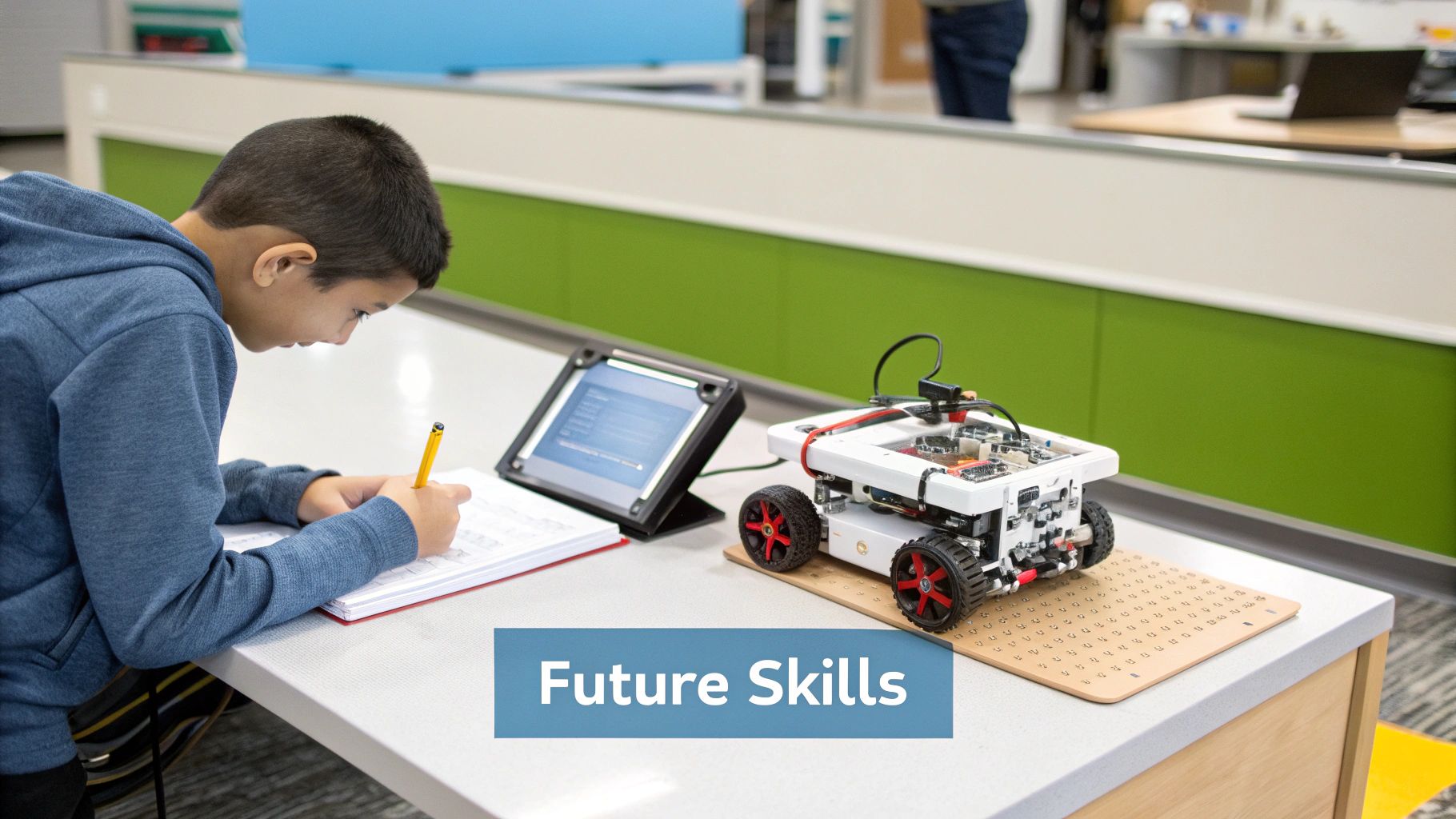
4. Innovation and Future-Ready Skills Mission Statement
An innovation and future-ready skills mission statement frames the school as a launchpad for the next generation of creators, entrepreneurs, and problem-solvers. This forward-looking approach prioritizes skills like digital literacy, collaboration, critical thinking, and adaptability over traditional content mastery. For private schools, this is a powerful market position, appealing directly to tech-forward families who understand that the future requires a different kind of education.
Strategic Analysis
This type of mission explicitly rejects the industrial-age model of education. It answers the question: "How do we prepare students for jobs that don't exist yet, using technologies that haven't been invented?" This focus on process and skill-building, rather than just knowledge acquisition, creates a dynamic learning environment that embraces change and complexity. It positions the school as a vital partner for parents concerned with long-term career relevance.
Key Insight: The World Economic Forum's "Future of Jobs Report" estimates that 65% of children entering primary school today will ultimately end up working in completely new job types. An innovation-focused mission directly addresses this reality, promising to equip students with transferable, durable skills.
Examples of this philosophy in action include:
- Big Picture Learning: This model is built around real-world internships and student-led projects, ensuring learning is deeply connected to practical application.
- Agora School (Netherlands): Students have no homework, no classes, and no tests, instead pursuing their own "challenges" with support from expert mentors.
Actionable Takeaways for Your School
Crafting an effective innovation-focused mission requires a deep commitment to non-traditional learning structures and a significant investment in both people and tools.
- Invest in Infrastructure and People: Your mission is hollow without the right resources. This means creating maker spaces, funding robust technology, and providing ongoing professional development for faculty to transition from lecturers to facilitators.
- Forge Real-World Partnerships: Actively partner with local tech companies, startups, and community organizations. These relationships provide authentic learning opportunities, mentorship, and internships that bring your mission to life.
- Embed Design Thinking: Integrate innovation methodologies like design thinking across the curriculum. This teaches students a repeatable process for identifying problems, brainstorming solutions, prototyping, and iterating-a core future-ready skill.
An innovation-focused mission statement is more than a marketing tool; it's a commitment to building a curriculum and culture that prepares students not just for college, but for life in a rapidly changing world.
Ready to build a mission statement that sets your private school apart and drives enrollment? Visit our website or book a complimentary consultation with JAG Consulting to align your vision with a powerful, actionable strategy.
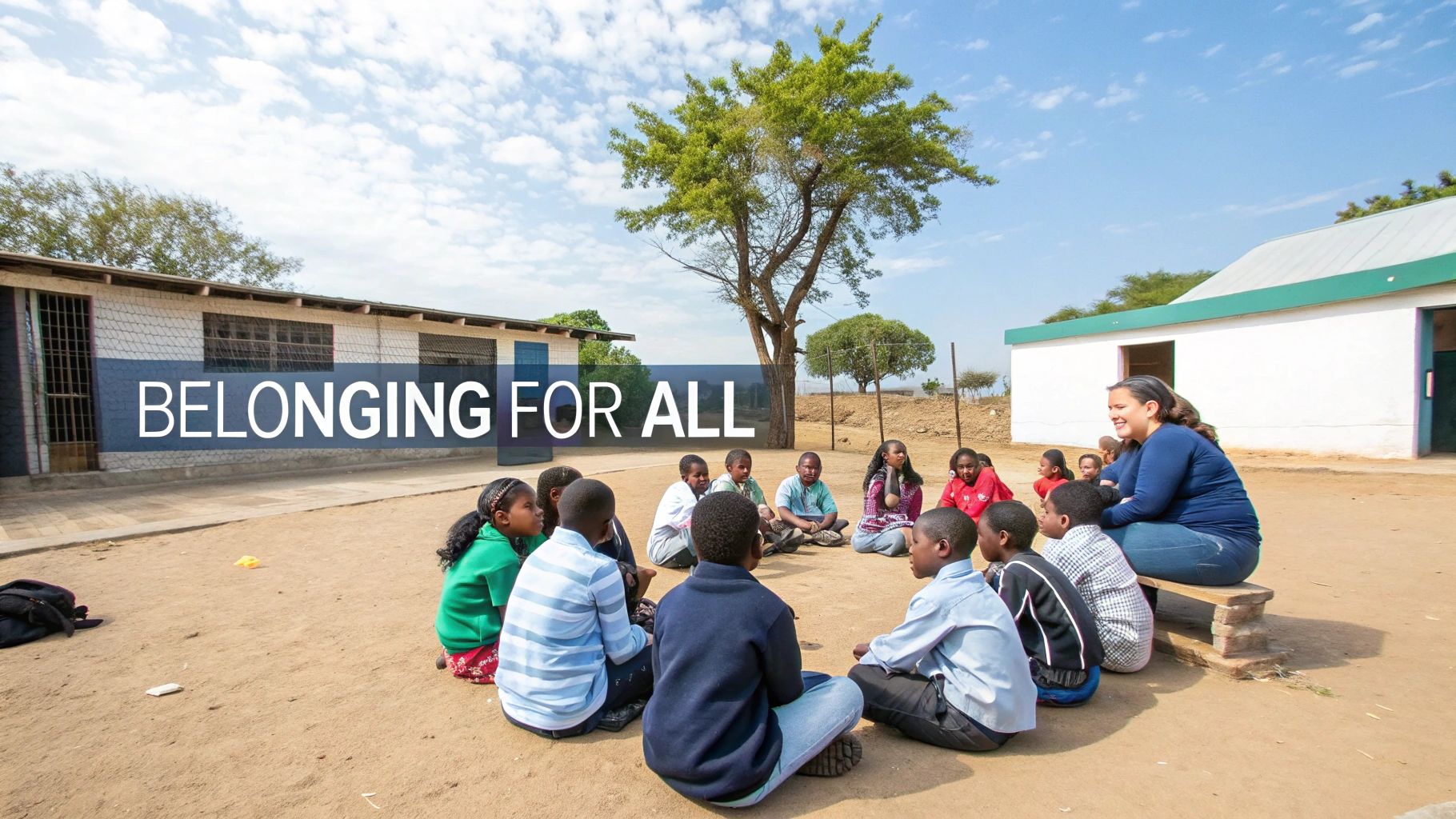
5. Inclusive and Diverse Community Mission Statement
An inclusive and diverse community mission statement explicitly establishes equity, diversity, inclusion, and belonging as foundational institutional values. This model moves beyond performative statements by committing the school to actively dismantling systemic inequities, recruiting diverse students and faculty, and embedding inclusive practices into its curriculum. For private schools, this is a critical differentiator that appeals to modern families seeking culturally responsive education and a genuine commitment to social justice.
Strategic Analysis
This type of mission statement answers the question: "How do we create an environment where every single member of our community feels seen, valued, and empowered to succeed?" It frames diversity not as a quota to be met, but as an essential component of educational excellence that prepares students for a complex, globalized world. It is a proactive stance that shapes every aspect of the school, from admissions and hiring to classroom instruction and community engagement.
Key Insight: Research from McKinsey & Company shows that organizations with greater ethnic and cultural diversity are 36% more likely to outperform their less diverse peers. In an educational context, this translates to richer learning experiences, enhanced critical thinking, and improved social-emotional development for all students.
Examples of this philosophy in action include:
- Brooklyn Friends School: Its Quaker-based mission is explicitly tied to social justice, diversity, and creating an equitable community.
- The Brearley School: The school has made a public commitment to anti-racism, which is reflected in its curriculum, policies, and community initiatives.
Actionable Takeaways for Your School
To build an authentic mission centered on inclusivity, your private school must translate its values into verifiable actions.
- Set Measurable Diversity Goals: Define clear, data-driven targets for student and faculty representation. This moves your commitment from an abstract ideal to a concrete, trackable objective.
- Integrate an Anti-Bias Curriculum: Audit your curriculum across all subjects to ensure it reflects diverse perspectives, histories, and voices. Provide faculty with ongoing professional development in culturally responsive teaching methods.
- Establish Support Systems: Create affinity groups and dedicated support structures for underrepresented students, faculty, and families. This fosters a sense of belonging and provides safe spaces for community members.
A mission statement focused on an inclusive community is not just a moral imperative; it is a strategic decision that strengthens the educational environment and prepares students for leadership in a diverse society.
Ready to build a mission statement that sets your private school apart and drives enrollment? Visit our website or book a complimentary consultation with JAG Consulting to align your vision with a powerful, actionable strategy.
6. Experiential and Project-Based Learning Mission Statement
An experiential and project-based learning (PBL) mission statement champions education through direct experience, hands-on inquiry, and real-world problem-solving. This model rejects passive learning, instead positioning students as active creators and investigators. For private schools, this approach is a powerful magnet for families disillusioned with conventional test-driven education, offering a dynamic and engaging alternative.
Strategic Analysis
This type of mission statement answers the question: "How can we make learning unforgettable and relevant?" It moves education from the abstract to the tangible, focusing on process and application over rote memorization. A PBL mission signals a commitment to cultivating skills like collaboration, critical thinking, and creativity, which are essential for navigating a complex, modern world. It frames the school as a laboratory for discovery, not just a repository for information.
Key Insight: A study by the Lucas Education Research division of the George Lucas Educational Foundation found that students in high-quality PBL programs outperformed their peers in traditional classrooms, showing greater gains in critical thinking and problem-solving skills. An experiential mission directly targets these high-demand competencies.
Examples of this philosophy in action include:
- Big Picture Learning: Its mission is built around personalized learning plans where students pursue their interests through real-world internships.
- High Tech High (San Diego): The school’s model centers on exhibitions of student work, where complex projects are presented to the public, demonstrating deep learning.
Actionable Takeaways for Your School
To build a credible experiential learning mission, your private school’s operations must authentically support this pedagogical model.
- Develop Community Partnerships: Your mission's success depends on real-world connections. Actively build a network of local businesses, experts, and organizations to serve as mentors, internship hosts, and project partners.
- Invest in Facilitator Training: Teachers in a PBL model act as project managers and learning coaches, not lecturers. Your mission must be backed by a budget for professional development focused on project design, facilitation, and alternative assessment.
- Create Portfolio-Based Assessments: Move beyond traditional grades. Implement digital portfolios or public exhibitions where students can document and present their work, demonstrating mastery and growth over time.
An experiential learning mission statement isn't just about fun activities; it's a strategic commitment to developing resilient, resourceful, and engaged lifelong learners.
Ready to build a mission statement that sets your private school apart and drives enrollment? Visit our website or book a complimentary consultation with JAG Consulting to align your vision with a powerful, actionable strategy.
7. Global Citizenship and International Perspective Mission Statement
A mission statement focused on global citizenship prepares students to thrive in an interconnected world. This approach goes beyond geography and language lessons; it cultivates cultural competence, multilingualism, and a deep understanding of diverse perspectives. For private schools, especially those serving expatriate communities or internationally-minded families, this mission is not just a value proposition but a fundamental necessity.
Strategic Analysis
This type of mission explicitly promises to develop students who are not just academically proficient but also culturally agile and ethically grounded global leaders. It answers the question: "How do we prepare our students to solve problems that transcend national borders?" This framework positions a school as a hub for international-mindedness, attracting families who see education as a passport to global opportunities and a more inclusive worldview.
Key Insight: The International Baccalaureate (IB) program, a leader in this philosophy, reports that IB students are significantly more likely to attend a top 20 university in the UK and feel more prepared for college-level coursework than their A-Level peers. A mission rooted in global perspective directly aligns with these proven outcomes.
Examples of this philosophy in action include:
- United World Colleges (UWC): Their mission is to "make education a force to unite people, nations and cultures for peace and a sustainable future," operating a network of schools worldwide.
- International School of Geneva: As the world's first international school, its mission is centered on providing an education that fosters intercultural understanding and respect.
Actionable Takeaways for Your School
To build an authentic global citizenship mission, your private school's operations must reflect its international aspirations.
- Pursue Global Accreditation: Align your curriculum with globally recognized standards like the International Baccalaureate (IB) or Cambridge Assessment International Education. This provides a clear, respected framework for your mission.
- Cultivate an International Faculty: Prioritize hiring educators with diverse international backgrounds and language abilities. Your staff should embody the global perspective you aim to instill in your students.
- Embed Global Learning: Integrate international case studies, cross-cultural projects, and global service-learning opportunities across all subjects. This ensures the mission is a daily reality, not an occasional theme.
A mission focused on global citizenship transforms a school from a local institution into a launchpad for the next generation of international leaders, making it one of the most compelling school mission statements examples for a modern audience.
Ready to build a mission statement that sets your private school apart and drives enrollment? Visit our website or book a complimentary consultation with JAG Consulting to align your vision with a powerful, actionable strategy.
8. Community Partnership and Local Connection Mission Statement
A community partnership mission statement positions the school not as an isolated institution, but as an integral hub within its local ecosystem. This model prioritizes deep, reciprocal relationships with local families, businesses, nonprofits, and civic organizations. For a private school, this approach creates a powerful narrative of local investment and relevance, transforming it from just another educational option into a cornerstone of the community it serves.
Strategic Analysis
This mission moves beyond generic statements about "community" and defines the school's role as an active local partner. It directly answers the question: "How does our school strengthen this neighborhood, and how does the neighborhood strengthen our school?" This place-based identity fosters authentic engagement and creates a loyal base of support, as the school's success becomes intertwined with the community's vitality. It is a powerful differentiator for schools aiming to attract families deeply invested in their local area.
Key Insight: Research from the Coalition for Community Schools indicates that students in these integrated environments show improved attendance, higher academic achievement, and increased engagement. A mission focused on local connection directly taps into these proven benefits, offering a tangible return on investment for both students and the community.
Examples of this philosophy in action include:
- Harlem Children's Zone: This renowned project provides a comprehensive network of services, deeply integrating education with community support to break the cycle of poverty.
- The Village School (Houston): It fosters global perspectives while maintaining strong partnerships with local Houston businesses and cultural institutions, providing students with real-world learning opportunities.
Actionable Takeaways for Your School
To build an authentic community-focused mission, your private school must embed partnership into its operational DNA.
- Map Community Assets: Identify and formally partner with local businesses, cultural centers, and non-profits. Create programs that leverage their expertise, such as internships, guest lectures, or joint service projects.
- Integrate Community Voice: Establish a community advisory board or include local leaders on your board of trustees. This ensures that community needs and perspectives are part of your strategic decision-making process.
- Design Reciprocal Programs: Develop service-learning initiatives where students address genuine community needs. This is not just volunteerism; it is curriculum-based learning that benefits both students and local partners.
A mission centered on community partnership builds a resilient school with deep roots, making it an indispensable local asset that families and stakeholders are eager to support.
Ready to build a mission statement that sets your private school apart and drives enrollment? Visit our website or book a complimentary consultation with JAG Consulting to align your vision with a powerful, actionable strategy.
8-Point School Mission Statement Comparison
| Model | Implementation complexity 🔄 | Resource requirements ⚡ | Expected outcomes ⭐📊 | Ideal use cases 💡 | Key advantages ⭐ |
|---|---|---|---|---|---|
| Student-Centered Learning Mission Statement | High — major PD, adaptive assessment, culture shift | High — robust data systems, individualized assessment, staffing | Improved individualized achievement and SEL; measurable student growth | Founders seeking differentiation; schools prioritizing personalization | Strong family/teacher alignment; clear curriculum framework; accreditation fit |
| Values-Based Character Development Mission Statement | Medium — define/operationalize values and model consistently | Medium — staff training, rituals, communication systems | Strong culture, behavioral consistency, alumni and donor loyalty | Faith‑based and independent schools; mission-driven communities | Distinctive brand; attracts values-conscious families; supports premium tuition |
| Academic Excellence and College Preparation Mission Statement | Medium — rigorous curriculum, assessment, college counseling systems | High — expert faculty, test prep resources, low counselor ratios | High test scores, strong college placement, clear performance metrics | Competitive urban/affluent markets; families prioritizing college outcomes | Measurable outcomes for marketing/accreditation; attracts academically motivated families |
| Innovation and Future-Ready Skills Mission Statement | High — integrate tech, interdisciplinary design, change management | High — technology infrastructure, maker spaces, ongoing PD | Enhanced creativity, digital literacy, entrepreneurial skills; industry partnerships | Tech-hub markets; entrepreneurial founders; schools seeking modern differentiation | Differentiates in market; aligns with employer needs; grant/partnership opportunities |
| Inclusive and Diverse Community Mission Statement | High — systemic DEI work, accountability, cultural transformation | High — sustained PD, diverse hiring, equity programs and tracking | Greater equity, richer perspectives, improved outcomes for underrepresented students | Schools committed to social justice; diverse or urban markets | Inclusive excellence; stronger community partnerships; accreditation alignment |
| Experiential and Project-Based Learning Mission Statement | High — curricular redesign, project facilitation, community ties | High — materials, field experiences, partnership coordination | Increased engagement, practical skills, portfolio-based assessment | Progressive schools; families seeking alternatives to traditional pedagogy | Memorable authentic learning; strong student agency and community partnerships |
| Global Citizenship and International Perspective Mission Statement | High — IB/accreditation, multilingual programs, exchange logistics | High — certified teachers, language programs, partnership funding | Global competence, multilingual graduates, international university readiness | International/expat communities; families seeking global mobility | IB recognition; international partnerships; strong appeal to mobile families |
| Community Partnership and Local Connection Mission Statement | Medium — relationship building, governance and local accountability | Medium — staff time, partnership management, community events | Strong local engagement, neighborhood impact, steady local enrollment | Neighborhood schools; urban schools seeking deep local ties | Authentic local relevance; community trust; recruitment via word‑of‑mouth |
Turning Your Mission from Words into Reality
Throughout this guide, we have explored a diverse collection of school mission statements examples, from those focused on student-centered learning and academic excellence to others championing global citizenship and innovation. Each example serves as a powerful testament to the idea that a mission statement is far more than a marketing slogan; it is the foundational DNA of a thriving educational institution. It is the North Star that guides every strategic decision, from curriculum design and faculty recruitment to community engagement and financial planning.
The true challenge, however, is not in writing an eloquent statement but in embedding it into the very fabric of your private school's culture and operations. A mission that exists only on a website or in an admissions brochure is a missed opportunity. For school founders, investors, and administrators, the critical task is ensuring this statement becomes a living, breathing entity that resonates in every classroom, hallway, and boardroom.
From Aspiration to Action: The Implementation Framework
A powerful mission statement acts as a strategic filter. It helps you say "yes" to the right initiatives and "no" to those that, while perhaps appealing, do not align with your core purpose. To bridge the gap between your mission and its execution, consider these three critical pillars:
- Operational Alignment: Your mission must directly influence your operational framework. If your mission is to foster "innovation and future-ready skills," your budget should reflect investments in technology, professional development for project-based learning, and partnerships with tech industries. Every line item should be justifiable through the lens of your mission.
- Cultural Integration: The mission must be the heartbeat of your school's culture. It should be a central theme during faculty onboarding, a reference point in parent-teacher conferences, and a visible guidepost in student assemblies. When your mission is to build an "inclusive and diverse community," your hiring practices, admissions outreach, and curriculum must actively support and reflect that commitment.
- Measurable Impact: How do you know your mission is succeeding? It requires translating broad ideals into concrete outcomes. To effectively transition your mission statement into actionable programs, it's vital to define clear and measurable outcomes. You can explore how to set powerful learning goals that align with your school's broader vision and create tangible benchmarks for success.
The Strategic Imperative of a Living Mission
For private school leaders, a fully realized mission is a significant competitive advantage. Research from The Enrollment Management Association shows that private schools with a clear, well-communicated, and actively implemented mission have higher rates of student and faculty retention and stronger philanthropic support. It attracts families who are not just consumers of education but true partners in your vision. This alignment creates a virtuous cycle: a strong mission attracts the right people, who in turn reinforce the culture, which ultimately delivers on the mission's promise.
The school mission statements examples we've analyzed are not just collections of words; they are strategic assets. They represent a clear promise to students, parents, and the community. Your final step is to ensure that your institution is built to deliver on that promise every single day, turning your inspiring vision into a lived reality.
Ready to transform your school's vision into a sustainable, high-impact reality? The expert team at JAG Consulting specializes in guiding private school founders, investors, and leaders through every stage of development, from crafting a compelling mission to achieving accreditation and strategic growth. Let us help you build an institution where your mission isn't just a statement, but the core of your success. Visit our website or book a call with JAG Consulting today to start building your legacy.

I'm Dr. Jeannie Gudith, Founder and CEO of JAG Consulting. We help you develop, improve, buy or sell your private school.
I'm so glad you're here
Hello!


© 2025 JAG CONSULTING.
all rights reserved. privacy policy + REFUND POLICY. TEMPLATE by sugar studios + Showit
