


A Guide to Year Round School for Private Schools
When you hear “year-round school,” it’s easy to imagine kids in classrooms all 12 months with no breaks. But that’s a common myth. The reality is much smarter.
A year-round school calendar doesn't add more days to the school year; it redistributes the same 180 instructional days more strategically. Instead of one long summer vacation, students get shorter, more frequent breaks throughout the year. The goal is simple: reduce academic burnout and improve learning retention.
Rethinking the Academic Calendar
The traditional nine-month school calendar feels like a permanent fixture in American education, but its roots are widely misunderstood. The popular story is that it was built around the farming cycle, freeing up kids for summer harvesting. The historical record, however, points to a 19th-century urban trend where affluent families fled sweltering cities for cooler summer destinations.
For private school leaders focused on delivering superior student outcomes, this begs a critical question: is a calendar designed for 19th-century city life still the best model for modern learning?
For a private school, the academic calendar isn't just about logistics—it's a strategic lever. The single biggest driver for adopting a year-round model is the fight against the "summer slide," the well-documented learning loss that happens during that long summer off. Research from the NWEA indicates that students can lose between 17% and 34% of the prior year's learning gains during summer break.
The big idea behind a balanced calendar is to break up that massive summer gap into smaller, more purposeful breaks. This creates a rhythm of continuous learning and gives everyone—students and faculty alike—regular chances to recharge. It’s about building a more sustainable pace for academic rigor.
The Problem With the Long Summer Break
The traditional calendar slams the brakes on learning every June. Come August, teachers often spend weeks—sometimes a full month—just reviewing concepts students forgot over the summer. This cycle of learning, forgetting, and re-learning kills academic momentum.
For private schools that promise continuous growth and a premium educational experience, that built-in inefficiency is a serious problem.
Let's quickly compare the two structures.
Traditional vs. Year-Round School Calendar at a Glance
This table breaks down the fundamental differences between the familiar nine-month calendar and a balanced, year-round model. It’s not about more school, but a different rhythm of learning and rest.
| Feature | Traditional Calendar | Year-Round Calendar (Balanced) |
|---|---|---|
| Instructional Days | ~180 days | ~180 days (the same amount of school) |
| Structure | Nine months of instruction followed by a long, 10-12 week summer break. | Instruction is broken into shorter blocks (e.g., 9 weeks on, 3 weeks off). |
| Major Breaks | One long summer break, plus shorter winter and spring breaks. | Multiple shorter breaks (intersessions) distributed evenly throughout the year. |
| Summer Break Length | 10-12 weeks | Typically 4-5 weeks |
| Primary Goal | Historically aligned with agrarian and early industrial societal patterns. | To reduce "summer slide" learning loss and provide a more continuous learning pace. |
| Intersessions | Not applicable. Remediation or enrichment happens in separate summer school. | Breaks can be used for targeted remediation, enrichment programs, or family travel. |
As you can see, the core difference is in the pacing. The year-round model aims to smooth out the learning curve, replacing the start-and-stop momentum of the traditional calendar with a steadier, more consistent rhythm.
While it’s not the default model in the U.S., its strategic value has kept it in the conversation for decades. According to the National Center for Education Statistics (NCES), in the 2017-18 school year, approximately 1,500 U.S. public schools operated on a year-round calendar, representing about 4% of all public schools. For private schools, this lower adoption rate represents a significant opportunity for differentiation. You can find more details in this in-depth research on year-round school calendars.
A Competitive Advantage for Private Schools
For an independent school, adopting a year-round schedule is more than an operational change; it’s a powerful market differentiator. It signals to prospective families that your institution is forward-thinking and laser-focused on student achievement.
It becomes a compelling marketing message: "We don't let our students regress. We’ve designed a calendar that fosters continuous progress." This can be a huge draw for parents who are deeply concerned about the summer slide and want an academic structure built for excellence in the 21st century.
Ready to explore how a balanced calendar could benefit your school? Book a call with JAG Consulting or visit our website to learn more.
Single-Track vs. Multi-Track Year-Round Models
Once a private school decides to explore a balanced calendar, the next big question is how to make it work on the ground. The practical application of year-round schooling boils down to two distinct models: single-track and multi-track.
Think of this choice as the difference between a specialized tool designed for a single purpose versus a versatile one built to solve a capacity problem. Each serves a fundamentally different strategic goal, so it’s critical for private school leaders to understand which one truly aligns with their mission. The decision isn't just logistical; it defines whether your primary objective is sharpening academic outcomes or maximizing operational efficiency.
This infographic captures the core idea of a year-round calendar: it’s about rearranging time, not adding more of it.
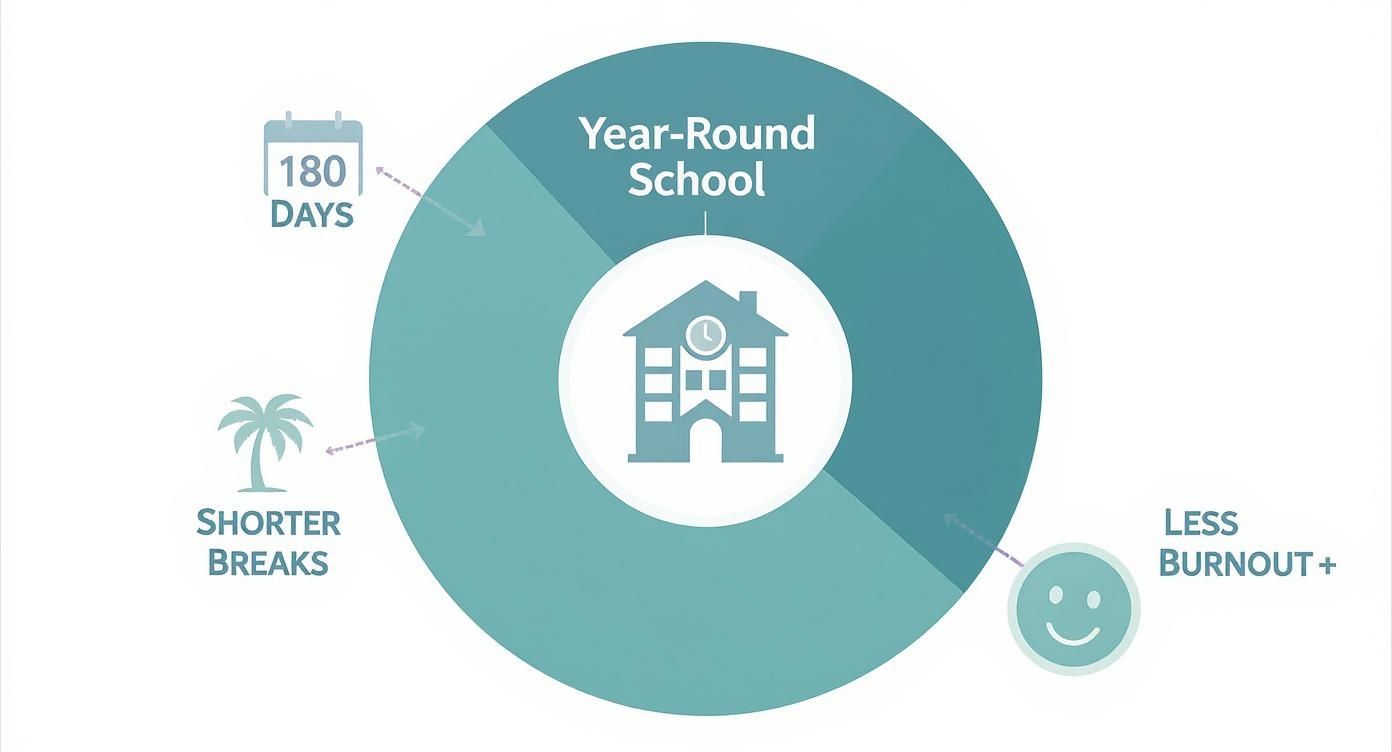
The goal is to create a more sustainable rhythm for learning, reducing the burnout that plagues both students and teachers under the traditional model.
The Single-Track Model: An Academic Focus
The single-track model is, by far, the most common and logical choice for private schools. It’s simple: every student and every teacher follows the same balanced calendar. The entire school community starts together, takes breaks together, and finishes the year together.
The purpose here is purely academic. By swapping the long, disruptive summer break for shorter, more frequent "intersessions," the single-track model gets to the heart of student learning and well-being. It’s designed to:
- Mitigate summer learning loss. Shorter breaks mean students don't have enough time to forget crucial math and reading skills, so teachers don't have to spend the first six weeks of school just catching everyone up.
- Decrease teacher and student burnout. Regular, restorative breaks are built into the academic year, helping everyone stay energized, focused, and engaged from start to finish.
- Create new opportunities for enrichment. Those intersession breaks are perfect for offering targeted academic support for students who need it or specialized camps and unique programs for those looking to go deeper.
This model is a powerful tool for schools laser-focused on academic excellence and a healthy, supportive culture. It unifies the entire community around a shared rhythm of intense learning and intentional rest.
A single-track calendar is like a symphony orchestra where every musician follows the same sheet music. The unified tempo and coordinated breaks create a harmonious educational experience designed for peak performance.
The Multi-Track Model: An Operational Solution
In sharp contrast, the multi-track model is an operational solution designed to solve one specific problem: overcrowding. This system divides students and teachers into different groups, often called "tracks." Each track follows its own staggered schedule, meaning that while one track is on break, the others are in session.
This clever rotation allows a school to serve significantly more students than its physical building can hold at any one time. For example, a campus built for 750 students could potentially serve 1,000 by rotating four tracks, with only three on campus at once. This can increase a school's enrollment capacity by 25% or more without having to pour a single yard of concrete for a new building.
However, this efficiency comes at a cost. The multi-track model introduces enormous logistical complexity. It’s a nightmare for families with children on different tracks and makes all-school events, athletics, and community-wide traditions incredibly difficult to schedule. For most private schools, where community and cohesion are paramount, the single-track model is almost always the more appropriate choice.
Knowing which model fits your school's vision is the essential first step. Are you looking to sharpen your academic edge and improve student well-being? Or are you trying to squeeze more students into a building that's bursting at the seams? Answering that question will point you down the right path.
Gauging the Real-World Impact on Your School
Let’s be clear: adopting a year-round calendar isn’t a minor logistical tweak. It’s a strategic decision that fundamentally changes the entire rhythm of your school. Before you even think about committing, you have to run a brutally honest analysis, weighing the academic wins against the very real operational and cultural hurdles.
This kind of change sends ripples through every corner of your community, from student achievement and faculty morale to parent satisfaction and re-enrollment rates.
The biggest headline benefit, and the one most schools chase, is its direct assault on the "summer slide." This isn't just theory; it's a well-documented phenomenon. Seminal research has shown that students can lose an average of one to two months of learning in critical math skills over that long, unstructured summer break.
By swapping out that one long vacation for shorter, more frequent breaks, you’re essentially creating a culture of continuous learning. Teachers get to spend far less time on review in the fall and more time diving into new, challenging material. For a private school that stakes its reputation on academic rigor, that's a powerful selling point.
The Academic and Operational Upside
Beyond just stopping the summer slide, a balanced calendar offers some compelling advantages that should resonate with any private school leader.
- Beating Burnout: This is huge. Giving both students and teachers regular, meaningful breaks to recharge can dramatically lower staff turnover and keep the classroom environment energized all year long. A Gallup poll found that K-12 teacher burnout reached 44%, tying it for the highest among all professions. A balanced calendar is a systemic approach to combatting this.
- Targeted Learning Opportunities: Those shorter breaks—often called intersessions—are the perfect time for specialized programs. You can offer focused academic support for students who need a boost or run advanced enrichment camps for things like STEM, arts, or athletics. This also opens up entirely new revenue streams.
- Deeper Teacher-Student Bonds: When teachers aren't spending the first six weeks of school reteaching forgotten concepts, they can build more consistent and meaningful relationships with their students. This continuity is the bedrock of a strong, supportive school culture.
The core operational advantage is simple: a year-round calendar keeps the learning momentum going. It replaces the traditional "sprint, stop, and restart" cycle with a steady, sustainable pace designed for deeper mastery and less academic fatigue.
Navigating the Inevitable Roadblocks
Of course, the transition isn't all smooth sailing. The challenges are significant, and they're usually more about people and logistics than academics. Overcoming them requires proactive planning and crystal-clear communication.
One of the biggest hurdles is family scheduling. Many of your families may have older or younger kids in other schools still on a traditional calendar. This creates immediate conflicts for family vacations, childcare, and summer plans. For private schools that rely on attracting and retaining families with choices, this is a make-or-break issue.
And then there's the disruption to long-held traditions tied to the summer break.
- Summer Camps and Sports: What happens to traditional summer-long camps, elite sports leagues, or even summer jobs for older students? These are real concerns for families.
- Faculty Pushback: Teachers often use their summers for professional development, earning advanced degrees, or working a second job. A new calendar forces a renegotiation of contracts, pay schedules, and expectations, which can spark resistance if not handled with care.
- Community Perception: In many places, the long summer vacation is more than a schedule—it's a cultural institution. Moving away from that norm can be viewed negatively by prospective families who value that traditional downtime.
Ultimately, the decision comes down to a simple question: do the powerful academic benefits of continuous learning outweigh the very real logistical and cultural shifts required? For private school leaders, this means getting a deep, honest read on your community's needs, priorities, and tolerance for change.
Is your school ready to explore if a year-round model is the right strategic fit? Book a call with JAG Consulting or visit our website to see how we help schools navigate complex decisions like this.
A Look at Global School Calendar Strategies
When we start talking about year-round school, it's easy to get stuck in a debate about the raw number of school days. But if you zoom out and look at what high-performing nations are doing, you see the conversation isn't about the quantity of instructional time at all. It's about the quality and the rhythm.
The traditional American calendar, with its long, sprawling summer break, is actually an outlier among most developed countries. This global perspective is critical for private school leaders. It shows that rethinking the academic calendar isn't about cramming more days in; it’s about fundamentally redesigning how you use time to deliver an exceptional education.
More Hours Don't Equal Better Outcomes
There's a common assumption that top-ranking academic countries get there through grueling, year-long schedules. The data tells a surprisingly different story.
Many of these systems focus on efficiency, teacher quality, and student well-being—not just sheer hours logged in a classroom. For instance, students in OECD countries get an average of about 7,634 hours of compulsory instruction from primary through lower secondary school.
But that average hides a massive range, from just 5,335 hours in Poland to nearly double that—11,047 hours—in Australia. Most strikingly, countries like Finland, famous for consistently high international test scores, are actually on the lower end of the instructional time scale. It’s powerful proof that more time in school doesn't automatically produce better results.
You can dig into the numbers yourself in this OECD report on classroom time.
Lessons from International Models
Looking at how other countries structure their academic year gives us some powerful models. Many high-achieving nations have already embraced the core principle behind the year-round school model: a better balance of learning and rest.
- Shorter, More Frequent Breaks: Countries like Germany and the United Kingdom punctuate their academic years with multiple breaks or "half-terms." These shorter vacations, usually one or two weeks long, serve the exact same purpose as intersessions in a balanced calendar—they prevent burnout and minimize learning loss.
- Emphasis on Teacher Professionalism: In systems like Finland's, where teachers spend fewer hours in the classroom than the OECD average (685 hours per year vs. 791), the calendar intentionally builds in significant time for teacher collaboration, planning, and professional development. They recognize that the quality of the teaching is far more impactful than the raw number of days it's delivered.
The key takeaway from these global strategies is that the academic calendar should be a tool that serves educational goals, not an unbreakable tradition. For private schools, this means a year-round calendar is a strategic opportunity to align your school’s time with its mission of academic excellence and holistic student development.
This isn't just about moving days around on a schedule. It's about adopting a philosophy of continuous, paced, and high-quality learning.
Are you ready to explore how a globally-informed calendar strategy could elevate your institution? Book a call with JAG Consulting to discuss a customized approach, or visit our website to learn more.
The Financial Realities of a Balanced Calendar
For any private school leader, the big question always comes back to the bottom line. Shifting to a year round school calendar is no different. It’s a move that demands a clear-eyed financial analysis, forcing you to weigh new operational costs against potential savings and—most critically—its impact on your enrollment and market position.
The numbers look completely different depending on the model you choose. A multi-track system, which is really designed to squeeze every last drop of utility out of a crowded campus, can create massive savings by kicking the can down the road on new construction. But for most private schools considering a single-track model, the conversation isn’t about infrastructure savings; it’s about operating costs and new revenue opportunities.
Analyzing Operational Costs
Let’s be clear: switching to a balanced calendar means your lights are on and your campus is running for more of the year, even if your total instructional days stay the same. This brings a few new line items to your budget that you have to model carefully.
- Utilities and Maintenance: Firing up the air conditioning in July and running the heat during a traditional winter break will absolutely increase your utility bills. Depending on climate, this could increase energy costs by 5-15%. Your custodial and maintenance teams will likely need adjusted schedules or more hours to keep the campus in top shape year-round.
- Staffing and Salaries: Teacher contracts need a second look. While the teaching days don’t change, spreading them over 11 or 12 months often means moving to a 12-month pay cycle. This can have a real impact on cash flow. You might also find you need extra administrative support to manage the more complex calendar.
The biggest misconception we see is that a year-round calendar automatically saves money. For single-track private schools, it’s often a cost-neutral or even a slight cost-increase scenario at first. The real ROI isn't in pinching pennies—it's measured in academic outcomes and how you stand out in a crowded market.
Marketing, Enrollment, and Revenue Generation
This is where the financial strategy gets really interesting. A year-round calendar isn't just a logistical change; it's a premium feature you can market directly to parents’ biggest academic fear: the summer slide.
Suddenly, your marketing message is a powerful differentiator. You're not just another private school. You're the school that offers continuous learning, stops academic backsliding, and provides a healthier, more sustainable pace for students and teachers. This can attract a very specific, dedicated slice of the market that is willing to invest more for a better educational model.
Of course, this approach isn't without risk. You will likely lose some prospective families who see that long summer break as sacred—a time for travel, camps, or long-held family traditions. Your success hinges entirely on how well you communicate the value and prove that the academic benefits are real and measurable.
This push for continuous learning isn't happening in a vacuum. Globally, despite huge gains in school access over the past decade, the out-of-school population has actually ticked up, with UNESCO estimating 250 million children and youth were out of school in 2021. This points to persistent challenges that more flexible, continuous learning models are trying to solve. You can explore more about the rising out-of-school population and its implications on the World Education Blog.
What’s more, those intersession breaks built into a balanced calendar are prime real estate for new revenue streams. These periods are perfect for offering specialized enrichment camps, academic bootcamps, or targeted tutoring—not just for your own students, but for the entire community.
Before making a move, it's crucial to model these financial shifts. Below is a sample table outlining the kinds of costs and revenue opportunities you'll need to consider.
Projected Budget Impact of Switching to a Year Round Calendar
| Expense Category | Potential Cost Increase | Potential Cost Savings/Revenue | Key Considerations |
|---|---|---|---|
| Utilities | 5-15% increase due to summer A/C and winter heating during breaks. | Minor savings from optimized HVAC scheduling. | Requires an energy audit to get precise figures. Smart thermostats can mitigate some costs. |
| Staff Salaries | 2-5% for contract adjustments (e.g., 12-month pay cycles, stipends). | Reduced need for summer school staff if intersessions cover remediation. | Teacher buy-in is critical. New contracts must be carefully structured and communicated. |
| Maintenance & Custodial | 5-10% for year-round staffing or overtime. | Potential savings from spreading deep cleaning projects throughout the year. | Staff burnout is a real risk. Schedules must be sustainable. |
| Marketing & Admissions | 10-20% in the first 1-2 years for a repositioning campaign. | Higher conversion rates from a differentiated value proposition. | Your messaging must clearly articulate the "why" behind the new calendar. |
| Auxiliary Programs | Initial investment in program development and staffing. | New revenue stream from intersession camps and academic programs. | Market demand for these programs must be validated. Pricing needs to be competitive. |
| Capital Expenditures | None directly, unless facility upgrades are needed for year-round use. | Significant long-term savings by maximizing facility use and avoiding new construction (more applicable to multi-track). | Single-track models won't see major capital savings, but can better utilize existing space. |
This table provides a framework, but your school's actual numbers will depend on your specific climate, facility, staffing model, and local market.
Ultimately, the financial success of a year-round model for a private school comes down to one thing: your ability to turn the academic advantages into a powerful enrollment driver.
Are you ready to analyze what this would mean for your school's strategy and bottom line? Book a call with JAG Consulting to build a detailed financial model, or visit our website for more resources.
Your Implementation Roadmap to a Year-Round School
Switching to a year-round calendar isn't just a minor administrative tweak. It’s a major strategic shift that demands meticulous planning, strong leadership, and a whole lot of communication.
Getting this right is as much about change management as it is about logistics. A clear, step-by-step roadmap is essential to build buy-in, tackle concerns head-on, and guide your community through the transition. Rushing the early stages is a classic mistake that almost always leads to faculty resistance and parent anxiety down the line.

Phase 1: Assembling Your Team and Gathering Data
Before a single decision is made, your first move is to form an exploratory committee. This can't be a top-down group; it needs to be a true cross-section of your school community. Pull in administrators, veteran faculty, board representatives, and a few influential parent leaders.
Their initial job isn't to sell the idea. It's to honestly investigate the feasibility and potential impact of a year-round model on your specific school.
This committee should get to work on a few key tasks:
- Conducting Community Surveys: Get a baseline. How do families, students, and staff feel about the current calendar? What are their gut reactions to a balanced calendar?
- Analyzing Financial Impacts: Your business office needs to model the numbers. What are the potential cost increases (think year-round utilities) and new revenue streams (like intersession programs)?
- Reviewing Peer Schools: Find other private schools that have made the switch. Learn from their experiences—both what went right and what they'd do differently.
Phase 2: Building Community Buy-In
With some initial data in hand, you're ready to go public. This phase is all about transparency and engagement. You have to proactively manage the narrative and address concerns before they fester into organized opposition. A well-thought-out communication plan is absolutely non-negotiable here.
The goal of this phase isn't just to inform, but to genuinely listen. A successful transition to a year-round school is built on a foundation of trust, and that trust is earned through open dialogue and a demonstrated willingness to address every question, no matter how small.
Your engagement strategy has to include a series of town hall meetings. Present the committee's findings clearly, showing both the compelling academic upsides and the real logistical hurdles. Use these forums as listening sessions. Document every concern and show your community that their voices are genuinely shaping the final decision. This turns stakeholders from passive observers into active partners in the process.
Phase 3: Creating the Transition Plan
Once you've secured enough buy-in and the board has given the green light, the focus shifts from if to how. This is where you map out a realistic timeline that gives everyone ample runway to prepare. A rushed implementation is a recipe for pure chaos.
A huge piece of this plan must be robust professional development for your faculty. Your teachers will need dedicated time and training to adapt their curriculum pacing and figure out how to best use the new intersession breaks. This is how you ensure the shift doesn't just change the schedule but actually elevates the learning experience for students.
Making this change is a significant undertaking. Are you ready to build a custom roadmap for your institution's future? Book a call with JAG Consulting to start the conversation, or visit our website for more insights.
Your Top Questions About Year-Round School, Answered
For private school leaders, board members, and investors, the idea of a balanced calendar inevitably brings up tough questions about operations, culture, and tradition. Shifting away from a schedule everyone knows requires having clear, confident answers for your stakeholders.
Let's tackle some of the most common questions that come up when schools consider moving to a year-round model.
How Does a Year-Round Calendar Affect Teacher Contracts and Pay?
This is one of the first and most important logistical hurdles. Moving to a year-round schedule isn’t just about changing dates; it means thoughtfully updating faculty contracts and how you handle compensation. While the total number of teaching days stays the same, spreading them out usually means switching to a 12-month pay cycle.
This change is often a huge win for teachers, giving them a steady, predictable income stream throughout the year. But the real game-changer is the impact on well-being. Those shorter, more frequent breaks are a powerful defense against educator burnout. We see it time and again: teachers in year-round schools report feeling more refreshed and energized, which translates directly to lower staff turnover.
What Happens to Summer Camps and Extracurriculars?
This is a huge concern for parents and, frankly, a big piece of the financial puzzle for any school with auxiliary programs. The key is to stop thinking about a single "summer break" and start seeing the breaks—or intersessions—as brand-new opportunities. Instead of one long summer camp season, you can now offer multiple, shorter specialty camps all year long.
These intersessions become the perfect venue for:
- Targeted Academic Support: Think focused tutoring "boot camps" for students who need a little extra help catching up in specific subjects without the pressure of the regular semester.
- Enrichment Programs: This is your chance to run unique camps in STEM, the arts, or leadership that you just can't fit into the normal curriculum.
- New Revenue Streams: You can open these programs to the wider community, creating a new and much more consistent source of non-tuition revenue for the school.
The move from one summer session to multiple intersession programs lets a school diversify its offerings in a powerful way. You not only serve your current students better but also transform your campus into a year-long hub of community activity.
How Do Families Manage Scheduling Conflicts?
Let's be honest: the "sibling problem"—where one child is in a year-round school and another is on a traditional calendar—is a real logistical headache for parents. Acknowledging this concern right out of the gate is absolutely critical for building trust and keeping families enrolled.
The solution is a mix of proactive communication and smart planning. The most successful schools we've worked with coordinate their calendars as closely as possible with local public districts to align major holidays and at least some of the breaks.
But the most effective strategy? Clearly and consistently communicating the why. When families see tangible proof that the balanced calendar prevents summer learning loss and actually boosts their child's achievement, they become far more willing to navigate the scheduling complexities. The value of continuous learning becomes a compelling reason to make it work.
Navigating these questions is the first step toward a successful transition. At JAG Consulting, we specialize in helping private school leaders analyze these challenges and build a strategic roadmap for implementation.
Ready to explore if a year-round school calendar is the right move for your institution? Book a call with JAG Consulting or visit our website to learn more.

I'm Dr. Jeannie Gudith, Founder and CEO of JAG Consulting. We help you develop, improve, buy or sell your private school.
I'm so glad you're here
Hello!

© 2025 JAG CONSULTING.
all rights reserved. privacy policy + REFUND POLICY. TEMPLATE by sugar studios + Showit
