

Teacher professional development: Elevate Private School Outcomes
When it comes to strategic investments, there’s nothing a private school can do that delivers a higher return than developing its own teachers. Great professional development moves way beyond simple compliance—it's the fuel for higher student achievement, a direct driver of parent satisfaction, and a critical factor in boosting re-enrollment in a crowded market.
To be clear, we're not talking about generic, one-off training days. Effective programs are sustained, content-specific, and woven directly into the fabric of your school's unique mission. In fact, research shows that when professional development is sustained and intensive (totaling 30-100 hours over 6-12 months), it can boost student achievement by as much as 21 percentile points.
Beyond Compliance: The Real Value of TPD in Private Schools
Too many school leaders see teacher professional development (TPD) as just another line item in the budget—a box to check for accreditation or state licensing. This misses a fundamental truth the best private schools have already embraced: TPD isn't a cost center; it's a powerful engine for your school's reputation, growth, and financial health.
When you get it right, a culture of continuous learning becomes a cornerstone of your school's success and a core part of your value proposition. For founders, boards, and Heads of School, this is one of the most important conversations you can have.
The Strategic Impact on Student Outcomes
The line between teacher quality and student success is direct and undeniable. Investing in your faculty’s skills is the fastest way to improve what happens in the classroom every single day.
Large-scale studies have shown that sustained, high-quality TPD is one of the most powerful levers for improving student outcomes. In fact, well-designed programs can raise student learning by 0.1–0.3 standard deviations. That’s roughly equivalent to adding several months of schooling to the academic year. You can learn more about these findings on teacher effectiveness and see how targeted support translates into real academic gains.
A strategic investment in your people leads directly to:
- Higher Standardized Test Scores: Teachers armed with the latest pedagogical strategies are simply better equipped to prepare students for academic assessments.
- Deeper Conceptual Understanding: Effective TPD helps teachers move beyond rote memorization to build critical thinking and problem-solving skills in their students.
- Increased Student Engagement: When teachers are passionate, skilled, and learning themselves, that energy is contagious. It creates a more dynamic and engaging classroom for everyone.
Fueling Enrollment and Parent Satisfaction
In the competitive private school market, parent satisfaction and word-of-mouth are everything. Today’s parents are savvy consumers, and they want to see a clear return on their significant tuition investment.
A visible, genuine commitment to teacher excellence is a powerful marketing tool that resonates deeply with families. When parents know their child's teachers are constantly honing their craft, it builds immense trust and confidence in your school's brand. This is crucial, as a key driver for parents choosing private schools is the perception of higher-quality teaching and academic standards.
By framing teacher professional development as a core strategic initiative, private schools can transform an operational requirement into a powerful differentiator that attracts top talent, satisfies parents, and secures long-term financial stability.
Ultimately, a robust TPD program signals that your school is committed to excellence from the ground up. This commitment translates directly into higher re-enrollment rates and a stronger admissions pipeline, making it an essential part of your school's long-term health.
Ready to design a TPD program that delivers real results? Book a call with JAG Consulting at https://link.jagconsultingservices.com/widget/bookings/prospective/school/consultation/zoom to discuss how we can help you build a framework for success or visit our website to learn more.
Building the Foundation for Impactful TPD
Let’s be honest. Effective teacher professional development (TPD) doesn't just appear on the calendar. It’s not about finding a popular workshop and hoping for the best.
Jumping straight to solutions without doing the foundational work is like building a house with no blueprint. True impact—the kind that actually changes classroom practice and improves student outcomes—starts with a deep, honest assessment of your school's unique needs. It begins with a clear understanding of where your faculty is now and where your strategic goals require them to be.
The process has to move beyond the simple annual survey. To get a genuine picture of where support is needed most, you have to combine multiple data streams. This multi-faceted approach ensures your TPD plan is built on evidence, not assumptions. Only then can you design professional learning experiences that teachers find relevant and that deliver a measurable return on your investment.
This process shows the direct line from strategic investment in TPD to tangible school success.
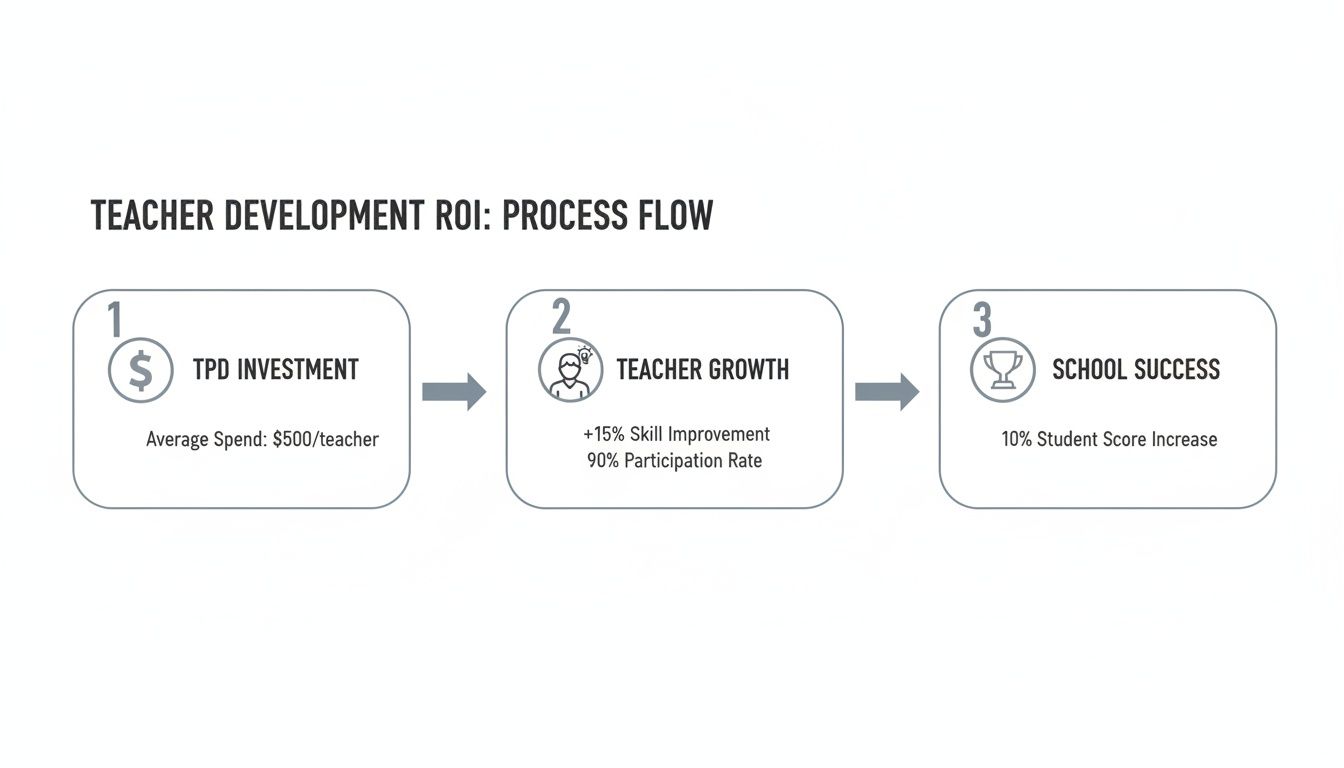
As you can see, a thoughtful financial commitment directly fuels teacher growth, which in turn leads to improved student outcomes and overall school-wide achievement.
Uncovering Real Needs Through Data
To design a program teachers will actually value, you must first diagnose the specific challenges and opportunities within your school. This means digging into both quantitative and qualitative information. The goal is to triangulate your findings, looking for patterns that emerge across different sources.
Here's where to look:
- Student Performance Data: Go beyond standardized test scores. Look at internal assessment results, writing samples, and project-based work. Are there specific grade levels or subject areas where students are consistently hitting a wall? This data often points directly to a need for content-specific pedagogical support for teachers.
- Classroom Observations: Non-evaluative, supportive observations—often done by department heads or instructional coaches—provide invaluable insights. They reveal how instructional strategies are actually being implemented in real-time and can highlight the gaps between intended and actual practice.
- Teacher Focus Groups and Surveys: Anonymous surveys can capture broad trends, but candid focus groups provide the "why." These conversations are where you uncover frustrations with current resources, identify desires for new skills (like integrating specific edtech tools), and build a sense of shared purpose from the very beginning.
Effective professional learning must be coherent. It has to connect new ideas to teachers' existing knowledge and align with school-wide goals. Research is clear on this: when TPD is perceived as relevant and connected, teacher buy-in and subsequent changes in practice increase significantly.
By combining these sources, you can get incredibly specific. You might discover that while a survey shows a general interest in "classroom management," your student data and observations reveal the actual issue is a lack of strategies for engaging neurodiverse learners in upper-school humanities classes. That specific insight is what makes TPD impactful.
To help you get started, here are some of the most effective data sources we use with schools to pinpoint their true professional development needs.
Needs Analysis Data Sources for TPD Planning
| Data Source | What It Measures | Example Insight for TPD |
|---|---|---|
| Student Achievement Data | Academic performance, learning gaps | Low scores in 8th-grade science point to a need for training in inquiry-based lab instruction. |
| Teacher Surveys | Self-perceived needs, interests, morale | High interest in AI integration but low confidence suggests a need for foundational AI tools training. |
| Classroom Observations | Instructional strategies, student engagement | Observations show inconsistent use of formative assessment, indicating a need for a workshop on the topic. |
| Teacher Focus Groups | In-depth feedback, underlying challenges | Teachers express frustration with supporting students with executive function deficits in project-based learning. |
| Parent Surveys/Feedback | Perceptions of teaching quality, communication | Feedback indicates a lack of consistent communication, highlighting a need for training on parent comms platforms. |
| Accreditation Reports | Alignment with standards, areas for growth | An accreditation recommendation to improve differentiation can become a central TPD goal for the year. |
| Department Meeting Minutes | Recurring challenges, collaborative goals | Minutes consistently show discussions about struggling writers, suggesting a school-wide writing pedagogy initiative. |
Using a mix of these sources gives you a 360-degree view, ensuring your TPD budget is spent on solving real problems, not just checking a box.
Aligning TPD with Your School's Strategic Vision
Once you have a clear picture of your faculty's needs, the next critical step is to connect those needs directly to your school's mission and strategic plan.
This alignment is crucial in a private school setting. Every initiative, especially one as resource-intensive as TPD, must demonstrate its value to the overall health and direction of the institution.
For a comprehensive perspective on current advancements, it can be helpful to look at insights into the broader education and training industry. This wider view can spark ideas about different training models or technologies being used successfully elsewhere.
Let’s say your strategic plan calls for becoming a leader in STEM education. Your needs analysis should specifically investigate your science and math teachers' comfort with inquiry-based learning or new lab technologies.
The resulting TPD goals have to be measurable and tied directly to that strategic objective. An effective goal isn't "improve science teaching." It's "Increase the use of project-based learning in all 6-8th grade science classes by 40% over the next two school years."
This level of specificity ensures that every dollar and every minute invested in professional development is purposeful and actively drives your school's vision forward.
Designing TPD That Teachers Actually Value

Alright, we've laid the groundwork. Now it’s time to build a professional development program your teachers will genuinely appreciate.
The days of mandatory, one-size-fits-all "sit and get" workshops are over. In the competitive world of private schools, keeping your best faculty means offering growth opportunities that are relevant, engaging, and make a real difference in their classrooms.
The secret is variety and choice. When teachers have some say in their own learning, their engagement skyrockets. We need to move beyond the traditional training model and offer a mix of options that cater to different needs, experience levels, and learning styles. This helps build a culture where growth is a collaborative journey, not a top-down mandate.
Moving Beyond the One-Off Workshop
A truly effective TPD strategy isn't built on single sessions. One-off workshops rarely lead to lasting change. Instead, the best private schools create interconnected experiences that build on each other throughout the year.
Research is clear on this: for professional development to stick, it has to be continuous. This means providing at least 20 hours of contact time on a specific topic, spread out over the school year. This sustained approach gives teachers the time they need to learn, practice, get feedback, and actually refine new strategies in their own classrooms.
The disconnect between training and classroom reality is a huge problem. OECD data shows that while over 80% of teachers in top-performing school systems get annual PD, only about 40–50% feel it’s directly relevant to their work. That gap is precisely why a thoughtful, needs-based program is so critical.
Core Models for High-Impact TPD
A great program mixes and matches different delivery models. Here are some of the most powerful approaches I’ve seen work in private schools:
- Instructional Coaching: This is a game-changer. It’s a one-on-one or small-group model that provides personalized, non-evaluative support. A coach works with a teacher to set goals, co-plan, observe, and give specific feedback. Studies show coaching can be one of the most effective TPD models for changing teacher practice and improving student outcomes.
- Professional Learning Communities (PLCs): These are small groups of teachers—maybe by grade level or department—who meet regularly to tackle common challenges. They might analyze student work, refine assessments, or explore new curriculum resources together. It’s collaboration with a purpose.
- Peer Observation and Feedback: When done right, this is incredibly powerful. You create a trusted, non-judgmental system where teachers can learn from each other. The focus is on shared reflection, not evaluation. A math teacher might observe a history teacher to see how they run a Socratic seminar, for example.
- Inquiry-Based Action Research: This model empowers teachers to investigate a specific classroom problem. They research solutions, try a new strategy, collect data on how it went, and share their findings. It builds a real sense of ownership and expertise.
The most valued professional development respects teachers as professionals. It is collaborative, driven by their identified needs, and provides ample time for them to work together to improve their craft.
Think of a middle school science department forming a PLC to improve lab report writing. They meet every other week to look at student samples, create a common rubric, and observe each other’s teaching. That's infinitely more impactful than a generic workshop on writing skills.
Integrating TPD into the School Calendar
One of the biggest hurdles is always time. A common mistake is cramming all the PD into a few intense days before school starts. The most successful schools I work with build learning into the regular rhythm of the academic year.
Consider a few scheduling strategies that actually work:
- Dedicated Time During the School Day: Implement early release or late start days once or twice a month, specifically for collaborative TPD.
- Reimagined Faculty Meetings: Stop using faculty meetings for announcements. Turn them into active learning sessions where teachers collaborate in their PLCs.
- Staggered Release Time: Use substitutes strategically to free up small teams of teachers for coaching cycles or peer observations during the school day.
Budgeting for this requires a mental shift, too. Instead of just paying for external speakers, invest in developing your in-house experts. This could mean funding a stipend for an instructional coach, paying for a few teachers to get specialized training so they can lead workshops for their peers, or providing resources for action research projects.
If you're looking for fresh ideas to make TPD more interactive, check out some of the innovative approaches in the Top 12 Educational VR Apps Revolutionizing Learning. Exploring new tech can spark some great ideas for your own faculty. By combining these proven models with creative scheduling and smarter budgeting, your school can build a PD program that teachers don't just value, but actively seek out.
Fostering a Culture That Keeps Your Best Teachers
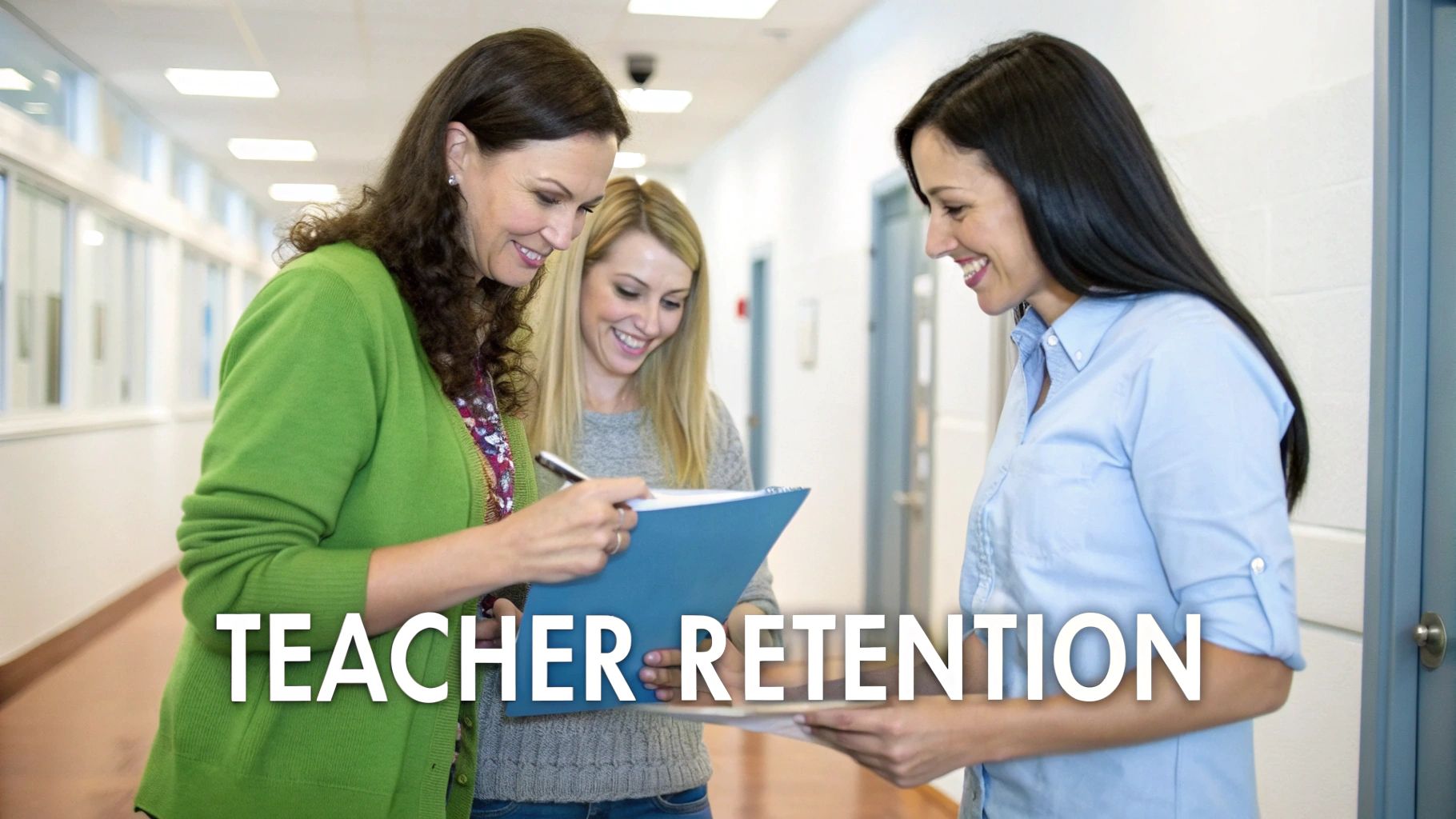
Let’s be honest: teacher attrition is one of the biggest threats to a private school’s stability, reputation, and bottom line.
Every time a great teacher walks out the door, a piece of your school’s institutional knowledge and community spirit goes with them. The costs to recruit, hire, and onboard a replacement are huge, but the damage to instructional continuity and parent confidence can be even greater.
The link between robust teacher professional development and a thriving, stable faculty isn’t just a theory—it’s a core business principle for successful private schools. Investing in your teachers' growth is the clearest signal you can send that they are valued professionals. It tells them they have a future at your school, not just a job.
This investment is more critical than ever. The worldwide teacher shortage is a major risk, and UNESCO data shows primary teacher attrition nearly doubled from 4.62% in 2015 to 9.06% in 2022. A lack of meaningful growth opportunities is consistently cited as a key reason teachers leave.
For private schools, where payroll can account for 60–70% of operating costs, stabilizing attrition isn't just a cultural goal; it's a vital financial lever. You can discover more insights about this global report on teachers to understand the full scope of the challenge.
Creating Clear Pathways for Growth
Top educators are ambitious. They want to see a path forward in their careers, and if they don't see one at your school, they’ll find one somewhere else. A culture of retention is built on showing teachers they can grow with you.
This means moving beyond a flat career structure. You can create meaningful leadership roles that don’t require leaving the classroom, such as:
- Mentor Teacher: A role with a stipend for experienced educators who guide new faculty.
- Instructional Lead: A department-level expert who pilots new curriculum or technology and trains their peers.
- Curriculum Fellow: A position focused on a year-long project to revise a specific subject area's scope and sequence.
These roles, supported by targeted professional development, give your best teachers a reason to stay and invest their talents right back into your community.
Building a Powerful Mentorship Program
A strong mentorship program is one of the most effective retention strategies you can have, especially for teachers in their first few years. New hires who feel supported and connected are far more likely to stick around long-term. In fact, comprehensive induction programs have been shown to increase teacher retention by up to 50%.
An effective program is more than just pairing a new teacher with a veteran. It needs structure, clear expectations, and dedicated time for mentors and mentees to meet, observe each other's classes, and co-plan. By investing in training your mentors, you equip them with real coaching skills, building a stronger, more collaborative faculty culture from the ground up.
A school's commitment to teacher professional development is the ultimate proof of its commitment to students. When you invest in the adult learners on your campus, you are directly investing in the quality of every child's education.
Celebrating Professional Learning Milestones
Finally, fostering a culture of growth means you have to celebrate it. When a teacher completes a graduate degree, presents at a conference, or earns a new certification, that success should be recognized publicly.
This doesn't have to be complicated. Simple, powerful gestures work best: a shout-out in the weekly parent newsletter, an announcement at a faculty meeting, or a small budget for teachers to share what they’ve learned with colleagues over lunch.
This public acknowledgment reinforces the value your school places on continuous learning and inspires others to pursue their own growth. By explicitly linking professional development to career opportunities and school culture, you create an environment where the best educators don't just want to work—they want to build a career.
Ready to build a TPD program that keeps your best teachers and strengthens your school? Book a call with JAG Consulting at https://link.jagconsultingservices.com/widget/bookings/prospective/school/consultation/zoom or visit our website to see how we help private schools thrive.
Measuring the True ROI of Your TPD Program
How do you prove your professional development program is actually worth the investment? In the world of private schools, where every dollar is scrutinized by the board and parents, showing a clear return on investment (ROI) isn't just good practice—it’s critical for survival.
The first step is moving beyond the simple "smile sheets." While it’s nice to know teachers enjoyed a workshop, feelings don't tell you if their teaching actually changed, if students learned more, or if the investment is paying off where it counts: your school's mission.
Real measurement connects the dots between the training you provide and the tangible results you see in the classroom. It’s about gathering the right evidence to tell a powerful story of impact to your key stakeholders.
A Framework for Meaningful Evaluation
To measure what truly matters, we need a structure that looks at different levels of impact. A practical model for private schools breaks down evaluation into a few key areas, moving from immediate reactions to long-term results.
This approach helps you answer the crucial questions: Did teachers learn it? Are they using it? Is it working for students? And is it helping our school thrive? By collecting data at each stage, you build an undeniable case for the value of your TPD program.
Let's look at the key levels of evaluation:
-
Teacher Reactions and Perceived Value: This is your baseline. Did teachers find the session relevant, engaging, and well-organized? This is where satisfaction surveys fit, but they need to be sharp enough to gather specific feedback, not just general feelings.
-
Acquisition of Knowledge and Skills: The next level up is measuring learning. Did teachers actually grasp the new concepts? This can be assessed through pre- and post-quizzes, skill demonstrations, or portfolio submissions.
-
Changes in Classroom Practice: This is where the rubber meets the road. Are teachers applying what they learned? Gathering this data means getting into classrooms through peer visits, instructional coaching cycles, or administrative walk-throughs focused on specific strategies.
-
Impact on Student Outcomes: The ultimate goal. Are we seeing measurable shifts in student achievement? This could be reflected in standardized test scores, internal benchmark assessments, student work samples, or even student engagement surveys.
-
Overall Organizational Impact: This is the highest level, connecting TPD to school-wide strategic goals. Key metrics here include teacher retention rates, parent satisfaction scores, and re-enrollment data. A strong TPD program that values faculty often leads to lower turnover, which has a significant financial and cultural ROI.
Connecting Goals to Measurement Tools
Here’s the secret: you have to decide how you’ll measure success before the professional development even begins. Your evaluation plan should be a direct mirror of your program goals.
The most powerful way to demonstrate ROI is to show a direct line from a professional development goal, to a change in teacher practice, to a corresponding improvement in student achievement. This narrative is undeniable for boards, parents, and accreditors.
For example, if your goal is to improve argumentative writing in the middle school, your measurement plan might look something like this:
| TPD Goal | Measurement Tool | Success Metric |
|---|---|---|
| Introduce a new writing rubric | Teacher survey & skill check | 90% of English teachers report high confidence in using the rubric. |
| Implement peer-editing strategies | Classroom observations | Evidence of peer-editing strategies used in 75% of observed lessons. |
| Improve student writing scores | Analysis of writing samples | 15% increase in the average score on the argumentative essay benchmark. |
This clear alignment makes it easy to collect the right data and report on your progress. It shifts the conversation from "We did some training" to "We invested in a writing initiative, and here are the specific results for our students."
Communicating Your Success
Gathering this data is only half the battle. The final, crucial step is sharing these powerful results with your board, investors, and parent community.
Create a simple, visually engaging one-page impact report at the end of a major TPD cycle. Use charts to show growth in student data. Include a quote from a teacher about how the training changed their practice. And don't forget to highlight the improved teacher retention numbers.
This proactive communication builds unstoppable momentum. It transforms teacher professional development from a perceived expense into a celebrated strategic investment that everyone can see is paying off.
Need help designing an evaluation plan that demonstrates real impact? Let's connect. Book a complimentary consultation call with JAG Consulting today at https://link.jagconsultingservices.com/widget/bookings/prospective/school/consultation/zoom or visit our website to learn how we help private schools build programs that deliver measurable results.
Your Top Questions About TPD, Answered
Even with the best strategy on paper, school leaders have real, practical questions about making a new professional development program work. Navigating the realities of budgets, schedules, and proving long-term impact is where great plans often fall apart.
Let’s tackle some of the most common—and toughest—questions we hear from private school leaders. These are the details that can make the difference between a TPD initiative that transforms your school and one that just becomes another binder on the shelf.
How Much Should We Really Budget for Teacher Development?
This is always the first question, and while there’s no magic number, here's a solid benchmark: high-performing schools typically invest between 1% and 3% of their total operating budget in professional development.
But honestly, the percentage is less important than how you allocate it.
Instead of creating one big, undefined TPD fund, think in terms of targeted initiatives tied directly to your goals. For example, your budget might be broken down into specific line items like:
- Stipends for a few in-house instructional coaches or mentor teachers.
- Funding for a small group of teachers to attend a specialized summer institute on project-based learning.
- Resources for department-level action research projects focused on closing a specific learning gap.
The goal is to link every dollar you spend directly to a problem you identified in your needs analysis. That’s how you make sure your investment is purposeful, not just a box to check.
How Do We Find the Time Without Burning Out Our Teachers?
Teacher time isn't just a resource; it's your most precious resource. Jamming TPD into an already-packed schedule is a surefire way to breed resentment and guarantee failure.
The most successful private schools don’t add TPD to the schedule; they build it into the schedule. They treat it like a core part of the job, not an afterthought.
Consider these proven strategies we’ve seen work time and again:
- Scheduled Early Release/Late Start Days: Carve out one or two afternoons a month specifically for collaborative TPD. Use this time for PLCs, data dives, or peer observations—not administrative updates.
- Reimagined Faculty Meetings: Stop using faculty meetings for announcements that could be an email. Turn them into active work sessions where teachers collaborate on real instructional challenges they’re facing in their classrooms.
- Strategic Use of Substitutes: Budget for substitutes to release small teams of teachers for things like peer observations or coaching cycles during the school day. This sends a powerful message that you value their learning enough to protect their time.
This approach respects teachers' time and weaves professional learning into the natural rhythm of the school year.
The most impactful teacher professional development isn't an event; it's an ongoing, job-embedded process. When schools build this process into their core operations, they create a culture where continuous improvement is not an extra task, but simply the way things are done.
We're Starting From Scratch. Where Do We Even Begin?
If you’re building a program from the ground up, the single most important piece of advice is to start small and focused. Don't try to solve every problem for every teacher in the first year.
First, go back to the needs analysis we outlined earlier. Crucially, involve your teachers in that process. Getting their input from day one is the best way to build early buy-in.
Then, pick one high-leverage area to tackle in your first year. Maybe your data points to a clear need for better support for neurodiverse learners. Or perhaps your teachers are asking for more effective ways to integrate technology.
Launch a single, well-supported pilot program around that one need. For example, you could start an instructional coaching program for just the middle school humanities department. Measure its impact carefully, gather feedback, and—most importantly—celebrate the small wins publicly.
This creates the positive momentum you need to build a strong case for expanding the program in the following years. A focused, successful pilot is far more powerful than a wide but shallow program that never gains traction.
Building a high-impact teacher professional development program is one of the most powerful strategic moves a private school can make. It’s not easy, requiring thoughtful planning, dedicated resources, and a real commitment to fostering a culture of growth.
The team at JAG Consulting specializes in helping private school leaders design, implement, and measure TPD programs that deliver tangible results. We work with you to align professional development with your school's unique mission and strategic goals.
Ready to see how a strategic TPD program can transform your school? Book a complimentary consultation call with JAG Consulting today or visit our website to learn more about how we support private schools worldwide.

I'm Dr. Jeannie Gudith, Founder and CEO of JAG Consulting. We help you develop, improve, buy or sell your private school.
I'm so glad you're here
Hello!


