

A Guide to Restorative Practices in Schools
Restorative practices are less a program and more a fundamental shift in how we build community and handle conflict in schools. It’s a framework built on repairing harm and strengthening relationships, moving away from a traditional focus on punishment. The goal is to shift discipline from a top-down system of rules and consequences to a collaborative process of accountability, empathy, and genuine understanding. It's both a proactive strategy for building a healthier school culture and a responsive one for when things go wrong. For private schools committed to holistic student development, this approach aligns seamlessly with missions centered on character and community.
Why Restorative Practices Are Shifting School Discipline
If you're a private school leader, you know the conversation around student discipline is a constant. For decades, we've relied on punitive models—detentions, suspensions, expulsions. But these often fail to get to the root of the behavior. In fact, research shows that suspension is one of the leading predictors of a student dropping out of school.
Worse, punitive methods can create a cycle of conflict, erode the trust between students and staff, and ultimately chip away at the very learning environment we work so hard to protect. This is where restorative practices offer a compelling, and frankly more effective, alternative for private schools.
This isn't just a passing trend. It's a different way of thinking about community and conflict. Instead of asking, "What rule was broken?" the restorative approach asks, "Who was harmed, and what needs to be done to make things right?" This simple pivot changes everything, moving the focus from punishment to true accountability and healing.
From Punishment to Repair
The core idea is to cultivate a strong, interconnected community where every student feels seen, heard, and valued. When a student's actions—whether it's bullying, plagiarism, or a simple classroom disruption—damage that community, the priority becomes repairing the harm done.
This process inherently builds crucial social-emotional skills like empathy, communication, and problem-solving. Students learn to grasp the real-world impact of their actions, take ownership, and become active participants in finding a solution. Frankly, it’s a far more educational experience than sitting alone in a detention hall.
The growing appeal of this model is hard to ignore. The use of restorative practices in American schools has seen dramatic growth. A national study revealed that 41.6% of schools were using restorative circles by 2018, a significant jump from 33.5% just two years earlier. This signals a major institutional shift. You can read the full research on this educational trend to see the data for yourself.
A Clearer Look at the Differences
To really grasp the power of this shift, it helps to see the two models side-by-side. The traditional approach is purely reactive, zeroing in on the infraction itself. The restorative approach is both proactive and responsive, focusing on the people involved and the relationships between them.
Here’s a table that breaks down the core differences in philosophy and practice.
Punitive vs Restorative Discipline: A Comparative Overview
| Focus Area | Traditional Punitive Approach | Restorative Practices Approach |
|---|---|---|
| Central Question | What rule was broken? | Who was harmed? |
| Primary Goal | Administer punishment, enforce rules. | Repair harm, restore relationships. |
| Accountability | Defined as taking the punishment. | Understanding impact and making amends. |
| Focus | On the rule-breaker and their misbehavior. | On the victim, community, and offender. |
| Process | Adversarial; school vs. student. | Collaborative; all parties work together. |
| Outcome | Exclusion, suspension, detention. | Reintegration, restitution, reconciliation. |
| Communication | One-way; adult-to-student directives. | Dialogue; structured circles and conferences. |
| Skill Building | Minimal; focuses on compliance. | Empathy, problem-solving, communication. |
Seeing it laid out like this makes the distinction clear. One is about managing behavior through consequences, while the other is about teaching behavior through community responsibility.
A restorative approach doesn't mean there are no consequences. Instead, the consequences are meaningful, logical, and focused on repairing the harm done. It’s about teaching students how to be accountable, not just punishing them for failing to be.
For private schools dedicated to developing well-rounded individuals, restorative practices align perfectly with missions centered on character, community, and ethical leadership. By fostering a culture of profound respect and genuine responsibility, schools can improve student well-being, elevate the academic environment, and strengthen their entire community.
Ready to explore how this powerful shift can strengthen your school? Book a call with JAG Consulting at https://link.jagconsultingservices.com/widget/bookings/prospective/school/consultation/zoom to discuss a strategy tailored for your institution, or visit our website.
Building Support for a Restorative Culture
Rolling out restorative practices isn't about sending a memo; it's about starting a cultural movement. This shift has to begin long before you hold your first restorative circle, and it starts with a united front from every corner of your school. A successful launch depends on smart, thoughtful communication tailored to your board, your faculty, and your parents—making sure everyone gets the "why" before you even get to the "how."
Without this deep-seated support, even the best-planned initiatives can stall out. Genuine buy-in means you have to speak directly to each group's unique priorities and anxieties, framing this change not as one more thing to do, but as a fundamentally better way to live out your school's mission.
Engaging Your Board of Directors
When you bring this to your board, the conversation needs to revolve around three things: mission alignment, risk management, and institutional reputation. Your board members are the guardians of the school's long-term health, so your pitch must speak to these high-level responsibilities.
First, connect restorative practices directly to your private school's mission statement. If your mission talks about character, community, or ethical leadership, this approach isn't just a nice idea—it's a direct, measurable way to bring those powerful words to life.
Next, explain how this shift reduces risk. Schools that truly embed restorative practices see dramatic drops in disciplinary issues. Research from the RAND Corporation found that implementing restorative practices led to a 19% reduction in total suspension days. This doesn’t just improve the school climate; it also lowers the risk of conflict and potential legal challenges. That’s a powerful argument for a board focused on protecting the institution.
Empowering Your Faculty
Your teachers are on the front lines, and their support is absolutely non-negotiable. It is critical to frame restorative practices in schools as a tool that empowers them, not another burden on their already overflowing plates.
Start by acknowledging their daily reality—managing tough classroom dynamics, dealing with disruptions, and the sheer amount of time that traditional discipline eats up. Position restorative methods as a more efficient and effective way to handle these challenges by getting to the root cause of conflict, which means fewer repeat behaviors down the line.
The goal is to move from a constant cycle of "putting out fires" to building a fire-resistant community. When teachers are equipped with restorative strategies, they spend less time managing behavior and more time teaching.
To make sure everyone has access to the best resources and can share what's working, it's a game-changer to create an internal knowledge base. This becomes a central hub for guides, scripts, and success stories, acting as an invaluable support system for your faculty as they build these new skills.
Communicating with Parents
Parents are your partners, but they're going to have questions. Their biggest concerns usually boil down to fairness and accountability. They need to know that misbehavior will be taken seriously and that their child will be safe. Your communication has to be proactive, clear, and confident.
Get ahead of their questions before they turn into concerns. Use newsletters, town halls, and parent-teacher conferences to explain the "what" and "why" of the new approach.
Here’s a simple way to frame it for them:
- Emphasize Stronger Accountability: Explain that restorative accountability is often more demanding than traditional punishment. It requires a student to actually face the people they’ve harmed, understand the impact of their actions, and take active steps to repair the damage.
- Focus on Skill-Building: Highlight that this approach teaches crucial life skills—empathy, problem-solving, and communication—that will serve their children long after they’ve graduated.
- Share Success Stories (with permission): Once you have some wins, share anonymized examples of how a restorative process resolved a conflict and actually made the community stronger. Real stories are far more powerful than abstract principles.
When you build this three-legged stool of support—with your board, faculty, and parents—you create a rock-solid foundation for a positive cultural transformation that will last.
Ready to build a united front for restorative practices at your school? Schedule a call with JAG Consulting at https://link.jagconsultingservices.com/widget/bookings/prospective/school/consultation/zoom to develop a communication strategy that resonates with your entire community, or visit our website to learn more.
Designing Your School's Restorative Framework
Moving from theory to practice is where the rubber meets the road. Designing a restorative framework isn’t about tacking on another program; it's about fundamentally changing how your school operates. You're weaving restorative principles into the very DNA of your daily life, from the classroom to the sports field.
One of the first and most powerful places to start is your student handbook and code of conduct. This document is a massive opportunity to shift the entire tone of your approach to behavior. You’re moving away from a long list of prohibited actions and punishments toward a guide for community expectations and how to make things right when those expectations aren’t met.
Recalibrating Your Code of Conduct
Transforming your code of conduct is a foundational move. The language you use signals what your school actually values. A punitive code focuses almost exclusively on what students cannot do. A restorative one, on the other hand, emphasizes how community members should treat one another.
Think about the difference in this language:
- Old approach: "Vandalism will result in a three-day suspension."
- Restorative approach: "Our community values respect for our shared spaces. If property is damaged, the person responsible will meet with those affected to understand the impact and create a plan to repair the harm. This may include restitution and service to the school."
This simple change reframes accountability as an active, participatory process. It’s not a passive consequence. This shift is critical. Schools that fully implement restorative practices often report significant drops in disciplinary referrals—some as high as 50%. By focusing on repair, you’re getting to the root of the issue, which makes future incidents far less likely.
Establishing a Tiered System of Support
A successful framework can't be a one-size-fits-all solution. You need a tiered structure that provides the right level of intervention for different situations, ensuring the response is always proportional to the harm.
Here’s what that looks like in practice:
- Tier 1: Proactive & Informal Practices. This is your foundation—the daily work. It includes things like community-building circles in classrooms, using restorative language in casual hallway interactions, and teaching basic conflict resolution skills to everyone. These are the small, consistent actions that build a strong, resilient culture.
- Tier 2: Responsive & Targeted Interventions. When minor conflicts pop up—a disagreement between friends, a classroom disruption—teachers can use informal restorative chats or small, impromptu circles. This empowers staff to handle issues quickly and effectively at the lowest possible level.
- Tier 3: Formal & Intensive Processes. For more serious incidents involving significant harm (think bullying, academic dishonesty, or physical altercations), a formal restorative conference is necessary. This is a structured meeting that brings together everyone affected to collectively decide on a path to repair.
The key to a functional tiered system is clarity. Your staff needs to know which tools to use and when. Your students need to understand the process. That consistency is what builds trust and predictability, making the whole system work.
Of course, rolling out a framework like this requires getting your key stakeholders—the board, faculty, and parents—on board. A smooth rollout is impossible without their support.
This graphic breaks down the essential flow for securing that buy-in.
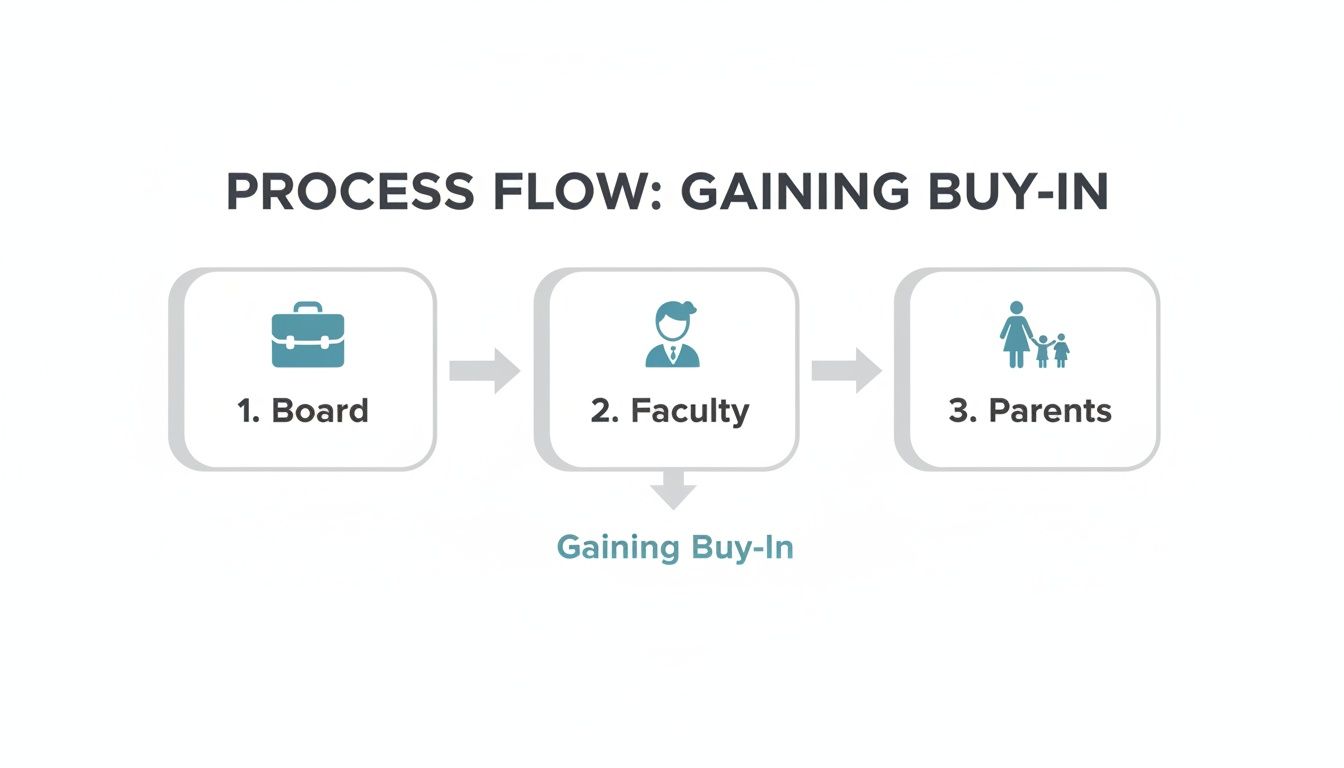
As you can see, a successful implementation requires a sequential and tailored approach. It starts with strategic alignment at the board level before you move to practical empowerment for faculty and transparent communication with parents.
Integrating with Existing Systems
Your new restorative framework must integrate smoothly with, not replace, your existing systems like student support services and safeguarding protocols. Think of it as a lens through which you view discipline, not an isolated department.
For instance, when a conflict erupts on the soccer team, the coach can use a restorative circle to address the issue. The goal isn't just to punish the players involved; it's to repair team trust so they can move forward productively.
Similarly, an academic integrity issue can be handled through a conference where the student truly understands the impact on their teacher and peers. This fosters a much deeper sense of academic honesty than a simple zero on an assignment ever could.
This integrated approach ensures that restorative practices become a shared responsibility, strengthening the entire school community.
Training Your Team for Real-World Success
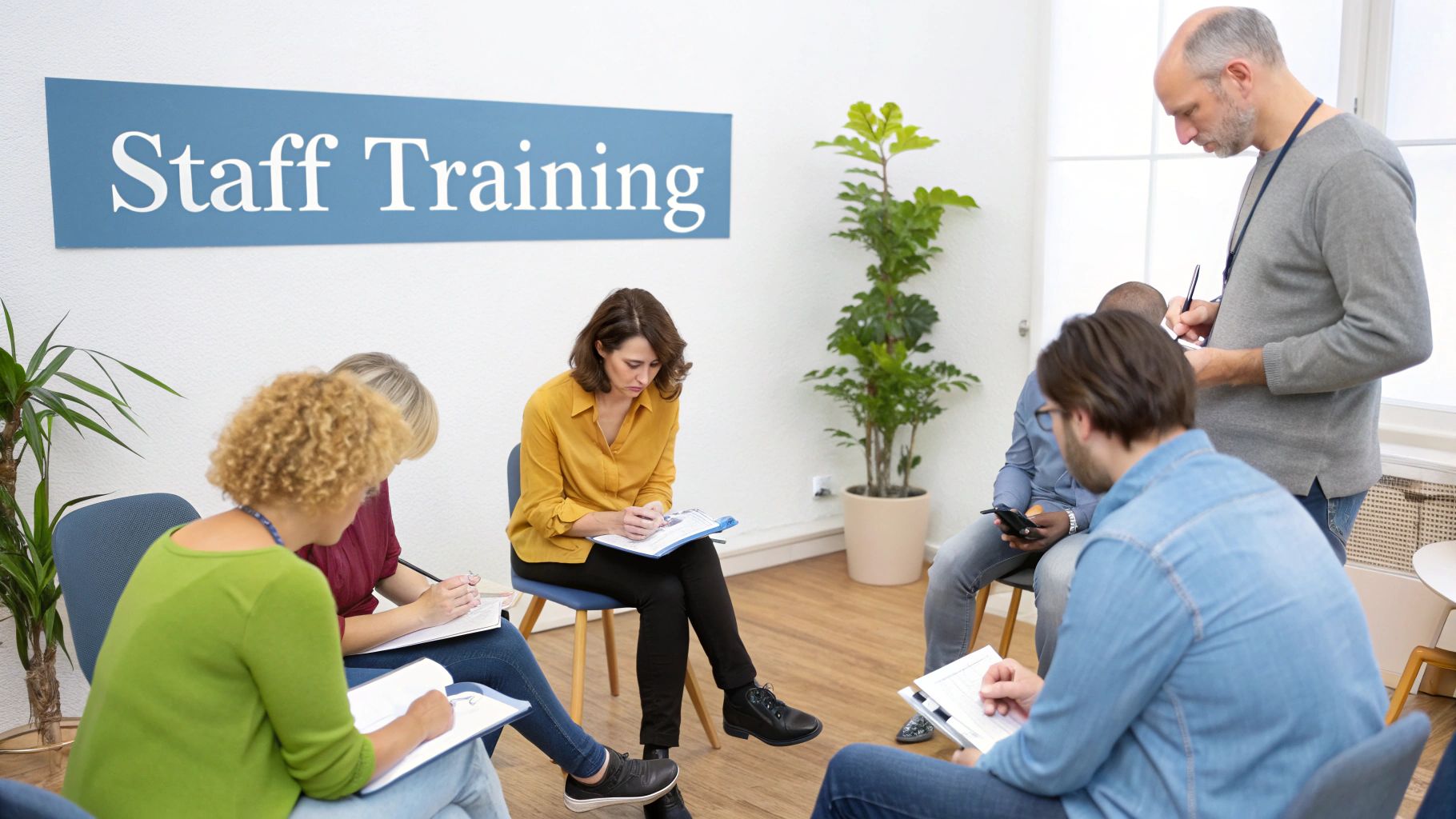
A perfectly designed framework is just a piece of paper without the people who bring it to life every single day. Your faculty and staff are the true engines of this cultural shift, making their confidence and competence non-negotiable.
Effective, ongoing professional development isn't just another line item in the budget. It's the single most important investment you can make in the success of your restorative practices initiative.
This training has to move beyond theory. It must give your team the practical, hands-on skills to facilitate restorative circles, ask questions that actually get students to reflect, and manage emotionally charged situations without panicking. Without that deep, real-world practice, the principles remain abstract concepts that will crumble at the first sign of genuine conflict.
Core Training Modules for All Staff
For this to work, everyone needs to be on the same page, using the same language. That means every adult in your community—from the Head of School to classroom teachers and support staff—needs foundational training. This creates a unified front and ensures students get a consistent restorative message, no matter who they're talking to.
The goal is building specific, actionable skills. Key modules should include:
- Facilitating Proactive Circles: This is the bedrock of community. Staff need to learn how to lead those daily or weekly check-in circles that build trust and empathy long before a problem arises.
- Using Restorative Language: This is all about shifting from punitive to restorative phrasing. Think moving from, "Why did you do that?" to the far more effective, "What happened, and who has been affected?"
- De-escalation and Affect Management: Your team needs the skills to stay calm and guide students through intense emotions, creating a safe container for honest dialogue.
- Running Responsive Circles and Conferences: This is the more intensive training for handling specific incidents of harm, guiding everyone involved toward meaningful repair.
Your training's success hinges on one thing: moving from passive listening to active practice. Role-playing real-world scenarios—a playground argument, a case of academic dishonesty, a social media blow-up—is essential for building the muscle memory and confidence your staff will need.
This kind of training has a profound impact. A two-year study of a major urban school district found that schools implementing restorative practices saw a 60% drop in days lost to suspension for willful defiance, demonstrating a significant improvement in school climate and student engagement.
Empowering Students as Active Participants
A truly restorative culture doesn't just happen to students; it happens with them. They can't just be passive recipients of this new approach. Training has to extend to the student body, giving them the language and skills to advocate for themselves and participate fully in resolving their own conflicts.
You can weave this directly into your curriculum or advisory programs.
- Conflict Resolution Skills: Teach students how to use "I-statements," active listening, and simple negotiation techniques so they can start resolving minor peer disputes on their own.
- Self-Advocacy: Equip students to articulate their feelings and needs respectfully. This is a crucial life skill that serves them in a restorative conference and far beyond.
- Peer Mediation Programs: For your older students, think about setting up a formal peer mediation program. This gives them incredible leadership opportunities and embeds restorative principles deep within the student culture itself.
When you teach students these skills, you're not just supporting the school's framework—you're equipping them for healthier relationships for the rest of their lives. The goal is to build a community where every single person has the tools to repair harm and strengthen connections.
Ready to build a comprehensive training plan that prepares your entire school community for success? Book a call with JAG Consulting today at https://link.jagconsultingservices.com/widget/bookings/prospective/school/consultation/zoom or visit our website to see how we help private schools implement effective, lasting change.
Measuring the Impact of Your New Approach
Bringing restorative practices into your school is a huge investment in your community’s culture. It’s an investment of time, training, and emotional energy. To justify that effort and keep getting better, you need to show that it’s actually working—with real numbers, not just feel-good stories.
Measuring the impact isn't just about ticking a box for the board. It’s about building a compelling case for this shift in culture to your board, your parents, and your faculty. When you can back up the "why" with hard data, you create unstoppable momentum.
Tracking Key Performance Indicators That Matter
The clearest way to show success is by tracking the numbers that directly reflect your school's climate and student behavior. Your board and parent community want to see concrete, quantitative proof that this new way of doing things is making a difference.
The goal is to paint a clear "before and after" picture. The metrics you choose should get right to the heart of what restorative practices are all about: reducing conflict and building a stronger community.
Some of the most powerful KPIs to keep an eye on include:
- Disciplinary Referrals: How many students are being sent out of class? A steady drop here is the number one sign that classrooms are becoming healthier, more functional spaces.
- Suspension and Expulsion Rates: Keep a close watch on both in-school and out-of-school suspensions. A big reduction shows you're getting better at resolving conflict and keeping students in the learning environment where they belong.
- Attendance and Truancy Rates: This one is often overlooked. Students who feel safer, seen, and connected to their school are simply more likely to show up every day. Better attendance can be a powerful ripple effect of a positive culture shift.
- Bullying and Harassment Reports: Track the number of formal reports. A decline is a great indicator that your proactive community-building efforts are paying off.
The Power of Quantitative Evidence
Hard numbers get people’s attention, especially school leaders and board members. While your school’s internal data is your most important tool, pulling in broader research can add some serious weight to your argument.
For example, incredible research from the University of Chicago Education Lab gave us powerful evidence of how restorative practices affect student behavior. They found that schools using restorative policies saw a staggering 35 percent reduction in in-school student arrests. And the impact didn't stop at the school gates—the study also documented a 15 percent reduction in out-of-school student arrests.
When you can present your school's own data—say, a 20% decrease in your disciplinary referrals—right alongside evidence like this, you build an undeniable case for the investment you've made.
Capturing the Qualitative Story
Numbers are crucial, but they never tell the full story. The real cultural change happening on your campus—the shift in how people feel, interact, and solve problems—is often best captured through qualitative data.
This is where you get the "why" behind the numbers. It's how you bring your success to life with personal stories and direct feedback, painting a much richer picture for everyone involved.
Methods for Gathering Qualitative Insights
- Climate Surveys: Send out anonymous surveys to students, staff, and parents each year. Ask specific questions about their feelings of safety, belonging, and trust. Comparing the results year-over-year is one of the best ways to measure shifts in perception.
- Focus Groups: Get small groups of students, teachers, or parents together for guided conversations. You'll be amazed at the nuanced insights you can uncover about what’s working and where you still have room to grow.
- Student and Staff Testimonials: Collect quotes and stories that show restorative practices in action (always with permission, of course). Sometimes, a single, powerful story about a resolved conflict can be more persuasive than a full page of statistics.
When you blend hard data with compelling human stories, you create a powerful feedback loop. You’re not just proving the value of restorative practices in schools—you're getting the insights you need to make your program even better next year.
Ready to design a measurement strategy that proves the impact of your restorative approach? Book a call with JAG Consulting at https://link.jagconsultingservices.com/widget/bookings/prospective/school/consultation/zoom to explore how we can help you track the right data, or visit our website to learn more about our services.
Ready to Build Your Restorative Community?
Making restorative practices a reality in your school is a journey, not a quick fix. We’ve walked through the path to building a stronger, more connected community—one that improves student well-being and reduces behavioral risks. Now, it's about taking that first step to put these powerful principles into practice.
This kind of change takes real commitment, but the payoff is immense. We're talking about healthier relationships, a genuinely positive school culture, and a significant drop in disciplinary issues. Schools that truly embrace restorative practices see students learn profound, lifelong lessons in empathy and accountability. It’s a shift that gets to the very core of developing the whole child.
As you think about your own school's journey, you might find this comprehensive guide to restorative practices in schools to be a great resource. It offers some fantastic perspectives that can help flesh out your planning.
The most impactful changes always start with a single, dedicated conversation. The key to success is understanding how these strategies fit your school’s unique culture, not forcing a one-size-fits-all model.
Ready to explore how these strategies can be adapted to your private school's specific needs and challenges? Book a complimentary 1:1 consultation with JAG Consulting at https://link.jagconsultingservices.com/widget/bookings/prospective/school/consultation/zoom to start the conversation, or head over to our website for more resources and real-world case studies.
Frequently Asked Questions
When we sit down with leadership teams at private schools, some excellent, practical questions always come up. Moving toward a restorative model is a significant cultural shift, and it’s smart to get these concerns out on the table right away.
Here are a few of the most common things we hear, along with our straight-up answers.
How Do Restorative Practices Actually Hold Students Accountable?
This is the big one. And the answer is that accountability is the absolute core of this approach—it just looks different from traditional punishment.
Instead of passive punishment (like a suspension), restorative accountability is an active responsibility. A student has to face the people they’ve harmed, listen to the impact of their actions, and then help create the plan to repair the damage.
Honestly, this is often far more challenging for a student than just sitting at home for three days. It forces them to develop empathy, reflect on their choices, and take concrete steps to make things right.
Isn't This Going to Take Up Way Too Much Instructional Time?
It’s a fair question. There’s an upfront time investment in training and getting the systems in place. No doubt about it.
But what most schools find is that restorative practices in schools actually save huge amounts of instructional time in the long run. Think about how many hours are currently lost to endless investigations, phone calls home, and dealing with the same conflicts over and over because the root cause was never addressed.
By proactively building community with things like brief, daily circles, you dramatically cut down on future disruptions. You’re not just putting out fires; you’re making the whole environment less flammable, preserving that focused learning time for everyone.
Is This Approach Really Suitable for All Age Groups?
Absolutely. The beauty of restorative practices is how adaptable they are, from the early years right through to graduation.
- In your early years program, it might be as simple as a "peace circle" to work through a conflict over a shared toy. The teacher guides them through using "I feel" statements to understand each other.
- In middle and high school, the conversations naturally become more complex. We’ve seen them used to effectively address everything from cyberbullying and academic dishonesty to conflicts on sports teams.
The core principles—repairing harm and valuing relationships—are universal. You’re just tailoring the application to be developmentally appropriate for the students in the room.
How Does This Work With a Diverse Student Body?
This is where a restorative approach truly shines. For many students, the core ideas of community, respect, and reconciliation are far more culturally resonant than traditional, top-down punitive models.
One study found that restorative practices were particularly effective for students from historically marginalized groups, helping to build a more equitable school culture. In fact, research indicates that while restorative practices benefit all students, the positive effects on behavior and mental health are significantly stronger for Black and Latino/a students.
The key is to implement these practices with cultural humility, paying attention to different communication styles and values. When you do it thoughtfully, this becomes a powerful tool for building a genuinely inclusive community where every student feels seen and heard.
Ready to talk through your school's specific questions and map out a strategy that fits your unique culture? The team at JAG Consulting has decades of experience helping private schools thrive.
Book a complimentary consultation call today or visit our website to learn more.

I'm Dr. Jeannie Gudith, Founder and CEO of JAG Consulting. We help you develop, improve, buy or sell your private school.
I'm so glad you're here
Hello!


