


Small Group Instruction: A Strategic Guide for Private Schools
Small group instruction is so much more than a teaching method—it's one of the most powerful strategic tools a private school can have in its arsenal. This approach fundamentally shifts learning from a standardized, whole-class model to a responsive, personalized experience that meets students exactly where they are.
For private schools, this isn't just good pedagogy. It's a powerful differentiator that speaks directly to families looking for superior educational outcomes for their children.
The Strategic Advantage of Small Group Instruction
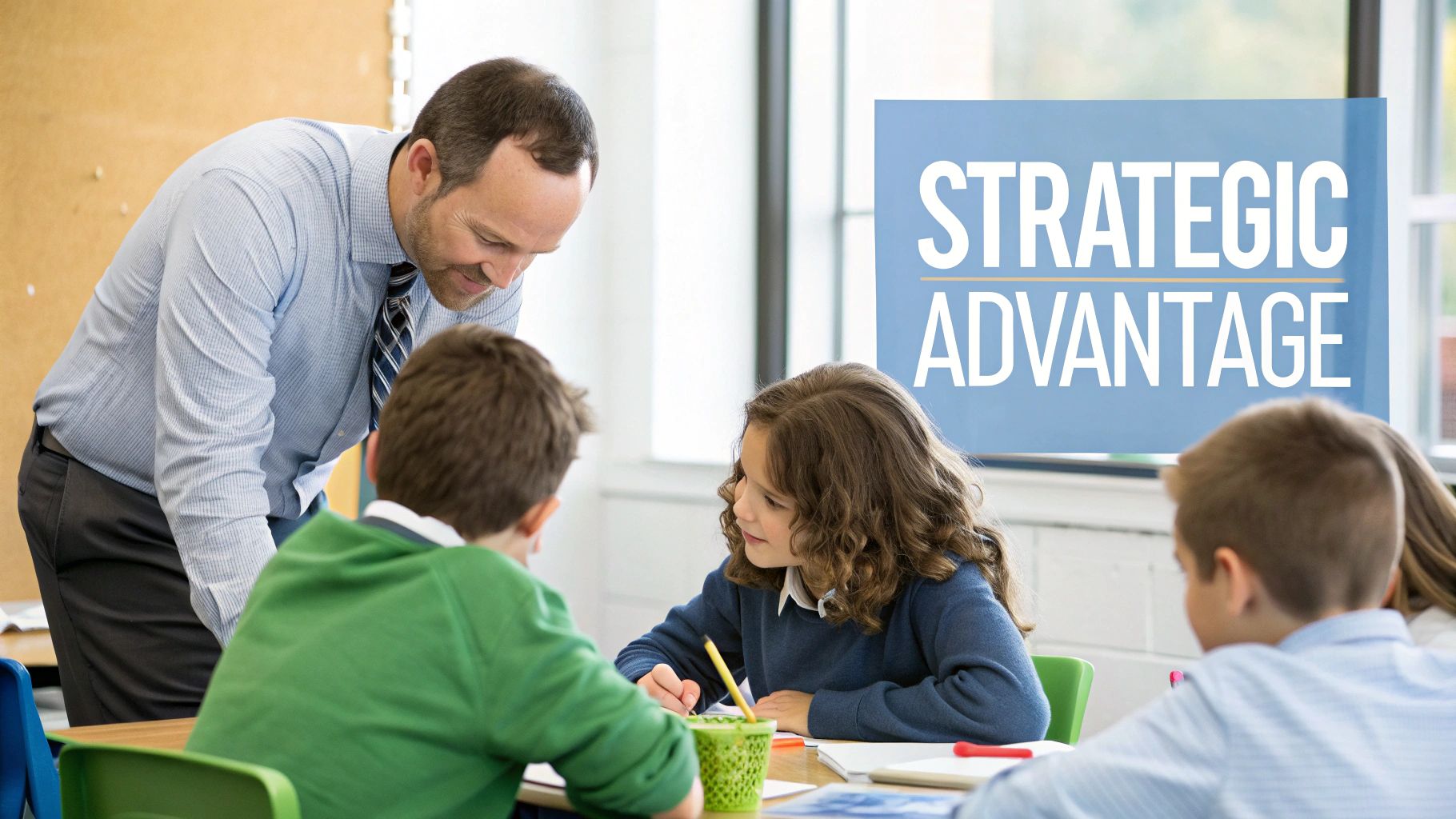
In the competitive private school landscape, proving you can deliver superior academic results is everything. It's how you attract and retain families. Small group instruction becomes a cornerstone of that value proposition, moving your school beyond the inherent limitations of a one-size-fits-all classroom. It empowers your teachers to give targeted support where it's needed, challenge your advanced learners, and create a classroom buzzing with interaction.
The model is incredibly effective because it lets educators pinpoint and address specific learning gaps before they become real problems. It’s the perfect setting for immediate, personalized feedback, which is absolutely crucial for building a student's confidence and helping them achieve mastery.
By incorporating proven active learning strategies, you shift students from being passive listeners to active participants in their own education. That shift fosters a much deeper level of understanding and engagement—a key selling point for discerning parents.
Closing the Achievement Gap
The data backing this up is compelling. Study after study shows that when students get focused attention in smaller settings, their learning accelerates. We’re not talking about marginal improvements; the effects on closing achievement gaps can be significant.
A comprehensive meta-analysis found that small-group teaching with 5 or fewer pupils per teacher led to effect sizes that translated to closing about 21% of the achievement gap for second graders and 14% for eighth graders.
This isn't just an alternative teaching style—it's a research-backed strategy that drives measurable academic progress.
A Differentiator for Private Schools
For private schools, building a robust small group framework offers a distinct market advantage. It sends a clear message to prospective families that you are deeply committed to individualized student success. This approach directly strengthens your school in several key areas:
- Enhanced Academic Reputation: When you can point to demonstrable gains in core subjects like reading and math, you build a rock-solid reputation for academic excellence.
- Improved Enrollment and Retention: Parents are actively looking for schools that cater to their child's unique learning profile. This becomes a powerful enrollment driver and keeps families coming back year after year.
- Stronger Accreditation Profiles: A well-documented small group program showcases your commitment to evidence-based practices and student-centered learning, which is exactly what accreditation bodies want to see.
Ultimately, adopting small group instruction is a strategic decision that aligns pedagogical best practices with the long-term health of your school. It delivers the personalized learning environment that modern families expect and the academic results that secure your school’s future.
Ready to see how a tailored small group instruction model can elevate your private school's academic program and market position? Book a complimentary consultation with JAG Consulting or visit our website to learn more.
Building Your School's Small Group Framework
Shifting to a genuine small group instruction model takes more than just good intentions. It demands a solid, strategic blueprint, and that blueprint has to start with a deep understanding of your students. Before you can even think about grouping them, you need to dig into the rich data your school already collects.
This isn't about guesswork. It’s about methodically analyzing diagnostic, formative, and summative assessments. What patterns are jumping out? Are there common sticking points in a specific math concept? Are a handful of students wrestling with the same phonics rules? This data-first approach transforms grouping from a shot in the dark to a precise strategy that hits exactly what your learners need, right when they need it.
Choosing Your Grouping Models
Once you have a clear picture of student needs, it’s time to choose the right tools for the job—your grouping models. There’s a common myth that small group instruction always means grouping by ability level. The reality is far more dynamic. The most effective private school frameworks use several models, with teachers fluidly switching between them based on the lesson's goal and how students are progressing.
There’s no research that crowns one specific model as the winner, which means flexibility is your greatest asset. In fact, some studies show that while a small group might learn more in a single 30-minute lesson, the time it takes to teach three 20-minute groups can completely wipe out any overall learning advantage compared to one 60-minute whole-class lesson. This makes choosing the right model for the right purpose absolutely critical for maximizing instructional time in your private school.
The most effective small group frameworks don’t lock teachers into one method. They empower teachers to be strategic, using data to decide when a uniform group is best for targeted skill practice and when a mixed-ability group will ignite richer discussion and peer learning.
For private schools built on a promise of academic excellence, this kind of adaptability isn't just a nice-to-have; it's everything. Your framework needs to be a living system, not a rigid set of rules.
Practical Grouping Scenarios for Private Schools
Let's get practical and look at how different models play out in a real private school setting. Each one serves a unique purpose, and knowing when to use each is where the art of teaching really shines.
Ability-Based Groups (Homogeneous)
This is the classic model, where students with similar skill levels work together.
- When to Use It: It’s perfect for targeted reteaching or enrichment. Think of a teacher pulling a small group of third graders who just aren’t getting multi-digit subtraction, or gathering advanced readers to tackle a more complex text together.
- Private School Context: This model is how you deliver on the promise of individualized attention. It provides hyper-focused support to ensure every single student masters core concepts before the class moves on.
Mixed-Ability Groups (Heterogeneous)
Here, you intentionally bring together students with a diverse range of skill levels.
- When to Use It: This is your go-to for project-based learning, literature circles, or collaborative science experiments. This structure naturally fosters peer mentoring, where advanced students solidify their own understanding by explaining concepts to their peers.
- Private School Context: This approach cultivates a true collaborative community, building the leadership and communication skills that families deeply value.
Interest-Driven and Project-Based Pods
These groups are exactly what they sound like—formed around a shared passion or a common project goal.
- When to Use It: Fantastic for sparking engagement in subjects like history or social studies. One group might dive deep into ancient Egypt while another becomes the resident expert on the Roman Empire, giving students a real sense of ownership over their learning.
- Private School Context: This is how you ignite student passion and autonomy. It showcases a curriculum that is both rigorous and wonderfully responsive to what genuinely fascinates your students.
The ultimate goal is to build a flexible system that aligns with your private school’s unique mission. By using data to create dynamic, purposeful groups, you’re laying the foundation for a truly responsive learning environment where every child can thrive.
Crafting a framework that fits your school's specific DNA can feel complex. To ensure your small group instruction model is built for maximum impact from day one, Book a complimentary call with JAG Consulting or visit our website to learn how we can help.
Mastering the Logistics of Rotations and Classroom Flow
A brilliant small-group strategy on paper is worthless without flawless on-the-ground execution. What turns a good plan into a great learning environment are the seamless logistics—the carefully choreographed rotations, the intuitive classroom layout, and the routines that become second nature to students.
Without this operational backbone, even the best-differentiated lessons get derailed by chaotic transitions and disengaged kids.
For private schools, mastering this classroom flow is a powerful and visible demonstration of your commitment to an orderly, purposeful, and student-centered atmosphere. It’s the practical magic that makes small-group learning not just possible, but incredibly effective.
This simple framework illustrates the core cycle: start with data, use it to form strategic groups, and then build your instructional plan around those specific needs.
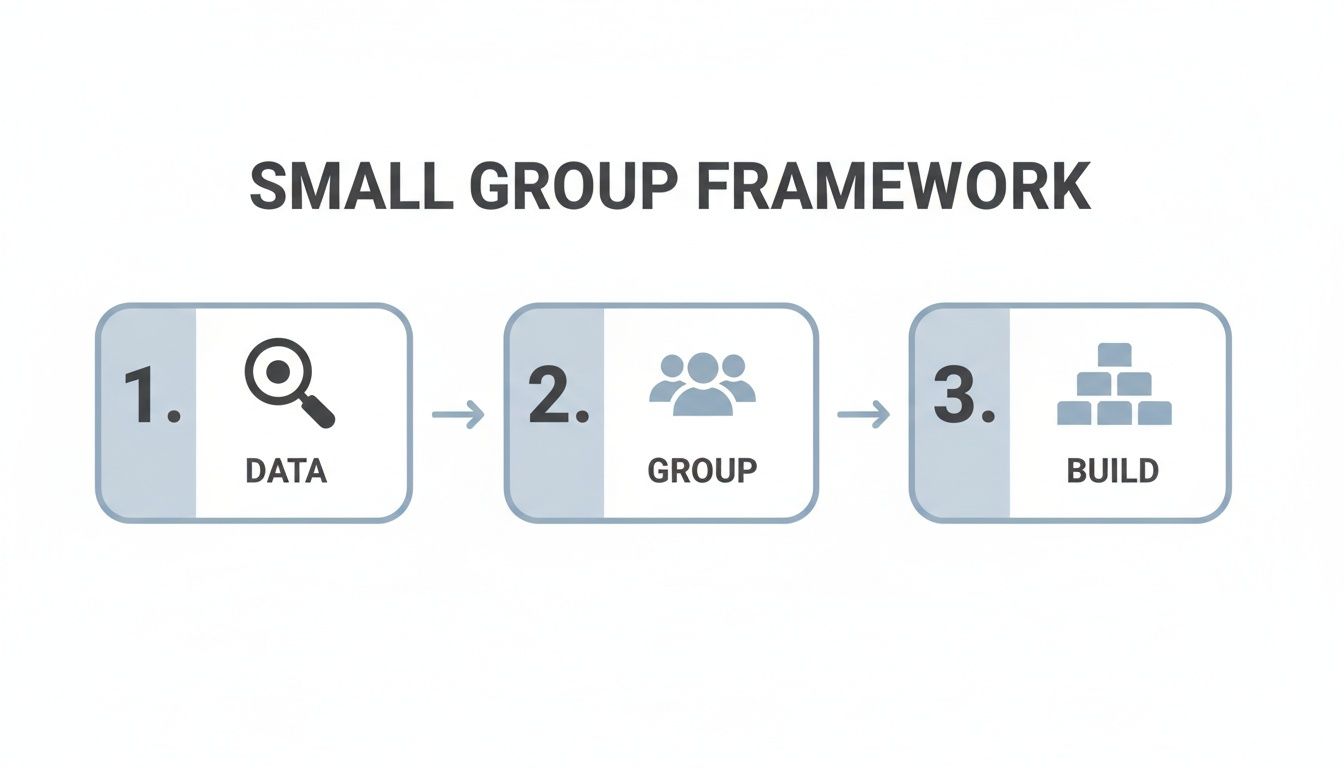
This just reinforces that successful small-group instruction is a living, data-driven process, not a one-and-done setup.
Crafting Efficient Rotation Schedules
The heart of a smooth small-group system is the schedule. It dictates the rhythm of the classroom, making sure every student gets the right mix of teacher-led instruction, collaborative work, and independent practice. The key is finding a model that fits your students' age, the subject matter, and your specific instructional goals.
You don't have to reinvent the wheel. Popular frameworks like the Daily 5 for literacy or various math workshop models provide excellent, road-tested starting points. These structures are built around the idea of short, focused rotations that keep students engaged and minimize downtime.
A study found that while a small group might learn more in a 30-minute lesson, the time it takes to teach three 20-minute groups can eliminate any overall learning advantage compared to a single 60-minute whole-class lesson. This makes an efficient, non-negotiable schedule absolutely critical.
Let’s look at how this might play out across different grade levels in a private school setting.
- Lower Elementary (Grades 1-2): For a 60-minute reading block, you could run three 20-minute rotations. One group works directly with the teacher on phonics, another practices sight words with a partner, and the third engages with educational apps on tablets. The rotations are quick and snappy to match shorter attention spans.
- Upper Elementary (Grades 4-5): In a 75-minute math block, you might use four rotations. The teacher leads a group on multi-step word problems, a second group completes independent practice, a third works on a collaborative problem-solving game, and a fourth focuses on fact fluency drills online.
The goal is to create a predictable yet flexible routine that becomes muscle memory for students.
Optimizing Your Classroom Layout
The physical environment of your classroom can either support or sabotage your small-group efforts. An optimized layout reduces friction during transitions and empowers students to find what they need without constantly interrupting the teacher. Think of your classroom as a well-designed workspace.
Start by creating distinct zones for different activities. A kidney-shaped table is a classic for a reason—it’s ideal for teacher-led instruction. Clusters of desks or a designated rug area work perfectly for collaborative tasks, and you’ll want to ensure there are quiet corners for independent reading or work.
Classroom Logistics Checklist
- Designated Zones: Are there clearly defined areas for teacher-led groups, partner work, and independent stations?
- Accessible Materials: Are materials for each station stored in labeled, color-coded bins that students can easily access and put away themselves?
- Clear Pathways: Can students move between stations without bumping into each other or disrupting other groups?
- Visual Aids: Are anchor charts with instructions and expectations for each station prominently displayed?
That last point is crucial. Anchor charts are visual guides that remind students of the task, the process, and behavioral expectations for each rotation. They are your silent co-teacher, building independence and minimizing the need to repeat instructions over and over. An anchor chart for an independent reading station might simply say, "Read the whole time," "Stay in one spot," and "Read quietly."
This level of organization does more than just keep the classroom tidy. It builds student autonomy and maximizes every single precious instructional minute.
Ready to design an operational framework that makes small-group instruction a success in your private school? The experts at JAG Consulting can help you master the logistics. Book a complimentary call today or visit our website to learn more about our services for private schools.
Designing Lessons That Truly Differentiate
Getting your groups and rotations humming is a huge step, but the real magic of small-group instruction happens inside the lessons themselves. This is where we move past the logistics and start crafting learning experiences that are genuinely differentiated, making sure every student gets the exact level of challenge and support they need. For private schools, this is the ultimate fulfillment of the promise made to every family.
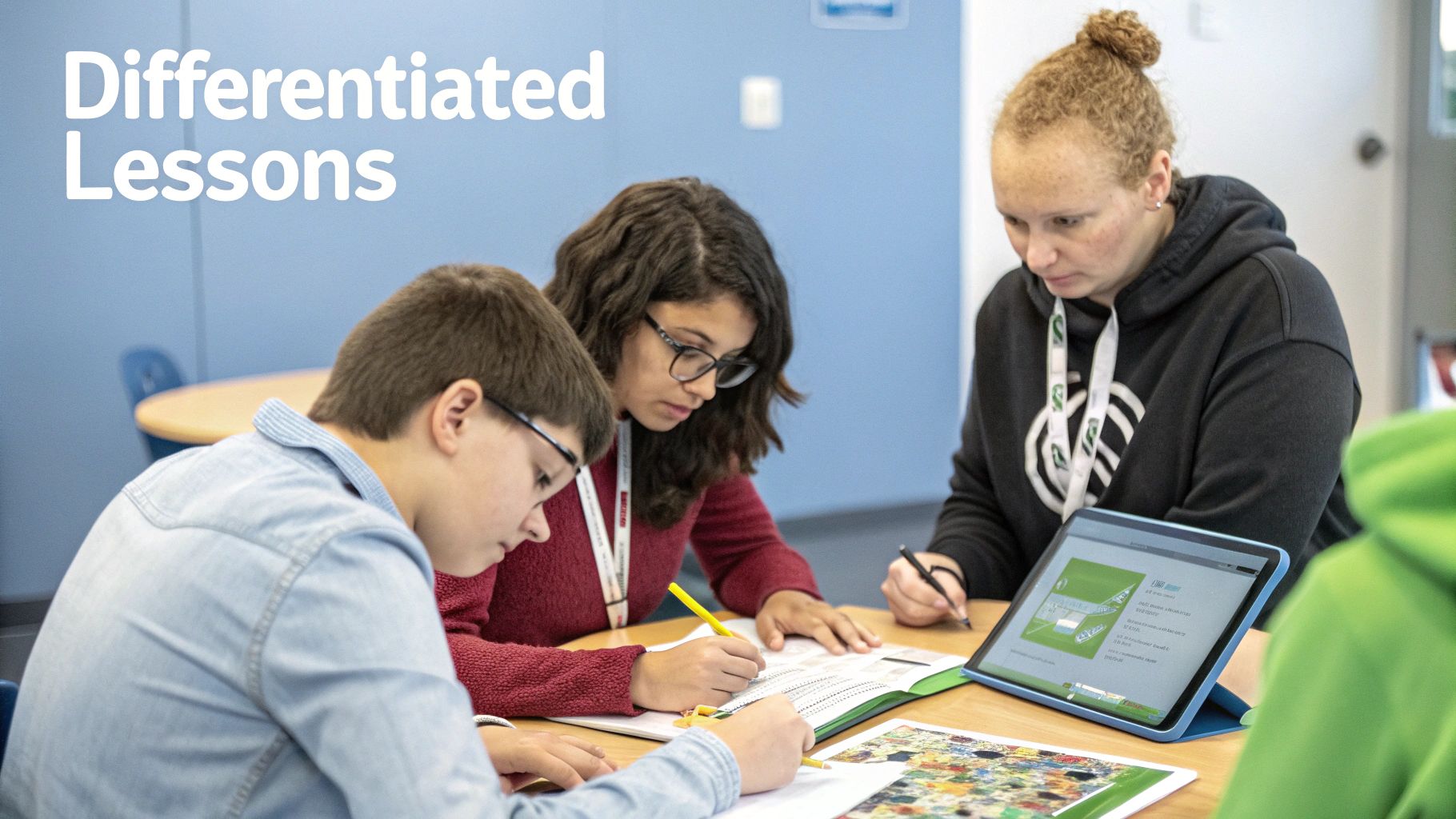
This isn't just about handing out an easier worksheet to a student who's struggling. True differentiation is a much more thoughtful process. It means modifying the content (what students learn), the process (how they learn it), and the product (how they show what they've learned) to help everyone achieve the same clear learning objective.
Modifying Content, Process, and Product
Let's walk through a real-world example from a private school classroom. Imagine a fifth-grade history objective: Students will be able to analyze the primary causes of the American Revolution. In a traditional classroom, this might mean everyone reads the same textbook chapter and answers the same 10 questions. With small groups, that single objective can come to life in a dozen different ways.
Content Modification: One group might be ready to tackle a grade-level primary source, like a letter from John Adams. For another group needing more support, you could provide the same letter but with annotations and vocabulary definitions. Your most advanced group? They might get two different primary sources with conflicting perspectives to compare and contrast.
Process Modification: The way students grapple with the material can change, too. A group of kinesthetic learners might map out cause-and-effect relationships on a giant whiteboard. At another table, a group that thrives on discussion could dive into a Socratic seminar, with you guiding them with probing questions.
Product Modification: Finally, you can offer flexibility in how students prove what they know. Forget the standard essay for everyone. Give them a choice. One student might write a paragraph, another could design a detailed timeline with explanations, and a third might even script a short dialogue between a Loyalist and a Patriot. Each of these products can absolutely demonstrate mastery of the core objective.
The beauty of this approach is that every student is working toward the same high standard, but the path they take is shaped to fit their unique learning profile.
The Power of Formative Assessment
So, how do you know which modifications to make for which students? The secret is a constant, low-stakes feedback loop driven by formative assessment. These aren’t high-pressure tests. They are quick, in-the-moment checks for understanding that give you the data you need to adjust your instruction on the fly.
The core principle is simple: use real-time student data to make real-time instructional decisions. This responsive teaching is what makes small groups so much more effective than a static, one-size-fits-all lesson plan.
This continuous feedback turns teaching from a monologue into an ongoing dialogue with your students' learning.
Essential Formative Assessment Techniques
Anecdotal Notes: As you circulate or lead a group, keep a clipboard or tablet handy. You're not writing a novel, just jotting down specific observations: "James successfully used the 'box method' for multiplication," or "Maria is still confusing 'their' and 'there' in her writing." These quick notes are gold when you sit down to plan the next day's groups.
Exit Tickets: This is a classic for a reason. At the end of a lesson, ask students to answer one or two quick questions on a slip of paper. Things like, "What are two things you learned about fractions today?" or "What was the most confusing part of our science experiment?" A quick scan gives you an immediate snapshot of where the class is.
Student Self-Reflection: Get students in the habit of thinking about their own learning. Simple things like a thumbs-up/thumbs-down check for understanding or having them rate their confidence on a scale of 1-3 can provide surprisingly accurate data. Integrating lessons on science-backed methods for efficient exam studying within small groups can also empower students to take more ownership of their preparation.
The data backs this up, especially in complex subjects. Meta-analytic reviews in STEM fields have found that collaborative, small-group learning has an average effect size of 0.47 compared to traditional lectures. That's a huge impact—it's enough to raise a student's score from the 50th to the 69th percentile.
When you combine thoughtfully differentiated lessons with constant formative assessment, you create a classroom where instruction is always targeted, purposeful, and profoundly effective.
Empowering Your Teachers for Small Group Success
Let's be honest. Your private school's biggest asset in making small group instruction work isn't the shiny new curriculum or a perfectly color-coded schedule. It’s your teachers.
Their ability to shift from being the "sage on the stage" to a dynamic, responsive guide is what makes this entire framework come alive. But that evolution doesn't just happen. It requires a real investment in professional development and a culture of constant, collaborative support.
Without empowering your faculty with the right skills and mindset, even the most carefully designed small-group system will fall flat. For private schools, investing in your teachers' growth here is a direct investment in the exceptional outcomes you promise your families.
The Evolving Role of the Teacher
In a small-group model, the teacher's job changes dramatically. They're no longer just broadcasting content from the front of the room. Instead, they become part coach, part diagnostician, part conductor of a complex, multi-layered learning environment.
This pivot demands a whole new set of skills. Teachers have to get comfortable managing multiple activities at once, using real-time data from a quick exit ticket to adjust instruction on the fly, and skillfully guiding student discussions to deepen critical thinking.
The research is clear on this: when teachers just replicate their whole-group methods in a smaller setting, the effectiveness plummets. The real magic happens when they learn how to truly capitalize on the intimacy and flexibility of the small group.
A Professional Development Roadmap
A one-and-done workshop isn't going to cut it. To build these crucial skills, private schools need to create a sustained professional development plan that addresses the specific, practical challenges of small-group teaching.
A practical plan could look something like this:
- Workshops on Real-World Differentiation: Go beyond the theory. Host sessions where teachers actually work together to redesign their existing lesson plans for a small-group format, focusing on modifying content, process, and product.
- Classroom Management for Rotations: This needs dedicated training. Cover the nuts and bolts of setting up and managing learning stations—from creating clear anchor charts and establishing routines to teaching students how to work independently and transition without chaos.
- Data-Informed Instruction: Run sessions that show faculty how to actually use tools like anecdotal notes and quick checks for understanding to form flexible groups and make immediate instructional pivots.
Teachers need more than theory; they need practical, actionable strategies. Effective professional learning should equip them not only with the 'why' behind small group instruction but also the 'how' for making it work in their unique classroom context.
This kind of focused training is non-negotiable. Reports from the What Works Clearinghouse confirm that programs using small-group literacy instruction have a positive impact on reading achievement—but that success is entirely dependent on high-quality implementation by well-prepared educators.
Fostering a Collaborative Culture
Maybe the most powerful form of professional development isn't a workshop at all. It's the ongoing, peer-to-peer collaboration that happens in the trenches. Creating structures that let teachers learn from each other is how you build collective confidence and refine your practice.
You can build this collaborative culture with a few key initiatives:
- Peer Observation Cycles: Set up a system for teachers to observe one another's small group sessions. The key is to follow it up with a structured, non-evaluative debrief where they can share what they saw and ask questions. It’s an incredible way to see different strategies in action.
- Shared Planning Time: This is critical. Carve out dedicated time in the schedule for grade-level or department teams to plan their small-group lessons together. This becomes the perfect forum for troubleshooting challenges, sharing resources, and celebrating what's working.
- Video Coaching: Encourage teachers to record short segments of their small-group instruction. They can review it with an instructional coach or a trusted colleague to reflect on their practice and pinpoint specific areas for growth. It feels vulnerable at first, but it's one of the fastest ways to improve.
By investing in both formal training and a strong collaborative culture, you empower your teachers to become true masters of small-group instruction. This commitment ensures the model is not just a scheduling change, but a profound and lasting improvement in how teaching and learning happen at your school.
Ready to build a professional development plan that empowers your faculty for success? Book a call with JAG Consulting or visit our website to see how we help private schools create thriving educational environments.
Measuring the Impact of Your Program
Rolling out a small-group instruction framework is a massive commitment for any private school. It takes time, resources, and a ton of faculty energy. To keep it going and maintain support from your board and community, you have to prove it's working. Measuring the impact isn't just about accountability—it’s how you refine your approach and tell a powerful story of student growth.
For private schools, this is non-negotiable. You have to connect these outcomes directly to your strategic goals. The data you collect becomes the undeniable proof that this shift is strengthening your academic reputation, boosting enrollment, and keeping families at your school. It changes the conversation from "we think this is helping" to "we know this is helping, and here's how."
Defining What Success Looks Like
To measure impact well, you need a healthy mix of numbers and stories—quantitative and qualitative data. Leaning only on standardized test scores gives you a flat, incomplete picture. A holistic view combines the hard data with the real-world experiences of your teachers, students, and parents.
Your Key Performance Indicators (KPIs) should connect directly to the goals you set from day one. Think about tracking a variety of metrics:
- Standardized Test Score Growth: Don't just look at scores; track cohort growth year-over-year. You're looking for accelerated progress, especially for students who were previously falling behind.
- Internal Benchmark Assessments: Keep a close eye on progress with your own curriculum-aligned assessments, like quarterly math tests or reading fluency checks. This gives you much faster feedback on whether the instruction is hitting the mark.
- Student Engagement Metrics: This is about observation. Are you seeing changes in classroom participation? Is on-task behavior improving during independent work? Are more assignments being completed on time?
These numbers give you the "what"—the concrete results of your small-group model.
The Power of Qualitative Feedback
While the numbers are crucial, they don’t tell the whole story. The "why" and "how" behind your program's success often come from what people are saying and feeling. This is where you uncover those critical shifts in attitude, confidence, and classroom culture that are just as important as any test score.
You have to be systematic about gathering this feedback. Consider putting a few simple systems in place:
- Teacher Surveys and Focus Groups: Regularly create space to ask teachers what’s working, what’s frustrating, and what support they need. Their frontline insights are gold for making real-time adjustments.
- Student Self-Reflections: Use simple tools like exit tickets or quick digital polls. Asking a question like, "When did you feel most confident in math this week?" can reveal more than a dozen test scores combined.
- Parent Questionnaires: Get a read on how parents perceive their child's progress and engagement. Positive feedback from families is an incredibly powerful endorsement for your school's board and for prospective parents.
When you weave the hard data together with these qualitative insights, you create a complete narrative. You’re not just showing academic gains; you’re demonstrating a more engaged, confident, and supportive learning community. That's the story that truly proves the value of your investment.
The long-term impact here can be profound. A large-scale experiment in Norway found that small-group math instruction boosted test scores by about 6% of a standard deviation. What’s really remarkable is that 3.5 years later, roughly 60% of that initial effect was still there across all achievement levels. This defies the typical "fade-out" effect seen in so many other interventions.
By diligently measuring both the numbers and the narratives, your private school can confidently show the immense value of small-group instruction, cementing its place as a cornerstone of your academic strategy.
So, where do you go from here?
You've seen the research and you understand the powerful impact small-group instruction can have on a private school. It's a significant shift, no doubt, but the rewards—for your students, your teachers, and your school's reputation—are immense. This is about moving from a powerful vision on paper to a tangible reality in your classrooms.
When you invest in this kind of proven, responsive teaching, you're embracing a more dynamic and effective learning environment. The data is compelling: research shows that well-implemented small group models can close achievement gaps by as much as 21% in the early grades. That’s the kind of measurable impact that resonates with families looking for the absolute best for their children.
But you don't have to navigate this journey alone. A well-executed plan is the difference between simply trying something new and truly transforming your school. Let our team help you build a framework that fits your unique community, maximizing the benefits while sidestepping the common pitfalls. Together, we can build a program that delivers on your school's promise of academic excellence.
Ready to transform your private school's instructional model? JAG Consulting can guide you every step of the way. Book a complimentary consultation call today and let's start the conversation. Visit our website to learn more about how we partner with schools like yours.

I'm Dr. Jeannie Gudith, Founder and CEO of JAG Consulting. We help you develop, improve, buy or sell your private school.
I'm so glad you're here
Hello!


© 2025 JAG CONSULTING.
all rights reserved. privacy policy + REFUND POLICY. TEMPLATE by sugar studios + Showit
