


Adjunct Professor Requirements: A Practical Guide for Private Schools
When you're hiring an adjunct, the baseline requirement is usually a master's degree in their field. That’s the standard. But for certain hands-on or vocational subjects, a bachelor's degree paired with deep, relevant professional experience can absolutely be the right fit. For private schools, though, it goes one step further: a genuine alignment with your school's unique mission is just as critical as any diploma.
The Evolving Role of Adjunct Faculty in Private Schools

Hiring adjunct faculty used to be seen almost purely as a cost-saving measure. Not anymore. Today, it’s a strategic move that makes an academic program more dynamic and connected to the real world. These professionals bring current industry knowledge straight from the field into your classroom, enriching the curriculum in ways a career academic sometimes can't.
This isn't just a minor trend; it’s a fundamental shift. According to the American Association of University Professors (AAUP), in the fall of 2021, a staggering 68% of U.S. faculty held contingent appointments. That's a massive jump from just 47% in 1987. This growing reliance on adjuncts gives private schools incredible flexibility, but it also creates the challenge of maintaining stability and hitting accreditation standards. You can dig deeper into these faculty hiring trends and their implications for private schools.
Strategic Advantages for Private Schools
For school leaders, getting your adjunct professor requirements right from the start is the first step in building a top-tier teaching team. A thoughtfully constructed adjunct faculty offers some serious advantages:
- Enhanced Curriculum Diversity: Adjuncts are perfect for teaching those specialized, niche courses that don't justify a full-time hire. This lets you offer a much broader—and more competitive—range of programs.
- Direct Industry Connection: An adjunct who is also a practicing software engineer, marketing director, or clinical therapist gives students invaluable, up-to-the-minute insights and networking opportunities you can't get any other way.
- Increased Program Flexibility: Part-time faculty allow you to scale up or down quickly based on enrollment shifts or to launch new pilot programs without the long-term financial commitment of a full-time professor.
When you stop seeing adjuncts as temporary fillers and start viewing them as strategic assets, you create a richer educational experience that closes the gap between academic theory and professional practice.
Building a Strong Hiring Framework
The goal is to build a hiring framework that balances academic credentials, hands-on experience, and raw teaching potential. This isn't just about checking a box for a degree. It's about finding an expert who can actually translate their knowledge into inspiration for your students. A solid framework ensures every adjunct you bring on board truly aligns with your school's mission and academic standards.
This guide will walk you through the essential steps to refine your adjunct professor requirements, from writing job descriptions that attract the right people to navigating accreditation with confidence.
Struggling to define the right qualifications for your faculty? Book a call with JAG Consulting to get expert guidance, or visit our website to learn how we help private schools build exceptional teams.
Nailing Down Your Core Adjunct Qualifications
This is where it all starts. Defining your core requirements for adjunct faculty is the bedrock of building a strong, effective, and defensible teaching roster. It’s about creating a clear framework that honors your school's unique mission while also satisfying the meticulous standards of accreditation bodies.
The first step is separating your absolute must-haves from the desirable "nice-to-haves."
This isn’t just an academic box-checking exercise. While degrees certainly matter, the modern private school—especially one that thrives on specialized, real-world knowledge—needs a more flexible playbook. The real key is to directly match the instructor's qualifications to the specific course they'll be teaching and the students they'll be serving.
Balancing Degrees and Decades of Experience
The most common starting point for an adjunct role is a master's degree in the teaching field. For graduate-level courses, that expectation often climbs to a terminal degree like a PhD. But if you stick too rigidly to that rule, you’ll slam the door on exceptional candidates whose real value is measured in years of high-level, hands-on experience.
A private school’s greatest strength is its agility—the ability to bring the real world into the classroom. Your hiring framework has to make room for those moments when professional expertise trumps an advanced degree.
Here are a few scenarios we see all the time:
- For a graduate marketing course: A PhD in Communications is great, but a marketing VP with 15+ years of leadership at a Fortune 500 company brings an irreplaceable, up-to-the-minute perspective that students crave.
- For an undergraduate coding class: A master's in computer science is solid. But a senior software engineer who has actually built and shipped popular applications offers the practical, in-demand skills that get students hired.
- For a fine arts studio class: An MFA is the traditional terminal degree. Yet, a professional artist with a stunning portfolio and years of gallery representation can provide mentorship that's far more relevant to an aspiring artist's career.
Your qualification framework shouldn't be a rigid gate; it should be a strategic filter. The goal is to ensure every single instructor, whether they're a seasoned academic or an industry veteran, has the proven expertise to deliver a phenomenal educational experience.
Creating a Tiered Qualification System
A tiered approach is the perfect way to standardize your requirements while keeping that crucial flexibility. When you categorize qualifications by course level and subject matter, you create a system that's consistent, easy for candidates to understand, and—most importantly—simple to defend during an accreditation review.
You can use the framework below as a starting point and tweak it to fit your school’s specific programs and mission.
Adjunct Qualification Tiers for Private Schools
This table helps you map the right level of academic and professional experience to different types of courses, ensuring your requirements are both appropriate and strategic.
| Qualification Tier | Minimum Degree | Required Professional Experience | Best For (Course Type) |
|---|---|---|---|
| Tier 1 Foundational | Bachelor's Degree | 10+ years of documented, relevant professional experience and industry certifications. | Introductory vocational, technical, or skills-based courses (e.g., culinary arts, graphic design software). |
| Tier 2 Undergraduate | Master's Degree in the specific field of instruction or a related discipline. | Minimum of 3-5 years of professional or teaching experience is highly preferred. | Core undergraduate courses, general education requirements, and introductory major-specific classes. |
| Tier 3 Advanced & Graduate | Terminal Degree (PhD, EdD, MFA, etc.) in the field. | A record of scholarly publication, research, or significant senior-level professional practice is often required. | Upper-division undergraduate seminars, specialized electives, and all master's or doctoral-level courses. |
With a tiered structure like this, you can confidently hire a seasoned journalist with a bachelor's degree to teach an introductory reporting class, while reserving your advanced media ethics seminar for a professor with a PhD in the field. It's a practical, logical way to build a faculty that is both diverse and deeply skilled.
Getting this framework locked in before you even think about writing a job description is essential. It drives fairness, consistency, and a much more strategic approach to finding the right talent.
If your team needs a hand creating a robust qualifications policy that fits your school's unique DNA, we can help. Book a call with JAG Consulting to get started, or visit our website for our full range of services for private schools.
Writing Job Descriptions That Attract Top Talent
Once you've nailed down your core requirements for adjunct professors, the real work begins. You need to translate those qualifications into a job description that does more than just list duties. A generic, copy-pasted job post will only attract generic applicants. Your goal here is to craft a compelling story that shows an industry expert why they should want to teach at your school.
Think of the job description as your first handshake. It needs to be professional, clear, and most importantly, it has to reflect your institution's unique character. Leading with your school's mission isn't just fluff; it's a powerful filter. A candidate who truly connects with your educational philosophy is far more likely to be a great long-term fit, which is a big deal when high faculty turnover can be so disruptive and costly. Statistics show that turnover costs can range from 30% to 150% of an employee's salary, making retention a key financial strategy for private schools.
Moving Beyond the Standard Template
The best job descriptions I've seen are built on three pillars: transparency, specificity, and opportunity. Vague language is a recipe for disaster—it leads to a flood of unqualified resumes and wastes everyone's time. Instead, break down the role into clear, digestible components that set accurate expectations right from the start.
For instance, don't just say "teach undergraduate history." Get specific. "Teach two sections of HY-101 World Civilizations, a foundational course for our first-year students, using the department's established curriculum framework." That level of detail helps candidates self-select and actually picture themselves doing the work.
The most effective job descriptions are a two-way street. They clearly outline the school's needs while simultaneously highlighting what's in it for the candidate. This creates a sense of mutual benefit and respect right from the beginning.
Essential Elements of a Compelling Adjunct Job Post
To build a description that really stands out, make sure it includes these critical pieces. Each one helps paint a complete picture of the role and your school's environment, attracting professionals who are not just qualified, but genuinely enthusiastic.
- An Engaging School Summary: Start with a short paragraph about what makes your private school special. Is it your small class sizes? A deep commitment to project-based learning? A unique faith-based mission? Sell your culture.
- Specific Course Responsibilities: Clearly list the exact course(s) the adjunct will teach. Be sure to mention key duties like developing a syllabus (or adapting an existing one), holding office hours, and using your specific Learning Management System (LMS), like Canvas or Blackboard.
- Transparent Logistical Details: Be upfront about the schedule and format. Is the position for the Fall 2024 semester? Is it on-campus, fully online (asynchronous or synchronous), or a hybrid model? For working professionals, these details are non-negotiable.
- Showcase the Benefits: What's in it for them? Highlight the perks that really matter at a private institution. This could be access to campus resources, professional development funds, or the chance to mentor students in a close-knit community.
For a deeper dive into crafting these posts, there are some excellent strategies for creating job descriptions that get results that I often recommend.
An Example of Effective Language
Let's look at the difference between a standard description and one that actually works.
The Standard Version (Don't do this):
"Adjunct Professor of Business needed. Must have a Master's degree and be able to teach marketing. Responsibilities include teaching, grading, and holding office hours."
The Effective Version (Do this instead):
"Northwood Preparatory School seeks an Adjunct Instructor of Marketing for the Spring 2025 semester to teach MKT-350 Digital Strategy. The ideal candidate is a current industry professional with 5+ years of experience who can bring real-world case studies into our project-based curriculum. This hybrid course meets on our campus Tuesday evenings, with remaining coursework delivered asynchronously via Canvas. At Northwood, you'll enjoy a 15-to-1 student-faculty ratio, mentoring ambitious students in a collaborative and supportive environment."
See the difference? The second version is far more powerful. It clarifies the requirements, names the specific course, sets expectations on the format, and sells the unique benefits of teaching at your school. This approach not only keeps you in compliance with accreditation standards by being transparent but also attracts the high-caliber, experienced professionals you actually want on your team.
If you’re looking to refine your hiring process and attract top-tier faculty, JAG Consulting can help. Book a call with our team to discuss your specific needs, or visit our website for more information.
A Practical Process for Vetting Adjunct Candidates
A great job description is the starting line, not the finish line. If you really want to find and secure top-tier adjunct talent, you need a proactive, multi-stage vetting process. The old "post and pray" approach just won't cut it in today's competitive academic market. To find the experts who can truly light a fire in your students, you need a system for recruitment, screening, and selection.
This means looking far beyond the usual job boards. While they have their place, the best candidates often come from targeted outreach within your own ecosystem. Think about tapping into your alumni community, engaging with local professional organizations, or even forging partnerships with leading companies in your area. These networks are full of seasoned pros who might be open to teaching but aren't actively scrolling through job listings.
Broadening Your Recruitment Horizons
A smart recruitment strategy casts a wide net, making sure you attract a diverse and highly qualified pool of applicants. Before you even think about screening, ask yourself: where are my ideal candidates spending their time?
- Professional and Industry Groups: Get active in local chapters of professional associations related to the subjects you need. Attending their events or posting in their newsletters can put you in direct contact with respected industry leaders.
- Alumni Networks: Your own graduates are a goldmine. They already get your school's culture and mission, which makes them fantastic potential instructors.
- Direct Corporate Outreach: For specialized courses in business or tech, reach out directly to department heads at local companies. Many senior leaders are passionate about mentoring the next generation and would jump at the chance to teach a single course.
The most successful private schools don't just wait for talent to find them; they build pipelines. A proactive approach to sourcing candidates ensures you're not just filling a vacancy but strategically enhancing your faculty.
The Initial Screening Phase
Once applications start rolling in, your initial review has to be both efficient and fair. This is where you filter the promising candidates from those who clearly don't meet your core requirements. When you're managing a flood of applicants and sifting through dozens of CVs, you might even consider using tools like AI resume screening tools to speed things up.
This flowchart lays out a clear process, ensuring you cover all your bases—from mission alignment to the nuts and bolts of the job.
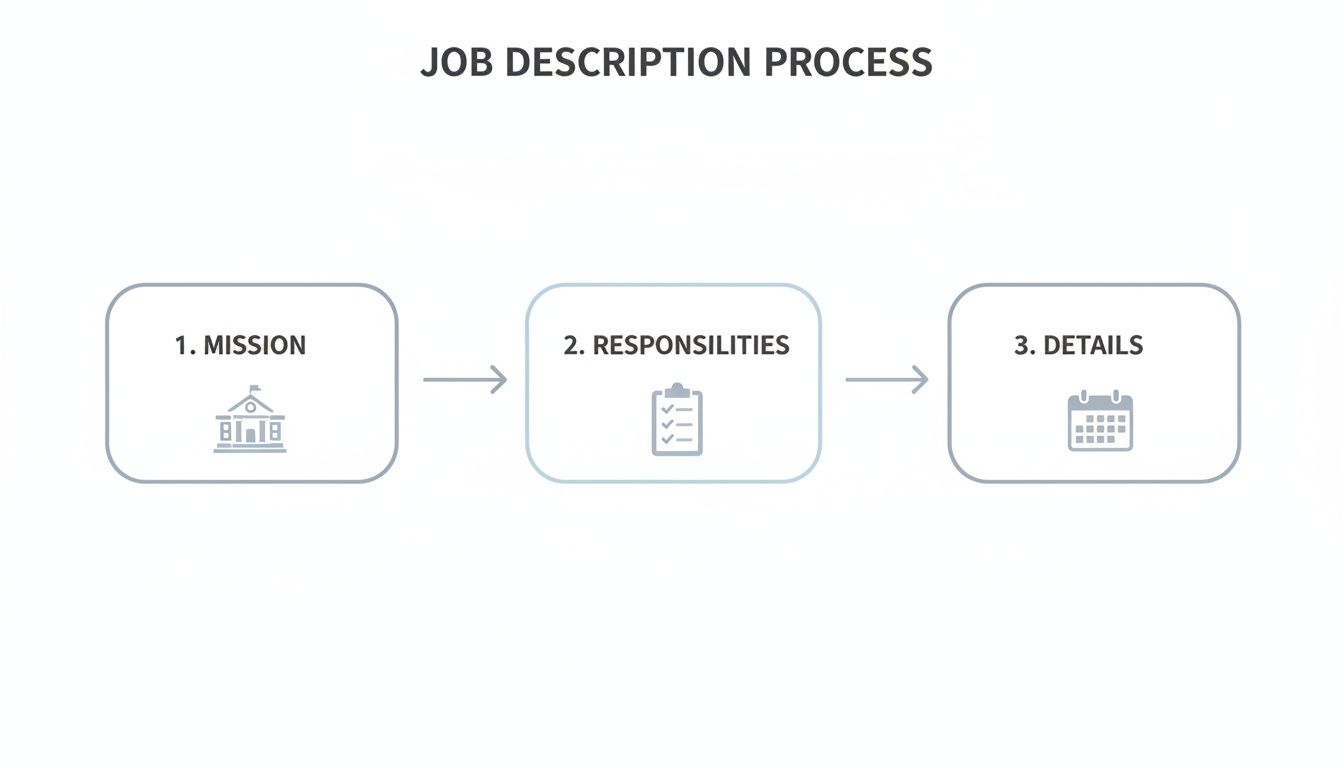
Following a structured approach like this ensures every single candidate is measured against the same core principles, from how they fit your mission to their ability to handle specific course duties.
Deepening the Vetting Process
After the initial screen, the vetting gets more personal. This is your chance to look past the CV and really discover a candidate's teaching potential and whether they're a good philosophical fit for your school.
The Interview
Your interview should be less about grilling them on their resume and more about uncovering their teaching philosophy. Ask open-ended questions that reveal how they think about student engagement and assessment.
- How would you handle a student who is really struggling with the core concepts of your course?
- Describe a time you used feedback to improve your own teaching methods.
- What excites you most about the prospect of teaching our students specifically?
The Teaching Demonstration
A teaching demonstration is non-negotiable. It is the single best way to see a candidate in action. For remote or out-of-state candidates, a pre-recorded 15-minute micro-lesson on a foundational topic from the course works perfectly. This lets you assess their communication style, clarity, and knack for making complex material accessible.
Remember, the competition for qualified faculty is fierce. According to the Bureau of Labor Statistics, the job market for postsecondary teachers is projected to grow 8% from 2022 to 2032, creating about 116,200 openings each year, many of which will be adjunct roles. With job sites listing hundreds of positions, private schools have to be meticulous to secure the best talent.
Finally, wrap things up with thorough reference and credential checks. Always contact the references provided and independently verify academic degrees. This diligence protects your institution and ensures you maintain the high standards your students and accreditation bodies expect.
Onboarding and Supporting Your Adjunct Faculty

Getting that signed offer letter is a major milestone, but it’s far from the finish line. The real work of integrating a new adjunct into your school's community begins the moment they accept. A thoughtful, supportive onboarding process is what separates a temporary contractor from a valued member of your academic team—and it's the key to setting them up for success.
This whole process starts with a rock-solid contract. Ambiguity is the enemy of a good working relationship, and a contract that leaves no room for interpretation protects both the instructor and your institution.
Crafting a Clear and Comprehensive Contract
Think of the adjunct contract as your first and best tool for setting clear expectations. It needs to go way beyond just salary and course titles; it should paint a complete picture of the role to minimize future misunderstandings and ensure everyone is aligned from day one.
A truly robust contract will explicitly detail:
- Compensation and Pay Schedule: Don't just list the stipend. State the exact per-course amount and the specific dates payments will be issued. The national average pay for a three-credit course hovers around $3,500, but this varies so widely by institution type and location that total transparency is non-negotiable.
- Course Load and Responsibilities: List the specific course codes and titles the adjunct will teach. Just as important, outline your expectations for office hours, grading turnaround times, and any required participation in departmental meetings.
- Intellectual Property Rights: This is a huge one. Define who owns the course materials created by the adjunct. Does the school retain rights to the syllabus and lectures, or does the instructor? Tackling this head-on in the contract prevents major headaches down the road.
- Term of Appointment: Specify the exact start and end dates (e.g., August 15, 2024, to December 10, 2024). It's also critical to state that reappointment is not guaranteed.
Designing a Structured Onboarding Experience
Let's be clear: a stack of papers and a key to the classroom is not an onboarding program. A meaningful integration process welcomes adjuncts into your school's culture and gives them the tools they actually need to do their job well. Adjuncts who feel connected to the institution are simply more engaged and more effective.
A strong onboarding plan needs to be more than just a syllabus template. Think about creating a multi-step orientation that covers all the practical essentials.
An investment in onboarding is an investment in student success. When adjunct faculty are well-supported and clear on expectations, they can focus their energy on what matters most—delivering an exceptional classroom experience.
Your orientation process should include dedicated time for a few key areas.
Essential Onboarding Components:
- Technology Training: Provide hands-on training for your specific Learning Management System (LMS), whether that's Canvas, Blackboard, or another platform. Don't forget the student information system for submitting grades and other critical tasks.
- Introduction to Key Personnel: Make sure they meet the department chair, academic dean, administrative support staff, and IT help desk contacts. Just knowing who to call with a question is invaluable and saves everyone time.
- Academic Culture and Policies: Walk them through your school's honor code, attendance policies, and student support services like tutoring and counseling. Crucially, ensure they understand the emergency procedures and the resources available to their students.
Providing Ongoing Support and Evaluation
The support can't just stop after the first week of classes. Adjunct faculty, especially those new to teaching, benefit immensely from ongoing guidance and feedback. When you create a supportive ecosystem, you ensure they continue to grow professionally and feel connected to your school's mission.
One of the most powerful strategies we've seen work is a peer mentorship program. Pairing a new adjunct with a seasoned full-time faculty member provides a go-to person for all those little questions about curriculum, classroom management, or just navigating the school culture. It's a simple way to build a real sense of community.
Beyond that, establishing clear channels for feedback is crucial. This should include formal classroom observations by a department chair—followed by a constructive conversation, not a lecture—and reviewing student course evaluations together. The goal isn't to be punitive; it's to identify areas for professional growth and to celebrate what's working. Offering access to professional development workshops or funds is another powerful way to show you're invested in their success.
Building a world-class faculty requires a strategic approach from recruitment all the way through ongoing support. If you need help developing more robust systems for your adjunct professors, JAG Consulting is here to help. Book a call with our team to discuss your school’s unique needs, or visit our website to learn more.
Navigating Accreditation and Compliance Requirements
For any private school, accreditation isn't just a badge of honor—it's the bedrock of your reputation. Accrediting bodies look closely at faculty qualifications, and you can bet your adjunct hiring practices will be under a microscope during every review cycle.
Getting this wrong can put your school’s standing at serious risk.
The entire game of accreditation compliance comes down to one thing: documentation. You have to be able to prove that every single instructor, including your part-time adjuncts, meets the established adjunct professor requirements for the courses they teach. This means building and maintaining an organized, audit-proof repository for every adjunct who walks through your doors.
Building an Audit-Proof Documentation System
A scattered, "we'll find it when they ask" approach to record-keeping is a massive red flag for accreditors. Your goal is a centralized digital file for each adjunct containing everything an auditor would ever need to see. This is how you ensure a smooth, successful review.
Your essential documentation checklist should include:
- Official Transcripts: These must come directly from the degree-granting institution to verify their highest earned degree. No photocopies allowed.
- A Current Curriculum Vitae (CV): Keep this updated to reflect their ongoing professional experience and accomplishments.
- Signed Contracts: Have clean copies of all employment contracts for each and every term they teach.
- Performance Evaluations: Keep all records of classroom observations and student feedback in one place.
Accreditation isn't about having perfect faculty; it's about having a defensible process. Demonstrating that you consistently verify credentials and monitor academic quality is what truly matters to review boards.
Key Areas of Scrutiny for Accreditors
Beyond just checking individual credentials, accrediting bodies are looking for institutional consistency and quality. They want to see how your adjunct faculty fits into your larger academic framework.
One of the first things they’ll look at is the ratio of full-time to part-time faculty. They want to see a stable core of permanent staff guiding the academic mission.
They’ll also dig into academic rigor. Accreditors need to see proof that a course has the same standards and learning outcomes whether it’s taught by a tenured professor or a brand-new adjunct. This is where clear syllabi templates, shared learning outcomes, and strong departmental oversight become non-negotiable.
With many private schools and universities reporting that adjuncts teach over 50% of their undergraduate courses, this consistency is more critical than ever.
A smart move is to incorporate specific language into your faculty handbook that clearly outlines the adjunct professor requirements and your entire verification process. This formalizes your commitment to quality and serves as undeniable evidence of your policies during an accreditation visit.
Navigating the complexities of accreditation can be a heavy lift. If you need an expert eye to prepare for a review or to tighten up your faculty policies, our team can help. Book a call with JAG Consulting to make sure your school is ready, or visit our website for more information.
When you're hiring adjuncts, a lot of questions pop up. It’s totally normal. Getting your policies right on the front end saves you from major headaches—and accreditation questions—down the road. Let’s tackle some of the most common questions we hear from school leaders.
The Big Question: What Should We Be Paying Adjuncts?
This is always the first thing people ask, and the honest answer is: it depends. According to the American Association of University Professors, the national average pay for a standard three-credit course is around $3,500. But that number can be misleading for private schools. In competitive markets or for highly specialized skills, we’ve seen that figure range anywhere from $2,000 to over $7,000 per course.
Your pay scale has to be grounded in your reality. Look at your region's cost of living, the specific credentials you’re asking for, and the real demands of the course. The key is to be competitive enough to attract the talent you need. Being transparent about your pay scale from the start builds trust and gets you better applicants.
What About Niche Subjects? Do They Really Need a Master's Degree?
This is a classic one. What if you need someone to teach advanced welding, digital animation, or another hands-on vocational skill where a master’s degree is almost irrelevant?
This is where you have to think like an accreditor. The core principle isn't about the degree itself; it's about whether the instructor is qualified to teach the subject matter.
Your job is to build a rock-solid, defensible case for why your chosen expert is the right person. This could be a portfolio of professional work, industry-recognized certifications, or a documented history of extensive experience. Document everything. That’s how you prove expertise.
Can We Hire Someone Who’s Still Finishing Their Degree?
Sometimes. It's a common scenario—you find a brilliant PhD candidate who has finished all their coursework and is now just working on their dissertation (often called "ABD" or All But Dissertation). Can they teach an undergrad class in their field? Absolutely. They often have incredibly deep and current subject matter knowledge.
The critical piece here is checking your accrediting body’s specific rules. They will have minimum degree requirements for who can teach certain course levels. As long as your candidate meets that minimum standard, you’re usually in the clear.
What’s the Right Mix of Full-Time vs. Adjunct Faculty?
There’s no magic ratio here. The ideal balance really depends on your school's mission, its size, and the kinds of programs you offer.
However, accrediting bodies have a clear perspective on this. They want to see a stable, core group of full-time faculty driving the academic vision. These are the people who should be handling curriculum development, student advising, and long-term planning.
If your faculty is overwhelmingly part-time, it can raise a red flag. It might suggest instability or a lack of institutional investment in academics. A healthy model is often one where adjuncts bring in specialized expertise or help manage enrollment peaks, but don't make up the majority of your teaching staff.
Defining and defending your adjunct professor requirements is a critical piece of building a high-quality, compliant private school. It shows you’re serious about academic excellence.
If you’re wrestling with your faculty policies or getting ready for an accreditation review, the experts at JAG Consulting are here to help. Book a call with JAG Consulting today and let's make sure your school is set up for success, or visit our website to learn more.

I'm Dr. Jeannie Gudith, Founder and CEO of JAG Consulting. We help you develop, improve, buy or sell your private school.
I'm so glad you're here
Hello!


© 2025 JAG CONSULTING.
all rights reserved. privacy policy + REFUND POLICY. TEMPLATE by sugar studios + Showit
