

Growth through school climate and culture: A Guide to Private School Success
School climate is the weather of your school—the daily mood you feel in the hallways—while school culture is the underlying personality built from deeply held values and traditions.
Getting this distinction right is the critical first step for any private school leader aiming to build a truly thriving community. A great school environment doesn't happen by accident; it's the direct result of intentional leadership that knows exactly what it's trying to build. For private schools, where families are making a significant financial investment, a positive and mission-aligned environment is not just a benefit—it's a core component of the value proposition.
Distinguishing School Climate and Culture

While people often use the terms interchangeably, climate and culture are two completely different layers of your school’s environment. Nailing the difference is essential because it tells you whether you need a quick, short-term adjustment or a much deeper, long-term strategic shift.
Imagine you walk through your school’s front doors. That immediate feeling—the energy in the hallways, the warmth of the greetings you receive, the visible buzz of engagement in classrooms—that’s your school climate. It’s the tangible, day-to-day atmosphere that students, staff, and families experience every single day.
The Feel of the School Climate
Climate is what you can see and feel on the surface. It's observable and can change pretty quickly based on new initiatives, a change in leadership, or even external events. Think of it as the mood of your school.
The key ingredients of climate are:
- Relationships: The quality of the daily interactions between teachers, students, and administrators. Is there respect? Trust? Openness?
- Safety: This is about more than just physical security. It’s the psychological safety students feel to be themselves, ask questions, and take academic risks without fear of judgment. Statistics show that students who feel safe at school are more likely to be engaged and have higher academic achievement.
- Environment: The condition of your physical spaces says a lot. Are classrooms inviting? Are common areas well-kept and used for connection?
A positive climate is something you can feel in your bones. It’s a powerful driver of daily well-being and engagement. In fact, schools with a strong, positive climate see higher student attendance, better engagement, and much stronger teacher retention.
The Foundation of School Culture
Go deeper, and you’ll find school culture. This is the school's core identity—its very personality. It’s the collection of shared values, beliefs, sacred traditions, and unwritten rules that have been baked in over years, sometimes even decades.
School culture is the underlying philosophy that drives every behavior and decision. It’s the “why” behind what your school does, while climate is the “how” it feels to be there.
Culture is far more stable and resistant to change. It shapes fundamental expectations, from academic rigor to how conflict is handled and how success is celebrated. For a private school, a strong, mission-aligned culture is your ultimate differentiator in a crowded market. It’s what builds lasting loyalty and turns families into lifelong advocates.
To make meaningful, lasting improvements, you first have to diagnose the problem correctly. Are you dealing with a "rainy day"—a climate issue that can be addressed with a targeted fix? Or are you facing a "tectonic shift"—a cultural problem that requires a deep, strategic, and patient approach?
Answering that question is the foundation of building a truly exceptional private school.
Why Climate and Culture Are Your Most Valuable Assets
For private schools, a healthy climate and culture are much more than just “nice-to-have” qualities. They are powerful, tangible assets that directly fuel your mission and your bottom line. Think of them as your school's most valuable, and often unseen, drivers of success.
Imagine a prospective family touring your campus. Long after they forget the specific details of your curriculum or the size of the gym, they will remember how your school felt. The energy in the hallways, the easy confidence in student-teacher interactions, the palpable sense of belonging—this is your climate in action. It’s one of your most persuasive admissions tools, speaking volumes more than any brochure ever could.
This atmospheric quality isn't just for visitors; it has a direct, measurable impact on the students you already serve. Research consistently shows that when students feel safe, respected, and connected, their academic engagement and achievement improve significantly. A strong school climate and culture create the psychological safety needed for students to take intellectual risks, ask tough questions, and grow into resilient, confident learners. A study by the National School Climate Center found that positive school climate can account for as much as a 20% variance in student achievement.
The Financial Impact of a Strong Culture
Beyond academics, the health of your school's environment has profound financial implications. One of the biggest is its effect on teacher retention. The cost to recruit, hire, and train a replacement teacher can be as high as 20-30% of their annual salary, and a supportive, collaborative culture is your most effective defense against the high costs of turnover and burnout.
A positive school climate improves job satisfaction, reduces burnout, and enhances collaboration among colleagues. When educators feel valued and supported, they are more likely to stay, innovate, and invest deeply in their students' success.
This stability creates a virtuous cycle. Experienced, motivated teachers deliver a higher quality of education, which boosts student performance and parent satisfaction. This, in turn, leads to stronger student retention and positive word-of-mouth referrals—the absolute lifeblood of private school enrollment.
Connecting Environment to Strategic Goals
Investing in your school's climate isn't a peripheral activity; it's a central component of sound strategic planning. A thriving internal environment directly supports your most critical institutional goals.
- Enrollment and Admissions: A welcoming and vibrant climate is a powerful differentiator that attracts mission-aligned families and helps you stand out in a crowded market.
- Staff Retention and Recruitment: A positive culture attracts top talent and dramatically reduces the high financial and institutional costs of staff turnover. In fact, schools with positive climates see much stronger teacher retention rates.
- Academic Excellence: A supportive environment enables both students and teachers to perform at their best, fostering classroom innovation and better academic results.
- Long-Term Financial Stability: High retention rates for both students and staff create a more predictable and stable financial foundation, allowing for better long-range planning.
Ultimately, your school's climate and culture are not soft metrics. They are hard assets that determine your ability to attract families, retain exceptional educators, and deliver on your foundational promise of an outstanding education. Neglecting them is a strategic risk, while intentionally cultivating them is one of the wisest investments a private school leader can make.
Ready to transform your school's environment into your greatest asset? Book a call with JAG Consulting to discuss a data-driven strategy tailored to your unique needs, or visit our website to learn more.
How to Measure Your School's Environment Accurately
You can’t fix what you can’t see. For private school leaders, moving beyond gut feelings and hallway chatter is the first step toward building a genuinely thriving school climate and culture. A data-driven approach gives you a clear roadmap, turning subjective feelings into things you can actually work on.
This process starts with reliable, objective tools designed to capture the true pulse of your community. While those informal conversations are valuable, they rarely paint the full picture. A structured assessment is the only way to uncover hidden trends and make sure every voice is heard.
Choosing Your Assessment Tools
A solid measurement strategy always blends numbers with stories—the quantitative with the qualitative. Relying on a single source of data can be misleading; combining several gives you a much more accurate, three-dimensional view of your school’s environment.
Here are three core tools every private school should consider:
- Validated Surveys: These are the bedrock of any serious assessment. Using established instruments, like the U.S. Department of Education’s School Climate Surveys (ED-SCS) or similar proven tools, ensures your questions are methodologically sound and your data is reliable. This isn't the time to create your own survey from scratch.
- Structured Focus Groups: Surveys tell you what people are feeling; focus groups help you understand why. These guided conversations with specific groups—like middle school students, new faculty, or long-time parents—provide the rich, qualitative context that numbers alone will never capture.
- Observational Walkthroughs: This is about seeing the climate in action. Leaders systematically walk the halls, cafeteria, and common spaces at different times of day with a specific observational goal. How do students interact between classes? What’s the energy level in the dining hall? Are common spaces actually welcoming and inclusive?
By pulling together data from all three sources, you can build a robust and nuanced understanding of your school's unique strengths and challenges.
Looking Beyond the Surface Numbers
One of the biggest mistakes a school can make is looking at a high-level satisfaction score and patting themselves on the back. A positive overall number can easily hide significant problems festering within specific pockets of your community.
A school might report 85% overall parent satisfaction, which sounds great. But what if that number is masking the fact that satisfaction among 9th-grade families is only 50%? Digging deeper isn't just good practice; it's essential for equitable and effective leadership.
This is precisely why breaking down your data is so critical. For example, large-scale surveys in major U.S. school districts reveal just how much positive aggregate metrics can obscure. Boston Public Schools’ 2025 climate survey reported that while some overall favorability measures hit 82%, a concerning 21% of students in grades 6–12 felt they belonged "a little bit" or "not at all." On top of that, reported school safety among these same students fell from 61% to 58% year-over-year—highlighting critical issues buried in the broader data. You can find out more about these climate survey findings and see how data can be broken down.
A Practical Process for Launching Your Assessment
A successful assessment requires careful planning and open communication. Just blasting out a survey isn't enough. You have to build trust and show you’re genuinely committed to acting on what you learn.
- Get Community Buy-In: Start by explaining the "why" to your staff, students, and families. Frame this not as a critique but as a collaborative effort to make a great school even better.
- Select and Deploy Your Tools: Choose the right mix of surveys, focus group protocols, and observation checklists that fit your school’s specific context and resources.
- Analyze and Disaggregate the Data: Go beyond the averages. Break down your results by grade level, department, student demographics, and years of tenure for staff and families. This is where the most powerful insights are hiding.
- Communicate Findings Transparently: Share a summary of the key findings—both the good news and the areas for growth—with your entire community. This transparency builds incredible trust and signals that you value their feedback.
This structured approach transforms measurement from a simple data-gathering exercise into a powerful strategic tool. It empowers you to pinpoint specific areas for improvement—like a dip in teacher morale or a decline in student sense of belonging—and make confident, data-informed decisions.
Are you ready to stop guessing and start measuring what truly matters in your school? Schedule a call with JAG Consulting to explore how a tailored assessment can provide the clarity you need to build a stronger school climate and culture.
Diagnosing Challenges in Your School's Climate
So, you've collected the survey data. That’s the easy part. The real work starts now: turning those numbers and percentages into a clear-eyed diagnosis of what's really happening on your campus. This is where you move beyond anecdotes and "I feel like…" statements to pinpoint the root causes of the challenges shaping your school's environment. Get this step right, and you can build interventions that actually work.
Making sense of a mountain of data can feel overwhelming. The key is to organize the feedback into specific domains. Think of it like a doctor diagnosing an illness—they don't just say "the patient feels unwell." They check specific systems: cardiovascular, respiratory, neurological. We need to do the same for our school's health.
This is the journey from scattered observations to actionable insights. It’s a process that separates schools that react from schools that lead.
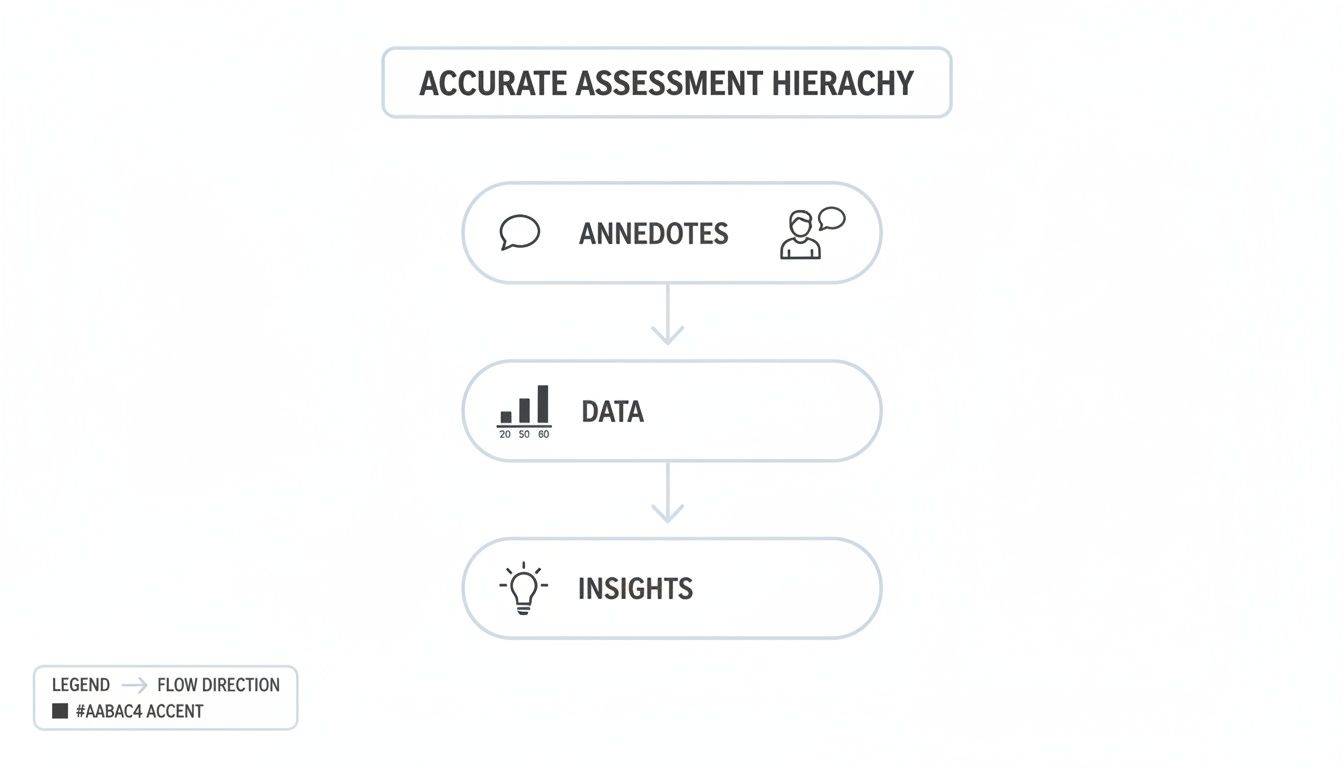
While hallway chatter and one-off parent comments are a starting point, they aren't a strategy. Only structured data can give you the reliable insights needed to make smart, targeted decisions.
School Climate Domains and Example Indicators
To bring clarity to your diagnosis, it helps to categorize your findings. The table below breaks down the key domains of school climate, explaining what each one measures and providing concrete examples of survey indicators. This framework will help you quickly identify where your strengths lie and, more importantly, where you need to focus your attention.
| Climate Domain | What It Measures | Example Indicator (from a survey) | Potential Red Flag |
|---|---|---|---|
| Safety | The extent to which students and staff feel physically and emotionally secure on campus. | "I feel safe making a mistake in class without being judged by my peers or teacher." (Agree/Disagree) | A high percentage of "Disagree" responses, especially in middle school grades. |
| Relationships | The quality of interpersonal connections among students, between students and faculty, and among staff. | "I feel like I have at least one adult at school I can talk to if I have a problem." (Agree/Disagree) | More than 15-20% of students disagreeing, suggesting a lack of trusted adult connections. |
| Teaching & Learning | The level of academic engagement, support, and challenge experienced in the classroom. | "My teachers challenge me to do my best work." (Often/Sometimes/Rarely/Never) | A significant number of students responding "Rarely" or "Never," pointing to disengagement. |
| Environment | The physical and institutional quality of the school, including facilities, resources, and sense of belonging. | "Students at this school are respectful of each other." (Agree/Disagree) | A split or negative response, indicating potential issues with peer culture or inclusivity. |
By sorting your survey results into these buckets, you can move from a vague sense that "something is off" to a specific, actionable problem statement like, "Our 9th graders are struggling with peer relationships and a sense of belonging." That’s a problem you can solve.
A Private School Case Study in Action
Let's put this into practice with a fictional private school, "Northwood Academy." Their annual climate survey flagged a troubling trend: while overall satisfaction was high, a full 35% of 9th-grade students reported feeling a low sense of belonging. The Head of School knew they couldn't ignore that number.
-
Diagnosis: Using the domain framework, they didn't just see a bad number; they saw a problem rooted in Relationships and Psychological Safety. This gave them focus.
-
Intervention: Instead of guessing, they organized focus groups with 9th graders. The students were candid: they felt intimidated by established social circles and found it hard to break in. Armed with this insight, Northwood launched a peer mentorship program pairing new students with 11th-grade leaders. They also completely redesigned their freshman orientation to focus on collaborative team-building activities, not just rules and schedules.
-
Measurement: One semester later, a quick pulse survey showed a 20% improvement in the sense of belonging among 9th graders. The problem wasn't solved, but the needle was moving in the right direction.
This is what a structured diagnostic process looks like. It turns broad data into a specific diagnosis, leading to targeted interventions. It’s how you stop wasting time and money on generic initiatives and start making a real impact on your school climate and culture.
Ready to move from data to diagnosis and develop a plan that truly works for your school? Book a call with JAG Consulting for expert guidance, or visit our website to see how we help private schools thrive.
Integrating Climate Goals into Your Strategic Plan
For too long, schools have treated climate initiatives like a side project—an important one, maybe, but separate from the “real” business of the school. This is a mistake.
True transformation happens when this work moves from the margins to the very center of your school's DNA. To create lasting change, you have to weave your climate and culture goals directly into your core strategic plan, your board governance, and your financial planning.
This isn’t about adding another item to your to-do list. It’s a fundamental shift in perspective. Instead of seeing a positive climate as the result of a successful school, you start seeing it as the engine that powers everything else.
Linking Climate to Broader Strategic Objectives
When you connect a healthy school environment to the metrics your board and leadership team care about most, its value becomes undeniable. This is how you move the conversation from a “soft” initiative to a hard-nosed strategic asset that drives tangible results.
Think about the direct connections:
- Enrollment Growth: A vibrant, welcoming climate is one of your most powerful marketing tools. It's what convinces a family on the fence to choose you.
- Academic Achievement: Psychological safety and a strong sense of belonging are the soil in which deep learning and intellectual risk-taking can actually grow.
- Fundraising Success: A positive, unified community culture inspires donor confidence and leads to greater philanthropic support. Happy communities give.
- Staff Retention: A supportive professional environment is your single best defense against the staggering financial and institutional costs of teacher turnover. Teacher turnover costs U.S. schools over $7 billion annually, a significant portion of which is preventable through improved school climate.
By framing the work this way, you elevate your school’s environment from a background concern to a primary driver of institutional success.
Setting SMART Goals for Your School Environment
Once you’ve made the strategic connection, the next step is to get specific. Vague aspirations won't get you anywhere. The SMART framework is the perfect tool to turn your vision into concrete, actionable goals.
A goal to "improve school spirit" is fuzzy and impossible to measure. But a SMART goal gets real: "Increase the student sense of belonging score on our annual climate survey by 10% among 9th and 10th graders by the end of the next academic year."
This level of detail brings clarity, helps you direct resources effectively, and—crucially—allows you to track your progress. For private schools, this data-driven approach is also essential for demonstrating a real return on investment to your board and key stakeholders.
Budgeting and Board Oversight
Great intentions mean nothing without resources. If climate goals are in your strategic plan, they must also be in your budget.
This might mean allocating funds for professional development on restorative practices, hiring a dedicated dean of students, or investing in upgrades to common areas to foster a stronger sense of community.
Effective board governance is the final piece of the puzzle. The board’s job isn’t to manage the day-to-day initiatives, but to provide high-level oversight and ensure accountability. This involves three key actions:
- Approving the Strategic Plan: Ensuring climate and culture goals are explicitly included and properly resourced.
- Tracking Key Metrics: Regularly reviewing a dashboard of climate indicators (like student belonging scores, teacher retention rates, and parent satisfaction) right alongside the financials and enrollment numbers.
- Holding Leadership Accountable: Asking the tough questions that connect climate data to the school’s overall performance and long-term health.
This strategic alignment also means planning for growth. Practitioner reports show a clear link between school size and perceived climate. A 2025 analysis found that districts with over 10,000 students had a climate favorability of about 52%, a full ten points lower than the 62% seen in smaller districts. This suggests larger systems face unique challenges in maintaining cohesion.
As a private school planning for growth, this data is a warning shot. You have to be proactive about scaling your culture, not just your enrollment numbers. Discover more about how school size impacts climate perceptions and get ahead of the curve.
By weaving your school’s environmental health into the very fabric of your strategic planning and governance, you ensure it gets the sustained focus and resources it needs to create real, lasting improvement.
Ready to make your school's environment a core strategic asset? Book a call with JAG Consulting to learn how we can help you build a comprehensive plan, or visit our website for more expert resources.
Your Work From Here
We’ve walked through the framework for understanding the powerful forces at play in your school—the daily climate everyone feels and the deep-seated culture that guides what you do. You’re now equipped to see them not as abstract concepts, but as critical drivers of your mission.
The key is moving from anecdotes to action. By gathering real data, you can diagnose what’s truly happening on your campus and design interventions that actually work. This isn’t a task for a committee or a one-off initiative; it belongs at the center of your strategic planning, board conversations, and financial forecasting.
This work is never truly “done.” It’s a constant cycle of listening, acting, and refining. But the payoff is immense. We know from years of research that schools with a healthy, supportive environment don’t just feel better—they perform better. They see higher student engagement, stronger academic results, and better teacher retention. These are the metrics that secure a private school’s future in an increasingly competitive world.
This is the foundational work. It’s what allows you to deliver on the unique promise you make to every family that walks through your doors. By investing in the health of your school’s environment, you create the conditions for every single person—student, teacher, and parent—to truly flourish.
Building a stronger school climate and culture is the most important journey a leader can take. Ready to get started?
Book a complimentary consultation with JAG Consulting to talk through your school's unique challenges, or visit our website to see how we help private schools build lasting success.
Your Questions Answered: School Climate and Culture in Practice
When it comes to school climate and culture, leaders often tell me they understand the concepts in theory, but the practical application feels fuzzy. They know it matters, but they aren't sure where to start or what to expect.
Let's clear up some of the most common questions that come up in our work with private schools. These are the real-world concerns that bridge the gap between knowing and doing.
How Long Does It Take to See a Real Difference?
You can absolutely feel a shift in your school climate within a single academic year. Think of it like changing the "weather" on campus. If you launch a targeted initiative—say, a new student recognition program or a streamlined communication protocol for parents—the day-to-day feeling can improve remarkably fast.
But changing your underlying school culture? That’s a different story. Shifting the deep-seated beliefs, habits, and "the way we do things around here" is a long game. Real, sustainable culture change takes consistent, focused effort over 3-5 years. It’s a marathon, not a sprint.
What's the Single Biggest Mistake Schools Make?
Without a doubt, the most critical mistake is guessing. Too many leaders make decisions based on assumptions, anecdotal feedback from a few vocal parents, or what they think is happening. This almost always leads to treating symptoms instead of the actual root cause of an issue.
A data-driven strategy isn't a luxury; it's non-negotiable. Using validated surveys, structured focus groups, and systematic observations ensures your efforts are aimed at the right problems. It's the only way to know if your solutions are actually working.
Flying blind is the most expensive mistake you can make. Objective data tells you exactly where to focus your time, energy, and resources for the greatest possible impact.
Can We Actually Improve Our Culture on a Small School Budget?
Absolutely. In fact, many of the most powerful culture-shaping initiatives have little to do with money. They’re about intentionality, consistency, and behavior—not budget.
Meaningful change is often driven by actions, not dollars. Consider these low-cost, high-impact strategies:
- Create Clear Communication Rhythms: Consistent, transparent information flow builds trust faster than any expensive program.
- Establish Meaningful Traditions: Rituals and celebrations that reinforce your mission create a powerful sense of belonging and shared identity.
- Empower Teacher Leadership: Giving faculty a real voice in decisions that affect them fosters ownership, boosts morale, and costs nothing.
- Recognize Positive Behaviors—Consistently: Acknowledging students and staff who live out your school's values is the most effective way to reinforce the culture you want.
These kinds of actions are practically free, but their return on investment in building a strong, positive school climate and culture is enormous. A limited budget is never a barrier to a thriving environment.
Ready to move from questions to a clear, actionable strategy for your school? The expert team at JAG Consulting can help you diagnose your school's unique climate and culture needs and build a roadmap for lasting success. Book a call with JAG Consulting today or visit our website to learn more.

I'm Dr. Jeannie Gudith, Founder and CEO of JAG Consulting. We help you develop, improve, buy or sell your private school.
I'm so glad you're here
Hello!


