

Role of Principals: The role of principals shaping private schools
Forget the old image of a principal roaming the halls as a simple disciplinarian. The modern role of principals in private schools is far more dynamic. Today’s most effective leaders are strategic architects, the central nervous system of the entire institution, driving everything from academic rigor to financial stability.
The Principal as the Architect of School Success
Think of a private school principal as the captain of a ship. They don’t just stand at the helm and steer; they manage the crew, navigate treacherous financial waters, chart the course for the future, and ensure the entire voyage is a success. This is a leadership role, not just an administrative one, and it’s about shaping the very identity and long-term health of the school.
A great principal’s influence is the foundation upon which a thriving educational community is built. Their impact is felt in every corner of the campus, from the classroom to the business office. They are the chief stewards of the school's mission, ensuring every decision—from curriculum choices to campus safety protocols—is aligned with its core values. In the competitive private school world, where NAIS reports that 86% of schools have an enrollment of under 500 students, this requires a rare blend of deep educational expertise and sharp business acumen.
Defining a High-Impact Role
The responsibilities of a principal connect directly to the things that matter most: student outcomes and the school's overall health. A truly effective leader creates an environment where both students and faculty are empowered to do their best work. Their influence isn't just a gut feeling; it's measurable.
Research shows that replacing an underperforming principal with a highly effective one can add nearly three months of learning for students each year. That impact rivals what an excellent teacher can do in a single classroom, but it extends across the entire school, benefiting every single student. You can learn more about these powerful leadership findings on NAESP.org.
This makes it crystal clear: the principal's role is one of the most significant levers a private school has for improvement. Their leadership touches on several key domains:
- Academic Vision: Setting high standards for learning and giving teachers the support they need to meet them.
- Operational Excellence: Making sure the school runs smoothly, safely, and efficiently day in and day out.
- Enrollment and Community: Serving as the school's chief ambassador to attract, enroll, and retain the right families.
- Financial Stewardship: Overseeing budgets and playing a key role in the long-term financial health of the institution.
Ready to find a leader who can architect your school's success? Book a call with JAG Consulting or visit our website to explore how we can support your leadership needs.
Breaking Down the Four Pillars of Principal Leadership
To really get a handle on what a modern principal does, especially in a private school, you have to look beyond a simple job description. It’s better to think of their role as resting on four distinct but deeply interconnected pillars. Each one represents a core domain of leadership that is absolutely essential for a school’s health, growth, and academic success.
This framework shows how a principal is really an architect, designing and overseeing different parts of the school at once. The visual below lays it out, placing the principal at the top, directing academics, operations, and the school's future growth.
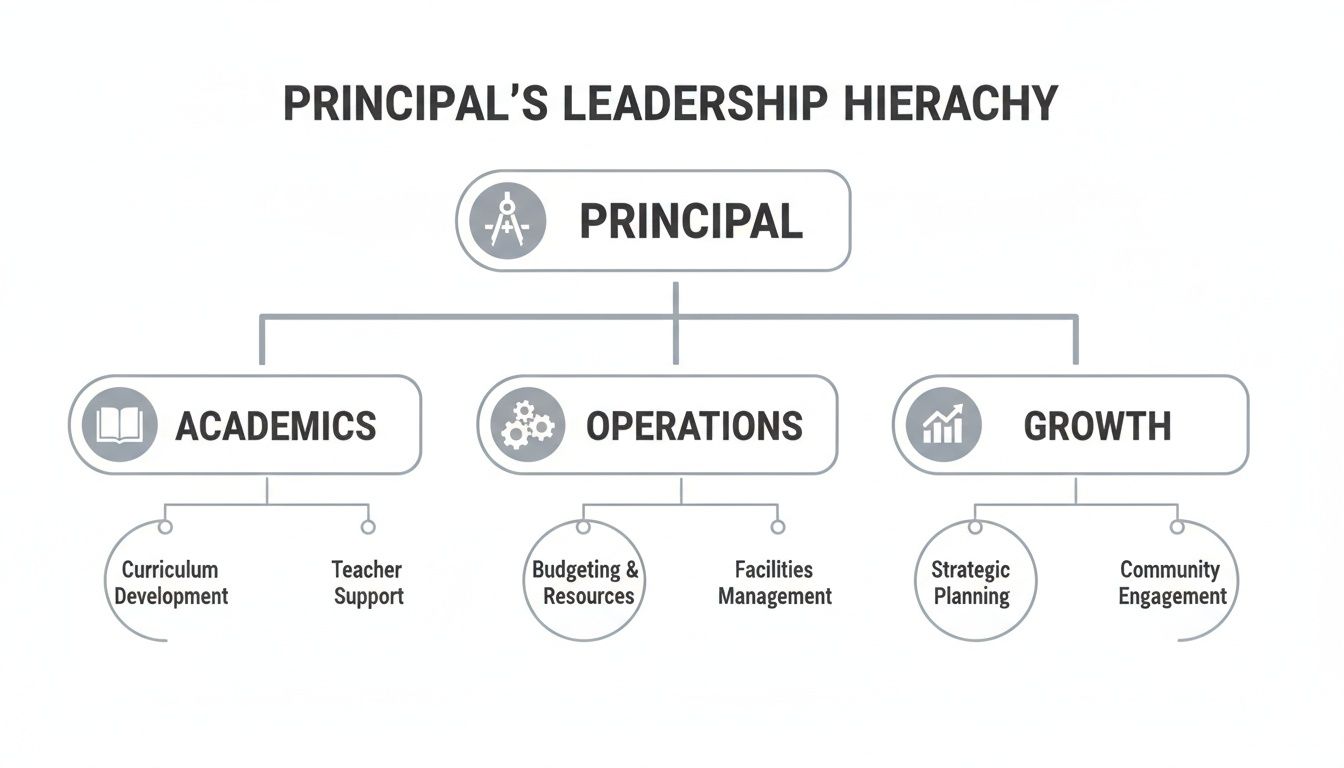
This makes it clear that a principal’s job isn’t just a flat list of tasks—it's a layered structure of strategic oversight. Let's dig into what each of these foundational pillars actually looks like day-to-day.
Instructional Leadership
The first and most important pillar is Instructional Leadership. This is the academic heart and soul of the private school. A great principal ensures the curriculum isn't just rigorous, but that it perfectly aligns with the school’s unique mission and educational philosophy.
Their role is also about fostering constant teacher growth. Principals who create meaningful professional development opportunities and give constructive, supportive feedback build an environment where educators can do their best work. This has a direct line to classroom quality and student achievement; it's been proven time and again that strong teacher support boosts learning outcomes.
Operational Mastery
Next up is Operational Mastery, which is all about the complex, behind-the-scenes work of running the school's daily functions. This pillar guarantees the entire campus is a safe, efficient, and supportive place for learning to happen. It means overseeing everything from facility management and safety drills to the smart allocation of resources like technology and classroom supplies.
Without smooth operations, even the most brilliant academic programs will stumble. This requires a leader who can think systematically, solve tricky logistical puzzles, and make sure every piece of the school day runs like a well-oiled machine.
Strategic Growth and Financial Health
In the competitive world of private schools, the Strategic Growth pillar is non-negotiable for long-term survival. Principals are deeply involved in enrollment management, marketing, and making sure current families stick around. They are often the school's chief ambassador, building the relationships that attract and retain families.
Beyond that, they play a vital role in financial stewardship. This means working on the annual budget, managing how departments spend money, and helping with fundraising. A principal’s ability to balance the educational vision with financial reality is what secures the school’s future.
Culture Cultivation
Finally, Culture Cultivation is the pillar that gives the school its personality and spirit. The principal is the chief culture officer, responsible for building a positive, inclusive, and mission-driven environment for students, faculty, and families.
Effective principals know that a strong school culture isn't a "nice-to-have"—it's a non-negotiable asset. Schools with positive climates report higher rates of teacher retention and greater parent satisfaction, which are the bedrock of stability and growth. According to a 2019 survey, 91% of private school teachers reported high levels of job satisfaction, a figure strongly linked to positive school leadership and culture.
This involves nurturing relationships with parents, championing the school’s core values, and making sure every single student feels like they belong. A vibrant school culture becomes a powerful advantage that supports every other pillar of leadership.
This table summarizes how these four pillars translate into the key functions a principal manages in a private school setting.
Principal Leadership Pillars and Key Functions
| Leadership Pillar | Key Functions in a Private School |
|---|---|
| Instructional Leadership | Curriculum development & alignment, teacher observation & coaching, professional development, student data analysis, academic program evaluation. |
| Operational Mastery | Facility management, safety & security protocols, daily scheduling, budget management, technology infrastructure, compliance & accreditation. |
| Strategic Growth | Enrollment & admissions oversight, marketing & community relations, student retention strategies, fundraising support, board collaboration. |
| Culture Cultivation | Mission & vision reinforcement, parent & community engagement, student discipline & support, staff morale & recognition, diversity & inclusion initiatives. |
Understanding these four domains is the first step toward finding and empowering the right leader for your school. If you’re ready to strengthen your school's leadership framework, book a call with JAG Consulting or visit our website to learn more.
How Great Principals Boost Academic Excellence and Teacher Retention
A principal’s real impact isn’t measured by budgets managed or policies written. It’s felt in the hallways, seen in the classrooms, and proven by the success of both students and teachers. The best principals are more than just administrators; they are the school's chief academic champions, creating an environment where everyone can do their best work.
They don’t lead by mandate. They lead by mentorship. Great principals are deeply involved in the academic life of their school, championing professional development that actually helps teachers grow instead of just checking a box. They provide feedback that builds confidence, not anxiety, and they foster a culture where data is a tool for improvement, not a weapon for judgment.
This kind of supportive leadership is the bedrock of a healthy private school. When teachers feel seen, heard, and trusted, their job satisfaction skyrockets. That’s not just a feel-good metric—it’s a direct driver of instructional quality and a positive school climate.
The Clear Link Between Leadership and Learning
The idea that a principal’s support boosts student success isn't just a hunch; it's a measurable reality. Study after study confirms that schools with strong, supportive leadership simply get better academic results.
Take a 2021 study of New York City schools. It found that the level of a principal's support was a significant predictor of student achievement. In fact, it was the only factor that reliably predicted gains in English Language Arts for grades 3-5. This shows a direct line from a principal who builds trust and collaboration to students who learn more effectively. You can dive into the full findings on how principal support impacts academics in the complete research paper from St. John's University.
Keeping Your Best Teachers is a Leadership Function
High teacher turnover is a quiet crisis. It’s expensive, it disrupts the community, and it hurts student learning. The single most important factor in whether a teacher stays or leaves? The principal. A toxic or unsupportive environment will drive away even the most passionate educators faster than anything else.
On the flip side, a principal who intentionally builds a positive work culture becomes a powerful retention magnet. One of the most impactful things great principals do is implement top teacher retention strategies that keep their best people in the building, teaching your students.
A principal's ability to create a stable, professional, and supportive faculty is directly linked to student achievement. Research indicates that schools with high teacher turnover see lower performance in both math and English, making principal-led retention efforts essential for academic excellence. In private schools, where teacher turnover is significantly lower (around 8% compared to 16% in public schools), effective leadership is often cited as the key differentiating factor.
So, what does this look like in practice? It’s not complicated, but it is intentional.
- Protecting instructional time: The best principals act as a shield, protecting teachers from administrative tasks that don't directly serve students.
- Recognizing and celebrating success: They make a point to publicly and privately acknowledge the hard work and wins of their faculty.
- Providing autonomy and trust: They hire good people and then empower them to make professional judgments in their own classrooms.
By focusing on these core areas, principals do more than just reduce turnover. They build a seasoned, collaborative team of educators who are deeply committed to the school's mission.
Is your school’s leadership fostering the academic excellence and teacher loyalty you need? Book a call with JAG Consulting to discuss how we can strengthen your leadership team, or visit our website to learn more.
Driving Enrollment and Ensuring Financial Health
In a private school, the principal has to wear two hats, and they have to fit equally well: academic leader and business strategist. The long-term survival of the school literally depends on their ability to keep classrooms full and the lights on. This pulls the principal’s role far beyond academics and squarely into the world of marketing, finance, and community building.

Let's be blunt: the principal is the school's most powerful marketing asset. They are the face of the institution. Their presence at admissions events, the way they talk to prospective parents, and their visibility in the local community all build the school's reputation. A warm, confident leader who lives and breathes the school's mission can be the single deciding factor for a family choosing where to invest in their child's future.
The Principal as Chief Enrollment Officer
Sure, a private school might have a dedicated admissions director, but the principal is the ultimate steward of enrollment health. Their leadership sets the tone for the entire process, making sure it’s welcoming, professional, and a true reflection of the school's unique values.
Strong leadership is a key driver of parent satisfaction, which directly impacts retention. Studies show that a positive school climate, heavily influenced by the principal, is a leading factor in a family's decision to re-enroll their child year after year. For private schools, where retention rates average a robust 91%, the principal's role in maintaining this loyalty is paramount.
Principals are often tasked with boosting school visibility and getting more families in the door. A solid education marketing strategy is a huge help here. The best principals contribute by:
- Articulating a Clear Vision: They consistently and passionately communicate what makes the school special. This gives the admissions team a compelling story to tell, not just a list of features.
- Building Community Partnerships: They get out there and build real relationships with feeder schools, local businesses, and community organizations to create a steady pipeline of prospective students.
- Engaging Current Families: They empower their current parents to become ambassadors, turning positive word-of-mouth into the most powerful enrollment tool you could ask for.
Ensuring Long-Term Financial Viability
Beyond just bringing students in, the principal plays a huge part in the private school's financial management. This doesn’t mean they’re crunching numbers like a CFO, but they are a key partner in protecting the school’s resources.
This often looks like collaborating with the board on the annual budget, managing departmental spending, and fighting to make sure resources are allocated where they matter most—supporting academic priorities.
In many private schools, the principal is also an active fundraiser. By building strong, authentic relationships with parents, alumni, and community donors, they help secure the gifts that fund new programs, campus upgrades, and critical financial aid. This direct involvement makes one thing crystal clear: a successful principal's leadership is directly tied to the school’s market position and financial future.
The Essential Skills of a Modern School Principal
What separates a competent school administrator from a truly exceptional leader? It’s not about flawlessly managing schedules or keeping the operational trains running on time, though those things matter. The real difference lies in a specific set of high-level skills that allow a principal to inspire growth, navigate tough challenges, and build a school that thrives.
These are the competencies that define the modern role of principals, especially in the competitive private school world where leadership is directly tied to reputation, culture, and enrollment.

This isn’t just a wish list. This is a blueprint for what school boards should be looking for when they hire and what they should be cultivating in their current leaders. These skills are the engine that drives everything else.
Visionary and Strategic Thinking
A great principal doesn't just manage the present; they architect the future. It’s about seeing beyond this year’s budget or the next admissions cycle. They are constantly scanning the horizon for trends, identifying opportunities, and setting a clear, compelling direction for the entire school.
It’s the difference between reactive management and proactive leadership. They ask, "What could our school become?" and then they build the roadmap to get there.
For instance, a visionary principal might see a growing demand for STEM education in the community. Instead of just adding a robotics club, they develop a multi-year strategy to weave project-based learning into the entire science and math curriculum. They secure funding for a new lab and forge partnerships with local tech companies. That’s how a simple idea becomes a signature program that gives the school a powerful market advantage.
Persuasive Communication and Emotional Intelligence
A principal’s vision is powerless if they can't get others to buy into it. Persuasive communication is the skill that inspires faculty, engages parents, and builds unwavering trust with the board. It’s not about giving speeches; it’s about creating genuine connection and shared purpose.
This goes hand-in-hand with high emotional intelligence—the ability to read a room, manage emotions (your own and others'), and build strong relationships.
Leaders with high emotional intelligence are better equipped to navigate difficult conversations, resolve conflicts, and foster a positive school climate. Research consistently shows that a principal's ability to connect with staff on a human level is a key factor in boosting morale and reducing teacher turnover.
Data Literacy and Adept Change Management
In today’s schools, gut feelings aren't enough. Modern principals need to be fluent in data, able to interpret everything from student assessment scores to enrollment funnel metrics. This isn’t about being a statistician; it's about making informed decisions grounded in evidence, not just tradition.
This skill is directly linked to change management. When the data points to a need for a shift—like adopting a new learning technology—the principal must guide the community through that transition. A principal who excels at change management communicates the "why" behind the change, makes sure teachers have robust training and support, and celebrates early wins to build momentum. It’s how you get a new tool embraced instead of resisted.
The table below breaks down these essential skills and shows what they look like in the real world of a private school.
Essential Principal Competencies and On-the-Job Application
| Competency | Example Application in a Private School |
|---|---|
| Visionary Thinking | Developing a five-year strategic plan that establishes the school as a leader in a specific academic niche, such as global studies or arts integration. |
| Persuasive Communication | Articulating the school's unique value proposition to prospective families during an open house, leading to increased application rates. |
| Emotional Intelligence | Mediating a conflict between a teacher and a parent with empathy, preserving the relationship and finding a constructive solution for the student. |
| Data Literacy | Analyzing student performance data to identify curriculum gaps and directing professional development resources to address those specific areas. |
| Change Management | Leading the faculty through the adoption of a new student information system by creating a phased rollout plan and providing continuous support. |
These competencies are the foundation of effective leadership. When a principal masters these skills, they don't just run a school—they elevate it.
Is your school’s leadership equipped with the skills needed for future success? To discuss how to identify or develop these competencies in your principal, book a call with JAG Consulting.
What This All Means For Your School
When you boil it all down, the success of a private school rests squarely on the shoulders of its leader. A great principal is the linchpin holding everything together—academics, operations, finances, and culture. The role of the principal isn't just another line item in the budget; it's the single most important investment a school can make in its future.
As we've explored, visionary leadership is the engine that drives everything from student learning and faculty retention to enrollment growth and financial health. When you empower a principal to be more than just a manager—to be the strategic architect of the school's future—you build an institution that is not only academically exceptional but financially sound. Their impact is felt directly on the bottom line and in the school's reputation throughout the community.
An investment in high-quality leadership pays dividends across the board. It’s an investment in every student, every teacher, and the long-term vitality of your school. The data is clear: schools with strong principals see higher teacher retention and greater parent satisfaction, the two foundational pillars of sustainable growth.
If you're ready to stop leaving your school's future to chance and start building the kind of leadership that creates lasting success, it's time to take the next step.
Are you prepared to find a leader who can deliver these results? Book a call with JAG Consulting today. Let's talk about your school's unique needs and how we can help you find the visionary leader you deserve. You can also visit our website to learn more about how we build thriving private schools from the ground up.
Your Questions Answered: A Closer Look at the Principal's Role
Leading a private school is a complex job, and it’s natural to have questions about how it all works. Let's tackle some of the most common ones we hear from boards and school founders, especially in the private school world.
How is a Private School Principal Different from a Public School Principal?
While the heart of the job—educational leadership—is the same, the role of principals in private schools is often much broader. Think of it this way: a public school principal operates within a large, established district system. A private school principal, on the other hand, is often running a small business.
Their responsibilities stretch far beyond academics and discipline. They are deeply involved in the functions that ensure the school's survival and growth: enrollment management, marketing, fundraising, and working hand-in-glove with a governing board. This demands a rare combination of educational vision and sharp business acumen.
How Do You Measure a Principal’s Performance?
With such a wide-ranging role, how can you tell if a principal is truly effective? It’s not just about test scores. Success is measured with a balanced scorecard of Key Performance Indicators (KPIs) that paint a full picture of the school's health.
- Student Academic Growth: Are students making measurable progress? This goes beyond standardized tests to look at value-added learning.
- Teacher Retention Rates: A low turnover rate is a powerful sign of a healthy, positive culture—something great principals build intentionally.
- Enrollment and Retention Figures: These numbers are the ultimate market feedback, directly reflecting parent satisfaction and your school's reputation.
- Parent Satisfaction Scores: What’s the word on the playground? Regular surveys give you direct, honest feedback on school climate and communication.
- Budget Performance: Is the principal a good steward of the school's resources? Meeting financial goals is non-negotiable for sustainability.
How Can a School Board Best Support Its Principal?
A principal's success is directly tied to the support they get from their board. This partnership is the foundation of a healthy private school.
The most effective boards focus on a simple but critical distinction: they govern, they don’t manage. They set clear, mutually agreed-upon goals and then empower the principal to handle the day-to-day operations.
This structure gives principals the autonomy and confidence to lead effectively. When a board also provides access to high-quality professional development and builds a relationship based on trust and open communication, they create an environment where their leader—and the school—can truly thrive.
Understanding and supporting the multifaceted role of principals is the single most important lever you can pull to unlock your school's potential. At JAG Consulting, we specialize in building the leadership frameworks that allow private schools to flourish.
Ready to see what stronger leadership could do for your school? Book a call with JAG Consulting https://link.jagconsultingservices.com/widget/bookings/prospective/school/consultation/zoom to discuss your specific needs or visit our website.

I'm Dr. Jeannie Gudith, Founder and CEO of JAG Consulting. We help you develop, improve, buy or sell your private school.
I'm so glad you're here
Hello!


