

How to Start an After School Program at Your School
Before you even think about hiring staff or buying supplies, the success of your after-school program hinges on the strength of its foundation. Getting this part right isn’t just a box-checking exercise; it’s the difference between launching a program that parents are clamoring for and one that struggles to fill seats.
For private school leaders, an after-school program is a massive opportunity. It’s not just about extending the day. It’s a chance to forge deeper connections with your families, open up a new and sustainable revenue stream, and offer enrichment that the regular curriculum just doesn’t have time for.
And the timing couldn’t be better. The demand for quality after-school care is exploding. The market is projected to surge from USD 31.21 billion in 2025 to a staggering USD 61.59 billion by 2032. That’s an annual growth rate of about 10.2%. What’s driving this? A huge demand from parents for structured, engaging activities, especially for pre-teens who now make up more than half the market. You can dive into the full market analysis to see these trends for yourself.
This growth is a green light, but capitalizing on it requires a methodical approach, not just a good idea.
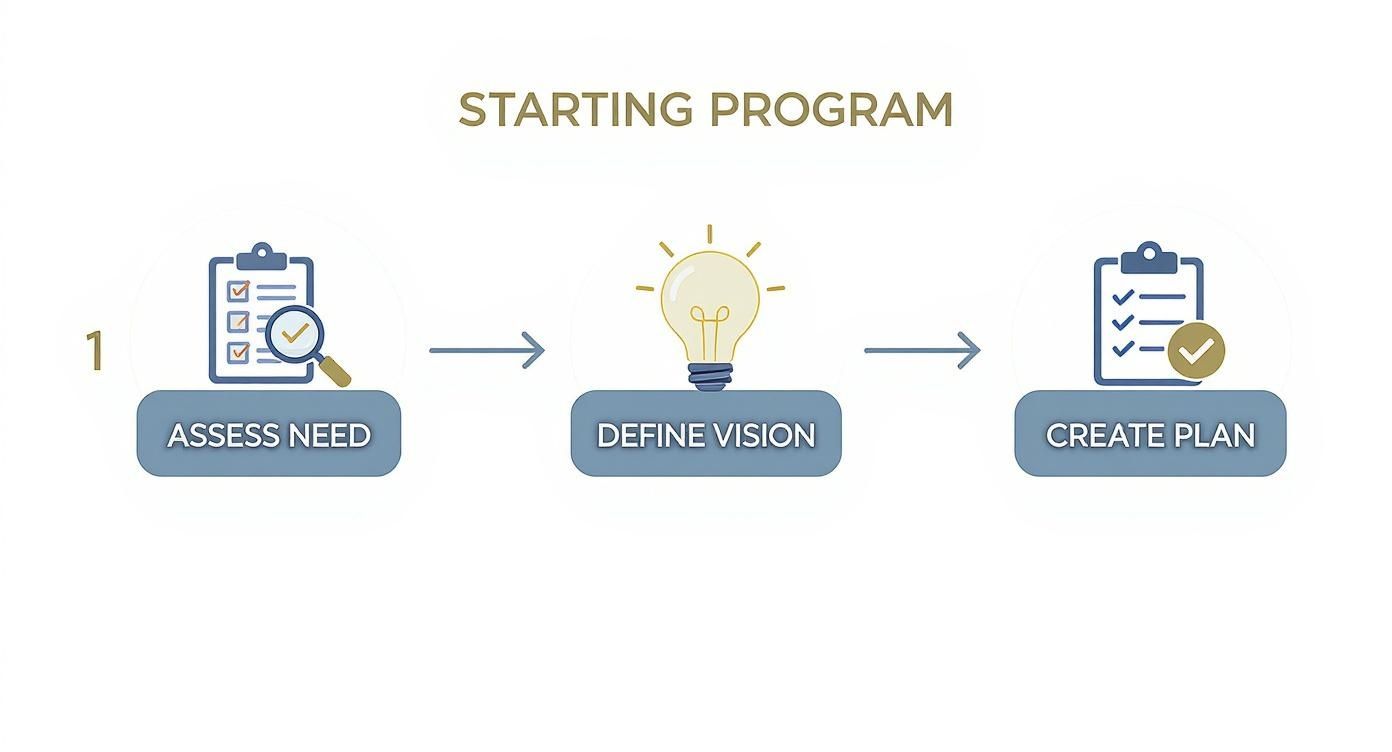
This simple flow is your starting roadmap: figure out what your community actually needs, shape a powerful vision for the program, and then build a concrete plan to make it happen. This is how you move from a vague concept to a program that truly serves your families.
Get Real Feedback with a Needs Assessment
Stop guessing. The single biggest mistake schools make is assuming they know what families want. Before you invest a single dollar, you need to find out what your parents actually need and are willing to pay for. A well-crafted needs assessment is your most critical first move.
This isn’t just about sending a one-question email. You need to dig for actionable data. A parent survey is your best friend here.
- Nail Down the Logistics: Do parents need care until 5:30 PM or is 6:30 PM the magic number? What about early dismissal days or school holidays? Get specific.
- Test Specific Activities: Don’t just ask about “art” or “sports.” Ask parents to rank their interest in concrete ideas like a “Coding & Robotics Club,” a “Visual Arts Studio,” a “Competitive Chess Team,” or even “Mandarin Language Immersion.”
- Clarify Academic vs. Enrichment: Is there a real demand for structured homework help and tutoring, or are your families really looking for creative outlets and social time? The answer will shape your entire program.
- Talk About Price (Carefully): You need to gauge price sensitivity. Present a few hypothetical tiers, like “$100/week for basic care” versus “$150/week for specialized clubs,” to see what your community views as a reasonable investment.
Key Takeaway: A thriving program is built on direct feedback, not your own assumptions. Surveying your families first ensures you’re creating something they are not only willing to pay for but are genuinely excited to join.
Define Your Program’s Vision and Mission
Once you have that real-world data from parents, you can start shaping a vision that actually connects. Your after-school program shouldn’t feel like a disconnected add-on; it needs to be an authentic extension of your private school’s DNA.
A strong mission statement becomes your north star, guiding every decision you make down the line, from curriculum design to who you hire. It answers the simple question: “Why are we doing this?”
For instance, a private school with a heavy STEM focus might build its mission around “inspiring the next generation of innovators through hands-on exploration in science and technology.” On the flip side, a liberal arts-focused school might aim to “cultivate creativity, curiosity, and character through immersive experiences in the arts and humanities.”
When your program’s vision clicks perfectly with your school’s core philosophy, it just makes sense to parents. It transforms your offering from a simple childcare service into an essential, value-added part of your educational ecosystem.
To give you a head start, here’s a quick checklist to make sure you’ve covered the essential feasibility questions before moving forward.
Initial Program Feasibility Checklist
This checklist helps you quickly evaluate if you have the core components in place. Answering these questions honestly will reveal your strengths and highlight areas that need more attention before you commit significant resources.
| Feasibility Area | Key Questions to Ask | Action Item |
|---|---|---|
| Community Demand | Have we surveyed at least 60% of our parent body? Do the results show clear demand for specific offerings and schedules? | Finalize and analyze parent survey data to confirm program direction. |
| Space & Facilities | Do we have dedicated or multi-use space available from 3-6 PM? Is it suitable for the activities parents requested? | Conduct a campus walk-through to audit available classrooms, gyms, and outdoor areas. |
| Financial Viability | Based on survey price points and estimated enrollment, does a preliminary budget show a path to profitability or break-even? | Create a high-level budget projection using survey data and estimated staffing costs. |
| Leadership & Staffing | Who will lead this program? Do we have internal staff interested in taking on roles, or will we need to hire externally? | Identify a potential program director and gauge interest among current faculty. |
| School Mission Alignment | Does the proposed program vision directly support and extend our school’s core mission and values? | Draft a 1-2 sentence mission statement for the program and vet it with school leadership. |
Working through this checklist provides the clarity and confidence needed to move from the idea stage to concrete planning.
Ready to translate these foundational steps into a thriving program for your school? Navigating the complexities of market analysis, financial modeling, and operational planning can be a challenge. Book a complimentary consultation with JAG Consulting today to get expert guidance tailored to your unique vision, or visit our website to learn more.
Building a Sustainable Financial and Operational Model
Once you’ve confirmed that parents are genuinely asking for an after-school program, it’s time to build the financial and operational model. A great idea is only as good as its financial legs. This is where your vision gets translated into a concrete plan—one that serves your families well while also strengthening your private school’s bottom line.
The opportunity is massive, but you can’t just open the doors and expect success. The real key is building a model that aligns with what your community can and will pay, making it both accessible for them and profitable for you.
Designing a Flexible Pricing Structure
Let’s move beyond the simple flat-rate fee. A one-size-fits-all approach just doesn’t cut it for modern families with constantly shifting schedules and diverse needs. To maximize both enrollment and revenue, your private school needs a multi-faceted pricing strategy that offers real flexibility.
Here are a few models we’ve seen work wonders for private schools:
- Tiered Pricing: Start with a base rate for general care (think homework help and free play). Then, offer premium tiers for specialized clubs like robotics, coding, or language immersion. This lets parents choose the exact level of enrichment that fits their child’s interests and their family’s budget.
- Flexible Drop-In Rates: Cater to parents with unpredictable work schedules by offering daily or even weekly drop-in options. Yes, you’ll price these higher on a per-day basis than the monthly plans, but this captures crucial revenue from families who don’t need care five days a week.
- Multi-Child Discounts: This is a powerful one. Encourage larger families to enroll all their kids by offering a 10-15% discount for the second and subsequent siblings. It’s a fantastic incentive that builds incredible loyalty.
Finding the right price point is a delicate balancing act. Your rates have to cover costs and turn a profit, but they also must feel valuable and fair to your parent community.
Creating a Comprehensive Budget
A detailed budget is the absolute backbone of your financial model. I’ve seen too many programs stumble because they underestimated their expenses. Your forecast has to account for every single cost, both the obvious and the hidden.
The best way to start is by breaking your expenses into two buckets: startup costs (the one-time investments to get going) and operational costs (your recurring monthly expenses).
Common Program Expenses to Budget For
| Expense Category | Examples | Budgeting Tip |
|---|---|---|
| Staffing Costs | Salaries, benefits, payroll taxes, background check fees, professional development. | This will be your largest line item, often hitting 60-70% of your total budget. |
| Supplies & Equipment | Art supplies, STEM kits, sports equipment, snacks, software licenses, curriculum materials. | Buy in bulk where you can. It really helps bring down the per-unit costs. |
| Facility & Utilities | Rent (if applicable), increased utility usage (electricity, water), cleaning services. | A good practice is to allocate a portion of your school’s existing utility bills to the program. |
| Marketing & Admin | Website updates, printed flyers, open house events, payment processing fees. | Lean on your school’s existing marketing channels to keep these costs minimal. |
| Insurance & Licensing | General liability insurance, child abuse and molestation (CAM) coverage, state licensing fees. | Do not cut corners here. Proper insurance is non-negotiable for managing risk. |
A meticulously planned budget prevents those nasty financial surprises and gives you a clear roadmap to profitability. It’s what turns your program from a hopeful idea into a viable business operation.
Identifying Alternative Funding Streams
While tuition will always be your main revenue driver, exploring alternative funding can elevate your private school’s program quality and make it more accessible. Securing outside funds can help you offer scholarships, buy better equipment, or bring in specialized instructors—all without having to raise fees on parents.
Look into community partnership grants from local businesses or foundations that support youth development and education. These aren’t just about the money; these partnerships can lead to invaluable community ties and amazing enrichment opportunities for your students.
Even with high demand, a huge gap exists between interest and actual enrollment in after-school programs. In the U.S., the parents of 29.6 million children want this kind of programming, but only about 7 million are enrolled. That gap, which affects 77% of interested families, often comes down to cost. Alternative funding helps your private school bridge that accessibility gap for your community. You can learn more about the unmet demand for afterschool programs.
Ready to build a financial model that guarantees success for your new program? Book a call with JAG Consulting at https://link.jagconsultingservices.com/widget/bookings/prospective/school/consultation/zoom or visit our website for expert guidance.
Getting Your Program Legal and Keeping Kids Safe
For any private school adding an after-school program, nothing is more critical than the safety of your students and your legal integrity. This isn’t just about checking boxes; it’s about building an unshakeable foundation of trust with your families. A secure, compliant environment is the bedrock of a successful program.
The web of regulations can feel intimidating at first, but breaking it down into manageable pieces makes it straightforward. Your first job is to understand and meet all state and local licensing requirements. These are absolutely non-negotiable.
Understanding State and Local Licensing
Every state has its own rulebook for programs that serve children, and your private school’s after-school program will almost certainly need to follow them. These aren’t suggestions; they are legal mandates designed to ensure a baseline of safety and quality.
Start by getting in touch with your state’s child care licensing agency. They are the ultimate source of truth for the regulations you must follow. Key areas they almost always cover include:
- Staff-to-Student Ratios: States mandate specific ratios, like one adult for every 10-15 elementary-aged kids, to guarantee proper supervision.
- Facility Safety: This covers everything from minimum square footage per child and fire safety compliance to ensuring access to safe outdoor play areas.
- Health and Sanitation: Regulations will dictate details like proper food handling for snacks, handwashing procedures, and cleaning protocols.
Adhering to licensing standards is your first line of defense in risk management. It shows parents and regulators that you are committed to running a professional, safe, and responsible program from day one.
Securing the Right Insurance Coverage
Your private school already has insurance, of course, but an after-school program brings new activities and new risks that demand specific coverage. Operating without the right policies is a massive liability that no school can afford. You’ll need to review and expand your insurance portfolio to protect your school, your staff, and your students.
The two most critical policies you’ll need to add or expand are:
- General Liability Insurance: This is your core policy. It covers accidents, injuries, and property damage that might happen during program hours and protects you from the financial fallout of an unexpected incident.
- Child Abuse and Molestation (CAM) Coverage: This is an absolute must-have. CAM insurance is a specialized policy that provides protection against allegations of abuse. In today’s climate, having robust CAM coverage is non-negotiable for protecting your school’s reputation and financial stability.
Find an insurance broker who specializes in educational institutions. They get the unique risks that come with youth programs and can make sure your policies provide comprehensive protection without any dangerous gaps.
Implementing Airtight Safety Protocols
Beyond the legal paperwork, your daily operational protocols are what truly create a culture of safety. These procedures need to be clear, consistent, and rigorously followed by all staff, students, and parents.
Your safety framework should be built on several key pillars:
- Rigorous Staff Screening: Every single staff member and regular volunteer must undergo a comprehensive background check. This means fingerprinting and a search of national and state child abuse registries. No exceptions.
- Secure Sign-In/Out Procedures: Use a secure digital or manual system that requires a signature from a parent or authorized guardian for both drop-off and pickup. Never release a child to someone who isn’t on the pre-approved list without getting direct confirmation from a parent.
- Emergency Preparedness: Develop and regularly practice drills for various emergencies, including fire, medical incidents, and security threats. You should also ensure all staff are certified in first aid and CPR.
By embedding these legal and safety measures into your program’s DNA, you give parents the ultimate peace of mind—that their child is not only learning and growing but is also safe and protected.
Feeling overwhelmed by the compliance details? You don’t have to figure it all out alone. Book a complimentary consultation with JAG Consulting to get expert guidance on risk management and safety protocols, or visit our website to learn more.
Designing a Curriculum and Daily Flow That Kids Actually Love
Let’s be honest. Your business plan and marketing flyers might get parents in the door, but the real heart of your after-school program is the daily experience you create for students. This is where you move beyond simple supervision and build something vibrant and enriching.
An engaging curriculum and a well-structured daily schedule are what make kids want to stay after the final bell. It’s the difference between a program that’s just a convenience and one that becomes an essential part of a child’s education.
Crafting a Balanced Daily Schedule
The hours between dismissal and pickup are precious. Your daily schedule needs a thoughtful rhythm, blending structure and freedom to meet kids where they are after a long school day. You’re aiming for a predictable flow that still leaves room for spontaneity and student choice.
A successful daily structure almost always balances four key elements:
- Academic Support: For many families, this is non-negotiable. A dedicated “power hour” for homework or quiet reading right after school lets kids get their work done, freeing up their evenings for family time.
- Creative Enrichment: This is your chance to shine. It could be a hands-on STEM project, a collaborative art class, a drama rehearsal, or learning a new instrument. This is where your program’s unique identity comes to life.
- Physical Activity: Kids have been sitting all day. They need to move. Whether it’s organized sports, free play on the playground, or a structured game in the gym, getting their bodies moving is essential. Research consistently shows that physically active kids have lower levels of depression and higher self-esteem—a huge win for everyone.
- Unstructured Play & Social Time: Never underestimate the power of downtime. Giving students time for free play is where they practice crucial social skills, learn to resolve conflicts on their own, and, most importantly, just get to be kids.
This balanced approach ensures your program supports the whole child—academically, creatively, physically, and socially.
Developing Theme-Based Programming
If you really want to capture students’ attention and reinforce your private school’s educational philosophy, you have to move beyond generic activities. The magic is in theme-based programming.
Thematic units or clubs create immersive experiences that can turn a simple afternoon into an adventure. They also give parents a crystal-clear value proposition, making your program a distinct and highly desirable choice.
Expert Insight: When you ask kids what they want from a program, they consistently say they want to have fun, be with friends, and learn new skills. Theme-based clubs hit all three of these points by creating a focused, social, and skill-building environment.
Think of these themes as mini-camps that might run for a semester or just a few weeks. By offering a handful of distinct options, you give students real agency over their afternoon. That choice alone dramatically increases their buy-in and enthusiasm.
To help you brainstorm, here’s a look at how different thematic structures can appeal to different types of students.
Sample Thematic Program Structures
The table below outlines a few popular program themes, their core focus, potential activities, and the kind of student they’re likely to attract. Use it as a starting point to build a diverse and exciting menu of options for your own community.
| Program Theme | Core Focus | Example Activities | Best For Students Who… |
|---|---|---|---|
| Robotics & Coding Club | STEM & Problem-Solving | Building and programming with Lego Mindstorms, learning basic Python, competing in team challenges. | Are analytical, enjoy hands-on building, and are curious about technology. |
| Young Artists’ Studio | Creativity & Self-Expression | Exploring different mediums like painting and sculpture, creating a collaborative mural, hosting a mini art show for parents. | Are imaginative, enjoy creative projects, and want to develop their artistic skills. |
| Sports Skills Camp | Physical Fitness & Teamwork | Drills for a specific sport (e.g., soccer, basketball), lessons on sportsmanship, friendly scrimmages and tournaments. | Are energetic, enjoy physical competition, and want to improve their athletic abilities. |
| Future Authors’ Workshop | Literacy & Storytelling | Writing and illustrating short stories, learning about character development, performing spoken word poetry or short plays. | Love to read and write, are highly creative, and enjoy sharing their ideas with others. |
When you design a curriculum with this level of intention, you’re creating much more than just after-school care. You’re building a dynamic, sought-after program that becomes an essential part of your school’s identity and a massive draw for families.
Ready to design a curriculum that will have families lining up to enroll? Crafting the perfect schedule and program themes can be complex. Book a complimentary consultation with JAG Consulting to get expert guidance on creating an engaging and effective program, or visit our website to learn more.
Hiring Your Team and Driving Enrollment
Your program’s design and financials are on paper, but the real soul of your after-school experience comes from the people you hire and the families you serve. You can have the most incredible curriculum in the world, but it’s only as good as the instructors bringing it to life.
This stage is a dual challenge: you have to build a team of passionate, reliable educators while simultaneously creating the buzz that fills every single spot.
This is where the vision becomes reality. A well-recruited team and a smart enrollment plan are the engines that will drive your success from day one, ensuring your program isn’t just operational, but thriving.
Building Your A-Team
Finding the right people is arguably the single most critical piece of a quality after-school program. You aren’t just looking for supervisors; you need mentors, creators, and leaders who are genuinely enthusiastic about spending their afternoons with kids. Look for candidates who bring both relevant experience and a contagious energy.
When you draft your job descriptions, go beyond a simple list of responsibilities. Describe the impact you want them to have on students.
- Look within your private school first. Your current teachers and aides already get your school’s culture and have relationships with students. They are often your best candidates.
- Tap into local colleges. Students pursuing degrees in education or child development are hungry for practical, part-time experience.
- Hire for passion, train for skill. While experience is great, a candidate’s genuine enthusiasm for youth development is something you just can’t teach.
Always keep state-mandated staff-to-student ratios in mind. These ratios, often around 1 adult for every 10-15 students, are non-negotiable for safety and for ensuring each child gets the attention they need to thrive.
An Enrollment Strategy That Creates Buzz
Your absolute best marketing asset is your existing parent community. They already trust your private school’s brand. Your initial enrollment push should be an “inside-out” campaign that leverages that built-in trust and communication network.
The goal here is to generate excitement and a sense of exclusivity, making enrollment feel like an opportunity parents don’t want to miss. It’s worth noting that the U.S. after-school sector is a massive market, valued at roughly USD 21 billion in 2025 and set to grow. Success comes from aligning with what parents want—enrichment and safe supervision—while tackling the biggest barrier: cost. You can find more data on the after-school care market.
Key Takeaway: Start your enrollment strategy with your current families. Create a targeted, multi-channel campaign that shows off your program’s unique value and makes signing up easy and exciting.
Your Go-To-Market Enrollment Playbook
Don’t just send a single email and hope for the best. A coordinated launch creates momentum and drives families to act. Here’s a simple but incredibly effective sequence for marketing the new program to your internal community.
- The Teaser Announcement: About a month before registration opens, send out a “Save the Date” message in your email newsletter and on social media. Announce that the program is coming and hint at the exciting themes you’ll be offering.
- The Info Session or Open House: Host an event where parents can meet the program director, see the space, and get their questions answered. This personal touch builds immense confidence and clears up any hesitations before they become barriers.
- Early-Bird Registration: For one week, open registration exclusively to your current families. Offer a small discount (5-10% off) for signing up early. This creates urgency and rewards your most loyal community members.
- The Public Launch: After the early-bird period, open any remaining spots to the wider community. Use compelling photos, videos, and testimonials from your open house to attract new families.
This phased approach nearly guarantees your program fills up quickly, often creating a waitlist that signals strong demand and sets you up for long-term success.
Need help building a team and launching a marketing plan that guarantees a full roster on day one? Book a call with JAG Consulting at https://link.jagconsultingservices.com/widget/bookings/prospective/school/consultation/zoom or visit our website to get expert, actionable advice.
Frequently Asked Questions
Got questions? You’re not alone. As you start mapping out your after-school program, it’s completely normal for a few key uncertainties to pop up. For private school leaders figuring out how to launch their first program, tackling these common concerns head-on is the best way to build confidence and move forward.
This final section cuts right to the chase, answering the most frequent questions we hear from private school leaders. The answers are direct, practical, and designed to help you sidestep common pitfalls.
What’s the Biggest Initial Hurdle for a Private School?
Honestly, it’s a tie between two things: accurately guessing what parents actually want and building a realistic financial model to deliver it. Too many private schools move forward on assumptions, only to be met with disappointing enrollment numbers right out of the gate.
At the same time, underestimating the true costs is an incredibly common and costly mistake. Expenses for specialized staff, the right insurance, and quality supplies add up much faster than you’d think. Your first move should always be to survey your parent community. Ask them what they need and what they’re willing to pay. This direct feedback is the only foundation for a conservative, realistic budget that ensures your program is both wanted by families and financially sound from day one.
How Can We Appeal to a Wide Range of Age Groups?
The key here is to ditch the one-size-fits-all approach. A great program creates distinct “clubs” or “tracks” that cater to different developmental stages, which gives students a real sense of ownership over their afternoons.
For your younger crowd (think Kindergarten through 2nd grade), the focus should be on guided play, story-based activities, and collaborative arts and crafts. Their afternoon needs more structure and hands-on guidance.
Once you get to 3rd grade and up, the magic word is choice. Offer them more autonomy with options like:
- A dedicated homework lab for quiet, focused work.
- A coding or robotics club for hands-on tech projects.
- Specialized sports clinics to build specific athletic skills.
By giving older students meaningful choices, you keep them engaged and ensure the activities stay challenging and relevant. It transforms your program from a place they have to be into a place they truly want to be.
Expert Insight: When students have a say in their activities, their engagement skyrockets. Offering distinct tracks not only improves the student experience but also makes your program far more attractive to parents of older children who have outgrown basic after-care.
What Are the Essential Legal and Insurance Policies?
First things first: you absolutely must research and comply with your state’s child care licensing regulations. These rules are non-negotiable and almost always apply to after-school programs, even those run by established private schools. They’ll dictate things like staff-to-child ratios, mandatory background checks, and detailed facility safety standards.
When it comes to insurance, you’ll need to go beyond your school’s standard policy. The two most critical add-ons are:
- General Liability: This covers the slips, trips, and falls—any accidents or injuries that might happen on your premises during program hours.
- Child Abuse and Molestation (CAM) Liability: This specialized coverage is an absolute must-have. It protects your school against allegations of abuse and is a non-negotiable part of modern risk management.
I highly recommend partnering with an insurance broker who specializes in educational institutions. They’ll make sure you have the comprehensive protection you need for all your program activities.
What’s the Most Effective Way to Market Our New Program?
Your most powerful and cost-effective marketing tool is right under your nose: your existing school community. These are parents who already trust your private school’s brand and your commitment to quality. Start your marketing by focusing exclusively on them.
Announce the new program through all your established channels—your weekly email newsletter, a banner on your website’s homepage, and your school’s social media accounts. Next, host an “insider” open house or an informational webinar just for current families. This lets them meet the program staff, ask questions directly, and feel like they’re getting the first look.
To build momentum, create a little urgency with an “early bird” registration discount exclusive to your enrolled families. Most importantly, make sure your marketing message directly references the needs and desires you uncovered in your initial parent surveys. This proves you listened and have built a program just for them.
Ready to turn your vision for an after-school program into a thriving reality but need expert guidance? Let’s build a successful, sustainable program together. Book a complimentary consultation with JAG Consulting today to get started by visiting us at https://link.jagconsultingservices.com/widget/bookings/prospective/school/consultation/zoom or visit our website.

I'm Dr. Jeannie Gudith, Founder and CEO of JAG Consulting. We help you develop, improve, buy or sell your private school.
I'm so glad you're here
Hello!


