


How to Open a Preschool A Founder’s Guide
Opening a private preschool is about so much more than a love for education. It demands a sharp vision and, just as importantly, a real, validated need in your community. Success starts right here, before you even think about buildings or budgets. You’ve got to build a unique educational philosophy that speaks directly to local families, and then do the hard work of proving your idea can actually fly. This initial groundwork isn't just a box to check—it's the launchpad for everything.
Defining Your Vision and Validating Your Idea
Before a single dollar is spent, the most critical work begins. You need to define the very soul of your school and prove there's an audience waiting for it. This isn't just a preliminary step; for private school founders, this is the core of your brand and the promise you make to your community. It’s where you move from a passionate idea to a concrete, strategic plan.
The journey starts by looking inward. What will make your private preschool different? Will you build it around a specific pedagogy like Montessori or Reggio Emilia? Maybe you're dreaming of a play-based curriculum, a nature-focused "forest school," or a language-immersion environment. Answering these questions is how you shape your educational philosophy. This becomes the North Star for your curriculum, your hiring decisions, and even how you design your classrooms.
Grounding Your Vision in Market Reality
Once you have a philosophy, you have to test it against the real world. That means digging deep into localized research to understand the competitive landscape and find the gaps you can fill. Just looking at demographics won't cut it. You need to get inside the heads of local parents and find out what they’re really looking for in early childhood education.
Good market research isn't complicated, but it is essential. It involves a few key moves:
- Competitor Analysis: Make a list of every existing private preschool in your target area. Dive into their tuition rates, the programs they offer, their educational philosophies, and what parents are saying in online reviews. Look for what they do well, but pay even closer attention to what they’re missing.
- Parent Surveys: Use simple online surveys and post them in local parenting groups on social media. Ask parents about their top priorities when choosing a preschool, what frustrates them about their current options, and what they’d be willing to pay for specialized programs.
- Community Engagement: Show up where families are. Go to local farmers' markets, library story times, and family-friendly events. Talk to parents. These informal chats can give you game-changing insights that you'll never find in a spreadsheet.
This research isn't just about getting a "yes" or "no" on your idea; it's about sharpening it. You might discover a huge demand for part-time or flexible scheduling, or a surprising interest in a STEM-focused program you hadn't even considered.
The whole point of this initial research is to find that perfect sweet spot where your unique passion meets an unmet need in the community. A private school built on that foundation has a powerful, built-in advantage from day one.
And the opportunity is massive. The global early childhood education market was valued at USD 308.26 billion in 2025 and is projected to hit USD 441.43 billion by 2029. This isn't just a number; it reflects a growing global understanding of how critical quality early learning is. That trend creates a fantastic environment for new, well-planned private schools. You can explore more data on the early childhood education market to get the bigger picture.
Crafting Your Mission Statement
With a clear philosophy in your head and solid market data in your hands, the final step is to boil it all down into a compelling mission statement. This isn't just a fluffy tagline for your website. It's a short, powerful declaration of your school's purpose, values, and goals. It needs to be memorable, inspiring, and clear enough to guide every single decision you make from here on out.
A strong mission statement nails three fundamental questions:
- What do we do? (e.g., "We provide a nurturing, play-based early learning environment.")
- For whom do we do it? (e.g., "…for children aged 2-5 in our community.")
- How do we do it uniquely? (e.g., "…by fostering curiosity, creativity, and a lifelong love of learning through a child-led curriculum.")
This process flow really brings home how these foundational steps connect to build a solid concept.
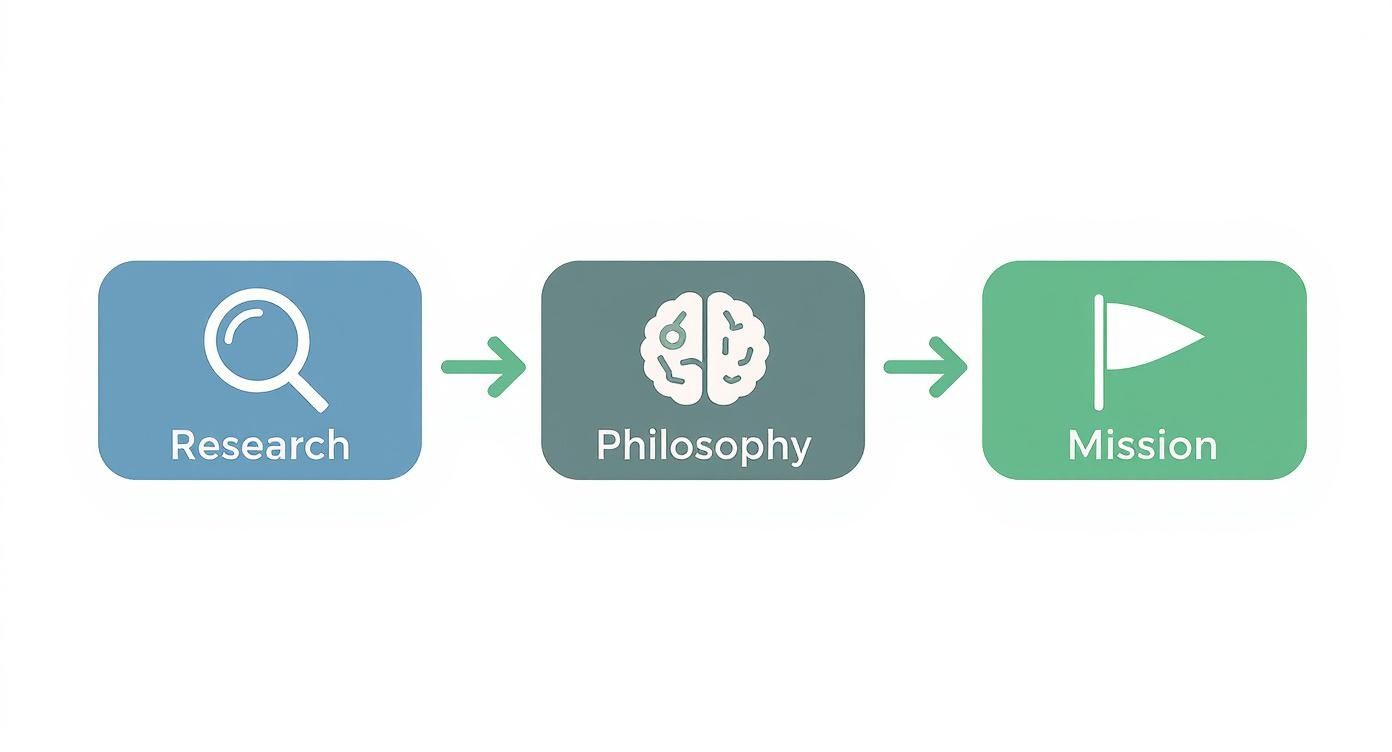
The visual makes it clear: a powerful mission is born directly from combining deep research with a thoughtful educational philosophy.
Before you commit, it's wise to run through a quick feasibility check. This isn't about deep financial modeling yet, but about confirming that the core components of your idea hold up to scrutiny.
Initial Feasibility Checklist for Aspiring Preschool Owners
This checklist summarizes the critical areas to investigate before you go all-in on your private preschool project. Use it to make sure you've covered all the foundational angles and aren't moving forward with any major blind spots.
| Checklist Item | Key Questions to Answer | Success Indicator |
|---|---|---|
| Personal Vision Alignment | Does this project align with my long-term personal and professional goals? Am I prepared for the demands of ownership? | You feel a deep, sustained passion for the mission, not just the idea of being a founder. |
| Unique Value Proposition | What specific, unmet need does my private school fill? Can I clearly state why a family should choose me over others? | You can articulate your school's unique value in 30 seconds or less, and it resonates with target parents. |
| Market Demand Validation | Is there tangible evidence (survey data, waitlists at competitors) that families are actively seeking what I plan to offer? | Competitors have waitlists, and/or parent surveys show a strong desire for your specific program type. |
| Competitive Landscape | Is the market oversaturated, or is there room for a new, high-quality player? Can I compete effectively on price or value? | You can identify a clear market niche that is underserved by existing schools. |
| Initial Financial Viability | Do back-of-the-napkin numbers suggest this can be a sustainable business? What is the likely range for tuition? | Preliminary estimates show a path to profitability within a 3-5 year timeframe. |
| Regulatory Awareness | Do I have a basic understanding of the state and local licensing requirements I will need to meet? | You've identified the primary licensing agency and have reviewed their basic requirements for new centers. |
Going through these questions forces you to be honest about the viability of your dream. It's a crucial step that separates the successful launches from the ones that stumble right out of the gate.
This foundational work is absolutely indispensable. It ensures you’re not just opening another preschool, but creating a truly valuable private educational institution that serves a real need. If you're ready to shape your vision and need an expert guide to navigate these critical first stages, book a free consultation with JAG Consulting today or visit our website to learn how we help founders launch successful private schools.
Building a Business Plan That Secures Funding
Let's be blunt: a powerful business plan is much more than a document you hand to lenders. It's the strategic blueprint for your private preschool's entire future. This is the process that forces you to translate your passionate vision into a viable, data-driven model that proves your school isn't just a great idea—it's a sustainable business.
For anyone serious about how to open a preschool, this document becomes your single most important tool. It’s what inspires confidence in investors and what will guide your own critical decisions when things get tough.
Forget the generic templates you can download online. A plan that actually secures funding tells a compelling story. It starts with the mission and market analysis you've already poured your heart into, weaving them into a narrative that demonstrates a clear, believable path to profitability. This is where your unique educational philosophy meets the hard, cold numbers of business operations.
Detailing Your School's Operations and Marketing
Before you can even think about projecting financials, you have to paint a vivid picture of the day-to-day reality of your school. This is the part of your plan that brings your vision to life for potential investors. It gets into the nitty-gritty: your proposed location, daily schedules, staffing plan, and the specific programs you’ll offer.
Will you provide half-day, full-day, or extended-care options? These aren't minor details; these choices directly impact your revenue potential and, just as importantly, your staffing costs.
Your marketing and enrollment strategy also needs to be defined with absolute clarity. It’s not enough to say you’ll “use social media.” A plan that gets funded specifies things like:
- Target Enrollment: State your desired student numbers for year one, two, and three. Be realistic. Base these figures on your facility's actual capacity and the local market demand you've already researched.
- Marketing Channels: Get specific. Will you be targeting local parenting blogs, building a community in specific Facebook groups, sponsoring community events, or forging partnerships with local pediatricians and real estate agents?
- The Enrollment Funnel: Describe the exact journey a prospective parent will take, from their first point of contact (likely your website) to a school tour and, finally, registration. This demonstrates a thoughtful, professional approach to customer acquisition.
This operational detail shows investors you've moved beyond the dream and have thought through the practicalities. It’s proof you understand that running a private school is as much about logistics as it is about pedagogy.
Crafting Realistic Financial Projections
This is it. The financial section is the heart of your business plan and, frankly, it’s where most investors flip to first. Your projections must be thorough, well-researched, and completely defensible. This is where you prove that your private preschool is a sound investment, not a passion project funded by hope.
Start by splitting your costs into two clear categories: one-time startup expenses and ongoing operational costs.
Startup Costs Breakdown:
| Category | Example Expenses |
|---|---|
| Facility & Renovation | Security deposit, initial rent, playground installation, painting |
| Legal & Licensing | Business incorporation fees, licensing application fees, permits |
| Curriculum & Supplies | Initial purchase of books, educational toys, art materials |
| Furniture & Equipment | Child-sized tables and chairs, shelving, office equipment |
| Initial Marketing | Website development, logo design, open house event costs |
Don’t underestimate these initial costs. The Small Business Administration notes that facility costs often represent one of the largest hurdles for new childcare businesses, making an accurate, well-researched estimate absolutely essential.
Next, you'll forecast your monthly operational budget. This includes salaries, rent, utilities, insurance, marketing, and a line item for ongoing supplies. Be meticulous here. Underestimating your monthly burn rate is one of the most common and critical errors new founders make.
Your financial projections are a story told in numbers. They should clearly show when you expect to break even and demonstrate a steady, logical path toward sustainable profitability. A well-constructed financial model isn’t just a spreadsheet; it’s your most persuasive argument.
Setting Competitive and Profitable Tuition Rates
Setting your tuition is a delicate balancing act. You have to cover your costs and generate a healthy profit, all while remaining competitive within your local market. That competitor analysis you did earlier? This is where it becomes your guide. Map out what other private preschools in your area are charging and, just as importantly, what services are included at each price point.
Your unique value proposition is what gives you pricing power. If you offer a specialized program like language immersion or a STEM-focused curriculum, you can often command a higher rate. But you must justify that premium in your business plan by connecting it back to concrete advantages like a superior curriculum, lower student-teacher ratios, or more highly qualified staff.
A clear, simple tuition structure is key. Present your rates for different programs (e.g., a 3-day week vs. a 5-day week) and clearly list any additional fees for things like registration, materials, or late pick-up. This transparency doesn't just help parents; it shows investors you have a solid, well-thought-out revenue model.
Building a comprehensive business plan is a demanding process, but it is the absolute cornerstone of a successful school launch. It forces clarity, uncovers potential challenges before they become disasters, and transforms your idea into an actionable roadmap.
If you're feeling overwhelmed by the financial modeling or need help structuring a plan that will truly impress investors, we can help. Schedule a complimentary consultation with a JAG Consulting expert to discuss how we can build a compelling business plan together, or visit our website for more resources.
Navigating the World of Licensing and Legalities
https://www.youtube.com/embed/6um1znVbFsc
Once you have a solid business plan, you’re ready to step into the most structured and non-negotiable part of the journey: compliance. Getting the legal and licensing aspects right is the absolute bedrock of a safe, trusted, and successful private preschool.
This stage can feel like you're drowning in paperwork and regulations, but it’s a totally manageable process if you just approach it methodically.
First things first, you need to give your school a legal identity. This single decision impacts everything from your personal liability to how you'll handle taxes. For most private school founders, the choice boils down to a few common structures.
- Limited Liability Company (LLC): This is a popular go-to for a reason. An LLC creates a protective shield between your personal assets (like your house) and the business’s debts, offering a crucial layer of security. It’s also flexible in how you're taxed and generally simpler to run than a full-blown corporation.
- S Corporation (S-Corp): An S-Corp can unlock some nice tax advantages by letting you take a formal salary and also receive distributions, which aren't subject to self-employment taxes. The trade-off? It comes with stricter rules, like the requirement to hold regular board meetings.
- Sole Proprietorship: While this is the easiest to set up, it's often the riskiest path for a private preschool. A sole proprietorship offers zero legal separation between you and the business. That means if the school runs into debt or legal trouble, your personal assets are on the line.
Choosing the right entity isn't a DIY task. I can't stress this enough: consult with a lawyer and an accountant who have direct experience with private schools. They’ll help you figure out the best fit for your financial situation and what you want to achieve long-term.
Understanding State and Local Licensing
With your business legally formed, the next big hurdle is getting all the licenses you need to actually open your doors. Every single state has a different agency that oversees childcare centers and preschools. Your first job is to pinpoint exactly which one it is—it could be the Department of Health, Social Services, or a dedicated Office of Child Care.
This agency's website will become your new best friend. It’s your primary source of truth, containing the official rulebook that spells out every requirement you have to meet. And believe me, these regulations are incredibly specific, covering every imaginable aspect of running a private school.
Navigating licensing requirements isn't about finding shortcuts; it's about demonstrating your commitment to providing a safe, high-quality educational environment. Treat your licensing specialist as a partner, not an adversary. They want to see safe, successful schools open in their community.
The investment in creating high-quality, compliant early childhood environments is a growing global priority. This reflects a broad recognition of just how important this sector is. For instance, the World Bank significantly increased its early childhood portfolio from USD 2.9 billion in 2014 to USD 18.7 billion in 2024, showcasing how major institutions view the strategic value of this field. You can read the full report on these investments to understand the bigger picture.
Preparing for Your Licensing Inspection
Before you can welcome a single student, a licensing specialist will show up for a thorough on-site inspection of your facility. They will come armed with a detailed checklist to make sure you’ve met every single state mandate.
Here are the areas they almost always focus on:
- Staff-to-Child Ratios: There are strict limits on how many children one teacher can supervise, and these numbers usually change depending on the age group.
- Health and Safety Protocols: They'll check everything from fire drills and first-aid kits to your sanitation procedures and proof of background checks for every staff member.
- Physical Space Requirements: You’ll need to meet the minimum square footage of usable space per child, for both your indoor and outdoor areas.
- Teacher Qualifications: Your teachers and aides will need to have specific educational credentials or a certain amount of experience.
Your goal here is to be over-prepared. Create policy handbooks that explicitly address each regulation, from your emergency evacuation plan to your sick-child policy. Have all your staff files perfectly organized with proof of qualifications and completed background checks. This level of preparation not only ensures a smooth inspection but also sets a professional tone for your school's operations from day one.
The legal and licensing phase is detailed and demanding, but it’s the foundation upon which your private school’s reputation will be built. For expert guidance through this complex process, book a call with JAG Consulting or visit our website to see how we help founders achieve full compliance with confidence.
Creating Your Educational Environment and Curriculum
This is where the rubber meets the road. All the mission statements and financial models in the world are just theory until you translate them into a physical space and a curriculum. For a parent walking through your doors, this is what makes your private school real.
Every single choice—from the color on the walls to the books on the shelves—is a visible signal of your school's soul. Let's get it right.
The journey begins with finding the right home for your school. Site selection is a massive decision, and it goes way beyond finding an affordable lease. Your location has to be safe, easily accessible for parents (think about the chaos of drop-off and pick-up), and, crucially, it must be able to meet your state's strict licensing standards for both indoor and outdoor space. Don't fall in love with a building until you've checked the regulations.
Designing a Space That Inspires Learning
The way your preschool feels has a huge impact on a child’s ability to learn. This isn't about interior design; it's about creating what the Reggio Emilia philosophy calls a "third teacher." The goal is to build classrooms that spark curiosity, invite exploration, and make children feel both safe and capable.
This means being deliberate about every element:
- Age-Appropriate Furnishings: Use tables, chairs, and shelves scaled to little bodies. This is a game-changer for fostering independence. When a child can reach their own materials and put them away, you're building confidence and self-sufficiency without them even realizing it.
- Distinct Learning Centers: Don't just throw toys in a room. Structure the classroom into clear zones: a cozy reading nook, a block-building area, a dramatic play corner, a sensory table, an art easel. This simple organization cuts down on chaos and helps children make purposeful choices about how they want to learn and play.
- Natural and Calming Elements: Ditch the loud primary colors and cluttered walls that overstimulate young minds. Opt for natural materials like wood, soft lighting, and a more neutral color palette. When you display the children's artwork, frame it and hang it with care—it sends a powerful message that their work is important and valued.
A well-designed learning environment isn't just a container for your curriculum; it's an active, essential part of the educational experience itself.
Choosing Your Educational Philosophy
Now for the heart of your private school’s identity: the curriculum. As you learn how to open a preschool, you’ll discover several well-established pedagogical approaches. You can absolutely adopt one of these proven models, or you can mix and match to create a hybrid that feels authentic to your vision.
The key is to pick a lane and stay in it. Your philosophy will guide everything from your teaching methods to your classroom setup and teacher training. And it's a monumental decision, especially when you consider that 90% of brain development happens before a child turns five. You're shaping the most critical learning years of their lives.
The best curriculum is one that is authentic to your vision and deliverable by your team. Whether you choose a well-known model or a custom approach, consistency and quality of implementation are what truly create an exceptional learning experience for children.
Let's break down some of the most respected philosophies in early childhood education to see how they differ.
Comparison of Popular Early Childhood Education Philosophies
This overview covers three leading pedagogical approaches to help you decide which best fits your private preschool's vision and values. Understanding their core differences is essential for aligning your school's environment and teaching practices.
| Pedagogy | Core Principles | Teacher's Role | Best Suited For |
|---|---|---|---|
| Montessori | Child-led, self-directed learning with specially designed materials. Focus on independence, order, and mixed-age classrooms. | A guide or observer who prepares the environment and introduces materials but does not lead direct instruction. | Private schools wanting to foster deep concentration, independence, and a love for self-paced, hands-on discovery. |
| Reggio Emilia | Project-based, emergent curriculum driven by student interests. Emphasizes collaboration, documentation of work, and the environment as a "third teacher." | A co-learner and researcher who documents children's thought processes and guides projects rather than dictating them. | Private schools focused on creativity, critical thinking, and developing strong social skills through collaborative, in-depth projects. |
| Play-Based (e.g., Waldorf) | Learning occurs through child-initiated and teacher-supported play. Focuses on social-emotional development, imagination, and problem-solving. | A facilitator of play who intentionally sets up learning opportunities and asks guiding questions to deepen understanding. | Private schools that believe in a holistic, unhurried approach to childhood development, prioritizing imagination and social competence. |
Choosing the right educational framework is one of the most exciting parts of starting your school. It solidifies your identity and gives you a clear language to communicate your value to prospective families. This decision will inform your facility needs, the materials you purchase, and the type of educators you hire.
If you need expert guidance in selecting or developing a curriculum that aligns perfectly with your school's mission and meets accreditation standards, we can provide the clarity you need. Book a complimentary call with a JAG Consulting expert today or visit our website to learn more.
Assembling Your Team and Marketing Your School
You can have the most beautiful facility and a world-class curriculum, but your private preschool's success ultimately comes down to two things: the people you put inside those walls and your ability to bring families through the front door. These two efforts must happen in parallel. This is the final, critical push where your detailed plans transform into a living, breathing school.
Building Your Dream Team of Educators
Let’s be clear: the educators you hire are not just employees. They are the heart and soul of your school. They will shape every child’s daily experience and become the faces your families learn to trust implicitly.
Finding the right people starts with a job description that does more than just list duties. It needs to tell the story of your school's unique mission. It should paint a picture of the kind of passionate, dedicated professional who will thrive in your environment, making the right candidates feel like they’ve found a home.
When it comes to interviews, go beyond the standard questions. Ask scenario-based questions that reveal a candidate's genuine teaching style and problem-solving instincts. For example: "Tell me about a time you handled a conflict between two children who both wanted the same toy," or "How would you spark a child's curiosity in a subject they initially find boring?" The answers to these questions give you a far deeper insight into their philosophy than any resume ever could.
And, of course, rigorous background checks are non-negotiable. This isn’t just a box to tick; it’s a foundational step. This includes comprehensive criminal history checks, calling every reference, and meticulously verifying educational credentials to ensure the safety of every child.
Crafting a Powerful Enrollment and Marketing Strategy
While you're building your team, you have to be just as aggressive in building enrollment. In today’s market, your digital presence is your school's front door. The first step is a professional, easy-to-navigate website that clearly communicates your educational philosophy, showcases your space with high-quality photos, and makes it incredibly simple for busy parents to book a tour.
Your marketing has to be intensely local. This is where local SEO (Search Engine Optimization) becomes your best friend. You absolutely must show up when parents in your neighborhood search for "preschool near me." This means setting up a detailed Google Business Profile, actively gathering positive online reviews, and ensuring your school's name, address, and phone number are perfectly consistent across all online directories.
Your marketing efforts should aim to build a community, not just a customer list. Parents are choosing a second home for their child, and they want to feel a sense of belonging and trust long before the first day of school.
The market you’re stepping into is substantial and growing. The global preschool market was valued at USD 330 billion in 2024 and is projected to hit USD 508.25 billion by 2033. North America is set for particularly rapid growth, driven by dual-income households seeking high-quality early education. Discover more insights about the preschool market to get a full picture of the opportunity.
Converting Interest into Enrollment
Digital marketing gets you leads, but personal connection is what closes the deal. One of the most effective ways to turn interested families into enrolled students is by hosting a well-organized open house. This is their chance to experience your environment firsthand.
To make your event a home run:
- Create a Welcoming Vibe: Your director and lead teachers should be there to personally greet families and answer questions.
- Showcase Your Space in Action: Set up engaging learning centers so children can immediately start playing and exploring. Let them see the magic.
- Have Information Ready: Prepare enrollment packets with tuition details, the school calendar, and application forms.
- Follow Up Fast: Send a personalized thank-you email to every family who attended, inviting them to schedule a private tour or complete their application.
Social media also plays a huge role here. Use platforms like Instagram and Facebook to give prospective families a peek behind the curtain. Share photos of your learning environment, introduce your amazing teachers, and post about your educational philosophy. This consistent engagement builds excitement and trust, cementing your private school’s reputation from day one.
Bringing your team and your first group of students together is an incredibly rewarding milestone. If you need expert support in developing hiring protocols or crafting a marketing strategy that fills your school, we're here to help. Book a call with a JAG Consulting expert or visit our website to get started.
Frequently Asked Questions About Opening a Preschool
As you get deeper into the process of opening a private preschool, the questions start piling up. We hear them all the time from founders just like you. Here are some of the most common ones we get, with straight-ahead answers to give you some clarity.
How Much Does It Really Cost to Start a Preschool?
The honest answer? It varies—a lot. Your final number depends heavily on your location, how big your facility is, and the overall scope of your vision.
That said, a realistic startup range for a small to mid-sized private preschool is somewhere between $30,000 and $100,000. This generally covers your big initial outlays: licensing fees, first month’s rent and security deposit, any minor renovations, and the first big purchase of furniture, equipment, and curriculum materials.
But don’t stop there. It's absolutely critical to have a healthy operating reserve in the bank. I always advise founders to plan for at least six months of operating expenses to cover essentials like payroll and utilities before your enrollment gets to a self-sustaining level.
Is Owning a Private Preschool Profitable?
Yes, it can be a profitable and incredibly rewarding venture, but that profit doesn’t happen by accident. It’s the direct result of smart, strategic business management.
For a well-run private preschool, typical profit margins fall in the 10% to 15% range. In high-demand areas or for schools with truly specialized programs, that number can certainly be higher.
Profitability really boils down to three key things:
- Full Enrollment: Keeping your classrooms full is, without a doubt, the most important factor.
- Efficient Operations: You have to be diligent about managing costs for staffing, supplies, and your facility—all without cutting corners on quality.
- Smart Tuition Pricing: This one’s a balancing act. You need to set rates that the market will bear and that accurately reflect the unique value you're providing.
Keep in mind that profitability is rarely immediate. Most private schools take two to three years to hit their stride and become consistently profitable after building up their reputation and enrollment.
The biggest unforeseen challenge for most founders is the sheer volume of non-educational tasks. From navigating zoning permits and managing vendor contracts to handling payroll, the administrative burden can quickly overshadow the passion for teaching.
This is exactly why having solid operational systems and a strong support network in place from day one is non-negotiable.
What Is the Hardest Part of Running a Preschool?
While your passion might be in curriculum and child development, the most persistent, gut-wrenching challenge is almost always staffing.
Finding, training, and—most importantly—retaining high-quality, passionate educators is a constant effort. The early childhood education sector has a national staff turnover rate hovering around 30%. That’s a tough number, and it can wreak havoc on classroom consistency and your school's culture.
So, how do you combat it? Successful private school owners obsess over creating a supportive, professional work environment. This means offering competitive pay and benefits, sure, but it also means providing real opportunities for professional growth. Building a positive culture where your teachers feel genuinely valued isn't a soft skill; it's your single best strategy for keeping your best people.
The road to opening a successful private preschool is paved with thousands of small details and critical decisions. Having an experienced guide in your corner can make all the difference, helping you sidestep the common pitfalls and get to opening day faster and with more confidence.
Are you ready to turn your vision into a thriving private school? The team at JAG Consulting has decades of hands-on experience helping founders navigate every stage of the process, from initial concept to opening day and beyond.
Don't go it alone. Book a complimentary consultation with a school launch expert today or visit our website to see how we can help you build the school of your dreams.
Article created using Outrank

I'm Dr. Jeannie Gudith, Founder and CEO of JAG Consulting. We help you develop, improve, buy or sell your private school.
I'm so glad you're here
Hello!


© 2025 JAG CONSULTING.
all rights reserved. privacy policy + REFUND POLICY. TEMPLATE by sugar studios + Showit
