


How to Start a Private School A Founder’s Guide
Starting a private school isn’t just about opening a new business—it's about creating a community, fostering a culture, and making a promise to families. It all begins with a foundational vision, then moves through the practical realities of legal structures, financial planning, and curriculum design. This is the journey of building an institution from the ground up, piece by piece.
Defining Your School's Core Mission and Vision

Before a single desk is ordered or a curriculum is purchased, you have to nail down your "why." What is the purpose of this school? A compelling mission and a crystal-clear vision are the bedrock upon which every other decision will rest. This isn’t just about writing down lofty ideals; it’s about creating the strategic framework that will give your school direction and meaning for years to come.
The process starts by identifying a genuine, unmet need in your community. Are local schools struggling to provide robust STEM programs? Is there a real hunger for arts-integrated learning? Maybe parents are desperately searching for smaller class sizes or a specific pedagogical approach like Montessori or project-based learning. Your vision has to offer a distinct, tangible solution to a real problem.
Conducting a Realistic Feasibility Study
A feasibility study is what separates a passionate idea from a viable plan. It’s a clear-eyed, honest assessment of whether your school can actually succeed in the current educational and economic landscape. This is where you ground your vision in hard data.
Your study should dig into a few key areas:
- Demographic Trends: Look at local population growth, average family income, and parental education levels. According to the National Center for Education Statistics, in 2021, 57% of private school students came from families with a household income of $100,000 or more. Are there enough families in your draw radius who can actually afford private tuition?
- Competitive Analysis: Make a list of every private, charter, and top-tier public school in your target area. What are their strengths, weaknesses, tuition rates, and enrollment numbers? This analysis will expose the market gaps your school can fill.
- Community Interest: This is huge. Use surveys, focus groups, and even informal coffee chats to gauge genuine interest from potential families. Positive feedback here is one of the strongest indicators of future enrollment success.
A powerful mission statement does more than inspire—it acts as a filter for every strategic decision, from hiring faculty to designing marketing materials. It ensures every aspect of your school aligns with your core purpose.
Navigating the Modern Educational Market
Launching a private school today means you’re entering a dynamic and growing sector. The global K-12 private education market hit a valuation of around $396.86 billion and is projected to nearly double to $953.84 billion by 2034. That’s not a typo.
This expansion, which is accelerating at a compound annual growth rate of 9.45% from 2024 to 2029, is largely fueled by rising demand for personalized learning and better educational technology. Understanding these trends is absolutely critical for positioning your school for long-term sustainability. For more data, you can check out insights on the K-12 private education market from GlobeNewswire.
Ultimately, your mission statement needs to be a concise, powerful declaration of your school's purpose. It answers the question: "What do we do, for whom, and why?" Your vision then paints a picture of your school's future impact, motivating your staff, attracting the right families, and guiding your board. Together, these two elements form the strategic compass that will navigate your school from a concept to a thriving reality.
Laying the Legal and Governance Groundwork
Your school’s vision, no matter how inspiring, needs a solid legal and governance structure to stand on. This isn't just about paperwork; it's the bedrock that determines how you raise money, who makes the big decisions, and how you’re taxed. Getting this right from day one saves you from massive headaches later and signals to the world that you're building a serious, professional institution.
The first fork in the road is deciding on your operational model. Will you be a mission-driven non-profit or a business-oriented for-profit school? This single choice will echo through every part of your school's future, so it needs careful thought.
Choosing Your Legal Structure: Mission or Margin?
For private schools, there are really two main paths: non-profit or for-profit.
A non-profit school, usually set up as a 501(c)(3) organization, is built around a specific educational mission. It’s overwhelmingly the most popular choice, and for good reason—it aligns perfectly with the community-centric nature of education. Statistically, over 80% of private schools in the United States operate as non-profits.
On the other hand, a for-profit school operates more like a traditional business, often as an LLC or S-Corporation. The goal here is to generate revenue for the owners. While less common, this model can offer more direct control and financial agility.
To make the right call, you have to understand the trade-offs. One structure isn't inherently "better," but one will be a much better fit for your specific vision and goals.
Here’s a quick breakdown to help you compare the two structures side-by-side.
Comparing Non-Profit vs For-Profit School Structures
| Attribute | Non-Profit (501(c)(3)) | For-Profit (LLC, S-Corp, etc.) |
|---|---|---|
| Primary Focus | Fulfilling an educational mission. | Generating financial return for owners. |
| Funding Sources | Eligible for tax-deductible donations, grants, and endowments. | Reliant on tuition revenue and private investments. |
| Taxation | Generally exempt from federal and state income taxes. | Subject to standard business income taxes. |
| Governance | Governed by a volunteer Board of Directors with fiduciary duties. | Controlled by owners or an appointed management team. |
| Surplus Revenue | Must be reinvested back into the school's programs and operations. | Distributed to owners or shareholders as profit. |
| Public Perception | Often seen as more community-focused and mission-driven. | Can be perceived as purely commercial, but offers market agility. |
Ultimately, this decision comes down to your core motivation. If your primary goal is to serve a specific educational need and build a community asset, the non-profit model is almost always the right choice. If you're building a business where education is the product, the for-profit route gives you that control.
Building a Powerhouse Board of Directors
No matter which legal path you take, effective governance is non-negotiable. For a non-profit, this means recruiting a dedicated Board of Directors. This isn't a ceremonial committee; it's a legal requirement and arguably your school's most critical strategic asset. A strong board provides the oversight, financial stewardship, and mission-driven guidance that a new school desperately needs.
Finding the right people is one of the most important steps you'll take. You're not just filling seats; you're building a brain trust. You need a diverse group of smart, passionate people who bring specific skills to the table. Think of it like assembling a team of superheroes, each with a unique power.
You should be looking for a mix of expertise:
- Finance: An accountant or financial pro who can dissect a budget and keep you on solid ground.
- Law: A lawyer to help navigate contracts, compliance, and liability—all the things you don't want to get wrong.
- Education: A veteran educator or administrator who understands academics, accreditation, and what makes a school tick.
- Marketing/PR: Someone who knows how to tell your story and drive enrollment.
- Fundraising: A person with a proven track record in development and securing major gifts.
- Community Leaders: Well-connected people who can open doors and be ambassadors for your school.
The board’s job is governance, not management. They hire and support the Head of School, they approve the budget, and they set long-term strategy. They do not pick out textbooks or manage the day-to-day drama. Keeping that distinction clear is vital.
So, where do you find these people? Start networking. Talk to leaders at local businesses, universities, and other successful non-profits. When you approach potential members, be incredibly clear about the time commitment and their responsibilities. An engaged, passionate board is a force multiplier that will help you navigate the chaos of launching and growing your school.
Once you have your team, get organized immediately. Equip them with a Board Governance Manual and a clear Code of Ethics so everyone understands their duties and operates with the transparency your new school deserves.
Getting Real About Your Financial and Funding Plan
An inspiring educational vision is just a dream without an equally powerful financial model to make it real. I've seen too many school founders get swept up in the excitement of curriculum and culture, only to be completely blindsided by the hard numbers. This is where your dream meets the spreadsheet—and where your mission becomes a viable, sustainable institution.
Building this plan isn't just about a first-year budget. You need a comprehensive, multi-year financial projection, looking at least three to five years down the road. It’s not about what it costs to open the doors; it’s about anticipating the financial reality of a growing, maturing school.
Projecting Your Startup and Operational Costs
The first step is a ruthless, line-by-line breakdown of every single expense you can imagine. These costs fall into two big buckets: the one-time investments to get started and the recurring costs to keep the lights on.
Startup Investments are the big, upfront expenses you'll face before you ever welcome your first student. These usually include:
- Facility Costs: The down payment on a building, renovation expenses, or security deposits for a lease.
- Legal and Incorporation Fees: The cost of setting up your 501(c)(3) or other legal entity.
- Initial Marketing Push: Website development, branding, and the ad spend needed to find your founding families.
- Core Resources: Big purchases like curriculum materials, library books, tech infrastructure, and classroom furniture.
Operational Costs are the ongoing expenses needed to run the school day in and day out. This side of the ledger covers everything from salaries and benefits to utilities, insurance, ongoing marketing, and professional development for your staff. A classic mistake is failing to build in a healthy contingency fund—I always advise founders to have at least six months of operating capital in the bank as a buffer.
Diversifying Your Revenue Streams
Tuition will almost always be your main engine, but relying on it alone is a fragile strategy. On average, tuition covers about 80% of a private school's operating budget. The most resilient schools build a diverse portfolio of income streams to cover the rest. This is what gives you stability and fuels your future growth.
For non-profit schools, a robust fundraising strategy is absolutely essential. The key channels are:
- Foundational Grants: Do your homework. Find and apply for grants from local, regional, and national foundations that believe in your educational mission.
- Annual Giving Campaigns: You need to build a culture of philanthropy among parents, alumni, and community members from day one.
- Capital Campaigns: For the big stuff—a new building, a major tech upgrade—a targeted, high-stakes campaign is how you raise serious funds.
- Major Donor Cultivation: Identify and build genuine relationships with people who have the means and the passion to make a game-changing gift.
For-profit schools have different tools, like seeking out angel investors or venture capital. The pitch is more about market opportunity and ROI, but the need for a solid, data-backed financial plan is just as critical.
This infographic shows how your school's foundational legal and governance framework directly shapes your financial strategy.
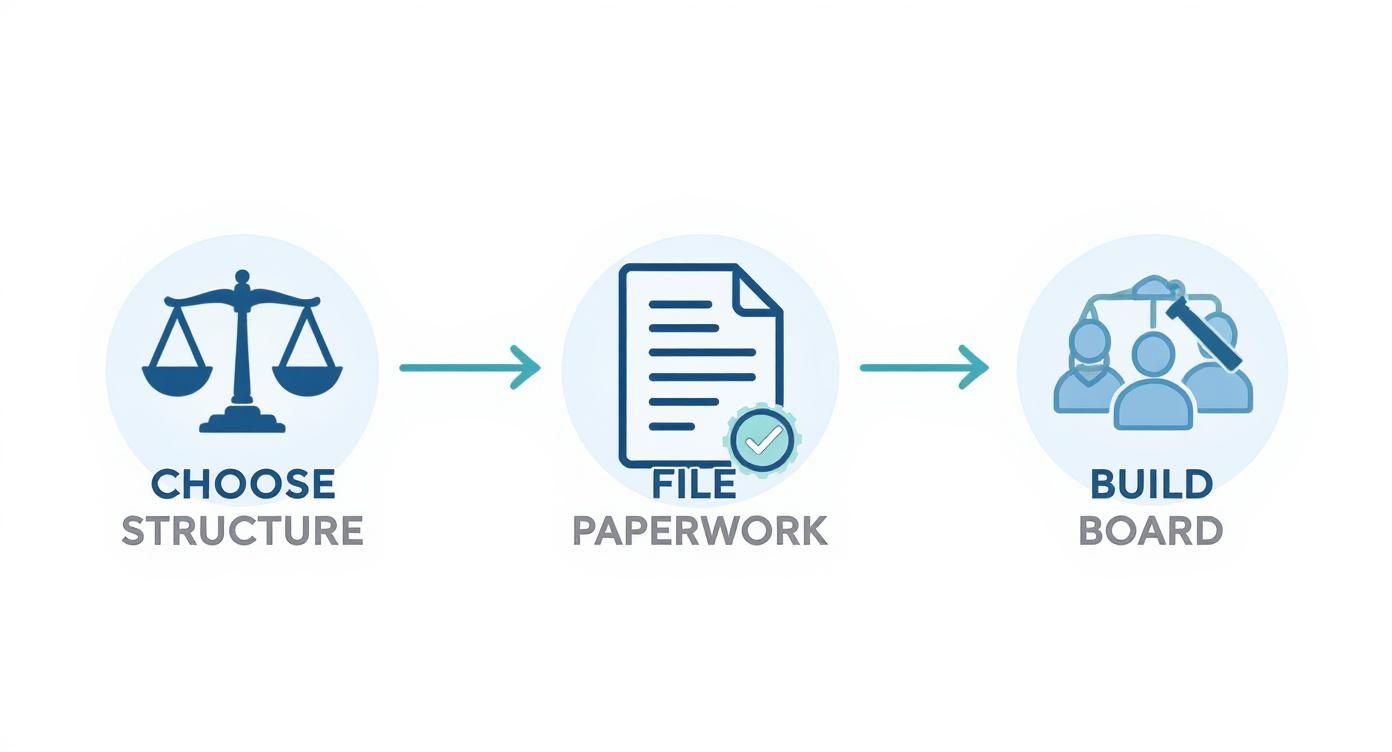
The path from choosing a structure to filing paperwork and building your board shows how those early legal decisions open the door for either non-profit fundraising or for-profit investment.
Avoiding Common Financial Pitfalls
Founding a school is a massive undertaking, and the financial hurdles are steep. Many founders simply underestimate the sheer amount of capital required. Research on education startups is sobering: a staggering 90% fail, and a huge part of that is miscalculating the cost to attract and keep students. The high initial costs of marketing and technology, paired with the long runway needed to build enrollment, create a risky combination. For a deeper look at these challenges, check out the insights on common pitfalls for education startups from Geniusee.
The single most frequent—and fatal—financial mistake is underestimating the cost of student acquisition. Too many founders believe a great program will sell itself. The reality is that a significant marketing budget is essential to build enrollment momentum in those critical first few years.
Ultimately, your financial plan is a living document. It must be reviewed, debated, and adjusted regularly by your leadership team and your board. A realistic, well-researched, and diversified financial strategy doesn’t just get your doors open; it ensures your vision can serve students for generations.
Designing Your Academic Program and Path to Accreditation
Once your legal and financial scaffolding is going up, it’s time to build the heart of your school: its academic program. The curriculum you choose is the living, breathing version of your mission. It’s the promise you make to every family about how you’ll shape the way their child learns, thinks, and grows.
https://www.youtube.com/embed/rgJf1LikBJ0
This isn't about just picking out a few good textbooks. It’s about architecting a coherent and engaging educational journey that is completely aligned with your vision. Whether you're building a classical academy, a project-based learning hub, or a Montessori haven, every single element of your academic program must tie directly back to your core philosophy. This is what turns a simple collection of classes into a powerful, life-shaping experience.
Choosing Your Curriculum Framework
You’ve got three main paths you can take to build your curriculum: adopt a proven model, adapt an existing one, or design something entirely from scratch. Each route has its own trade-offs, and there's no single "right" answer.
Adopting a Model: This means taking a well-established, off-the-shelf curriculum like Core Knowledge or the International Baccalaureate and implementing it wholesale. The huge advantage here is that you get a complete scope and sequence, lesson plans, and often professional development resources right out of the box. This can dramatically accelerate your launch and give you immediate credibility.
Adapting a Framework: Maybe you love the principles of project-based learning but want to tailor them to your school's unique STEM focus. Adapting a framework gives you a solid pedagogical foundation to build on while leaving room for innovation and customization. It’s a great middle ground.
Designing from Scratch: This is the most demanding path, but it offers the purest expression of your school's vision. It’s a common choice for schools with a highly specialized niche. Be warned, though: it requires tremendous expertise and hundreds of hours to properly map out standards, create assessments, and ensure a logical learning progression across all grade levels.
No matter which path you take, the goal is vertical and horizontal alignment. In simple terms, what a student learns in third-grade math must set them up for success in fourth-grade math (vertical alignment). At the same time, the critical thinking skills they learn in science should be reinforced in their history class (horizontal alignment).
Planning for Accreditation from Day One
Think of accreditation as the ultimate seal of approval from the educational community. It's an independent, third-party validation that your school meets high standards for everything from academic quality and financial health to operational integrity. New schools can't be accredited right away, but you absolutely must build your school with accreditation in mind from the very first day.
Treating accreditation as a future problem to solve is a rookie mistake that can cost you dearly. It’s more than a plaque for the lobby; it has a direct impact on your reputation. For most families, a school’s academic standing and college placement record—both heavily influenced by accreditation—are top decision-making factors. In fact, a 2019 survey found that over 70% of parents considered accreditation an important factor when choosing a private school.
Don’t view accreditation as a final hurdle to clear years down the road. Instead, treat the accrediting body's standards as the blueprint for building your school correctly from the start.
Integrating Accreditation Standards into Your Operations
Your first move is to identify the right accrediting agency for your school. There are national bodies and several powerful regional ones, and each has a slightly different focus. Look for organizations that accredit schools with a mission and scope similar to yours.
Once you’ve targeted an agency, get your hands on their standards manual and treat it like your bible. You need to embed their requirements into every piece of your planning:
- Governance: Does your board structure, do your bylaws, and do your financial oversight practices meet their specific criteria? They will check.
- Curriculum: You'll need to meticulously document your curriculum, demonstrating how it’s both mission-aligned and academically rigorous.
- Hiring: Their standards will often dictate the minimum qualifications and credentials for your faculty and administrators.
- Facilities: Your campus will have to meet specific health, safety, and learning environment standards long before students arrive.
By weaving these standards into your school's DNA from the beginning, you create a seamless path to achieving "candidate for accreditation" status as soon as you open your doors. This signals quality and credibility to prospective families long before you earn full accreditation, giving your new school the boost it needs to attract its founding students.
Marketing Your School to Attract the Right Families

An empty classroom is just a room. It’s the students and families who walk through your doors that bring your mission to life. After all the hard work designing your curriculum and building a solid financial plan, the next make-or-break step is creating a marketing and admissions engine that fills those seats with the right families.
This isn't just about running ads. It's about telling a compelling story, building a genuine community, and creating a seamless journey from a parent's first curious click to their child's first day of school.
Success starts by knowing exactly who you're talking to. Who is your ideal family? What do they truly value in an education? Where do they hang out, both online and off? Creating a detailed prospective parent persona is the key to moving beyond generic messages and speaking directly to the families who are a perfect fit for your school's culture.
Build Your Digital Front Door
Let's be clear: your school's website is its front door, main lobby, and first impression all rolled into one. It has to be more than an online brochure. It needs to be a tool laser-focused on capturing interest and guiding visitors to take the next step.
Your site must be visually compelling and dead simple to navigate on a phone. It should be rich with content that shows, not just tells, what makes your school special. Think about:
- Real-Life Visuals: Use authentic photos and videos of your actual students and teachers in action. Stock photos are the fastest way to look generic. Avoid them at all costs.
- Clear Calls-to-Action (CTAs): Every single page should have an obvious next step. Don't make people hunt. "Schedule a Tour," "Inquire Now," and "Download Our Viewbook" should be impossible to miss.
- Storytelling, Not Lists: Don't just list your programs. Tell the story of your school’s philosophy and the specific outcomes you deliver for students. Why do you exist? What problem do you solve for families?
Understanding the bigger picture helps, too. The private school world is massive and growing. In the U.S. alone, the K-12 private education market is valued between $52-$53 billion. Globally, international private schools generate around $67.3 billion a year. This context underscores how vital it is to define your niche. Are you a local community school or an international institution? That single decision will shape every part of your marketing. For more on this, check out these insights on the private school market from DoJo Business.
Execute a Multi-Channel Marketing Plan
Your website is the hub, but you need spokes to drive traffic to it. You have to meet families where they are, which means a smart mix of digital and good old-fashioned outreach.
A modern marketing plan for a new school should include:
- Local SEO: This is non-negotiable. You must optimize your website to show up when parents in your area search for "private schools near me."
- Social Media: Platforms like Instagram and Facebook are perfect for building community. Share "day-in-the-life" content and run targeted ads to reach families in specific zip codes.
- Content Marketing: Start a blog. Write articles that answer the real questions parents are asking. This establishes your school as an educational leader, not just another option.
- Community Engagement: Never underestimate the power of face-to-face connection. Host informal coffee chats at local cafes. Partner with libraries, real estate agents, or community groups that serve young families.
The most effective marketing isn’t about convincing every family to choose you. It's about connecting deeply with the families who already share your core values. Your greatest asset is authenticity.
Design a Seamless Admissions Process
Your marketing efforts generate leads; your admissions process turns those leads into enrolled students. This experience must be welcoming, organized, and a perfect reflection of your school's culture. From the first email to the final decision letter, every touchpoint should make a family feel seen, valued, and informed.
Here's what a strong process looks like in practice:
- A Welcoming First Response: Have a system to respond to inquiries promptly and personally. An automated email is fine, but a personal follow-up within 24 hours is better.
- An Impactful Open House: Go way beyond a simple building tour. Let prospective families hear from current students. Have them meet your most passionate teachers. Let them experience a mini-lesson to feel the magic.
- A Crystal-Clear Application: Make your online application easy to fill out. Be completely transparent about deadlines, requirements, and, yes, tuition. No surprises.
- Personalized Follow-Up: A simple, human touch can be the deciding factor. A handwritten note from the Head of School after a tour can make an unforgettable impression in a family's decision-making process.
By combining a powerful brand story with a strategic marketing plan and a flawless admissions experience, you’ll build the momentum needed to launch your school with full classrooms and a thriving, mission-driven community from day one.
Common Questions from School Founders
Starting a private school is a journey filled with tough calls and strategic forks in the road. As you work to turn a powerful idea into a real, operational school, a few key questions always bubble to the surface. Here are some straightforward answers to the most pressing things nearly every school founder has to figure out.
How Much Capital Do I Realistically Need to Start a Private School?
This is the million-dollar question—sometimes literally. The capital you need to get started swings wildly depending on your vision.
A small, leased micro-school might get off the ground for $250,000. But if you're planning a larger K-8 school and building your own campus? That can easily run into several million dollars. The biggest variables are always location, whether you rent or build, the grade levels you serve, and the scope of your programs.
Before your first tuition check comes in, your initial budget has to cover some major ground. You should be prepared for significant cash outlays in a few key areas:
- Facilities: This is your biggest ticket item, whether it’s a lease deposit, a down payment on a property purchase, or the funds for renovations to get a building classroom-ready.
- Core Resources: Think curriculum materials, technology infrastructure, classroom furniture, and library books. It all adds up fast.
- Professional Fees: You’ll need to budget for legal and incorporation fees from the start, not to mention accounting and consulting services.
- Marketing: You have to spend money to find your first families. A substantial initial marketing push isn't optional; it's essential for attracting that founding cohort.
Most importantly, you absolutely must have an operational runway. Plan to have at least six months of operating capital—salaries, utilities, insurance—in the bank before your doors ever open. This is non-negotiable for surviving the critical first year.
Should My New Private School Be Accredited Immediately?
Nope. In fact, you can't be. New schools aren't accredited right away because accreditation is a rigorous evaluation process that requires you to be up and running for a while, often two or three years. It’s a stamp of approval on your track record, which you first have to build.
But that doesn't mean you can ignore it. You absolutely must plan for accreditation from day one. Thinking this way signals quality and a serious commitment to prospective families long before you have the official seal.
Don’t wait to think about accreditation. From the moment you start planning, you should select a target accrediting agency and use their standards as a blueprint for building your school’s policies, curriculum, and governance structure.
This strategy lets you apply for "candidate for accreditation" status much sooner. That designation becomes a powerful marketing tool, proving you're serious about meeting high standards well before you achieve full accreditation.
What Are the Most Common Mistakes New School Founders Make?
Every founder’s journey is different, but a few common landmines can derail even the most promising new schools. I see the same three mistakes most often: underestimating capital needs, neglecting marketing, and setting up a weak governance structure.
Many founders are passionate educators first and business leaders second. This can lead them to dramatically miscalculate the true cost of launching and then sustaining the school until enrollment is stable.
They also tend to believe a great academic program will just sell itself. This leads them to underinvest in a professional marketing and admissions process, which is critical for attracting those first few waves of students. Finally, a weak or non-existent board of directors leaves the founder isolated, without the expert support, strategic oversight, and accountability needed to navigate the inevitable financial and operational hurdles.
How Do I Hire the First Teachers for a School That Doesn't Exist Yet?
Hiring your founding faculty isn’t about filling positions—it’s about selling a compelling vision. You're looking for mission-driven educators who are genuinely fired up by the rare opportunity to build a school’s culture from scratch.
Plan to start your recruitment process about 6-9 months before your doors open.
Your job descriptions and interviews need to be dripping with your unique educational philosophy. Be totally upfront about the challenges of a startup environment, but frame it as a chance for pioneering teachers to leave a lasting mark on an institution. This is about legacy.
To get the best people, you have to offer competitive, market-rate salaries and benefits. Your passion, a clear and inspiring vision, and a rock-solid business plan will be your most powerful recruiting tools. These are the things that give great educators the confidence to take a leap of faith and join you.
Starting, growing, or even selling a private school involves countless complex decisions. At JAG Consulting, we provide the specialized expertise to guide you through every stage, from initial concept to a thriving institution. We help founders accelerate timelines, reduce risk, and build sustainable schools grounded in excellence.
Ready to turn your vision into a reality? Explore our services and schedule a complimentary consultation.
Article created using Outrank

I'm Dr. Jeannie Gudith, Founder and CEO of JAG Consulting. We help you develop, improve, buy or sell your private school.
I'm so glad you're here
Hello!


© 2025 JAG CONSULTING.
all rights reserved. privacy policy + REFUND POLICY. TEMPLATE by sugar studios + Showit
