

How to Open a Private School A Founder’s Practical Guide
Before you write a single line of curriculum or scout a single location, you have to answer the most important question: Why does this school need to exist?
This isn't just about a feel-good slogan. Your answer—your core mission and educational philosophy—is the bedrock of your entire school. It’s the strategic blueprint that will guide every decision you make, from the teachers you hire to the families you attract.
Defining Your School's Core Mission and Vision

Think of your mission and vision as the soul of your school. They’re more than just words for your website; they are the guiding principles that will make you stand out in a crowded market. A clear, compelling identity gives your school purpose, connects with families who share your values, and creates a filter for every single choice you'll face.
And the market is ready for new, purpose-driven schools. Parents are actively seeking specialized, high-quality learning environments, driving incredible growth in the private education sector. Approximately 9.4% of all elementary and secondary students in the U.S. attend private schools, a testament to the strong demand.
The global private K-12 education market is already valued at roughly $431.5 billion and is expected to hit $609.2 billion by 2029. This isn't just a trend; it's a massive opportunity for founders who can identify and serve a specific educational need. Digging into these education sector statistics can help you grasp the full potential.
Conducting a Thorough Market Analysis
A great idea is only great if it meets a real-world demand. That’s why a market analysis isn’t just a good idea—it’s a non-negotiable first step to see if your concept has legs.
Start by getting the lay of the land in your target community. Are the local public schools bursting at the seams? Do the existing private schools have waitlists a mile long? These are flashing green lights signaling an unmet need.
Look for the specific gaps. Maybe the area has plenty of traditional K-8 schools but is desperate for a high school with a serious STEM or arts focus. Or perhaps it’s an early childhood desert, creating a perfect opening for a top-tier, play-based preschool.
Your analysis needs to be practical and data-driven:
- Demographic Data: Get your hands on numbers for population growth, average household income, and the number of school-aged kids in the area.
- Competitor Review: Make a list of every private school nearby. Note their tuition, educational model (e.g., Montessori, IB), enrollment figures, and what people say are their strengths and weaknesses.
- Community Surveys: Talk to local parents. Use simple surveys or focus groups to find out what they’re actually looking for in a school and what they feel is missing from their current options.
Crafting Your Educational Philosophy
Once you’ve found that gap in the market, it's time to build the philosophy that will fill it. This is where you bring your passion and vision to life. You’re answering the big question: "How will our students learn?" This is the pedagogical heart of your school.
Not sure where to start? Consider these popular models:
- Montessori: Focuses on self-directed, hands-on learning in mixed-age classrooms.
- Reggio Emilia: An emergent curriculum driven by student interests, expressed through various "languages" like art, music, and drama.
- STEM/STEAM: Integrates science, technology, engineering, arts, and math into a project-based curriculum.
- Classical Education: Centers on a traditional liberal arts framework, emphasizing logic, rhetoric, and the great books of Western civilization.
Your educational philosophy is your promise to parents. It's the assurance that your school offers a distinct, intentional, and effective approach to learning that aligns with their values and aspirations for their children.
This philosophy flows directly into your mission statement—a short, powerful declaration of your school’s purpose, who you serve, and what you stand for.
For a STEM-focused school, it might be: "To empower diverse learners to become a new generation of innovators by fostering critical thinking, collaborative problem-solving, and a passion for scientific discovery." See how that’s clear, inspiring, and sets a real, tangible goal?
To help you stay on track, here is a simple checklist for these crucial first steps. It's designed to ensure you're building on a solid foundation from day one.
Initial Strategic Planning Checklist
| Milestone | Key Actions | Primary Goal |
|---|---|---|
| Market Validation | Analyze local demographics, survey parents, and conduct a full competitor review. | Confirm a genuine, unmet need for your school concept in the target community. |
| Philosophy Definition | Research and select a core educational model (e.g., Montessori, STEM, Classical). | Establish the pedagogical "how" of your school's approach to learning. |
| Mission & Vision Crafting | Draft a concise mission statement and a forward-looking vision statement. | Articulate your school's purpose, values, and long-term aspirations clearly. |
| Initial Stakeholder Input | Form a small advisory board or conduct focus groups with target parents. | Test your core concepts and gather early feedback to refine your direction. |
| Feasibility Check | Create a high-level budget projection based on your model and market realities. | Ensure your vision is financially viable before committing significant resources. |
Working through these milestones methodically will prevent costly mistakes and give your project the focus it needs to succeed.
Building this foundational identity is a complex but absolutely critical first step. For founders navigating this process, getting expert guidance can make all the difference. If you're ready to turn your vision into a concrete plan, book a call with JAG Consulting or visit our website to see how we help build successful schools from the ground up.
With a clear vision for your school, it's time to build the scaffolding that will hold it all together. This phase is less about educational philosophy and more about the brass tacks of legal structures, governance, and regulations. Think of this as the foundation—get it right, and you have a stable base for growth. Get it wrong, and you're building on shaky ground.
For-Profit vs. Non-Profit: The Defining Choice
One of the first, and most significant, decisions you'll make is choosing the right legal entity. This isn't just a box to check on a form; it dictates how you're funded, your tax obligations, and the very soul of your school's purpose.
There’s no "right" answer here, only the right fit for your goals.
-
For-Profit (LLC or S-Corp): This path treats your school like a business. It gives you more operational agility and the option to distribute profits to owners or investors. Founders looking to build a scalable, proprietary educational model often lean this way because it can be easier to attract investment capital.
-
Non-Profit (501(c)(3)): This is the classic private school model for a reason. As a non-profit, you can accept tax-deductible donations and apply for grants—two massive potential funding streams. The catch? All revenue must be plowed back into the school's mission. You'll also be guided by a board of directors who have a strict legal duty to protect that mission. It's no surprise that over 75% of U.S. private schools are non-profits; the structure just aligns perfectly with a community-first educational focus.
Your legal structure is more than a tax status—it's a public declaration of your school's ultimate priority. A for-profit model says innovation and investor returns are key drivers. A non-profit model plants a flag for community benefit and mission-driven service.
Hacking Through the Red Tape: State and Local Rules
Once your entity is chosen, the real administrative marathon begins: securing all the necessary licenses and permits. This is a tangled web of state and local requirements, and you can't afford to miss a single one.
You’ll need to get intimately familiar with:
- State Department of Education Rules: Every state has its own playbook for private schools, dictating everything from teacher certification standards to curriculum guidelines and what it takes for a student to graduate.
- Zoning and Building Codes: Your dream building must be zoned for educational use. You’ll need a Certificate of Occupancy and a stamp of approval from the fire marshal, ensuring the site meets stringent safety codes.
- Health and Safety Mandates: The local health department will have its own set of rules, especially if you plan to serve food. They'll also want to see your emergency preparedness plans.
As you start signing contracts for your facility or with vendors, it's critical to know where you stand on digital paperwork. A common question we get is, are legally binding electronic signatures valid for these foundational agreements? Getting this right ensures all your initial contracts are solid from day one.
Assembling Your A-Team: The Founding Board
For non-profit schools, the founding board of directors is everything. This isn't a group for ceremonial roles or impressive names on a letterhead. They are the legal guardians of your school's mission and its financial viability. A strategically built board is your single greatest asset in the early days.
Think of your board as a multi-tool; you need a diverse set of skills to tackle any problem that comes your way. Aim for a mix of expertise:
- The Legal Mind: An attorney who can navigate contracts and keep you compliant.
- The Numbers Guru: An accountant or finance pro to build a sound budget and financial strategy.
- The Education Veteran: An experienced educator or administrator who provides academic credibility and oversight.
- The Community Connector: A well-respected local leader who can open doors, champion your cause, and drive fundraising.
Putting this legal and governance backbone in place is painstaking work. It demands meticulous planning and specialized know-how to sidestep mistakes that could stall your opening or create headaches for years to come.
If you’re ready to build a solid legal and governance foundation for your new school, JAG Consulting can provide the expert guidance you need. Book a call with JAG Consulting at https://link.jagconsultingservices.com/widget/bookings/prospective/school/consultation/zoom or visit our website to see how we help founders like you navigate these crucial early stages with confidence.
Designing Your Academic and Operational Blueprint

With the legal paperwork filed and your board in place, it’s time to get to the heart of your school—the academic and operational engine. This is where your educational philosophy stops being an idea and starts becoming the day-to-day experience for students, parents, and staff.
This blueprint defines not just what students will learn but how the school will run to make that learning possible. Getting these details right is critical; they will define your school’s culture, build its reputation, and create the resilience needed to thrive for years to come.
Choosing Your Curriculum Framework
The curriculum is the intellectual architecture of your school. It’s the most direct expression of your mission, so it’s essential to choose a framework that truly aligns with your core philosophy. You really have two main paths: adopting a proven, established model or building your own from the ground up.
Adopting a well-known framework like the International Baccalaureate (IB), Montessori, or a classical education model gives you instant credibility. These programs come with a full suite of materials, teacher training resources, and a built-in network of peer schools, which can dramatically cut down on development time. With over 5,000 schools in 159 countries offering IB programmes, it’s a path that provides a solid, respected foundation.
On the other hand, creating a proprietary curriculum gives you total freedom to build something unique, like a specialized STEM program or a project-based arts academy. While this offers incredible flexibility, it’s far more resource-intensive. You'll need deep subject matter expertise and a rigorous development process to ensure you meet accreditation standards down the road.
Building Your Operational Backbone
Even the most brilliant curriculum will fall flat without a strong operational system to support it. Smooth, efficient operations create an environment where teachers can focus on teaching and students can focus on learning, without all the background noise and friction.
Your operational core will be built on a few key systems and documents:
- Student Information System (SIS): Think of this as your school's central nervous system. It manages everything from admissions and enrollment to grades, attendance, and parent communication. This is a major decision that touches every single person in your school community.
- HR Policies and Procedures: A clear, comprehensive employee handbook is non-negotiable. It needs to cover everything from hiring practices and performance reviews to codes of conduct and benefits administration.
- Parent-Student Handbook: This document sets the expectations for your entire community. It should clearly spell out policies on academics, discipline, communication, and safety, acting as a foundational agreement between the school and its families.
A key part of this process is figuring out how to measure student engagement effectively. This isn't just a "nice-to-have"; it ensures your academic program is actually connecting with students, not just being delivered at them.
A well-designed operational blueprint isn't about rigid rules; it's about creating clarity and consistency. When everyone knows the 'how' and 'why' behind school procedures, you build a culture of trust and efficiency that allows your academic mission to shine.
Defining Key Leadership and Staffing Roles
Your vision is only as strong as the people you bring on board to make it happen. Before you even think about posting a job opening, you need to map out your organizational chart, starting with the most critical leadership roles. This plan should be tied directly to your school's size, model, and budget.
For a new K-12 school, the initial leadership team almost always includes these three roles:
- Head of School: The CEO and chief academic leader. This person is responsible for the overall strategy, culture, and external relationships.
- Director of Admissions: The face of the school for prospective families. Their primary job is to meet enrollment targets.
- Business Manager: The financial steward. They oversee everything from budgeting and tuition to payroll and facilities management.
Once those key positions are defined, you can start outlining your initial academic staffing needs based on your projected student-to-teacher ratio and curriculum. The national average student-to-teacher ratio in private schools is 12.2 to 1, a key selling point for many families that you should plan for. This kind of strategic planning ensures you hire the right people, for the right roles, at the right time.
Crafting this blueprint is a detailed process that bridges your big-picture vision with on-the-ground reality. If you need support translating your mission into a workable academic and operational plan, the team at JAG Consulting is here to help. Book a call with JAG Consulting at https://link.jagconsultingservices.com/widget/bookings/prospective/school/consultation/zoom or visit our website to learn how our expertise can bring your school to life.
Crafting a Realistic Financial Model and Securing Funds

A powerful mission and a brilliant curriculum are inspiring, but they don't keep the lights on. The long-term health of your school hinges on a single, unglamorous truth: financial sustainability.
Building a realistic, detailed financial model isn't just a budgeting exercise. It's the document that builds investor confidence, guides your strategic decisions, and ultimately determines if your school will survive its critical first few years. This is where you move from a passion project to a viable enterprise.
Building Your Five-Year Budget
One of the most common pitfalls I see founders make is focusing only on year-one startup costs. A truly effective financial plan projects at least five years into the future, mapping out a clear path to stability and, eventually, profitability. Your model needs to be a conservative, comprehensive, and clear story of every dollar required to launch and operate.
Start by breaking down your costs into two main buckets:
- Startup Costs (One-Time): These are the big, upfront expenses needed just to open your doors. Think facility acquisition or renovation, furniture and equipment, curriculum materials, legal and incorporation fees, and your initial marketing blitz.
- Operational Costs (Recurring): These are the ongoing expenses required to run the school month after month. The biggest line item here will almost always be payroll and benefits, followed by rent or mortgage, utilities, insurance, and ongoing marketing.
Underestimating cash flow needs during the first 24-36 months is the single biggest financial mistake a new school can make. Many schools take several years to reach their break-even enrollment number, and you absolutely must have enough cash reserves to cover the deficit during that ramp-up period.
Your financial model is your roadmap to sustainability. It must anticipate not only the costs of opening but the real-world cash burn of operating before you reach full enrollment. A well-capitalized school is a resilient school.
The investor community is keenly aware of the potential in this sector. Recent data on private school and edtech startups reveals 76 companies secured a staggering $14.2 billion in funding. This massive capital inflow highlights the financial viability of innovative education models, especially when backed by a solid business plan. You can explore more about these private school startup funding trends to get a feel for the landscape.
To help you get started, here's a look at the key budget categories you'll need to account for in your financial model.
Sample Startup Budget Categories
| Cost Category | Examples of Expenses | Budgeting Tip |
|---|---|---|
| Facilities & Real Estate | Down payment, lease deposits, renovations, architect fees, permits. | Get multiple bids for any construction or renovation work. Build in a 15-20% contingency for unexpected costs. |
| Furniture & Equipment | Desks, chairs, library shelving, science lab equipment, playground structures, office furniture. | Explore leasing options for high-cost equipment like copiers or tech to reduce upfront capital outlay. |
| Curriculum & Materials | Textbooks, software licenses, library books, art supplies, physical education equipment. | Account for both initial purchases and annual replenishment costs. Subscription-based digital curricula can smooth out expenses. |
| Technology Infrastructure | Servers, Wi-Fi network, student/staff laptops, smartboards, security systems. | Don't forget ongoing costs like software-as-a-service (SaaS) fees for your Student Information System (SIS). |
| Legal & Professional Fees | Incorporation, 501(c)(3) application, licensing, accounting setup, consulting fees. | Engage legal counsel early. Getting your legal structure right from the start saves immense headaches and costs later. |
| Initial Marketing & Launch | Website development, branding, digital ad campaigns, open house events, print materials. | Allocate a healthy budget here. You can't fill seats if families don't know you exist. |
| Payroll & Staffing | Salaries for pre-launch administrative staff, hiring fees, background checks. | This includes paying key leadership before the doors open. Founders often forget to pay themselves during this phase. |
This table provides a framework, but your specific costs will depend entirely on your school's model, location, and scale. A detailed, line-by-line budget is non-negotiable for securing funding.
Identifying Your Funding Sources
With a detailed budget in hand, you can begin the critical work of securing capital. The right funding strategy often involves a blend of different sources, tailored to your school's legal structure—for-profit or non-profit.
For Non-Profit Schools:
- Capital Campaigns: A structured fundraising drive to secure large, tax-deductible donations from founding families, community leaders, and philanthropic foundations.
- Grants: Pursuing funding from foundations that support education, community development, or specific curricular initiatives like STEM or the arts.
- Tax-Exempt Bonds: A powerful financing tool available to non-profits for major capital projects like building construction or campus expansion.
For For-Profit Schools:
- Private Investors: Pitching to angel investors or venture capital firms who are interested in the education market. This requires a compelling business plan and a clear return-on-investment projection.
- SBA Loans: Government-backed loans from the Small Business Administration are designed to help small businesses and can be an excellent source of initial funding.
- Founder Capital: Utilizing personal funds or loans from friends and family, often the first money in.
Regardless of your chosen path, you will need a persuasive business plan and a polished pitch deck. These documents must clearly articulate your school's unique value, market opportunity, operational plan, and, most importantly, the financial projections that prove your model works. They are your primary tools for turning potential backers into committed partners.
Developing a bankable financial model and navigating the complexities of fundraising are daunting tasks. The expert team at JAG Consulting specializes in creating financial strategies that build investor confidence and set new schools up for success.
Book a call with JAG Consulting today at https://link.jagconsultingservices.com/widget/bookings/prospective/school/consultation/zoom or visit our website to learn how we can help you secure the funding needed to bring your vision to life.
Building a Winning Enrollment and Marketing Machine
You can have the most incredible campus and a brilliant curriculum, but none of it matters without students in your classrooms. After all the meticulous planning, your school's success now comes down to building a powerful enrollment and marketing machine.
This isn't about sales gimmicks or clever taglines. It’s about making genuine connections with families who are looking for exactly what your school offers.
It all starts with telling your school's unique story. You need a strong brand identity—a clear, compelling message that communicates your mission, values, and educational philosophy. This identity becomes the bedrock for everything you do, from your website's homepage to the flyers you hand out at community fairs.
Forging Your Brand Identity
Your brand is so much more than a logo and a color palette. It’s the feeling and reputation your school cultivates in the community. It’s the promise you make to every family that walks through your doors.
A strong brand identity answers one simple question: "Why should a family choose this school over all the other options?"
To get there, go back to your core mission. Are you a STEM-focused academy promising to shape future innovators? Are you a small, nurturing preschool built around play-based learning? Every email, social media post, and open house presentation has to echo this core promise, creating a consistent narrative that connects with your ideal families.
The Modern Marketing Mix for Private Schools
Gone are the days of relying on a single newspaper ad and hoping for the best. Today’s parents are researchers. They start their school search online months, sometimes even years, in advance. A winning strategy has to meet them where they are.
Your marketing should blend a smart digital presence with high-touch, old-fashioned community engagement.
-
Your Digital Front Door: Your website is your school's first impression. It needs to be professional, easy to navigate, and optimized for search engines (SEO) so parents find you when they Google "private schools near me." Social media is non-negotiable for showcasing your school's vibrant culture through photos, videos, and student success stories.
-
Get Out in the Community: Never, ever underestimate the power of a face-to-face conversation. Open houses are a cornerstone of private school marketing for a reason. They give families a chance to walk your halls, meet your teachers, and feel the energy of your community firsthand.
-
Build Local Partnerships: Get to know the local real estate agents, pediatricians, and community leaders. These people can become powerful advocates for your school, referring families long before they even start their official search.
The goal of marketing isn't just to get inquiries; it's to build a pipeline of mission-aligned families. Every ad, post, and event should be an invitation for families to see if their values and hopes for their child match your school's unique promise.
Architecting a Seamless Admissions Process
Once your marketing sparks interest, you need a smooth, welcoming admissions process to turn that interest into enrollment. A clunky, confusing, or impersonal process will scare off even the most excited families.
Every step, from the first phone call to the final acceptance letter, should feel supportive and make them feel good about their decision to explore your school.
The journey from curiosity to a signed enrollment contract usually looks something like this:
- Inquiry and Information: Make it incredibly easy for parents to ask for information, whether on your website or by phone. And when they do, respond quickly and personally.
- The Campus Visit: This is your school’s audition. Whether it’s a big open house or a private tour, this is your chance to bring your school to life. Research shows the campus tour is often the most influential part of a family's decision.
- Application and Review: Give parents clear instructions and deadlines. Keep them in the loop while you review their application—don't leave them guessing.
- Acceptance and Onboarding: The acceptance letter should feel like a celebration. Follow it up with a clear, welcoming onboarding process that makes new families feel like they belong before day one.
Building this enrollment engine from the ground up is a huge undertaking, and it’s where many new schools stumble. Getting the strategy and execution right is absolutely critical to hitting your enrollment targets and ensuring your school is financially stable from the very beginning.
If you’re ready to build a marketing and admissions strategy that fills your classrooms with the right families, the experts at JAG Consulting can help. Book a call with JAG Consulting or visit our website to learn how we create enrollment success stories.
8. Launching Your School and Ensuring Long-Term Success
You’ve done the hard work. You’ve navigated the planning, secured the funding, and started building a community around your vision. Now comes the final, thrilling push to opening day, where all that careful preparation transforms into a living, breathing school. The focus shifts from high-level strategy to on-the-ground execution.
But remember, the journey doesn't end when you cut the ribbon. In many ways, it's just beginning. Your first year is a critical time for refining every process, from morning drop-off to after-school clubs. It’s about intentionally building your culture and proving that your educational model truly works for students and their families. Success isn’t just a smooth launch; it’s about creating a foundation for sustained excellence.
The process of filling your school for that first year—and every year after—boils down to a simple, powerful flow. You build the brand, you reach the market, and you enroll the families who are the right fit.
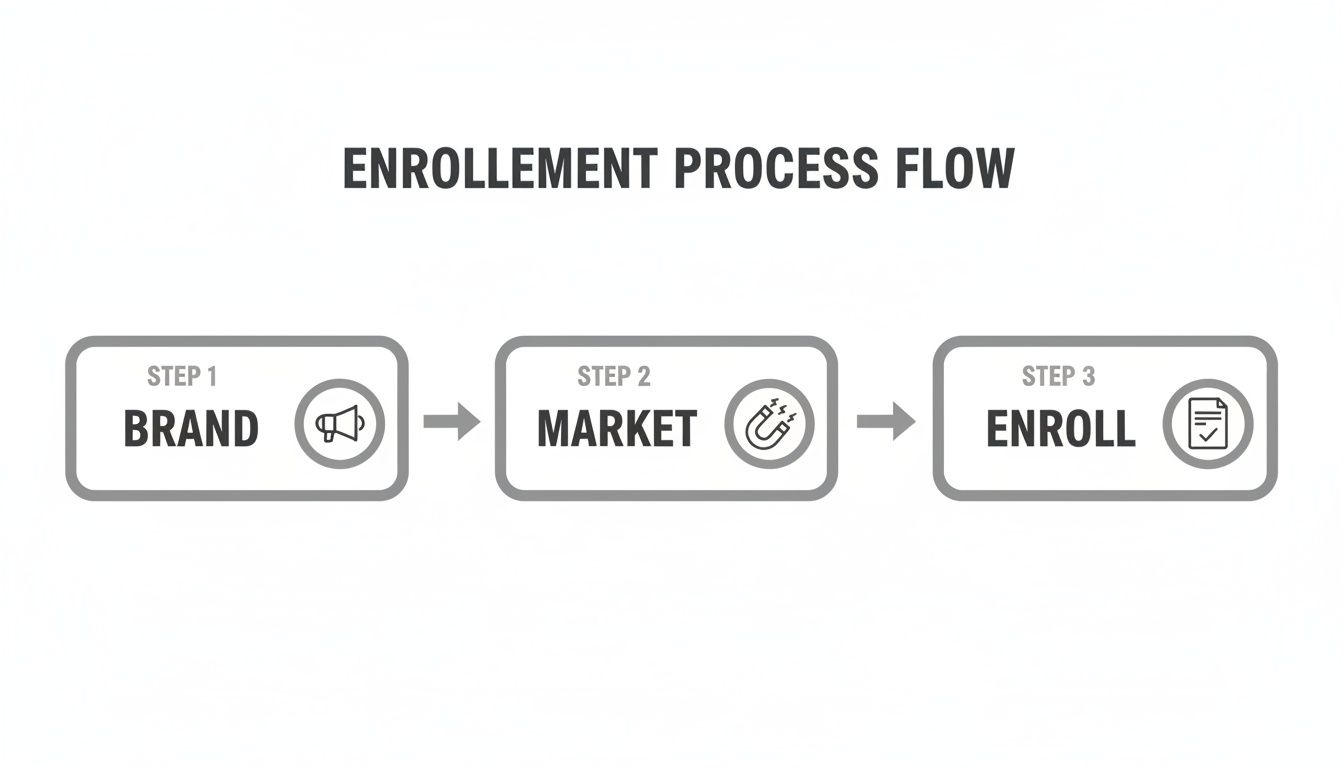
This illustrates a core truth: a strong, authentic brand and smart, targeted marketing are what feed a successful enrollment pipeline. This pipeline is the lifeblood of any new school. The road to opening a school is demanding, filled with potential pitfalls, but getting the right guidance can help you sidestep costly mistakes and get you to opening day faster and stronger.
Ready to make that final push from vision to reality? Book a call with a JAG Consulting expert today or visit our website. We’ve been in your shoes, and we know how to help you succeed.
Common Questions from School Founders
If you're mapping out how to start a new school, you're not alone. Founders often grapple with the same big questions right at the beginning. Here are the honest answers to the questions we hear most often.
How Long Does It Really Take to Open a School?
From the first spark of an idea to the first day of school, you should plan for a solid 18 to 24 months. While every launch is different, that timeline is a realistic window for getting all the critical pieces in place without cutting corners.
Think of it in three big phases:
- Months 1-9: The Foundation. This is all about groundwork. You'll be deep in market research, forming your legal entity, securing that crucial first round of funding, and, most importantly, finding and locking down a facility.
- Months 10-18: Building the Core. Now the focus shifts from planning to building. This is when you'll hammer out your curriculum, hire your Head of School or another key academic leader, and kick off your initial marketing and enrollment campaigns to start building buzz.
- Months 19-24: The Final Sprint. The last six months are an intense push to the finish line. You'll be heavily focused on hitting enrollment targets, finalizing the facility for inspections, hiring your full teaching staff, and buttoning up every last operational detail before you open the doors.
What’s the Biggest Financial Mistake Founders Make?
By far, the most common—and most dangerous—financial mistake is underestimating how much cash you'll need for the first two to three years of operation. Many founders create a perfect budget to get the doors open, but they completely forget to plan for the deficit they'll run before hitting a sustainable enrollment number.
A new school is a startup, plain and simple. It needs enough operating runway to cover payroll, rent, and all the other fixed costs while you ramp up. Just budgeting for opening day is a recipe for disaster.
Beyond that core mistake, we often see founders fail to set aside a real marketing budget—you can't enroll students who've never heard of you. Another classic error is not building in a contingency fund of at least 15-20% for the inevitable surprises, like an HVAC system that dies a month before school starts.
Do I Need a Background in Education to Start a School?
No, you absolutely don't, but it certainly helps. We've seen incredibly successful schools founded by people with backgrounds in business, finance, and community organizing.
The real key is self-awareness. You have to know what you're good at and, more importantly, what you're not. If your expertise is in operations and finance, your very first and most critical hire must be an experienced Head of School or Academic Director. This person brings the educational credibility and curriculum expertise that families and accreditors demand. The magic formula isn't one perfect founder; it's a balanced founding team with skills that complement each other.
Navigating the path to opening a private school is a massive undertaking, but you don't have to do it alone. At JAG Consulting, we provide the expert, hands-on guidance to turn your vision into a thriving school.
Ready to take the next step? Book a complimentary consultation with our school launch experts or visit our website to learn more about how we help founders like you succeed.

I'm Dr. Jeannie Gudith, Founder and CEO of JAG Consulting. We help you develop, improve, buy or sell your private school.
I'm so glad you're here
Hello!


