


Starting a montessori school: A Practical Guide to Launching Your Program
So, you have a passion for child-centered learning and a dream of opening your own Montessori school. That’s a fantastic starting point, but turning that vision into a thriving, sustainable private school is a journey that begins long before you pick out your first set of Pink Tower blocks.
It all starts with a heavy dose of reality—transforming your passion into a concrete, viable business plan.
From Vision to Viable School Business
Every successful private school I’ve worked with began not just with an idea, but with a well-researched vision grounded in the real world. Before you get lost in the details of classroom design or hiring teachers, you have to answer one critical question: is this dream a viable business?
The good news? The wind is at your back. The global demand for Montessori education is strong and growing. The market is valued at USD 9.8 billion in 2024 and is projected to hit USD 18.3 billion by 2033—that's a compound annual growth rate of 7.1%. North America alone accounts for a USD 4.2 billion piece of that pie, fueled by parents actively seeking alternative education models and investing more in early childhood development. This growing market, where 92% of schools operate as private institutions, signals a clear opportunity for new private Montessori schools.
This isn't just about following a trend; it's about meeting a real, documented demand.
The process of turning your idea into a plan isn't complicated, but it does require discipline. You have to move methodically from analysis to mission, and only then to planning.
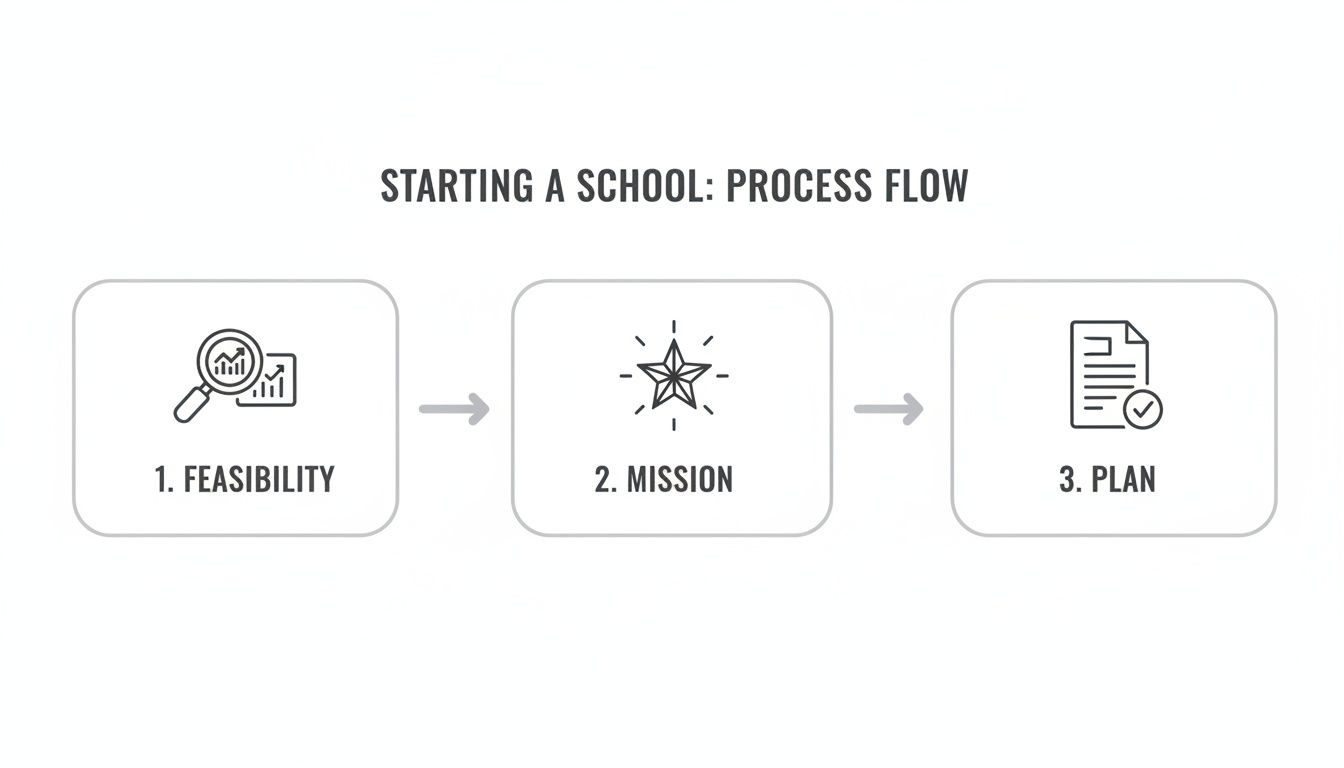
This sequence is crucial. Skipping the initial analysis is one of the most common—and costly—mistakes I see private school founders make.
Conducting a Feasibility Study
Think of a feasibility study as your first, most important reality check. It’s a systematic investigation to determine if your proposed private school actually has a chance to succeed in your target community. This isn't just about counting kids; it’s about understanding the entire educational ecosystem you’re about to enter.
You need to dig into some tough questions. Who are your competitors? I’m not just talking about other private schools—you need to look at high-performing public preschools, charter schools, and any other program vying for the same families. What are their tuition rates, enrollment numbers, and educational philosophies?
Most importantly, what will make your private school different? This is your unique value proposition. Will you offer a dual-language program? Serve a hard-to-find infant community? Provide an extended-day option that working parents desperately need? This process helps you find a genuine gap in the market, ensuring you’re building a private school that is truly necessary.
Defining Your Mission and Philosophy
Once you have the market data, you can build a mission statement that will become your school's north star. This isn't some fluffy corporate slogan; it’s a clear, concise declaration of your purpose, your values, and the community you are here to serve. It will drive everything from curriculum choices to hiring decisions for your private school.
A powerful mission statement doesn’t just describe what you do; it inspires action and attracts families and educators who share your core beliefs. It is the heart of your school’s identity and culture.
Before getting too deep into the specifics of Montessori, it’s worth understanding the fundamentals of getting any enterprise off the ground. This guide on how to start a small business in Australia covers foundational steps that apply no matter where you are.
Your philosophy needs to get specific about how you'll bring the Montessori method to life. Will you pursue affiliation with AMI or AMS? How will you adapt the principles for different age groups, from toddlers to elementary? Nailing down these answers creates the coherent educational framework that becomes the bedrock of your program. This foundational work is non-negotiable.
To help you structure this critical first phase, we've outlined the core questions your feasibility study must answer.
Core Questions for Your Feasibility Study
Answer these foundational questions to ensure your vision is grounded in a solid strategic and financial reality before you proceed.
| Key Area | Question to Address | Why It Matters |
|---|---|---|
| Market Demand | What's the demographic profile of my target area (household income, parental education, number of young children)? | This confirms if there are enough of the right families to support your private school long-term. |
| Competition | Who are my direct and indirect competitors, what are their tuition rates, and what are their enrollment numbers? | It helps you find your unique space in the market and avoid a head-to-head price war. |
| Value Proposition | What specific, unmet need will my private school fill? (e.g., infant care, dual language, extended day) | This is the "why" that convinces families to choose you over established alternatives. |
| Financial Viability | Based on projected tuition and local real estate costs, what's a realistic startup budget and path to profitability? | It grounds your passion in financial reality, which is essential for securing funding and ensuring sustainability. |
| Regulatory Landscape | What are the local zoning, licensing, and accreditation requirements I'll need to meet? | Overlooking this early can lead to costly delays and roadblocks down the line. |
Working through these questions methodically will give you the confidence—and the data—to move forward with a plan that has a real chance of success.
Building a Bulletproof Business and Financial Plan
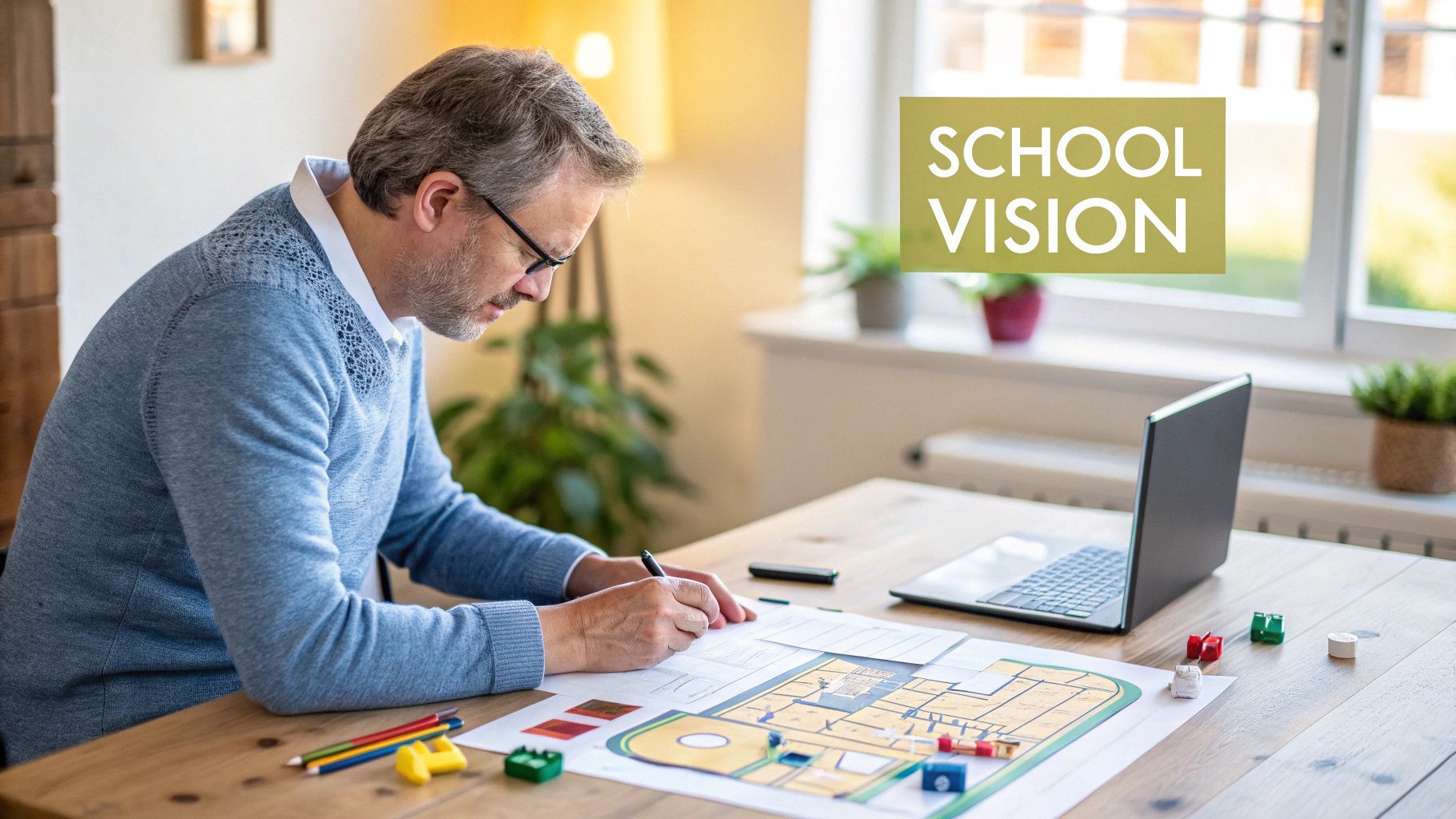
Your vision for a Montessori school is powerful, but a compelling business plan is what turns that vision into a fundable reality. Think of it as your operational blueprint—the document that translates your mission into a concrete strategy for investors, board members, and your future team.
But let's be blunt: the heart of that plan, the part that gets the most scrutiny, is the financial model. This is where your passion meets the hard numbers. A meticulously crafted financial projection is often the single most critical element in securing funding and ensuring your private school’s long-term health.
Deconstructing Your Startup and Operational Costs
First things first, you need to build an exhaustive list of every single expense. Don't guess. Research, get quotes, and ground every number in reality. These costs fall into two buckets: the one-time startup expenses to get your doors open and the recurring operational costs that keep them open.
Common Startup Costs Include:
- Facility Expenses: Your down payment or security deposit, plus any renovations needed to meet licensing codes, and initial utility setup fees.
- Montessori Materials: This is a major investment. It covers the complete set of authentic materials required for each classroom you plan to launch.
- Furniture and Fixtures: Everything from child-sized tables and chairs to shelving and administrative office furniture.
- Legal and Licensing Fees: Costs for forming your legal entity, applying for childcare or school licenses, and initial accreditation fees.
- Initial Marketing and Branding: Think website development, logo design, and the promotional materials for your launch campaign.
Once you have a firm handle on these initial outlays, your focus can shift to the ongoing expenses that will shape your monthly and annual budgets.
Projecting Revenue and Setting Tuition
With your costs clearly defined, you can start modeling your revenue. For most private schools, this is driven almost entirely by tuition, which makes setting the right price point an absolutely critical decision. This is where your feasibility study pays off, informing a tuition structure that is both competitive in your local market and sustainable for your school.
A 2022 global census documented 15,763 Montessori schools across 154 countries, and only about 9% received any government funding. This really underscores the private nature of the sector and why tuition is the primary revenue engine.
Your financial model must project revenue based on multiple enrollment scenarios. We always recommend building a conservative case (e.g., 60% capacity), a realistic case (80%), and an optimistic case (95-100%). This shows investors you have a plan for different outcomes and aren't just hoping for the best.
This kind of scenario-based planning is crucial for mapping your cash flow. It helps you pinpoint your break-even point—that magic moment when revenue covers all your operational costs—and shows exactly how much runway you have before becoming profitable.
Seeking Funding and Ensuring Long-Term Stability
Armed with a detailed, defensible financial model, you can walk into meetings with potential investors, lenders, or philanthropic donors with confidence. Your plan does more than just ask for money; it demonstrates that you’ve done the hard work to mitigate risk and build a sustainable organization. It proves your vision isn't just inspiring, but financially sound.
As you develop your plan, be sure to explore all potential funding avenues. If you're setting up a non-profit, for example, look into the best practices for applying for grants for nonprofit preschools to create a buffer for your tuition-based income. Layering in these alternative funding streams adds a powerful layer of financial resilience to your private school.
Building a robust business and financial plan is a complex, high-stakes process. Getting the numbers wrong can jeopardize your entire project before you even welcome your first student. Every calculation must be sound and every projection must be defensible. It's non-negotiable.
Don’t leave your school’s future to chance. If you need an expert eye to help build a financial model that will win over investors and set your private school up for success from day one, we're here to help.
Book a call with JAG Consulting to get started or visit our website for more resources.
Getting Legal: Licensing, Structure, and Accreditation
Once you have a solid business plan, it's time to tackle the legal framework that will turn your vision into a real, operational school. This phase can feel like wading through bureaucracy, but getting it right from the start is absolutely non-negotiable. Skipping steps here can lead to costly delays or even shut you down before you open your doors.
Your very first decision is a big one: choosing the formal legal structure for your school. This choice has huge implications for everything from your tax status and fundraising ability to your personal liability.
Choosing Your Legal Structure
Most private schools go one of two ways: they set up as a for-profit entity, usually a Limited Liability Company (LLC), or they organize as a non-profit.
An LLC is often faster to establish and gives you more flexibility in how you run things. Profits are treated as direct income to the owners. Simple and straightforward.
A non-profit, on the other hand, is mission-first. This structure allows you to accept tax-deductible donations and apply for grants, which can be a game-changer for funding. But this path also comes with stricter oversight from a board of directors and a much closer relationship with the IRS. There's no "best" answer—it all comes down to your financial goals and the kind of private school you want to build.
Untangling State and Local Licensing
With your legal entity in place, the next hurdle is securing the licenses you need to operate. Be prepared: the requirements for private schools and childcare centers can vary wildly from state to state, and even from one county to the next. You have to become an expert on the rules in your specific location.
Common Licensing Requirements You'll Encounter:
- Health and Safety Codes: These are the nitty-gritty rules for facility cleanliness, how you prepare food, and what to do in an emergency.
- Staff-to-Child Ratios: States mandate exactly how many teachers you need for a certain number of children in each age group. These ratios are non-negotiable.
- Background Checks: Every single staff member who interacts with children will need to undergo criminal background checks and fingerprinting.
- Zoning and Building Codes: You have to confirm that your building is zoned for educational use and passes all fire and safety inspections.
Missing even one of these can bring your entire project to a screeching halt. I always advise founders to create a master checklist and start the application process ridiculously early. These things often involve multiple inspections and can take months.
The Critical Choice of Montessori Accreditation
Beyond the government red tape, you’ll face a fundamental decision about your private school's identity: whether to pursue affiliation with a Montessori accrediting body. In the United States, the two big players are the Association Montessori Internationale (AMI) and the American Montessori Society (AMS).
This isn't just about putting a logo on your website. This choice will steer your curriculum, who you hire, and the materials you buy.
Your decision between AMI and AMS is not just a label; it is a pedagogical commitment. It defines the specific expression of Montessori philosophy your school will embody and signals a standard of quality to prospective families.
While both organizations are rooted in authentic Montessori principles, they have some key practical differences in their approaches.
AMI vs. AMS: A Practical Comparison
| Aspect | Association Montessori Internationale (AMI) | American Montessori Society (AMS) |
|---|---|---|
| Philosophical Approach | Adheres very strictly to Dr. Maria Montessori’s original writings and methods with minimal deviation. | Allows for more flexibility and adaptation, often integrating complementary educational philosophies and modern research. |
| Teacher Training | Known for its rigorous, intensive training programs that are consistent globally. Focuses deeply on the original theory. | Offers more varied training options through affiliated university programs. Training can be more adaptable to state requirements. |
| Classroom Materials | Requires the use of specific, approved materials with precise presentations as laid out by Dr. Montessori. | Encourages the use of classic materials but allows for teacher-made additions and other supplementary resources. |
Picking your accreditation path early creates a clear roadmap for almost everything that follows. It helps you find teachers with the right training, purchase the correct materials from day one, and design a program that meets a recognized standard of excellence families are looking for.
Navigating the legal and accreditation landscape is a heavy lift. To make sure you’re checking every box without derailing your launch, getting expert guidance can make all the difference.
Visit our website or book a call with JAG Consulting to get the support you need.
Designing the Prepared Montessori Environment
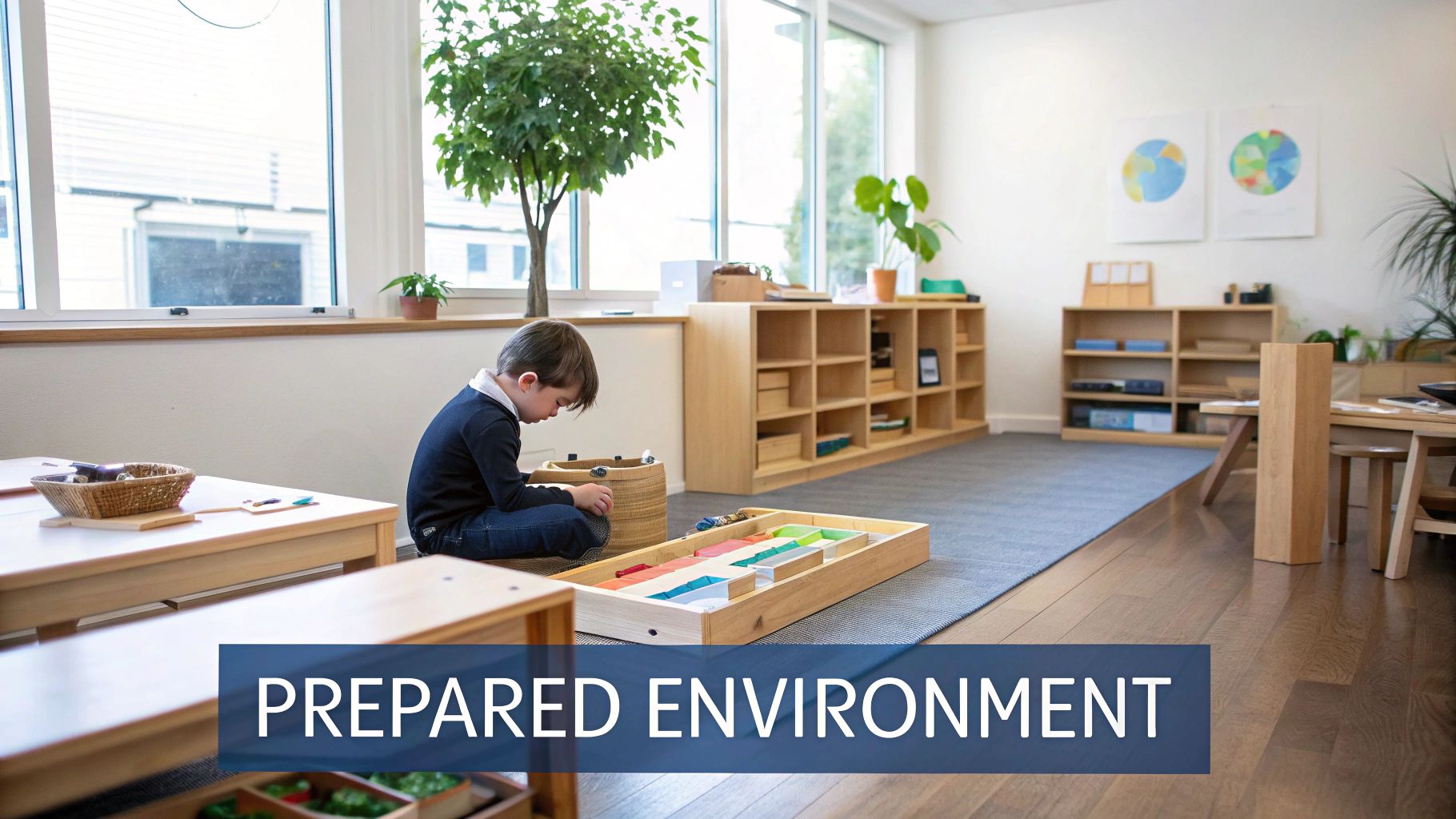
In a Montessori school, the environment itself is considered the "third teacher." It's far more than just a classroom; it’s a meticulously prepared space designed to spark curiosity, build independence, and honor a child’s natural path of development. When you’re starting a new private school, bringing this prepared environment to life is one of your most critical—and most rewarding—responsibilities.
This isn’t about interior design. It’s a pedagogical exercise. The flow of the room, the specific materials on the shelves, even the quality of the light—every single choice is intentional. These elements directly shape a child's ability to focus, explore, and learn. A truly prepared Montessori classroom is beautiful, orderly, and deeply empowering for the children within it.
Selecting and Designing Your Physical Space
The building you choose is the canvas for your vision. While you can adapt almost any space, certain features will make creating an authentic Montessori setting much easier.
First and foremost, ample natural light is non-negotiable. It fosters a calm, inviting atmosphere that is essential for deep concentration. It's not just a feeling, either—studies show students in classrooms with more natural light score 20% higher on math tests and 26% higher on reading tests.
You'll also want to look for a facility with direct and easy access to the outdoors. A strong connection to nature is a cornerstone of the Montessori philosophy. This outdoor space isn't just for recess; it's a place for gardening, gross motor work, and real-world scientific observation.
Inside, the layout needs to be built for freedom of movement and intuitive organization. Think open floor plans that can be sectioned into distinct curriculum areas without walls or clutter. And, of course, everything is child-sized. Low shelves, small tables and chairs, and accessible sinks give children the tools they need to care for themselves and their classroom independently.
Zoning the Classroom for Purposeful Work
One of the hallmarks of a prepared environment is its logical structure. The classroom is typically organized into five distinct curriculum areas, each with its own shelving that holds a sequential progression of materials. This predictable order helps children make sense of their world and builds their capacity for logical thinking.
-
Practical Life: This is often the heart of the classroom for younger children. It’s filled with activities like pouring, spooning, buttoning, and washing that build fine motor skills, concentration, and a sense of responsibility.
-
Sensorial: These beautiful materials are engineered to refine the senses. Classic materials like the Pink Tower, Brown Stair, and Cylinder Blocks help children visually discriminate and bring order to their perceptions of the world.
-
Language: From the tactile Sandpaper Letters to the hands-on Movable Alphabet, this area provides a systematic, concrete path to literacy.
-
Mathematics: Abstract mathematical concepts become tangible here. Concrete materials like the Golden Beads and Number Rods allow children to physically hold and manipulate quantities, building a deep, physical understanding of math.
-
Cultural Studies: This is where the world opens up. It covers geography, history, science, and the arts through maps, globes, artifacts, and experiments that ignite a child's curiosity.
Each area should be clearly defined but flow naturally into the next, allowing children to move freely and choose their work without getting in each other's way.
Sourcing and Budgeting for Authentic Materials
The specialized materials will be the single largest line item in your classroom setup budget. It’s a significant investment, often accounting for 20-30% of a new private school’s initial classroom budget. You have to be strategic.
Start by focusing on the core, classic materials for each curriculum area. You absolutely do not need every item in a supplier’s catalog on day one. Create a phased purchasing plan, starting with the essentials for your founding students and adding to your collection as the school grows.
When sourcing materials, quality is everything. Authentic Montessori materials are precisely crafted from natural materials like wood and metal. Their beauty and durability aren't just for aesthetics; they are designed to invite the child to work and to withstand years of purposeful use.
Take the time to compare different suppliers on quality, authenticity, and price. While it's tempting to cut corners with cheaper alternatives, investing in high-quality, authentic materials pays for itself over time. They are safer, more durable, and—most importantly—provide the exact developmental experience Dr. Montessori intended.
Crafting the perfect prepared environment requires careful planning and a deep understanding of Montessori principles. If you need help sourcing materials or designing a classroom layout that meets accreditation standards, JAG Consulting can provide the expert guidance you need. Book a call with our team or visit our website to learn more.
Hiring Your Dream Team and Enrolling Founding Families
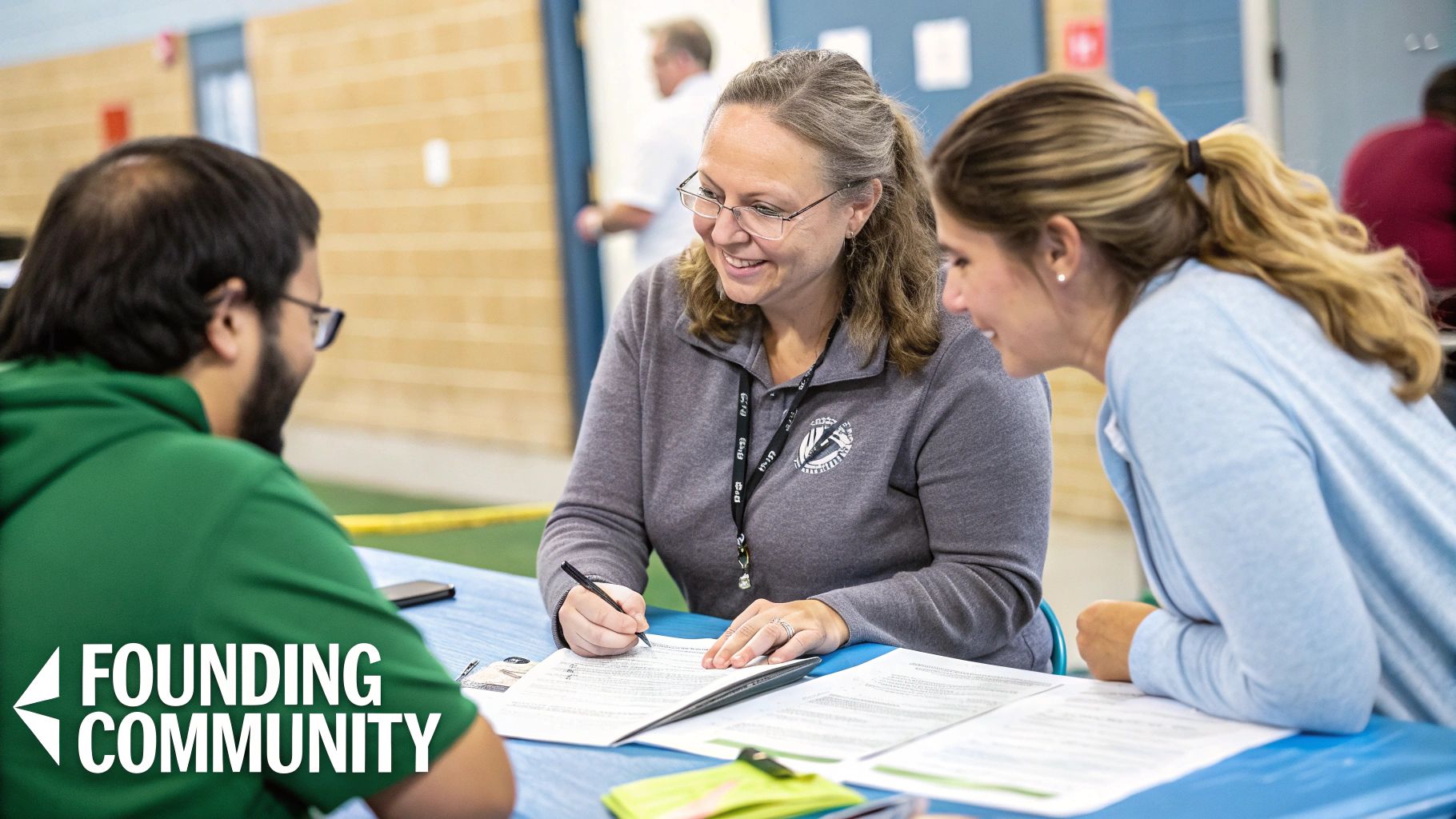
A beautifully prepared environment is a critical piece of the puzzle, but a school truly comes to life with its people: the passionate educators and the founding families. These are the individuals who will shape your private school’s culture from day one. This stage is a delicate dance—recruiting a dream team of Montessori guides while, at the same time, attracting the first families who believe in your vision.
The educators you hire are the guardians of your school's promise. And your founding families? They're your earliest champions. Their trust and enthusiasm will build the momentum that sustains your community for years.
Recruiting and Hiring Your Montessori Guides
Finding the right educators goes far beyond just checking a box for an AMI or AMS certification. You're looking for guides who don't just understand the pedagogy but truly live its principles. They need to be keen observers, patient facilitators, and deeply respectful of each child's unique developmental journey.
Your entire recruitment process has to be designed to uncover this deep alignment.
Crafting a Job Description That Attracts the Right People
Start with a job description that speaks the language of a true Montessori professional. Ditch the generic list of duties and instead paint a vivid picture of your school’s unique mission and what it feels like to work there.
- Highlight Your Philosophy: Be specific. Are you strictly AMI, AMS-aligned, or independent? Do you have a special focus, like a dual-language program, a heavy emphasis on outdoor education, or a commitment to serving a specific community?
- Describe the Environment: Talk about the beautiful, prepared environment you're creating. Mention your commitment to providing high-quality, authentic materials. This signals to serious candidates that you respect the craft.
- Emphasize Professional Growth: What opportunities will they have for ongoing professional development, mentorship, or collaboration? This shows you're invested in their long-term success, not just filling a role.
This level of detail acts as a filter, attracting candidates who are genuinely excited by your specific vision, not just anyone looking for a teaching job.
Mapping Your Enrollment Strategy
As you’re searching for your team, you need to be building excitement and attracting your first cohort of students. A multi-channel enrollment strategy is essential for reaching families where they are and showing them why your private school is the right choice. This is where your educational philosophy connects to the tangible benefits parents are looking for.
It helps to anchor your marketing message in proven outcomes. For instance, recent meta-analyses have shown that Montessori education often leads to stronger development in cognitive abilities, social skills, and academic achievement compared to traditional methods. Highlighting this evidence-based approach can be a powerful magnet for parents. You can find plenty of research on this topic to strengthen your talking points.
Your enrollment process should be a seamless, welcoming experience that mirrors the respect and care of a Montessori classroom. From the first click on your website to the first day of school, every touchpoint should make families feel seen, heard, and valued.
This requires a smart blend of digital outreach and genuine community building. A professional, user-friendly website is your digital front door, but it’s the grassroots efforts that build the deep, lasting connections that form a strong school community.
Your Enrollment Funnel and Timeline
Think of enrollment as a journey you guide families through. A structured timeline ensures no one gets lost along the way and keeps your launch right on schedule.
| Phase | Key Actions | Timeline Goal |
|---|---|---|
| Awareness & Interest | Launch website & social media, host community info sessions (virtual & in-person), place local ads. | 6-9 Months Before Opening |
| Consideration & Tours | Begin scheduling school tours (even in a partially finished space), share parent testimonials, host "Meet the Founder" events. | 4-6 Months Before Opening |
| Application & Decision | Open online applications, communicate tuition and aid information clearly, conduct family interviews. | 3-4 Months Before Opening |
| Enrollment & Onboarding | Send acceptance letters and enrollment contracts, collect deposits, host a welcome event for founding families. | 1-3 Months Before Opening |
Building a team and a community from scratch is a complex but incredibly rewarding challenge. Getting the hiring and enrollment process right sets the stage for a vibrant, thriving, and sustainable private school.
If you need support developing a recruitment strategy that attracts top talent or a high-impact enrollment plan, JAG Consulting is here to help. Book a call with our team to make sure your launch is a resounding success.
Answering Your Top Questions About Starting a Montessori School
As you start down the path of launching a new Montessori school, a lot of questions pop up. It’s natural. After years of guiding founders and investors through this exact process, I’ve seen that everyone—from seasoned educators to first-time entrepreneurs—grapples with the same core challenges.
Let's dive into the most common questions we hear and get you some clear, practical answers to build your confidence.
What Are the Key Differences Between AMI and AMS?
This is one of the very first forks in the road you'll encounter. While both the Association Montessori Internationale (AMI) and the American Montessori Society (AMS) honor Dr. Montessori's legacy, they approach it with different philosophies.
Think of AMI as the purist's path. It holds incredibly close to Dr. Montessori's original writings and methods, with very little deviation. The teacher training is rigorous, globally consistent, and deeply focused on the original pedagogy.
AMS, on the other hand, was founded to adapt the Montessori method to the American educational landscape. It allows for more flexibility, encouraging the integration of contemporary educational research and often aligning more easily with state licensing and certification requirements.
Your choice here will ripple through everything—teacher training, classroom materials, and your private school's core philosophy. It's a foundational decision worth deep consideration.
AMI vs AMS: A Practical Comparison
Here's a side-by-side look at the two main Montessori organizations to help you decide which affiliation is the right fit for your school's philosophy and goals.
| Aspect | Association Montessori Internationale (AMI) | American Montessori Society (AMS) |
|---|---|---|
| Philosophy | Strict adherence to Dr. Montessori's original pedagogy and materials. | Integrates contemporary research and allows for more flexibility and adaptation. |
| Teacher Training | Highly rigorous, globally standardized, and in-depth. Focuses on deep spiritual and scientific preparation. | Also rigorous, but often more accommodating to traditional university structures and state requirements. |
| Curriculum | Follows the original curriculum with minimal modification. Emphasizes specific, approved materials. | Allows for some complementary materials and activities alongside the core Montessori curriculum. |
| Accreditation | A single, globally recognized standard for schools that meet its high criteria. | Offers its own accreditation process that is well-respected, particularly within the United States. |
| Best Fit For | Founders seeking to create a private school with deep fidelity to the classical Montessori method. | Founders who need to align with state regulations or want to blend Montessori with other proven educational insights. |
Ultimately, there's no "better" choice—only the one that aligns best with your vision. Consider your target community, state laws, and personal educational philosophy when making your decision.
How Much Capital Is Really Needed to Start?
This is the big one, and the honest answer is, "it depends." But let's put some real numbers on it. A private Montessori school's startup cost can range from $150,000 to well over $1 million. The biggest variable, by far, is the cost of real estate in your target area.
Here’s what drives that number:
- Facility Costs: This isn't just rent. It’s the security deposit or down payment, plus the funds for renovations to meet stringent childcare licensing codes—think child-sized bathrooms, specific door hardware, and playground safety standards.
- Materials & Furniture: This is a major line item. Fully equipping just one Primary classroom with authentic Montessori materials and child-sized furniture can easily cost $10,000 – $15,000.
- Operational Runway: Don't make the mistake of opening with your bank account at zero. You absolutely need a safety net of at least 6-9 months of operating expenses (salaries, rent, utilities) set aside before your doors open.
How Long Does It Take to Launch a School?
Give yourself 18 to 24 months. I know that sounds like a long time, but a realistic timeline is your best friend. This isn't a process you can rush.
This timeframe allows you to move through each critical phase properly: deep market research, business planning, securing your funding, finding and renovating a facility, navigating the often slow-moving licensing and accreditation bodies, hiring great staff, and running a thoughtful enrollment campaign.
Rushing is one of the most common and costly mistakes a new private school founder can make. Each step, from getting your non-profit status approved to waiting for a city building permit, operates on a timeline you can't control. Building in buffer time is the key to a smooth, less stressful launch.
What Is the Most Effective Way to Attract the First Families?
Your first ten families are your evangelists. They are the ones who will build your private school's reputation through word-of-mouth. To find them, you need a smart mix of a polished digital presence and authentic, on-the-ground community building.
Of course, you need a professional website that clearly shares your mission and makes it easy for parents to learn more or schedule a tour. That's non-negotiable.
But the real magic happens through personal connection. Host small, informal "Meet the Founder" info sessions at local libraries, coffee shops, or even a supporter's living room. This gives you a chance to share your passion directly, answer questions face-to-face, and build the kind of genuine relationships that inspire trust. It’s that trust that convinces a family to take a chance on a brand-new private school.
Why Should Parents Choose My Montessori School?
This question cuts to the core of your value proposition. Parents are looking for more than just beautiful wooden materials and a child-led philosophy; they are investing in their child's future. You need to be able to articulate the proven outcomes.
Luckily, the research is on your side. Study after study confirms that a high-fidelity Montessori education has a significant, positive impact on a child's development—both academically and in crucial non-academic areas like executive function and social skills.
When you can confidently share these evidence-backed benefits, you move the conversation from "why is this so expensive?" to "this is a valuable long-term investment." You can read more about these research findings to arm yourself with the data that shows parents the true, lasting value of your program.
Navigating the complexities of starting a Montessori school can feel overwhelming, but you don't have to figure it all out alone. JAG Consulting offers expert, hands-on guidance for every stage—from financial modeling and accreditation to enrollment strategy—to ensure your vision becomes a thriving, sustainable reality.
Book a complimentary call with our team today or visit our website to learn how we can support your journey.

I'm Dr. Jeannie Gudith, Founder and CEO of JAG Consulting. We help you develop, improve, buy or sell your private school.
I'm so glad you're here
Hello!


© 2025 JAG CONSULTING.
all rights reserved. privacy policy + REFUND POLICY. TEMPLATE by sugar studios + Showit
