


What Is the Modern Role of a Principal in Private Schools
Forget the old-school image of the principal as just the top administrator or head disciplinarian. Today, a private school principal or head of school is the strategic architect of the entire institution.
They are the CEO, the chief culture officer, and the lead instructional coach, all rolled into one dynamic role. Their leadership is the central force that determines everything from academic outcomes and operational stability to your school's reputation in the community.
Unpacking the Modern Principal's Blueprint

The job is no longer about shuffling papers and managing the day-to-day. A modern principal operates at the busy intersection of academics, finance, enrollment, and community relations. They are the ones who translate a school's mission from a plaque on the wall into a living, breathing reality.
For founders and boards, getting this right is non-negotiable. An effective principal doesn't just manage the present; they build the future. In fact, research consistently shows that their influence is the single most important school-based factor in determining student achievement, second only to the quality of classroom instruction itself.
The Shift From Manager to Strategic Leader
The role has evolved dramatically. The private education market now demands a dynamic leader who can navigate complex challenges with a clear, forward-thinking vision—not just a "lead teacher" who got promoted.
One of their first strategic tasks is defining the school's internal structure. You can learn more about best practices for creating a school organizational chart to see just how foundational this single task is for long-term success.
This strategic leadership breaks down into a few critical domains:
- Academic Excellence: They set the instructional vision and ensure the curriculum is delivered to the highest standards.
- Operational Integrity: They manage everything from campus safety and facility upkeep to technology integration.
- Financial Stewardship: They oversee the budget, making sure every dollar is aligned with the school’s mission.
- Community Engagement: They build and nurture the relationships between students, parents, faculty, and the board.
A principal's leadership is no longer an optional add-on; it is the engine that drives continuous improvement. By aligning people, time, and resources with student needs, they create a powerful synergy that translates directly into better outcomes.
Why This Role Is Your Most Critical Asset
At the end of the day, the principal's effectiveness has a direct and measurable impact on your school’s health. Strong leadership leads to higher teacher retention—a crucial metric given that private school teacher turnover can be as high as 25% annually. This creates a more stable and effective learning environment for students. The data is clear: schools with great principals see significant gains in student performance.
For investors and boards, selecting and empowering the right leader isn't just an operational decision—it's your most important strategic investment. This guide will give you the insights you need to understand this role fully and make the informed decisions that will secure your school’s future.
Are you looking to hire, develop, or support a high-performing school leader? Book a call with JAG Consulting today or visit our website to learn how we empower private schools to thrive.
Leading the Academic Vision
First and foremost, the principal is the school’s Chief Academic Officer. This job goes way beyond observing a few classes or juggling teacher schedules. A great principal is the architect of a unique, mission-aligned academic experience—the very thing that becomes your school's signature strength and the reason families choose you over everyone else.
This is where the promises made on admissions tours become reality in the classroom. The principal is the guardian of that promise. They ensure every single piece of the academic program, from the curriculum chosen in preschool to the instructional methods used in AP Physics, delivers on the school's mission. They set the tone for academic rigor, intellectual curiosity, and a culture where both students and teachers feel empowered to do their best work.
From Manager to Instructional Leader
The single most important transition a principal can make is from being a manager of tasks to becoming a true leader of learning. This means curating a curriculum that isn't just rigorous, but is also dynamic and engaging—one that truly reflects the unique philosophy of your school. It’s about building a coherent educational journey from the first day of kindergarten all the way to graduation.
Of course, a brilliant curriculum is only as good as the teachers who bring it to life. That’s why a huge part of the principal's role is fostering a culture of continuous professional growth. This isn't about one-off training days; it's about creating structured, ongoing opportunities for teachers to collaborate, learn from each other, and constantly refine their craft.
The principal's leadership is the engine that drives continuous improvement. By aligning people, time, and resources with what students actually need, they create a powerful synergy that translates directly into better academic outcomes and a stronger school community.
Using Data to Coach and Elevate Faculty
Effective instructional leadership is data-informed, not data-driven in a punitive way. The best principals use a whole range of data points—not just standardized test scores—to get a clear picture of what’s happening in classrooms and coach their teachers effectively. This might look like:
- Observational Data: Regular, non-evaluative classroom visits focused on providing specific, actionable feedback.
- Student Work Analysis: Sitting down with teachers to collaboratively review student assignments, spot trends, and figure out how to adjust instruction.
- Performance Metrics: Analyzing assessment data to pinpoint where students are thriving and, just as importantly, where they need more support.
The goal isn't to micromanage. It's to be a supportive coach who helps every teacher become their best. When a principal builds that kind of trusting environment for feedback, they create a team of educators who are genuinely committed to growth. And that, in turn, directly benefits students. This hands-on, coaching-focused approach is where a principal has the greatest potential to make a real impact.
The principal's influence on student outcomes is huge, yet it’s often squeezed by endless administrative demands. Research shows that principal and teacher leadership can account for up to 27% of the variance in student achievement—second only to the direct impact of a teacher in the classroom. Despite this, a survey of principals across 14 countries revealed a staggering statistic: 68% of their time is eaten up by routine management tasks, not instructional leadership. You can dig into these global findings on the UNESCO GEM Report website.
This highlights a critical challenge for private school boards: you have to create systems that protect the principal's time. You need to free them up to focus on the academic vision that ultimately drives student success and keeps parents happy. When a principal is free to actually lead learning, the entire school wins.
Is your school's leadership team empowered to focus on academic excellence? JAG Consulting helps private schools develop the frameworks and support systems needed to elevate instructional leadership. Book a call with JAG Consulting today or visit our website to see how we can help you build a stronger academic program from the top down.
Mastering Operations and Financial Stewardship
If the school's academic vision is its soul, then its operational and financial health is the skeleton that holds everything together. A principal’s job extends far beyond the classroom walls; they are, in effect, the school's Chief Operating Officer. This is where the big-picture vision gets translated into the daily realities of running a safe, efficient, and sustainable organization.
In a private school, this responsibility is amplified tenfold. Unlike public schools with government funding, private schools are mission-driven businesses. Every single decision—from landscaping the campus to upgrading the Wi-Fi—carries a direct financial consequence. The principal must constantly walk the tightrope of careful resource stewardship and delivering an exceptional educational promise.
The Principal as Chief Operating Officer
A school is an incredibly complex machine with a thousand moving parts. The principal's job on the operational side is to make sure every single non-academic function is working in concert to support student learning. It's a demanding, detail-oriented part of the role that requires a surprisingly diverse skillset.
Key operational domains include:
- Campus Safety and Security: Creating and enforcing protocols to ensure every student and staff member is safe. This has become a massive focus, with 84% of private schools naming bullying prevention as a top safety concern.
- Facilities Management: Overseeing the maintenance, cleanliness, and long-term planning for the school’s physical buildings and grounds. A well-kept campus sends a powerful message to parents and boosts student morale.
- Technology Integration: Managing everything from student information systems to classroom laptops, ensuring the tech infrastructure actually helps teachers teach.
- Human Resources: Handling the nuts and bolts of employment, from faculty contracts and benefits to legal compliance, all while fostering a professional and supportive workplace.
All these operational and financial gears must turn in service of the academic vision. This visual breaks down how the central academic strategy branches out into core pillars that depend entirely on sound operational support.
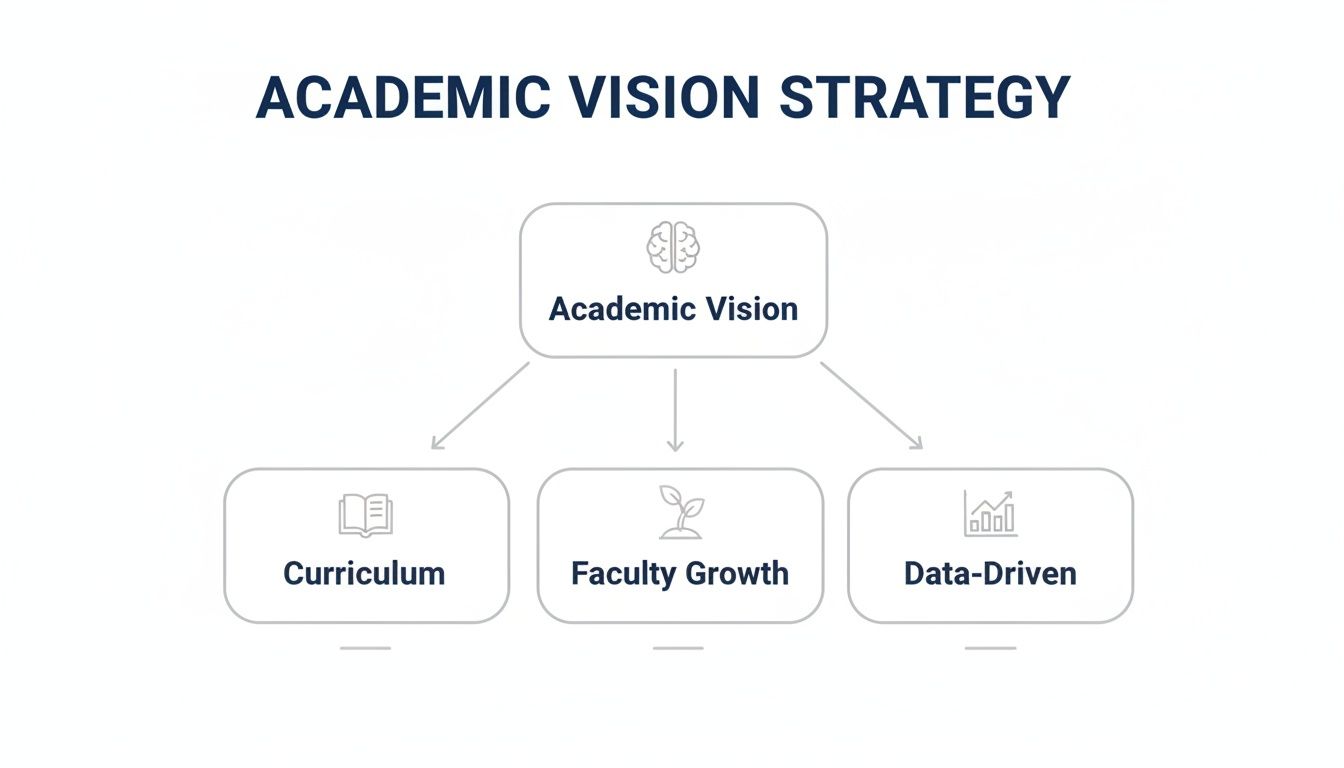
As you can see, lofty goals like curriculum development and faculty growth don't happen in a vacuum. They require real dollars and a well-oiled operational machine to become a reality.
The table below breaks down these core functional areas into three distinct domains, showing how a principal's responsibilities span from the classroom to the business office.
A Principal's Core Functional Areas
| Domain | Key Responsibilities | Success Metric Example |
|---|---|---|
| Instructional Leadership | Curriculum oversight, teacher evaluation & coaching, professional development, student assessment analysis | Year-over-year growth in standardized test scores or mastery-based assessments. |
| Operational Management | Facilities, safety, technology, HR, daily logistics, vendor management | Maintaining a 95%+ student and faculty retention rate, indicating a stable and positive environment. |
| Financial & Enrollment Strategy | Budgeting, financial aid, enrollment forecasting, fundraising liaison, admissions oversight | Meeting or exceeding enrollment targets while maintaining a healthy operating margin of 5-10%. |
Each domain requires a different mindset, but a successful principal must be able to move fluidly between them, always connecting the dots back to the school's primary mission.
Mastering Financial Stewardship
For a private school principal, financial savvy isn't a "nice-to-have"—it's a core competency for survival. They are the primary steward of the institution's fiscal health, which is about much more than just balancing the budget. It’s about allocating every single dollar in a way that directly supports the school's mission.
A school's budget is its mission translated into numbers. An effective principal knows that financial decisions aren't just about cutting costs; they're about making strategic investments in the people and programs that deliver on the school's promise to families.
This means working hand-in-glove with the business office and the board to develop and manage the annual operating budget. This process requires a clear-eyed forecast of both revenue (mostly tuition) and expenses.
It also involves making tough calls. Does the school invest in a new STEM lab or hire another learning specialist? Should the marketing budget get a boost to drive enrollment, or should those funds be used for faculty professional development? The principal has to weigh the potential impact on both the academic program and the bottom line, operating at that critical intersection of education and business.
Is your school's operational framework and financial strategy aligned for long-term success? JAG Consulting specializes in helping private schools build sustainable operational models. Book a call with JAG Consulting today or visit our website to learn how our expertise can strengthen your institution.
Driving Enrollment and Community Engagement
In the competitive world of private schools, enrollment isn't just a number—it’s the lifeblood of the institution. While academics are the product, your community is your brand. This is where the role of a principal or Head of School explodes beyond just academic oversight. They become the school’s chief storyteller, primary brand ambassador, and community builder-in-chief.

Unlike public school leaders who serve a captive audience, private school heads have to actively win the hearts and minds of prospective families, day in and day out. Their ability to articulate the school’s unique value and foster a warm, welcoming culture directly translates into filled seats and a healthy budget. This makes their deep involvement in the admissions process not just helpful, but absolutely essential.
The Principal as Chief Brand Ambassador
Today, 89% of private schools identify a welcoming school climate as a cornerstone of their strategy for attracting families. That climate isn’t built by glossy brochures; it’s built by people, with the principal leading the charge. They are the living, breathing embodiment of the school's mission.
When a principal leads a campus tour or speaks at an open house, families are looking for more than just facts and figures. They’re gauging authenticity, passion, and vision.
- Articulating the Vision: Can they powerfully communicate why the school exists and what makes its approach special? This is the core of your story.
- Building Personal Connections: Are they adept at making genuine connections, remembering names, and truly listening to the hopes and fears of prospective parents?
- Showcasing the Community: They use storytelling to bring the school’s culture to life, highlighting student triumphs and faculty dedication in a way that feels real and compelling.
A school's culture is its most powerful marketing tool. An effective principal doesn't just manage this culture; they actively cultivate it and showcase it to the world, turning parent satisfaction into your most effective enrollment driver.
This ambassadorial role demands tight collaboration with the admissions and marketing teams. The principal provides the authentic stories and proof points that fuel marketing campaigns, and their visible, engaged presence gives families the confidence to make one of the most important investments of their lives.
Fostering a Culture of Retention
Getting new families in the door is only half the battle. Keeping them is what ensures long-term stability. A principal's ability to build a strong internal community is the single biggest key to high retention rates. Happy parents become loyal advocates who re-enroll year after year and generate powerful word-of-mouth referrals—in fact, over 60% of private school families cite word-of-mouth as a key factor in their school choice.
This boils down to a few key actions:
- Ensuring Consistent Communication: Keeping parents in the loop with regular, transparent communication builds trust and prevents surprises.
- Creating a Welcoming Environment: This means making the school a place where parents feel seen, heard, and genuinely valued as partners.
- Being Visible and Accessible: An open-door policy is great, but being a consistent presence at athletic games, arts performances, and parent association meetings is even better.
When a principal successfully builds these strong community ties, the school transforms from a mere service provider into a true community hub. That deep sense of belonging is a priceless asset that directly impacts your enrollment sustainability.
Is your school leader equipped to be a powerful brand ambassador and community builder? JAG Consulting helps private schools align their leadership strengths with enrollment goals. Book a call with JAG Consulting today or visit our website to explore how we can enhance your community engagement strategy.
Navigating Board Governance and Strategic Plans
A thriving private school runs on the strength of the partnership between its leader and its governing body. The principal, or head of school, is the essential bridge connecting the board's high-level, long-term vision with the day-to-day reality of running the school. This is one of the most delicate parts of the role of a principal, demanding a unique blend of strategic foresight and masterful on-the-ground execution.
This is the relationship where the school’s future gets hammered out. The principal’s job is to take the board's strategic goals—the "why"—and translate them into concrete, actionable plans that teachers and staff can actually implement—the "how." It means feeding the board a steady diet of clear, data-driven reports on everything from academic benchmarks to financial health, making sure their governance decisions are firmly planted in reality.
Clarifying Governance vs. Management
One of the most common friction points in any private school is the blurry line between governance and management. For things to run smoothly, that distinction has to be crystal clear.
- The Board's Role (Governance): The board is the guardian of the school's long-term health and mission. They're responsible for setting strategic direction, providing financial oversight, and, most importantly, hiring and supporting the head of school. They set the destination.
- The Principal's Role (Management): The principal owns the day-to-day operations and is tasked with hitting the strategic goals the board has set. They manage the faculty, oversee the curriculum, and run the school. They chart the course to reach the destination.
When a board member starts questioning specific hiring decisions or trying to dictate curriculum details, they’re stepping into management. That move undermines the principal's authority and creates chaos. On the flip side, when a principal fails to keep the board updated on strategic progress, they create a vacuum that practically begs for micromanagement. Getting this boundary right is non-negotiable for effective leadership.
An effective principal is both a translator and a diplomat. They translate the board's 30,000-foot vision into a ground-level operational reality and diplomatically manage communication to keep everyone aligned and moving in the same direction.
The complex work of managing board relationships and building long-term strategy isn't unique to schools. In fact, principals can gain powerful insights from the world of strategic planning for small business, as many of the core principles apply directly to running a sustainable educational institution.
A Partnership Built on Trust and Data
Ultimately, this partnership lives or dies on trust, and trust is built through consistent, transparent communication. The principal has to provide the board with regular, easy-to-digest reports that paint a clear picture of the school’s performance against its own goals. We’re talking hard numbers on enrollment funnels, teacher retention, student academic growth, and budget performance.
This data-driven approach takes the emotion and guesswork out of board meetings, paving the way for productive, forward-thinking conversations. It empowers the board to govern effectively from their vantage point and gives the principal the backing they need to lead with confidence.
The stability of this relationship isn't just a "nice-to-have"—it's a critical factor in leadership retention. The churn among school leaders has become a massive problem. Recent data shows that roughly 16 percent of principals left their schools during the 2021-22 academic year. Worse, surveys found that nearly 40 percent of school leaders were planning to leave their jobs in the coming years. For private schools, that level of turnover is profoundly disruptive and expensive, making a supportive board-principal relationship a strategic imperative. You can find more details on the challenges driving this principal exodus at EdWeek.
A strong governance structure isn't about control; it's about empowerment. It enables a principal to lead effectively, which is what drives a school toward fulfilling its mission.
Are you looking to strengthen your school's governance model or develop a more effective strategic plan? JAG Consulting provides expert guidance to help boards and school leaders build the strong partnerships needed for long-term success. Book a call with JAG Consulting today or visit our website to learn more.
Hiring and Supporting Your Ideal School Leader
Finding the right principal is arguably the single most important decision a private school board will ever make. This isn't just about filling an office; it's about entrusting someone with the very soul of your school. This leader is the steward of your mission, the driver of academic quality, and the public face of your community.
Get this hire right, and you lay the foundation for years of stability and growth. Get it wrong, and the consequences can set a school back in profound ways, from faculty morale to enrollment numbers.
The old way of hiring—sifting through resumes and holding a few standard interviews—just doesn't cut it anymore. A modern search isn't about filling a vacancy; it's a strategic recruitment effort to find the perfect mission-fit. That means designing a process that reveals how a candidate actually thinks, leads, and solves problems.
Crafting a Modern Hiring Process
To truly understand if a candidate has what it takes, your board needs to build a multi-faceted evaluation that goes beyond the CV. You're looking for hard evidence of past performance while creating opportunities to see their skills in action, right now.
An effective hiring framework must include:
- Performance-Based Tasks: Give them a real problem to solve. Ask candidates to analyze actual school data—like enrollment trends or academic scores—and present a strategic plan. This reveals their analytical horsepower and vision in a way no interview question ever could.
- Diverse Stakeholder Feedback: Your next leader has to connect with everyone. Involve key faculty members, parent representatives, and even student leaders in the process. Their combined perspectives give you a 360-degree view of a candidate’s ability to build relationships.
- Culture-Fit Scenarios: Present candidates with realistic dilemmas pulled straight from your school’s unique culture. Ask how they would navigate them. This is a powerful test of their emotional intelligence and genuine alignment with your core values.
The goal isn't just to find someone who can do the job. It's to find the leader who was made for your specific school. This requires looking past credentials to find a true match in philosophy, leadership style, and vision.
Setting Clear Expectations with KPIs
Once your new leader is in place, their success hinges on a clear, mutually agreed-upon set of goals. Vague expectations are a recipe for frustration and failure on both sides. Instead, the board must work with their new principal to define Key Performance Indicators (KPIs) that create a balanced scorecard for success.
These KPIs should span the full role of a principal:
- Academic Growth: Are students mastering learning objectives? What do performance metrics show?
- Teacher Retention: What’s the year-over-year faculty retention rate? You should be aiming for 90% or higher.
- Enrollment Stability: Are you meeting or beating annual enrollment and re-enrollment targets?
- Financial Health: Is the annual budget being managed effectively to maintain a healthy operating margin?
This approach gives everyone a clear framework for evaluation and support, ensuring the board and the principal are rowing in the same direction.
It's also worth noting that gender representation in school leadership remains a global issue. Data shows women hold at least 20 percentage points fewer secondary school leadership positions across 70 countries, even though they make up the majority of teachers. With their hiring autonomy, private schools have a unique opportunity to lead on this front by implementing transparent, competitive recruitment that actively promotes diversity. You can find more insights on how to professionalize principal recruitment on the World Education Blog.
Are you preparing to hire a new school leader or looking to better support your current one? JAG Consulting provides expert guidance on executive searches and leadership development for private schools. Book a call with JAG Consulting today and let's make sure your most important leadership decisions are the right ones.
Common Questions About the Principal's Role
If you're a founder or a board member, trying to pin down the exact nature of school leadership can feel surprisingly tricky. The titles—Principal, Head of School—often get tossed around interchangeably, but the roles themselves have critical differences. Getting this right from the start isn't just about semantics; it's about setting your school and your leader up for success.
Let's clear up some of the most common questions we hear from school leaders and boards.
What's the Difference Between a Principal and a Head of School?
While the terms are sometimes used interchangeably in conversation, in the world of private schools, they usually represent two very distinct levels of leadership. Think of it like the difference between a division manager who runs a specific product line and the CEO who runs the entire company.
A Principal is typically focused on the day-to-day life of a specific division. You’ll have a Lower School Principal or an Upper School Principal, and their world revolves around the students, faculty, and curriculum within that part of the school. They are the hands-on academic and cultural leaders for their division, reporting up to the Head of School.
The Head of School, on the other hand, has a much broader, more strategic view. They are responsible for the entire institution's health and future. The Head is the main point of contact for the Board of Trustees, leads the charge on fundraising and long-term financial planning, and is the public face of the school in the wider community.
What Are the Most Critical Skills for a New Principal?
A strong teaching background is a given, but what truly separates a good principal from a great one are the relational and strategic skills they bring to the table. The modern principal isn't just an instructional expert; they're the CEO of a complex, mission-driven organization.
Here’s what you should be looking for:
- Exceptional Communication: Can they articulate the school's vision in a way that inspires parents, motivates a tired teacher on a Tuesday afternoon, and gives the board a clear, confident picture of the school's progress? This is non-negotiable.
- Financial Literacy: A private school principal has to understand the numbers. They need to be comfortable with budgeting, enrollment forecasting, and making smart decisions about how to allocate precious resources to keep the school on solid financial ground.
- Resilience and Adaptability: The job is a constant juggling act of competing priorities—an upset parent, a budget deadline, and a teacher in crisis can all land on their desk before 10 AM. A successful leader has to be able to handle that pressure and pivot without losing sight of the big picture.
How Can We Measure a Principal's Effectiveness Besides Test Scores?
Relying only on standardized test scores to judge a principal's performance is like judging a chef solely on the saltiness of their soup. It gives you one piece of data, but you miss the entire flavor of their work.
An effective principal creates a thriving ecosystem, not just a high-performing academic machine. Measuring that ecosystem requires looking at the health of its community, the stability of its faculty, and the satisfaction of its families.
To get a true picture, you need a more balanced scorecard. Consider tracking these key metrics:
- Teacher Retention Rate: Happy, supported teachers stay. A high retention rate, ideally 90% or above, is one of the strongest indicators of a positive school culture and strong leadership. High turnover is a major red flag.
- Enrollment and Attrition Data: Are you hitting your enrollment goals? Are families staying year after year? These numbers are a direct reflection of parent satisfaction and the strength of your school's community.
- Stakeholder Surveys: Anonymous surveys for parents, students, and faculty provide invaluable feedback on everything from school climate to leadership effectiveness. This is where you get the "why" behind the numbers.
When you combine these metrics with academic data and financial performance, you get a complete, three-dimensional view of your principal's impact.
Understanding and clearly defining the role of a principal is the bedrock of a successful private school. At JAG Consulting, we specialize in helping founders and boards find, develop, and support the kind of exceptional leaders who build thriving school communities.
Ready to find the right leader for your school's unique mission? Book a call with JAG Consulting today or visit our website to learn how we empower private schools to thrive.

I'm Dr. Jeannie Gudith, Founder and CEO of JAG Consulting. We help you develop, improve, buy or sell your private school.
I'm so glad you're here
Hello!



© 2025 JAG CONSULTING.
all rights reserved. privacy policy + REFUND POLICY. TEMPLATE by sugar studios + Showit
